La Mercè is Barcelona's Festa Major — the main annual festival of the city, not a district festival or a cultural niche event, but the full thing. It runs from Wednesday 23 to Sunday 27 September 2026, centered on the feast day of Nostra Senyora de la Mercè (Our Lady of Mercy), Barcelona's patron saint, on September 24.
The history is specific. In 1218, according to Catalan tradition, the Virgin Mary appeared simultaneously to King Jaume I, Saint Pere Nolasc, and Saint Ramón de Penyafort — all in the same night — asking them to found an order devoted to ransoming Christian captives from Moorish territories. The Mercedarian Order was born in Barcelona that year. In 1687, when a plague of locusts devastated the city, the Barcelona city council placed the city under La Mercè's protection. When the plague ended, she was formally declared patroness. Papal ratification came in 1868; the civic festival — with gegants, castellers, and sardanes — took its current shape from 1871 onward under the leadership of mayor Francesc de Paula Rius i Taulet.
The Basílica de la Mercè, home of the venerated statue, stands at Carrer de la Mercè 19 in the Gothic Quarter, a short walk from the port. The current building dates to 1765, though a church has occupied the site since the 13th century. On September 24, there is a solemn mass and civic ceremony attended by Barcelona's political authorities — the one event with a dress code in a festival that otherwise has none.
In 2026, more than 500 events run across five days. All of them are free. The edition also marks the 25th anniversary of Barcelona's sister-city relationship with Shanghai, which becomes the festival's guest city — over 100 artists from Shanghai and China's community in Barcelona perform across the program.
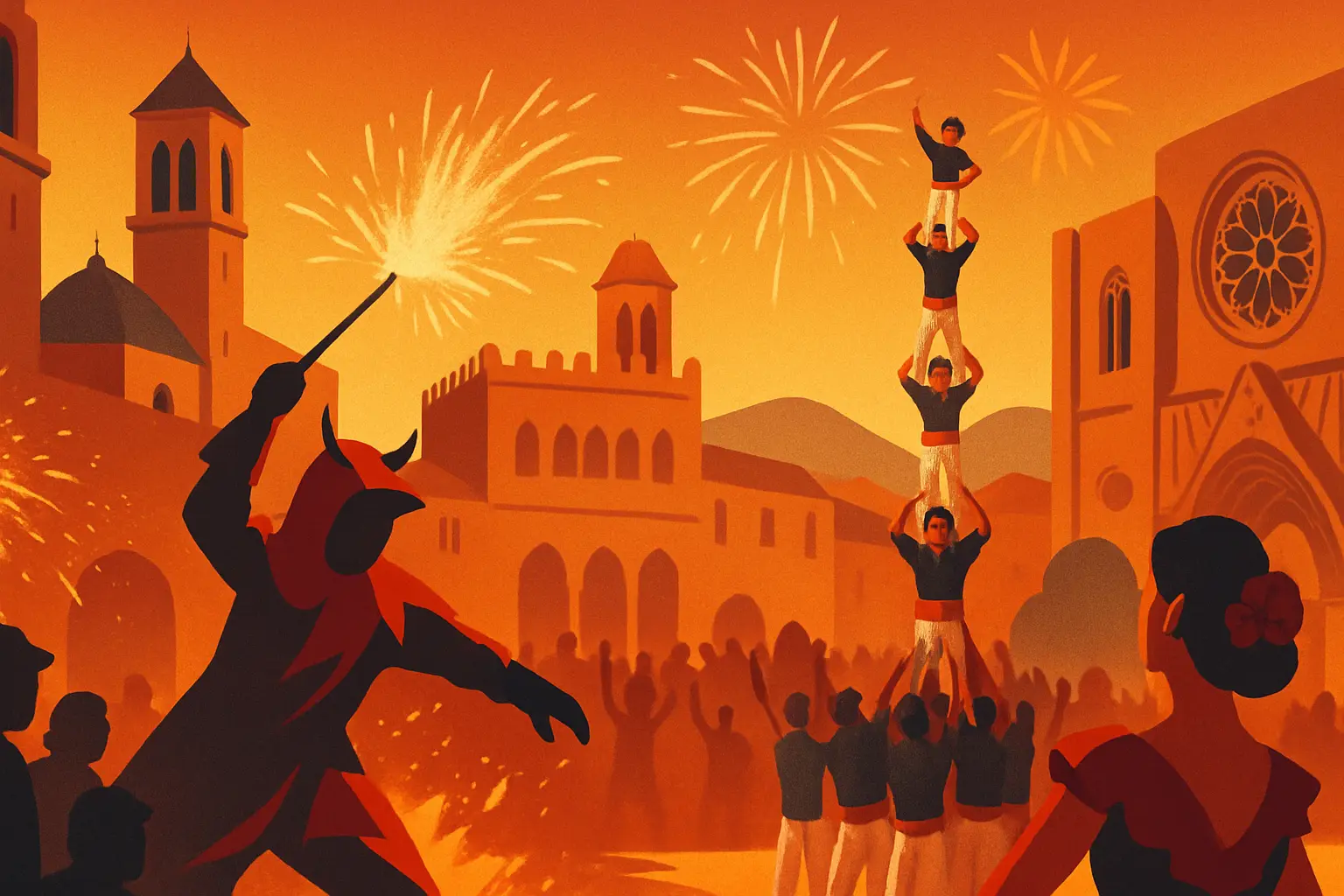
The correfoc (Catalan for 'fire run') is the event that most confuses first-timers and most rewards anyone who prepares for it properly. Groups called colles de diables ('devil companies') dress in devil costumes and parade through the streets with fireworks mounted on pitchforks. Enormous fire-breathing dragon figures — the bestiari — shoot bursts of sparks over the crowd. Participants who step off the pavement and into the street run through the sparks. Those who stay on the pavement are largely safe but will still receive sparks.
The 2026 correfoc runs along Via Laietana, the broad boulevard that cuts through the Gothic Quarter and El Born from Plaça d'Urquinaona down to the seafront. It takes place on Saturday 26 September at dusk, with the children's correfoc earlier in the afternoon. Metro to Urquinaona (L1/L4) or Jaume I (L4); position yourself along the route before it begins.
What to wear is the single most important practical consideration: cotton or denim only. Synthetic fabrics — polyester, nylon, acrylic — reach melt temperature at spark heat (~900°C) and bond to skin. This is not a dramatized warning; it is the reason every Catalan festival website publishes a clothing list before any correfoc. The list: long-sleeved cotton top, long jeans or cotton trousers, long cotton socks that cover your ankles, closed shoes, a cotton hat or scarf that covers all your hair tightly, swimming goggles or safety goggles, and a neck buff over the nose and mouth to filter gunpowder smoke. Leave jewelry at home — metal heats up quickly. Bring old clothes, not good ones; spark holes are normal souvenirs.
If you want to participate (entering the street), aim for the back half of the correfoc column, where the density of sparks is slightly lower. If you want to watch from a safe distance, the pavement on either side offers that, though sparks do reach. Both are legitimate choices — the correfoc is designed to be participated in at whatever level you choose.
Get short, interactive stories that make each place easier to remember while you travel.
On Thursday 24 September, at 13:00, the Diada Castellera de la Mercè takes place at Plaça de Sant Jaume — the square between Barcelona's city hall and the Palau de la Generalitat, in the heart of the Gothic Quarter. It is one of the most important dates in the castellera calendar and draws multiple colles (tower-building teams) competing on the same day.
Human towers (castells) are built by multiple teams in competition. A typical tower is labelled by width and height: a quatre de nou (four-wide, nine levels) is serious; a tres de deu (three-wide, ten levels plus the crown of two small children) is the peak achievement in the sport. Colles building castells ten or more levels high are competing at the sport's elite tier. The Diada Castellera de la Mercè regularly sees record attempts.
The structure of a castle: a wide base of people (the pinya) absorbs the weight; above them rise successive levels of increasingly narrow human rows (tronc), topped by three small children — the aixecador, the enxaneta, and the dosos. The enxaneta at the top raises a hand with four fingers extended (the Catalan national salute) to signal the castle is complete, then descends by stepping across the shoulders of the tronc. The whole sequence — construction, completion signal, and controlled deconstruction — takes anywhere from three to fifteen minutes per attempt.
To get a viewing position: Metro L4 to Jaume I, arrive by 11:30 at the latest. By 12:15 the square is full. The best positions are along the low walls at the sides; the center is where the castellers work, and spectators are pushed back by the pinya. Cameras are permitted everywhere. Do not lean into the pinya to take photos — the people inside it are structural.
The Piromusical closes La Mercè on Sunday 27 September at 22:00. It is a 20–25 minute pyrotechnic show choreographed to a musical score — a technically sophisticated combination of aerial fireworks, ground-level effects, and timed music that distinguishes it from a standard fireworks display.
In 2026, the Piromusical fires from Bogatell beach rather than its traditional position near the Font Màgica on Montjuïc, due to construction works at Fira de Montjuïc. The move is a significant change: from an elevated hilltop venue where you looked up at the fireworks, to a beachfront position where the entire Barcelona waterfront — from Barceloneta to the Fòrum — has sightlines of roughly equal quality. The best views are from Bogatell beach itself (Metro: Llacuna or Bogatell, L4), from the Port Olímpic promenade, from Barceloneta beach, and from elevated positions in Poblenou.
Practical note on crowds: arrive at least one hour before 22:00 to claim a beach position. After the show ends, every metro station along L4 between Barceloneta and Poblenou will have queues. Waiting 30–45 minutes after the show ends before attempting the metro reduces the crowd significantly. Night buses also run along the seafront.
BAM (Barcelona Acció Musical) is the 30-year-old music strand embedded within La Mercè. In 2026 it runs 39 concerts across four confirmed venues: Moll de la Fusta (the port-adjacent boardwalk), Rambla del Raval, Plaça Reial, and the Antiga Fàbrica Estrella Damm (the historic brewery at Carrer del Rosselló 515, in Eixample). BAM leans toward emerging and underground music — electronic, experimental, indie, and world music — and has historically been the strand where artists with later large followings appeared early in their careers.
The wider Música Mercè program uses larger venues across the city. Avinguda de la Catedral, directly in front of the Barcelona Cathedral, is confirmed as a primary stage. Bogatell beach also hosts large concerts in addition to the Piromusical on the final night. Confirmed artists for 2026 include the Shanghai Chinese Orchestra (marking the guest-city relationship), María Terremoto (flamenco), Maika Makovski, Aterciopelados (Colombian rock), and a La Barcelona Flamenca show featuring guitarist Chicuelo. Neighborhood squares across all 10 Barcelona districts host smaller concerts throughout the five days — the full program publishes at bcn.cat/lamerce in early September.
All concerts are free. The main stage areas fill up during headliner acts; arriving 45 minutes before a listed artist reduces waiting. The Plaça Reial BAM concerts are particularly atmospheric — the square's colonnaded façades act as natural acoustic reflectors, and the bar terraces immediately behind the audience stay open throughout.
La Mercè 2026 runs Wednesday 23 through Sunday 27 September. Here is a breakdown by day for planning a visit:
Wednesday 23 September: Festival opening. The Pregó (ceremonial opening speech) is typically held at the Basílica de la Mercè (Carrer de la Mercè 19) or at the Plaça de Sant Jaume in the evening. BAM concerts begin. This is the quietest day of the five — ideal if you prefer smaller crowds for your first orientation walk through the Gothic Quarter and El Born.
Thursday 24 September (La Mercè Day — Barcelona public holiday): The core day of the festival. Museums open free of charge. The Diada Castellera at Plaça de Sant Jaume begins at 13:00. The festive bestiary (gegants, capgrossos, falcons) parades through the Gothic Quarter from the morning. A solemn mass at the Basílica de la Mercè in the morning. Giants return to Plaça de Sant Jaume at 22:00. This is the day with the densest program and the largest daytime crowds.
Friday 25 September: A midweek day — crowds are lighter than the weekend. BAM concerts continue. Neighborhood festivals run in most of Barcelona's 10 districts. Good day for the main concert stages at Avinguda de la Catedral without the full weekend crowds.
Saturday 26 September: The children's correfoc in the afternoon, followed by the main Correfoc at dusk along Via Laietana. This is the night with the most spectacle and the highest attendance of the five days. Dress correctly before leaving your accommodation.
Sunday 27 September: Final day. Sardanes at Plaça de la Catedral and Plaça de Sant Jaume in the afternoon. BAM final concerts. The Piromusical at 22:00 from Bogatell beach closes the festival.
Is the correfoc safe? Yes, if you dress correctly. The correfoc has run continuously in Barcelona since its revival in the 1980s — it is a managed event with organized colles de diables who control the pace and direction of the sparks. The primary risk is from wearing synthetic clothing, which the clothing guidance above eliminates. Children participate; the dedicated children's correfoc on Saturday afternoon is specifically designed for younger participants with lower-intensity sparkwork.
What can kids do at La Mercè? Quite a lot. The children's correfoc (Saturday afternoon) is a standard entry point. The castellers competition at Plaça de Sant Jaume is designed for all ages — children regularly crown the towers as the enxaneta. The gegants parade through the old town (Thursday 24 September from the morning, returning at 22:00) is one of the more memorable spectacles for younger visitors: the 3–4 metre papier-mâché giant figures have been part of Barcelona's civic processions since 1424. BAM concerts at Plaça Reial and Rambla del Raval are all-ages and outdoor.
Can I combine La Mercè with regular Barcelona sightseeing? On 24 September (a public holiday), the Sagrada Família, Montjuïc, and most museums are open and, in many cases, free. Morning is the window — by 11:30 you want to be heading toward Plaça de Sant Jaume for the castellers. The Sagrada Família requires advance timed-entry booking regardless of the holiday, and September is peak season.
Can I visit without speaking Catalan or Spanish? The entire festival is open-access. No tickets, no registration, no check-in. Walk in. The festival program at bcn.cat/lamerce is in Catalan, Castilian Spanish, and English.