Montjuïc — pronounced mon-ju-EEK — rises 173 meters above Barcelona's port on the city's southwestern edge, separated from the urban grid by the neighborhoods of Poble Sec and the Paral·lel avenue below. It is neither a park nor a neighborhood in the conventional sense; it is a hill that accumulated history so unevenly and so violently that its surfaces are difficult to read without context.
The name is one of the oldest debates in Barcelona's toponymy. The most accepted explanation is that it derives from Mons Iudaicus — Mount of the Jews — a reference to the medieval Jewish cemetery that occupied the hill from at least the 12th century until the Jewish community was expelled from Barcelona in 1391. That cemetery was later built over, and its existence survived only in the name. An alternative etymology proposes Mons Iovis — Mount of Jupiter — suggesting a Roman sanctuary on the hilltop, which aligns with evidence of Roman-era quarrying on the slopes. Both theories remain contested. What is not disputed is that the hill has been used for every purpose a city needs to keep off its main streets: fortifications, cemeteries, quarries, exhibitions, prisons, sports venues, and gardens.
Castell de Montjuïc stands at the hill's highest point (Carretera de Montjuïc, 66) and is the oldest structure visitors will encounter. A first fortification was built here in 1640, during the Catalan revolt known as the Reapers' War. The current star-shaped fortress dates primarily from 1751, designed by the engineer Juan Martín Cermeño for the Bourbon monarchy — the same dynasty whose forces demolished a major quarter of Barcelona in 1714 to build their citadel, as documented in the ruins beneath El Born.
The castle's military value was less important than its political one. Throughout the 19th and 20th centuries, it functioned repeatedly as a prison and execution site for political opponents. In 1897, the anarchist Francisco Ferrer Guàrdia — founder of the Escola Moderna, a secular rationalist school — was court-martialed and shot here in 1909 after being accused of leading the Tragic Week uprising in Barcelona. He almost certainly had not.
The most resonant execution was that of Lluís Companys i Jover on October 15, 1940. Companys had been President of the Generalitat de Catalunya — the autonomous Catalan government — and had declared a Catalan state within the Spanish Federal Republic in 1934, for which he was imprisoned and later amnestied. When Franco's forces won the Civil War in 1939, Companys fled to France. He was arrested by the Gestapo in August 1940, extradited to Spain under a Franco–Hitler agreement, brought to Montjuïc, and shot without a credible trial. He reportedly removed his shoes before the firing squad so he could die with his feet on Catalan soil.
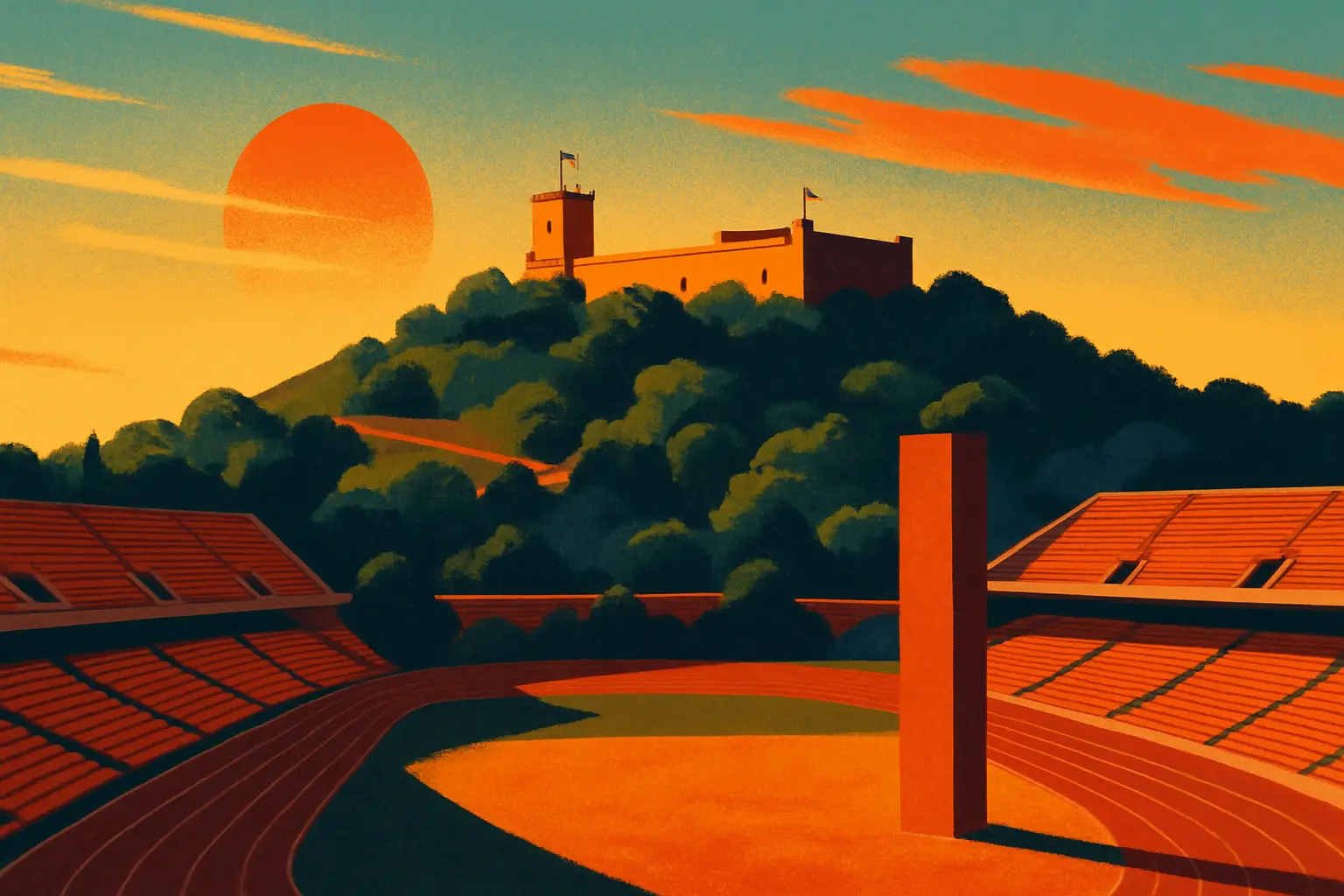
In 2001, the city of Barcelona renamed the Olympic stadium on the hill — originally known as the Estadi Olímpic de Montjuïc — as the Estadi Olímpic Lluís Companys. The stadium sits within direct sightline of the castle. That renaming is one of the more pointed acts of civic memory in modern Spanish urban planning.
Today the castle is open daily and operated by the city of Barcelona (€9 admission). The walls, moats, and viewing terraces over the port are the main draw. A permanent exhibition inside addresses the castle's history as a site of repression — though it is not as candid about the specific executions as the facts would justify.
Get short, interactive stories that make each place easier to remember while you travel.
Much of what visitors see on Montjuïc today was constructed for the 1929 International Exposition, held from May to December of that year and organized partly as a showcase for Barcelona's industrial and cultural ambitions under the Primo de Rivera dictatorship. The exposition covered 118 hectares from Plaça d'Espanya up the hill's lower slopes and drew nearly 5.9 million visitors.
The axis of the exposition — Avinguda de la Reina Maria Cristina, running from Plaça d'Espanya toward the Palau Nacional — was flanked by exhibition pavilions, most of them demolished after the event closed. Two survive in reconstructed or original form. The German Pavilion, designed by Ludwig Mies van der Rohe, was one of the most influential buildings in 20th-century architecture — a single-story pavilion of travertine, glass, and two reflecting pools that redefined what a building could be. The original was demolished after 1929; a meticulous reconstruction opened in 1986 at Avinguda del Marquès de Comillas, 5, and is now a functioning architectural monument (€7 admission, closed Mondays). The Pavelló Mies van der Rohe is worth an hour of any architect's time, and worth twenty minutes of anyone's.
The Font Màgica — the Magic Fountain at the base of the avenue — was designed by engineer Carles Buïgas and completed in just 13 months for the exposition's opening night. It used 3,000 liters of water per second in its original configuration and its premiere, on May 19, 1929, drew crowds that lined the hill above. The fountain still operates today with evening water-and-light shows, using a version of Buïgas's original hydraulic engineering updated with modern LED color systems.
The Palau Nacional at the avenue's head — now housing the MNAC — was designed as the exposition's central monument. Its dome is visible from much of the city and was an explicit statement of ambition about Barcelona's place in European culture.
The Museu Nacional d'Art de Catalunya (Mirador del Palau Nacional, s/n) is, by most measures, the most important museum in Barcelona that isn't the Picasso Museum — and arguably more significant for understanding Catalonia's own cultural history. Its collection spans Romanesque, Gothic, Renaissance, and modern Catalan art. The Romanesque collection is the reason it matters globally.
In the early 20th century, art historians and archaeologists began discovering that the stone Romanesque churches scattered across the Pyrenean valleys of northern Catalonia — built between the 10th and 13th centuries, then largely abandoned as population shifted to cities — contained extraordinary painted murals. Freezing winters, crumbling roofs, and the absence of any custodial community meant these paintings were deteriorating rapidly. Worse, foreign buyers — primarily American dealers acting for museum collections in Boston, New York, and Cleveland — had begun detaching portions of murals and removing them from Spain.
The Catalan government commissioned a team of specialists to detach and preserve the most endangered murals using a technique called strappo, which transfers painted surfaces to canvas supports. Between roughly 1919 and 1923, murals from more than 25 churches were brought to Barcelona and eventually installed in the MNAC, reconstituted in purpose-built apsidal settings that reproduce the spatial experience of the original chapels.
The centerpiece is the Apse of Sant Climent de Taüll (c. 1123), whose central figure — Christ Pantocrator in a mandorla, surrounded by the symbols of the four Evangelists — is arguably the finest surviving example of Romanesque monumental painting in Europe. It was removed from the church of Sant Climent in the Val de Boí valley, which still exists and can be visited; the church now displays a digital projection reproduction. Standing in front of the original in the MNAC, in its dimly lit apsidal space, is a genuinely disorienting experience: you are looking at a painting made 900 years ago for a mountain community of a few hundred people, now in a palace built for a world's fair.
The Anella Olímpica — the Olympic Ring — occupies the flat plateau on Montjuïc's upper eastern slope. Barcelona won the bid to host the 1992 Summer Games over Paris, Brisbane, Belgrade, Birmingham, and Amsterdam, in a vote held in 1986. The decision transformed not just Montjuïc but the entire city: the Vila Olímpica was built in Poblenou, the port was renovated, and beaches were created where industrial waterfront had been.
The Estadi Olímpic Lluís Companys is the hill's most historically layered structure. It was originally built in 1929 — in part for a failed bid to host the 1936 Summer Games, which went instead to Berlin under Hitler. The façade and gate towers from 1929 were preserved; the interior was entirely rebuilt by architects Vittorio Gregotti and Federico Correa for the 1992 Games, expanding capacity to 65,000 seats. It hosted the opening and closing ceremonies, the athletics events, and the football finals. The stadium now hosts occasional concerts and FC Barcelona matches when the Camp Nou undergoes renovation. Entry to the grounds is free.
The Palau Sant Jordi, designed by Japanese architect Arata Isozaki and completed in 1990, sits adjacent to the stadium and is one of the most admired sports and concert venues in Europe — an 17,000-seat arena whose roof structure, a complex three-dimensional space frame, was assembled on the ground and hydraulically lifted into position. This technique, unprecedented at the time, is now widely used in large-span construction.
The Torre Calatrava — the telecommunications tower designed by Santiago Calatrava, with its tilted needle and sphere — rises above the Olympic Ring and was built to broadcast the Games' television signal. Its tilt is precisely calibrated: the needle points toward the North Pole.
The Fundació Joan Miró (Parc de Montjuïc, s/n) opened in 1975 in a building designed by Josep Lluís Sert, Miró's friend and one of the defining figures of Mediterranean modernism. The building's white walls and skylights create a specific quality of light — diffuse and even — that Sert designed around the paintings inside. The foundation holds over 14,000 works spanning Miró's entire career, from early Catalan landscapes to the large-scale abstract compositions of his late period.
The most historically specific work in the collection is the Mercury Fountain (1937), originally created for the Spanish Republican Pavilion at the 1937 Paris International Exposition — the same exposition where Picasso exhibited *Guernica*. Miró designed the fountain as a political statement about Almadén, the mercury mining town in Extremadura that the Republican government controlled and whose exports were a significant source of wartime revenue. The fountain flows mercury, not water. It is enclosed behind glass for safety reasons.
Miró died in Palma de Mallorca in 1983 and is buried in the Cementiri de Montjuïc on the hill's southern slope — one of the largest and most architecturally interesting cemeteries in Spain, with elaborate family mausoleums in a variety of styles from neoclassical to modernista.
The hill's gardens reward time if you have it: Jardins de Laribal (terraced Mediterranean gardens near the cable car station), Jardí Botànic de Barcelona (a research garden with Mediterranean-climate flora from five regions worldwide — California, Chile, South Africa, Australia, and the Mediterranean basin itself, arranged by climate zone), and the Jardins de Mossèn Costa i Llobera on the south slope — one of Europe's largest outdoor collections of cacti and succulents, best visited in the warm months when the plants are actively growing.
Fundació Joan Miró admission: €16 general, €9 reduced. Closed Mondays. Book online at fmirobcn.org to skip the entrance queue, which can reach 30 minutes in peak summer.
The rooftop terrace of the Fundació offers one of the best unobstructed views of the Estadi Olímpic and the Torre Calatrava — better than the viewpoints on the main road.
Jardí Botànic de Barcelona (Carrer del Doctor Font i Quer, 2): open daily 10:00–17:30 in winter, 10:00–20:00 in summer. Admission €3.50. A calm, largely uncrowded alternative to the more visited gardens near the cable car station.
Montjuïc requires planning because its attractions are spread across 300 hectares of terraced hillside and the distances between sites are longer than they appear on a map. The key decision is sequencing: do you work top-down (castle first, then descend through the Olympic Ring to the MNAC and fountain) or bottom-up (MNAC first, then climb). Top-down is better in summer because the castle is exposed and brutal in midday heat — go early, then descend as the day cools.
**Full day vs. half day:** A focused half-day (4–5 hours) can cover the MNAC Romanesque collection, the Magic Fountain plaza, and a walk through the Olympic Ring. A full day adds the castle, Fundació Joan Miró, and one of the garden circuits. Trying to do everything in one day is theoretically possible but leaves no time to absorb what you've seen.
**Transport from the city:** The most practical entry is the **Telefèric de Montjuïc** from Paral·lel (Line L2/L3), which deposits you mid-hill near the Fundació Joan Miró and climbs further to the castle. Bus 150 from Plaça d'Espanya covers the same ground for a standard transit fare. The Transbordador Aeri from Barceloneta is spectacular but deposits you at the port-side base of the hill — you'll still need the cable car or bus to reach the summit sites.
**Best month to visit:** May, June, and September balance good weather with manageable crowds. August is viable before 11:00 and after 19:00. July and August midday on the castle esplanade, without shade, is punishing — bring water and sun protection regardless.
**The Olympic Ring at night:** The Estadi Olímpic grounds are open without charge and the Torre Calatrava is lit after dark. Walking the Ring's perimeter at night, when the city lights spread below and the hill is quiet, is one of the better free experiences in Barcelona and almost entirely unknown to visitors who haven't stayed past the Magic Fountain show.
**Pueblo Español:** The Poble Espanyol (Avinguda de Francesc Ferrer i Guàrdia, 13) — the 1929 replica village of regional Spanish architecture — is worth an hour if you are curious about vernacular architecture, and a full evening if you're there on a night when it hosts concerts or markets. General admission is €16; check the events calendar at poble-espanyol.com before deciding.