Eusebi Güell's commission was modeled on an English concept: the private garden city. Güell had visited England and was impressed by planned residential developments where middle-class buyers could own detached homes with gardens within a designed landscape. He wanted to build Barcelona's equivalent on the Turó del Carmel, a 100-meter hill at the northern edge of the Gràcia neighborhood, then largely undeveloped scrubland.
The plan called for 60 residential plots, a market hall, communal spaces, and a viaduct road system that would allow carriage access to every corner of the hillside without the roads cutting visually into the landscape. Gaudí designed this infrastructure with his characteristic obsession: the viaducts would be supported by stone columns angled to handle both the weight of the structure and the lateral thrust of the hillside, each column a slightly different response to local conditions. The market hall — today's Hypostyle Hall — would have 86 Doric columns and serve as the central social space for the planned community.
The development never found its market. Barcelona's wealthy families preferred the Eixample, the flat gridded expansion district where Gaudí himself and Domènech i Montaner were simultaneously building their most ambitious apartment houses. The hill was considered too remote. Between 1900 and 1914, only Martí Trias i Domènech and Gaudí himself bought plots — two houses out of sixty. Güell died in 1918 having transferred the park to the city of Barcelona. The failed development became, by accident, one of the city's most democratic public spaces.
Without Eusebi Güell, modern Barcelona would look substantially different. Güell (1846–1918) was not merely a wealthy client — he was a partner in the fullest sense, someone who commissioned Gaudí before Gaudí was famous and who allowed him to develop ideas that other patrons would have curtailed on cost or practicality grounds. The two met in 1878 when Güell, visiting the Paris World's Fair, noticed a display case designed by the young Gaudí and sought him out in Barcelona.
From that introduction came an uninterrupted 40-year collaboration: Palau Güell (1886–1890) on Carrer Nou de la Rambla — today a UNESCO-listed building and one of Gaudí's most powerful and austere interiors; the Colònia Güell workers' village in Santa Coloma de Cervelló, where Gaudí's crypt experiments directly informed the structural logic of the Sagrada Família; and Park Güell, the largest outdoor project they attempted together.
Güell's role in the park was not passive. He consulted on the layout, approved architectural decisions, and continued to invest long after it was financially clear the development would not succeed as planned. When he died, his family offered the estate to the city rather than demolish or sell it commercially — an act of cultural patronage that was also, practically speaking, the only viable option. The city paid the family a purchase price. Güell Park opened as a public park in June 1926. Gaudí, who had been living in the park's show house since 1906, died that same month — struck by a tram on the Gran Via and initially unrecognized, he was taken to the Hospital de la Santa Creu, where he died three days later, aged 73.
Get short, interactive stories that make each place easier to remember while you travel.
The monumental zone — the ticketed section — covers the park's constructed core: the main entrance with its two gatehouses, the Dragon Staircase, the Hypostyle Hall, and the Great Terrace. These are the spaces Gaudí designed as communal infrastructure for the planned community, and they are what almost every photograph of Park Güell shows.
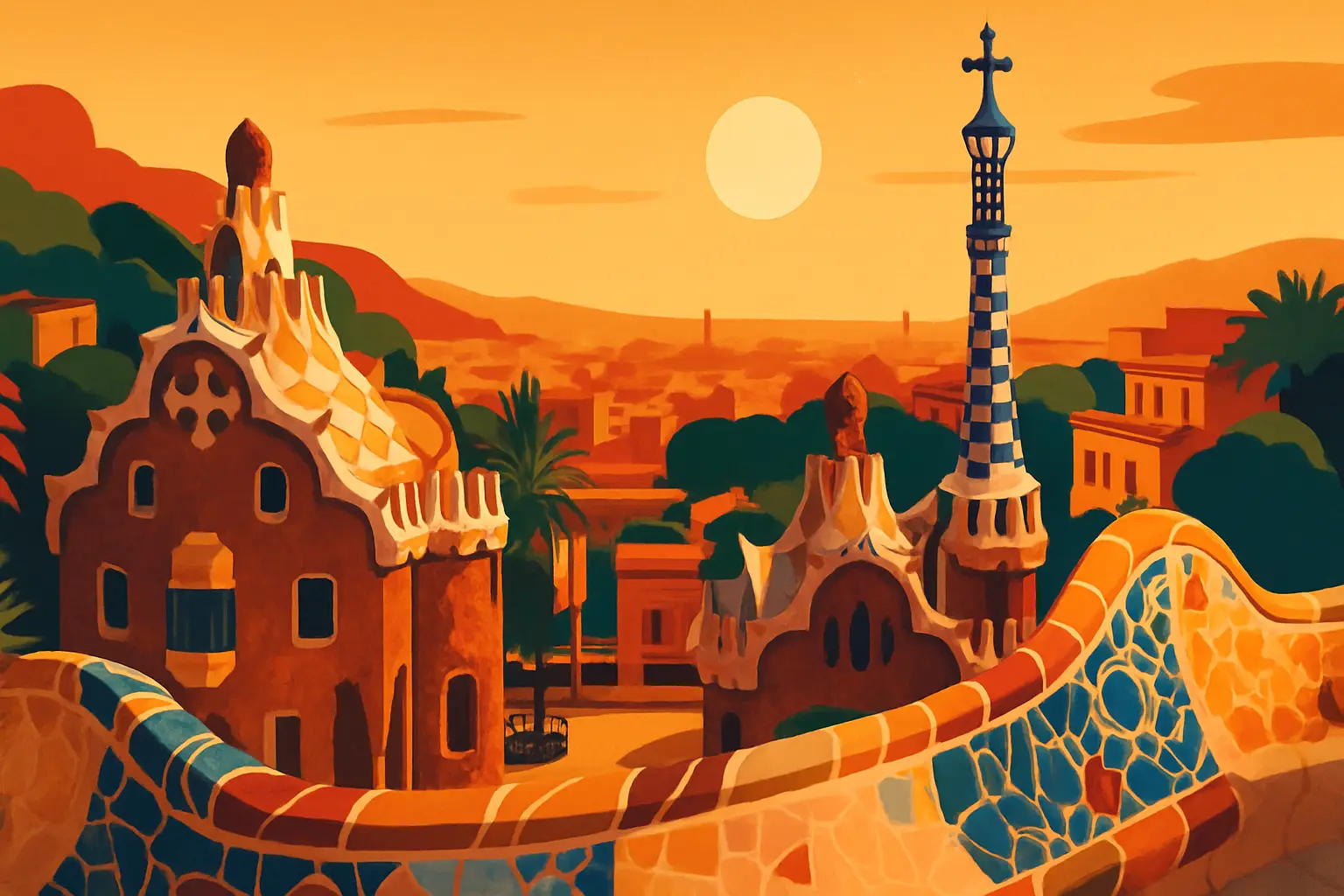
The two gatehouses at the Carrer d'Olot entrance are routinely described as gingerbread houses, and the comparison is not entirely wrong — both are clad in white render with ceramic details, and both have rooftops that curve organically, without a straight line anywhere. They were intended as the porter's lodge and a residents' waiting room. The taller one now houses a small Gaudí interpretation center.
The Dragon Staircase connects the entrance to the Hypostyle Hall via fountains and retaining walls in stone and ceramic. The creature perched on the central fountain is technically a salamander, not a dragon — though the distinction is debated, and tourist merchandise resolutely ignores it. Its ceramic skin uses trencadís — the broken-tile mosaic technique — in green, yellow, and orange that reacts dramatically to changing light.
The Hypostyle Hall (also called the Hall of a Hundred Columns, though there are 86) was to be the covered market of the planned community. The Doric columns are classical in form but subverted in nearly every detail: they are slightly inclined, they carry drainage pipes from the terrace above through their hollow centers, and their capitals are decorated with ceramic roundels rather than carved stone. The ceiling between the columns is covered in white mosaic with embedded ceramic fragments and Venetian glass — intricate work primarily executed by Jujol.
The Great Terrace above is Park Güell's most recognizable space: a broad panoramic platform ringed by the serpentine bench, with views extending south across the Eixample grid to the sea on clear days. The bench was designed by Gaudí as a single flowing form accommodating seating at multiple inclinations, but the actual mosaic work was executed by Josep Maria Jujol, who embedded fragments of broken plates, tiles, and ceramic figures into the surface in patterns that become more intricate the closer you look.
Trencadís — pronounced tren-KAH-dis — is a technique using irregularly shaped fragments of broken ceramic, tile, and glass embedded in mortar to create mosaic surfaces. It is older than Gaudí; the technique appears in Roman and Islamic decoration and was common in Catalan regional building. What Gaudí and Jujol did was apply it at architectural scale, to curved surfaces that industrial tile-cutting techniques of the era could not have handled, and to do so using fragments sourced from broken factory seconds and discarded crockery rather than purpose-made tesserae.
The practical logic was economic: broken tiles from Barcelona's tile factories cost almost nothing. The aesthetic result was something machines could not replicate — surfaces that fracture light unpredictably, that read differently from different angles and in different weather, and that hold color at an intensity that smoothly cut tiles diffuse. On the Great Terrace bench, the trencadís surface has been in continuous outdoor use since 1914 and remains structurally intact — a testament to the durability of the technique under Mediterranean conditions.
Josep Maria Jujol (1879–1949) deserves more credit than he typically receives in descriptions of Park Güell. He joined Gaudí's office in 1906 at age 27, and at Park Güell he was responsible for the detailed design of the bench surface, the Hypostyle Hall ceiling mosaics, and much of the ceramic work on the Dragon Staircase. His contribution was not supervision of craftsmen executing Gaudí's designs — it was original creative work within a conceptual framework Gaudí established. Jujol went on to produce his own remarkable architecture in the towns around Barcelona: Torre de la Creu and the Casa Negre, both in Sant Joan Despí, reveal a sensibility distinct from Gaudí's and worth seeking out if you are interested in Catalan modernisme beyond the tourist circuit.
The majority of visitors to Park Güell spend their time in the monumental zone, photograph the terrace and the dragon, and leave. This is understandable — but it means they miss the park's original function as a designed landscape.
The free zone covers the forested slopes and terraced viaduct paths that occupy the bulk of the hill above and around the monumental section. No ticket is required to enter from the Carmel or upper park entrances. The paths wind through pine and carob trees, connecting three levels of viaducts — sloping stone arcades where the columns are angled at the exact inclination needed to transfer load efficiently, each column a slightly different response to the forces at its specific location. Walking under these viaducts is one of the more quietly extraordinary architectural experiences in Barcelona: Gaudí's engineering is completely visible, entirely functional, and looks as though it grew from the hillside rather than being built onto it.
At the summit — accessible via a steep path from the free zone — is the Calvary, a rocky outcrop with three stone crosses and one of the most complete panoramic views in the city: 360 degrees, from the sea to the south to the Collserola hills to the northwest, and on clear days the silhouette of the Pyrenees to the north. The Calvary was part of Gaudí's original landscape plan and is rarely crowded, even at peak summer.
To reach the free zone directly: take Metro L5 (blue line) to El Carmel and walk 10 minutes uphill along Carrer de la Murtra. You enter the park from the eastern side and reach the upper viaducts within a few minutes of arrival, bypassing the Carrer d'Olot queue entirely.
The show house built on one of the development's two sold plots was intended to demonstrate to prospective buyers what a Park Güell residence could look like. Gaudí purchased it from the original buyer in 1906 and lived there until the last months of his life, when he moved into the Sagrada Família workshop to be closer to his final project. The house is now the Casa Museu Gaudí, a small museum containing original furniture, personal objects, and architectural drawings from Gaudí's final decades.
The house was designed not by Gaudí but by Francesc Berenguer i Mestres, one of his longtime collaborators. It is a conventional villa by the standards of the park — two stories, a tower, a garden — and its plainness relative to Gaudí's own buildings makes it interesting rather than disappointing. This was what he chose to live in when he could have built anything.
The museum is modest in scale and benefits from low expectations: it is not a comprehensive Gaudí retrospective but a quiet domestic space that communicates something about a private man who had, by his final decade, become essentially a recluse. He walked to Mass at the church of Sant Felip Neri every evening. He accepted no new commissions beyond the Sagrada Família. He ate almost nothing. Photographs from 1924 show a thin, white-bearded man who looked considerably older than his 72 years.
Admission: €5.50. Open daily 9:00 AM to 6:00 PM (7:00 PM April–October). The museum is inside the monumental zone and can be visited with either a full monumental zone ticket or a separate Casa Museu admission at the dedicated museum entrance.
The most important practical fact: the monumental zone requires advance tickets. In peak season (April through October), same-day availability is limited or nonexistent. Book at parkguell.barcelona. Tickets are €10 per adult; the entry window is 30 minutes, strictly enforced.
The debate about whether the monumental zone is 'worth it' depends on what you want. If you want the Great Terrace view, the Dragon Staircase, and the Hypostyle Hall ceiling: book the ticket. If you are primarily interested in Gaudí's engineering and the park as a landscape — the viaducts, the forest paths, the Calvary — the free zone offers more genuine architectural understanding at no cost.
A recommended two-part visit: arrive at the Carmel entrance in the morning, walk the free viaduct zone for 45 minutes, descend to the monumental zone for your pre-booked slot, spend an hour on the terrace and in the Hypostyle Hall, exit through Carrer d'Olot. Total time: 2–2.5 hours.
Tickets: €10 at parkguell.barcelona. Book 3–5 days ahead in July–August; 1–2 days ahead in spring and fall. Children under 7 enter the monumental zone free.
Getting there by metro: L3 (green line) to Lesseps or Vallcarca, then walk 15–20 minutes uphill. L5 (blue line) to El Carmel for the eastern free-zone entrance.
Getting there by bus: Bus 24 from Passeig de Gràcia stops on Carretera del Carmel, a short walk from the park's upper entrances and considerably less congested than the Carrer d'Olot approach.
Opening hours (monumental zone): Daily 8:00 AM–8:30 PM (summer); 8:00 AM–6:00 PM (winter). First and last slots are consistently the least crowded.
What to wear: The path from Carrer d'Olot to the Calvary involves significant uphill walking on stone and gravel. Comfortable walking shoes are essential. Minimal shade exists in the monumental zone — a hat and sunscreen are necessary in July and August.
Food near the park: The café inside the park is overpriced and crowded. Exit via Carrer d'Olot and walk 5 minutes downhill into the Gràcia neighborhood for honest-priced coffee and bocadillos at any of the neighborhood bars on Carrer de Verdi.
Is Park Güell worth the €10 ticket? For most visitors, yes — but only if you book in advance and arrive in the first or last hour of operation. The monumental zone at peak midday in August is extremely crowded, and the Great Terrace loses its contemplative quality entirely. At 8:00 AM or after 7:30 PM, the experience is extraordinary.
How long do you need? The monumental zone can be seen in 60–90 minutes at a comfortable pace. Allow an additional 45–60 minutes for the free zone viaducts. The Casa Museu Gaudí adds another 30–45 minutes. A full visit combining all three: roughly 2.5–3 hours.
How does it compare to the Sagrada Família? They reward different kinds of attention. The Sagrada Família is a single building of overwhelming scale, still under construction. Park Güell is a designed landscape with multiple structures, best appreciated by walking slowly and noticing how the architecture responds to the hillside. Both are essential; neither substitutes for the other.
Can I visit the free zone without any ticket? Yes. The wooded paths, viaducts, and Calvary viewpoint above the monumental zone are free to enter from the Carmel or upper park gates. You cannot access the terrace, Hypostyle Hall, or Dragon Staircase without a monumental zone ticket, but the free zone accounts for the majority of the park's area and is where the engineering is most visible.
Is it good for kids? Yes. There is open space, natural terrain, and the Dragon Staircase delights most children under 10. Paths in the free zone are uneven; strollers are manageable on the main terrace but difficult elsewhere. The park involves a lot of uphill walking from both main entrance points.