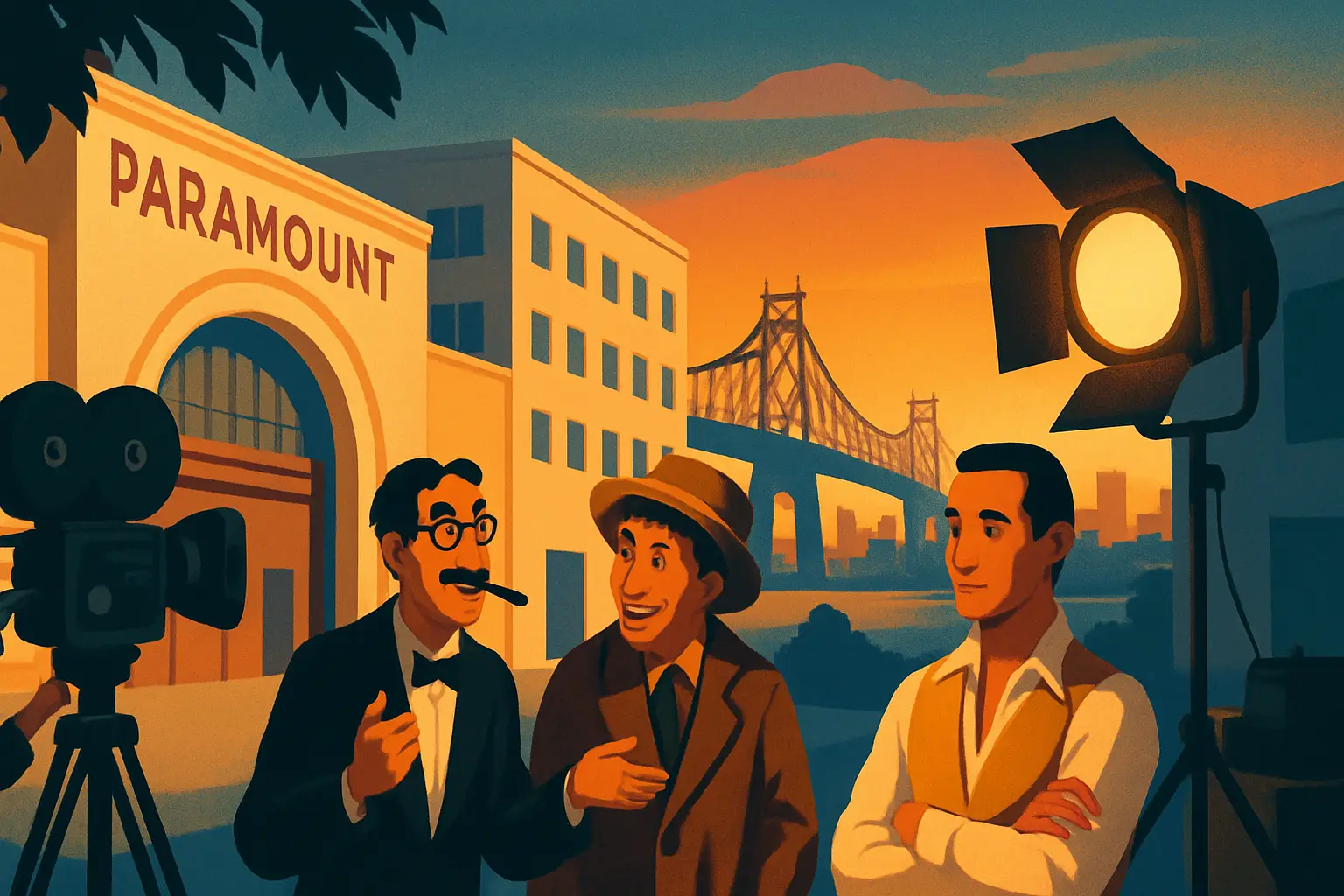
In 1920, Adolph Zukor — a Hungarian immigrant who had already built Famous Players Film Company into one of the most powerful studios in early cinema — opened a production facility in Astoria at 35-11 35th Avenue. The building became the East Coast headquarters of what would shortly be renamed Paramount Pictures, and for twelve years it was the creative capital of the American film industry.
More than 130 films were produced here during the silent era, with up to six features shooting simultaneously on its main stage and basement sets. Rudolf Valentino worked here. W.C. Fields and Gloria Swanson worked here. The Marx Brothers filmed The Cocoanuts (1929) and Animal Crackers (1930) on these stages — their first two movies, both adapted directly from their Broadway stage hits, both recorded in Astoria because the transition to talking pictures required New York's theatrical talent pool more than California's climate.
Paramount relocated everything to California in 1932. The weather argument won, as it always does. The Astoria building survived — it was used to produce U.S. Army training films during World War II — and reopened in 1976 as Kaufman Astoria Studios. *Sesame Street* was taped here for decades. *The Wiz*, *Hair*, *Presumed Innocent*, and *Ugly Betty* all filmed on these stages.
The studio remains operational. You can't tour the active production areas, but the original 1920 facade on 35th Avenue is visible from the street. Standing there and knowing what happened in that building is one of the better small revelations Queens has to offer.
The Museum of the Moving Image (36-01 35th Ave) sits directly adjacent to Kaufman Astoria Studios, and the placement is intentional — the museum was founded in 1988 specifically to occupy part of the original studio complex and tell the story of American film and television production.
It is the only museum in the United States dedicated entirely to moving-image art, history, and technology. The permanent collection holds 130,000 artifacts: early projectors, Foley sound equipment, production props, video game consoles through every generation, and materials from a century of film and television. One gallery recreates a 1920s movie house with period-correct projection equipment.
The best-kept secret is the film screening program. MOMI screens independent, international, and archival cinema weekly, often with filmmaker Q&As, and the audiences are modest — genuinely good odds of getting a seat at something you'd otherwise see in a packed Manhattan theater with a two-month waitlist. Admission on Fridays between 4 and 8 p.m. is free.
Address: 36-01 35th Ave; open Tue–Fri 10:30 a.m.–5 p.m., Sat–Sun 10:30 a.m.–6 p.m.
Admission: $20 adults / $16 seniors / $12 children; free Fridays 4–8 p.m.
Check movingimage.org for the weekly film screening calendar — the Q&A events are consistently undersold
Get short, interactive stories that make each place easier to remember while you travel.
Greek immigration to Astoria began in the 1950s, accelerated through the 1970s, and by the 1990s the concentration of Greek-owned tavernas, pastry shops, fish markets, and social clubs made 31st Street the culinary center of Greek New York. Much of that community has since dispersed to Long Island and New Jersey suburbs — but the restaurant infrastructure on 31st Street and Ditmars Boulevard held, reinforced by a second generation of Greek American owners who didn't close.
Taverna Kyclades (33-07 Ditmars Blvd) is the anchor: a no-reservations fish taverna where the day's catch is displayed in a refrigerated case at the entrance. You choose from what came in that morning — branzino, whole porgy, striped bass — priced by weight, grilled simply with olive oil and lemon. The waits for outdoor tables on summer evenings run 30 to 60 minutes. Arrive when they open at 5 p.m. or plan for lunch.
Zenon Taverna (34-10 31st Ave) is the reliable answer for classic meze: saganaki fried cheese flambéed tableside, taramosalata, spanakopita, grilled octopus that's been slow-cooked before it hits the fire. The interior has the no-frills quality that only survives when the kitchen is good.
Omonia Café (32-20 Broadway) has been serving loukoumades — small fried honey donuts — and Elleniko coffee since the mid-1970s. In August the outdoor tables stay open late. It's the right ending to an evening in Astoria: a small strong coffee, a plate of donuts, the neighborhood walking past.
Steinway Street — named for William Steinway, who built a factory town here in the 1870s around his piano manufacturing plant — runs north-south through central Astoria. Between Astoria Boulevard and 28th Avenue, it is one of the most concentrated stretches of Egyptian and Middle Eastern commercial life in North America.
Egyptian immigrants began settling Steinway Street in the 1970s and 1980s, followed by communities from Yemen, Sudan, Eritrea, and the Levant. The commercial strip contains halal butchers, Arabic-language bookshops, hookah lounges, spice import grocers with open bins of cumin and fenugreek, and a cluster of pastry shops and cafes that operate well past midnight.
Basra (25-66 Steinway St) is the standard address for knafeh — the Palestinian cheese pastry soaked in orange blossom syrup, served warm and cut from a large round tray. Kabab Café (25-12 Steinway St) is the neighborhood legend: a 20-seat Egyptian restaurant run by Ali El Sayed since 1990, where the daily menu is whatever Ali cooked that morning. There is no printed menu. He tells you what he made. The place has no web presence worth speaking of, which is why it's been full for 35 years.
The contrast between 31st Street (Greek, Mediterranean, European-facing) and Steinway Street (Egyptian, Middle Eastern, North African-facing), separated by a ten-minute walk through the same ZIP code, is the thing that makes Astoria worth understanding rather than just visiting.
Astoria Park runs along the East River at the northern end of the neighborhood. The defining feature isn't the river view — it's the Hell Gate Bridge directly overhead, one of the most structurally significant bridges built in the 20th century.
Formally the East River Arch Bridge, the Hell Gate was completed in 1916 by engineer Gustav Lindenthal as the rail crossing linking New Jersey to Long Island through Penn Station. Its arch span of 977 feet was the longest steel arch bridge in the world when it opened. Engineers designing the Sydney Harbour Bridge — which opened in 1932 and became the more famous structure — studied the Hell Gate extensively and used it as their primary structural model, scaling the arch design upward.
The bridge still carries Amtrak's Northeast Corridor trains. Every Acela traveling from Penn Station toward Boston passes over this span, usually without anyone on board knowing they're crossing the oldest and most internationally influential steel arch bridge in the United States.
The park beneath it contains a WPA-built outdoor swimming pool from 1936 — one of the largest public pools in New York City — open July through Labor Day. The lawn south of the pool faces the river with the 59th Street Bridge and Manhattan skyline downstream. Summer evenings here, with the Hell Gate lit and the water in view, are the kind of thing that makes you wonder why you've been skipping Queens.
Bohemian Hall and Beer Garden (29-19 24th Ave) opened in 1910 as the social hall of the Bohemian Citizens Benevolent Society, a fraternal organization serving Astoria's Czech and Slovak immigrant community. The outdoor courtyard behind the hall — a half-acre space with long picnic tables, old trees, and a wooden bar — has operated continuously since then, making it the oldest surviving beer garden in New York City by a margin of several decades.
The Czech community that founded it is mostly gone from Astoria; the Benevolent Society still exists but its membership is largely ceremonial. What remains is the space: a courtyard large enough for several hundred people, shaded by trees planted over a century ago, with Pilsner Urquell on tap, Czech lagers from rotating craft breweries, and a kitchen producing sausages and pierogies.
In late August it is exactly what it sounds like: long tables of neighborhood regulars and visitors on a warm evening, pitchers being passed, nobody checking their phone. The Greek and Egyptian restaurants on 31st Street and Steinway are a 15-minute walk away. Many people do both on the same night — dinner at Zenon, beer garden afterward.
Address: 29-19 24th Ave; open Mon–Fri 5 p.m.–2 a.m., Sat–Sun noon–2 a.m.; no reservations
Pilsner Urquell is the house draft; rotating Czech and German craft lagers available alongside it
Outside food is allowed — pick up from a nearby restaurant and eat in the courtyard
How do I get to Astoria from Manhattan? The N or W train from Times Square or 57th Street takes about 25 minutes with no transfers. The trains run elevated here — you get an above-ground view of the neighborhood as you approach. Get off at Astoria-30th Avenue for 31st Street and Zenon; continue one stop to Astoria-Ditmars Blvd for Taverna Kyclades, Astoria Park, and Bohemian Hall.
What's the best day to go? A Saturday in late summer covers everything: MOMI is open from 10:30 a.m., the outdoor pool in Astoria Park is open until Labor Day, Taverna Kyclades serves lunch starting at noon, and Bohemian Hall opens at noon. Arrive at Steinway Street by early afternoon for the pastry shops before they sell out. A weekday visit means shorter waits at Kabab Café and a quieter beer garden.
Is Astoria safe? Consistently — it's a dense, actively commercial neighborhood with foot traffic well into midnight along Ditmars Boulevard, 31st Street, and Steinway. The streets are well lit and the neighborhood's density keeps them active.
What else is near Astoria? The 7 train, accessible from Main Street in Flushing or from Queens Boulevard, connects to Jackson Heights — a South Asian and Latin American neighborhood with its own dense food scene along 74th Street and Roosevelt Avenue, and an entirely different story from Astoria's. See our Jackson Heights guide for that half of Queens.