The standard account of the Chicago hot dog traces it to the 1893 World's Columbian Exposition — the same fair that introduced Cracker Jack, Juicy Fruit gum, Pabst Blue Ribbon's first ribbon, and Frederick Law Olmsted's landscaping of Jackson Park. Among the vendors on the midway were Samuel Ladany and Emil Reichel, two Austrian-Hungarian Jewish immigrants who had recently arrived in the United States. They set up a stand selling an all-beef frankfurter — specifically all-beef, which was significant in a city with a large Jewish population whose dietary laws prohibited pork — and did well enough that they stayed.
The following year, 1894, Ladany and Reichel formalized the operation as the Vienna Beef Company, named after Vienna because both men had passed through the Austrian capital and it carried associations of quality German and Austrian sausage-making traditions. The company set up on the Near North Side of Chicago and has been there in various forms ever since, now headquartered and operating a factory in North Center.
Why Chicago rather than New York, which had a much larger immigrant population and a far more established street food culture? Partly timing — the World's Fair concentrated the attention and the foot traffic — and partly Chicago's particular geography of cheap, accessible beef. The Union Stock Yards, which processed and distributed a significant fraction of all American meat, were located on the South Side. Beef in Chicago was not a luxury ingredient. Ladany and Reichel were selling an all-beef frankfurter in a city that processed millions of cattle per year. The economics were favorable in a way they would not have been in Boston or Philadelphia.
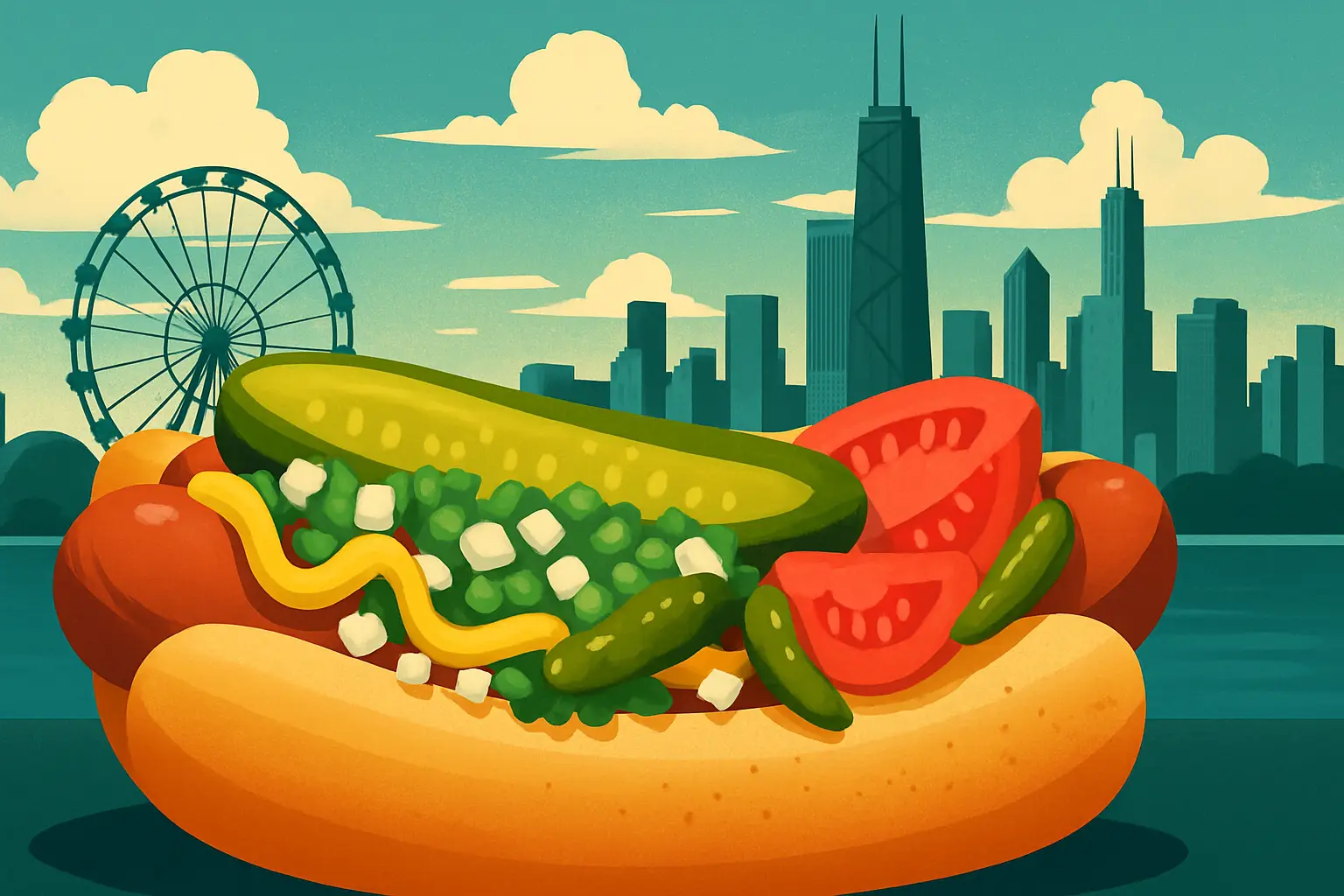
The phrase 'dragged through the garden' describes the process of loading a Chicago hot dog — the sausage is set in a steamed poppy seed bun and then moved across the toppings in sequence, picking each one up as it goes. The poppy seed bun is not decorative. It is a structural requirement: the seeds provide grip and a slight textural contrast to the steamed bun, and the bun itself is steamed (never toasted or grilled) because it needs to be soft enough to compress around the toppings without splitting.
The seven toppings in their canonical order:
Yellow mustard goes on first, directly on the sausage. Not Dijon, not whole-grain — plain yellow mustard with enough acidity to cut through the fat. Chopped white onion follows. Not red, not caramelized, not grilled — raw white onion, finely chopped, for sharpness. Neon-green sweet pickle relish is the most visually distinctive element of the Chicago dog. The color is not natural; it comes from added food dye, and it looks wrong in a way that becomes deeply comforting once you've eaten enough of them. The sweetness of the relish is the primary counterbalance to the mustard's acid. One whole dill pickle spear, tucked along the side of the dog, adds crunch and another layer of pickle flavor. Two sport peppers — small, pickled, moderately hot Capsicum annuum peppers that Vienna Beef packages specifically for this application — provide heat. Tomato wedges (two, cut from a fresh tomato) add brightness and a little sweetness. Celery salt is sprinkled last, over everything, and it functions as the seasoning that ties the toppings together.
The cumulative effect is a hot dog with six different flavor registers — acid, sweet, salty, spicy, fresh, savory — in roughly two bites. The sausage itself, a Vienna Beef all-beef frankfurter in a natural casing, provides a snap when you bite through it and a specific garlicky flavor profile that differs meaningfully from the soft, blander sausages found in cheap hot dogs nationwide.
Get short, interactive stories that make each place easier to remember while you travel.
Ask a Chicagoan why there is no ketchup on a Chicago hot dog and you will get several different explanations, none of them definitive, which is itself telling. The prohibition is real — many stands genuinely don't stock ketchup, and some will refuse or mock a request for it — but its origin is fuzzy enough to suggest that it emerged from cultural practice rather than a single decision by a founding figure.
The most persuasive explanation is functional: ketchup is sweet. The Chicago dog already has sweetness from the neon relish and the tomato. Adding ketchup would collapse the carefully calibrated flavor architecture into a single dominant sweet note, obliterating the acid-sweet-salty-spicy balance that makes the toppings work as a system. In this reading, the ketchup rule is less about Chicago identity and more about protecting a construction that took decades to stabilize.
The cultural explanation is complementary: ketchup was historically associated with lower-quality hot dogs that needed the sauce to mask an inferior sausage. A hot dog stand that refused ketchup was signaling that its product was good enough to stand on its own. The Wieners Circle (2622 N. Clark St., Lincoln Park), which has been Chicago's most famous hot dog stand since the 1980s, has formalized this logic into performance — staff members are legendarily abrasive to customers who make requests they consider unreasonable, and asking for ketchup at 2 a.m. on a weekend is essentially volunteering for a public ribbing.
Superdawg, which has been operating on Milwaukee Avenue since 1948, put the anti-ketchup policy on their menu from the beginning. Maurie Berman, who co-founded Superdawg with his wife Flaurie, described it as a point of quality rather than snobbery — the dog didn't need it. The Berman family still runs Superdawg, which makes it one of the rare food institutions in Chicago where the founding family's philosophy remains in daily operation.
Not every Chicago hot dog tradition went in the direction of more toppings. In 1946, Gene Mormino and Jude Testa opened a hot dog stand in River Grove — a suburb on the western edge of Chicago, reachable by car or the Blue Line Metra — and built their reputation on a stripped-down approach that has remained essentially unchanged for eighty years.
The Depression Dog (the name refers to the Depression-era logic of maximum satisfaction for minimum price, though the stand opened after the Depression had ended) uses Vienna Beef sausage, a steamed bun, yellow mustard, sweet relish, onions, and sport peppers. No tomatoes, no pickle spear, no celery salt. The distinguishing feature is that fries are served in the same paper sleeve as the dog, pressed against the sausage so they absorb its fat and seasoning as you eat. The fries are shoestring, cooked in pure vegetable oil, and they arrive crisp from the fryer. The combination of hot dog and fry in one hand, bite by alternating bite, is the experience Gene & Jude's was designed around.
The stand is small — a few tables inside, more on the sidewalk in good weather — and the operation is deliberately simple. You order at the counter, you eat standing or sitting, you leave. The cash-only policy and the limited menu are not nostalgia affectations; they are the same operational choices Mormino and Testa made in 1946, preserved because the current ownership (the stand has changed hands but not character) has never seen a reason to change them.
Gene & Jude's is worth the trip from downtown specifically because it demonstrates that the Chicago hot dog tradition is not monolithic. The seven-topping canonical form and the Depression Dog minimalism are both genuine expressions of what Chicago cooks discovered over decades of making cheap food taste good.
The canonical Chicago hot dog is a steamed dog — the Vienna Beef frankfurter goes into a water-steam bath alongside the bun, emerges fully cooked and juicy, and gets dressed with its seven toppings. This is the format at Gene & Jude's, at Portillo's, and at most traditional stands.
But Chicago also has a robust char dog tradition, centered on grilling the sausage directly over charcoal or on a flat-top griddle until the casing blisters, chars, and snaps with particular aggression. The flavor profile shifts dramatically: a char dog has caramelized exterior notes and a drier texture, and the smokiness from the char means the toppings play a different role — they're cooling the heat of the burnt casing rather than building a balanced seven-part architecture from scratch.
The Wieners Circle is the shrine of the char dog tradition. Located at 2622 N. Clark Street in Lincoln Park, it has been open since 1983 and operates as a late-night institution that draws a specific crowd: post-bar, uninhibited, comfortable with the fact that staff members will say outrageous things to them without provocation. The char dog at the Wieners Circle — blistered, split slightly from the heat, loaded with the full garden — is genuinely excellent food, and the environment around eating it is its own kind of entertainment. The stand is open until 4 a.m. on Friday and Saturday nights. Going sober is also fine; the food is good at any hour.
Jimmy's Red Hots (4000 W. Grand Ave., Humboldt Park) is the other canonical char dog destination, operating since 1954 in a neighborhood that does not see much tourist traffic but is accessible by car. The stand is smaller and quieter than the Wieners Circle; the char dog is more consistently executed because the crowd is more consistently local.
Chicago has more hot dog stands than McDonald's, Burger King, and Wendy's combined — the statistic has been cited so often it has become cliche, but it remains approximately true and useful for understanding the density of the city's hot dog culture. These six cover the essential range:
Superdawg — 6363 N. Milwaukee Ave., Norwood Park. Chicago's last surviving carhop drive-in, open since 1948. Superdawg (their name for their version of the Chicago dog) comes in a box to keep the toppings from sliding. Hours: Sun–Thu 11 a.m.–1 a.m., Fri–Sat 11 a.m.–2 a.m. Cash and card. Hot dog around $6–7.
The Wieners Circle — 2622 N. Clark St., Lincoln Park. The char dog standard-bearer and the city's most entertaining late-night stand. Open until 4 a.m. Fri–Sat. Staff interactions are not for the sensitive. Char dog around $4–5.
Gene & Jude's — 2720 River Rd., River Grove (20 min west of downtown). Cash only. Depression Dog with fries-in-the-sleeve, under $5. Open roughly 10:30 a.m. to 10 p.m., but they close when the product runs out.
Portillo's — 100 W. Ontario St., River North (and multiple other locations). The most accessible option for visitors staying downtown. Large, loud, chain-ish but still using Vienna Beef. Hot dog around $5–6. Open 10 a.m. daily. Online ordering available.
Jimmy's Red Hots — 4000 W. Grand Ave., Humboldt Park. The char dog alternative to the Wieners Circle, quieter and more local. No frills, no attitude. Hot dog under $4. Cash preferred.
Vienna Beef Factory Deli — 2501 N. Damen Ave., North Center. Mon–Fri 9 a.m.–3 p.m. The manufacturer's own counter, where you can taste the canonical product at the source and buy the full retail kit (frankfurters, neon relish, sport peppers, poppy seed buns) to recreate it at home. Hot dog around $4.
Can I just ask for ketchup and see what happens? Yes. The worst outcome at most stands is a politely dismissive response or a mild ribbing. The Wieners Circle is the exception — the staff there treat it as an invitation. If you genuinely need ketchup, Portillo's will provide it without comment.
Is Portillo's worth the visit? It is worth one visit, especially if you're staying in River North and want the full Chicago hot dog experience without a cab to Norwood Park. It's a chain with genuine quality control and the correct Vienna Beef product. It is not the most interesting stand in the city, but it is the most convenient for downtown visitors.
What's the best time to visit Chicago for the hot dog experience? Hot dog stands are year-round Chicago institutions. Superdawg as a drive-in is best in late spring through early fall (May through October) when eating in the car is pleasant. Gene & Jude's and the Wieners Circle are as good in January as in July. September specifically is excellent — the summer crowds have thinned, the weather is still warm, and the ball parks are still hosting games, which means the city's hot dog culture is operating at full pitch.
The Chicago White Sox hot dog at Guaranteed Rate Field (333 W. 35th St., Armour Square) uses Vienna Beef. Cubs games at Wrigley Field (1060 W. Addison St., Wrigleyville) also serve Vienna Beef. Eating a hot dog at a baseball game in this city is a historically accurate act.
If you're traveling with children, Superdawg is the clearest winner — the animatronic mascots, the drive-in format, and the food quality make it a destination that works for every age.
The full seven-topping Chicago dog and the Depression Dog at Gene & Jude's are both under $7 as of 2026, making them among the best value-per-experience meals available in any major American city.