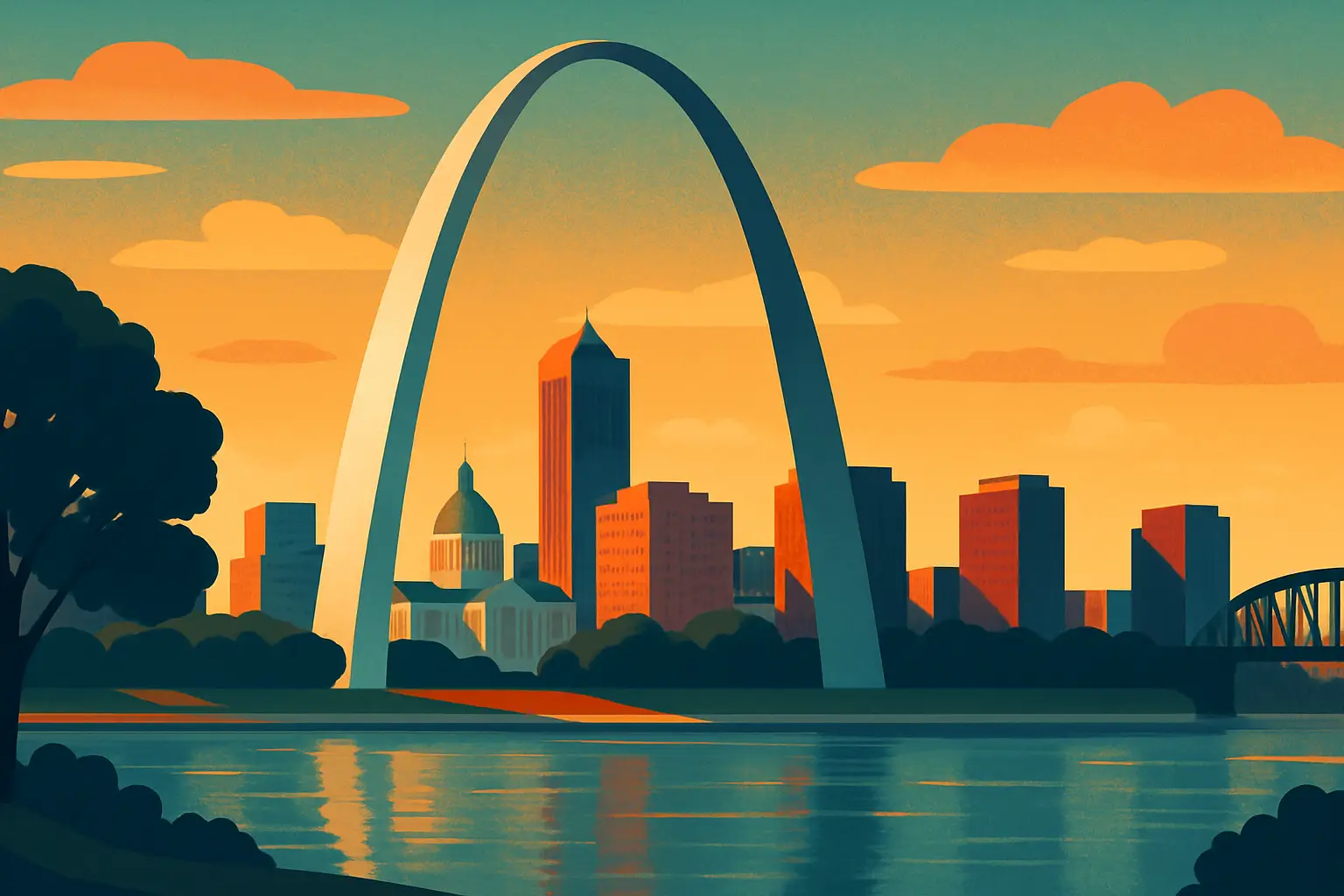
The Gateway Arch stands on the west bank of the Mississippi River in downtown St. Louis, on the site where the city served as the primary departure point for 19th-century settlers heading west. At 630 feet tall, it is the tallest arch in the world and the tallest man-made monument in the Western Hemisphere — taller than the Washington Monument by 75 feet.
The arch was built to mean something, not just to be impressive. It commemorates Thomas Jefferson's vision of a continental United States, the 1803 Louisiana Purchase that doubled the country's land area, and the millions of settlers who crossed the Mississippi on their way toward the Pacific Coast. St. Louis was the last major city before the frontier.
The surrounding park — officially Gateway Arch National Park — became America's newest national park in 2018, making it one of the only national parks located entirely within a major city. The park encompasses the Arch, an underground museum and visitor center, and a stretch of the Mississippi riverfront, plus the Old Courthouse three blocks away.
Eero Saarinen, the Finnish-American architect who designed the Arch, won a national design competition in 1947 from a field of 172 entries. Between that competition win and the start of construction in February 1963, he spent years refining the exact shape. What he chose was not a parabola — the curve most people assume — but a weighted catenary, which is the shape a heavy chain takes when suspended from both ends, adjusted for the varying mass of the arch legs as they taper from 54 feet wide at the base to 17 feet wide at the top.
The engineering precision required to build it was extraordinary. The 142 triangular steel sections — each with a carbon-steel interior and stainless-steel exterior — had to be placed within a tolerance of 0.4 mm at the base so that both legs would meet precisely at the apex, 630 feet in the air. Engineers reported no gap when the two sides were joined. The arch was completed in October 1965 at a cost of $13 million. It opened to the public in June 1967.
Get short, interactive stories that make each place easier to remember while you travel.
The most distinctive feature of visiting the Arch is how you get to the observation deck. Rather than conventional elevators, the Arch uses a system of pod-cars that hold five people each and rotate independently as they travel up the curved interior of each leg. The pods tilt to stay level as the leg curves inward — a detail that feels more like a fairground ride than a national park experience, and that is genuinely unlike anything else in the country.
The ride takes about four minutes up and three minutes down. At the top, visitors step into a narrow observation capsule with 16 small windows on each side, offering views of downtown St. Louis, the Mississippi River, and on clear days, as far as 30 miles. The observation deck holds roughly 40 people at once.
Tram tickets require advance booking and sell out during summer. As of early 2026, tickets were priced at $15 for adults during promotional periods — confirm current pricing at gatewayarch.com before you go. If you have an America the Beautiful Annual Pass for national parks, it reduces the ticket price by $3. The tram is not accessible for visitors who cannot climb approximately 96 steps at the top.
Book at gatewayarch.com or recreation.gov — same-day tickets are sometimes available but not guaranteed
Best timing: the 9 a.m. or 10 a.m. windows tend to have the shortest lines
The observation capsule windows are narrow (about 7 inches wide) — the ride and the engineering are the experience, not panoramic glass
The Museum at the Gateway Arch sits directly beneath the arch in an underground visitor center and is completely free — no tickets required. Reopened in 2018 after a $380 million renovation, the museum covers the full story of westward expansion: the Lewis and Clark Expedition, the era of covered wagon migration, the displacement of Indigenous peoples, the construction of transcontinental railroads, and the industrial growth that followed.
The redesigned exhibits use primary source documents, maps, artifacts, and recorded oral histories rather than simplified summaries, which makes it more challenging and more rewarding than most national park visitor centers. The section on Indigenous nations encountered during westward expansion is notably well-done — honest about displacement rather than framing the period as uncomplicated progress.
Even if the tram is sold out or you choose not to take it, the museum alone justifies making the trip to the Arch. Plan an hour minimum.
A five-minute walk from the Arch, at 11 North 4th Street, stands the Old Courthouse — one of the most historically significant buildings in the United States and part of Gateway Arch National Park. In 1847 and 1850, the courthouse hosted the first two Dred Scott trials. Dred and Harriet Scott were an enslaved couple who sued for their freedom in this building, arguing that their time in free states and territories had legally ended their enslavement. The Missouri courts ruled against them both times.
Their case eventually reached the U.S. Supreme Court, which issued the Dred Scott decision in 1857 — ruling that Black Americans held no rights under the Constitution. The decision became one of the most consequential in American history, accelerating the political crisis that led to the Civil War. The room where the Supreme Court's ruling was declared is also the same room where Dred and Harriet Scott were later freed, in 1857, after their owner's family arranged their manumission.
The courthouse opened four new museum galleries in May 2025 covering the Dred Scott case and Virginia Minor's women's suffrage case from the 1870s. Ranger-led tours are free and need no reservation for groups under 10 people. The building's address is 11 North 4th Street; the Arch is visible from the front steps.
The Gateway Arch sits inside an 82-acre national park that runs along the Mississippi riverfront. After the Arch and the Old Courthouse, the park itself is worth a walk.
Laclede's Landing, a nine-block historic district immediately north of the park, has 19th-century cobblestone streets and cast-iron warehouse architecture — the oldest surviving block of the original St. Louis waterfront. Tom Sawyer and Becky Thatcher riverboats offer one-hour sightseeing cruises from the dock at the base of the Arch; seeing the arch from river level provides scale that standing under it does not.
For photographs, the Arch is best shot from across the river on the Illinois side, or from the Eads Bridge — the 1874 steel truss bridge immediately north of the park, which is walkable and free. From the bridge, you get the arch framed against the St. Louis skyline without having to be in East St. Louis itself. Early morning and late afternoon light hit the stainless-steel surface most dramatically.
The park's main address is 100 Washington Ave, St. Louis, MO 63102. There is no on-site parking. The nearest pre-arranged option is Stadium East Parking Garage via the park's Preferred Parking Program ($10 for 5 hours); buy in advance at iparkit.com/TheArch, especially on Cardinals game days when surrounding lots fill early.
MetroLink, St. Louis's light rail system, stops at Arch-Laclede's Landing station (Red Line), a short walk to the park's north entrance. From St. Louis Lambert International Airport (STL), the MetroLink Red Line runs directly downtown in about 40 minutes — no transfer needed.
The visitor center and museum are open daily from 9 a.m. to 6 p.m., with extended hours on Fridays and Saturdays during summer. The Arch is open year-round.
The best time to visit is on weekday mornings in spring or fall, when lines are shortest and temperatures are comfortable. Summer is the busiest period and when tram tickets are most likely to sell out. October in St. Louis averages highs in the mid-60s Fahrenheit — ideal for the park walk and the riverfront.
Is the Gateway Arch free? The museum underneath is always free. The Tram Ride to the Top requires a separate ticket, currently around $15 for adults (confirm current pricing at gatewayarch.com). An America the Beautiful Annual Pass reduces the tram ticket price by $3.
How long does a visit take? Plan 2-3 hours if you include the tram ride, the museum, and a walk to the Old Courthouse. The tram experience itself (check-in, ride up, time at the top, ride down) takes 45-60 minutes from start to finish.
Can you visit without taking the tram? Yes — many visitors spend an hour or more in the free museum and on the park grounds without taking the tram, and the Old Courthouse is a separate stop entirely.
What should I skip? The IMAX movie offered at the visitor center covers similar ground to the museum and is the least essential part of the visit — if time is limited, skip it in favor of the Old Courthouse. Details verified October 2026; hours and prices change, so confirm before you go.