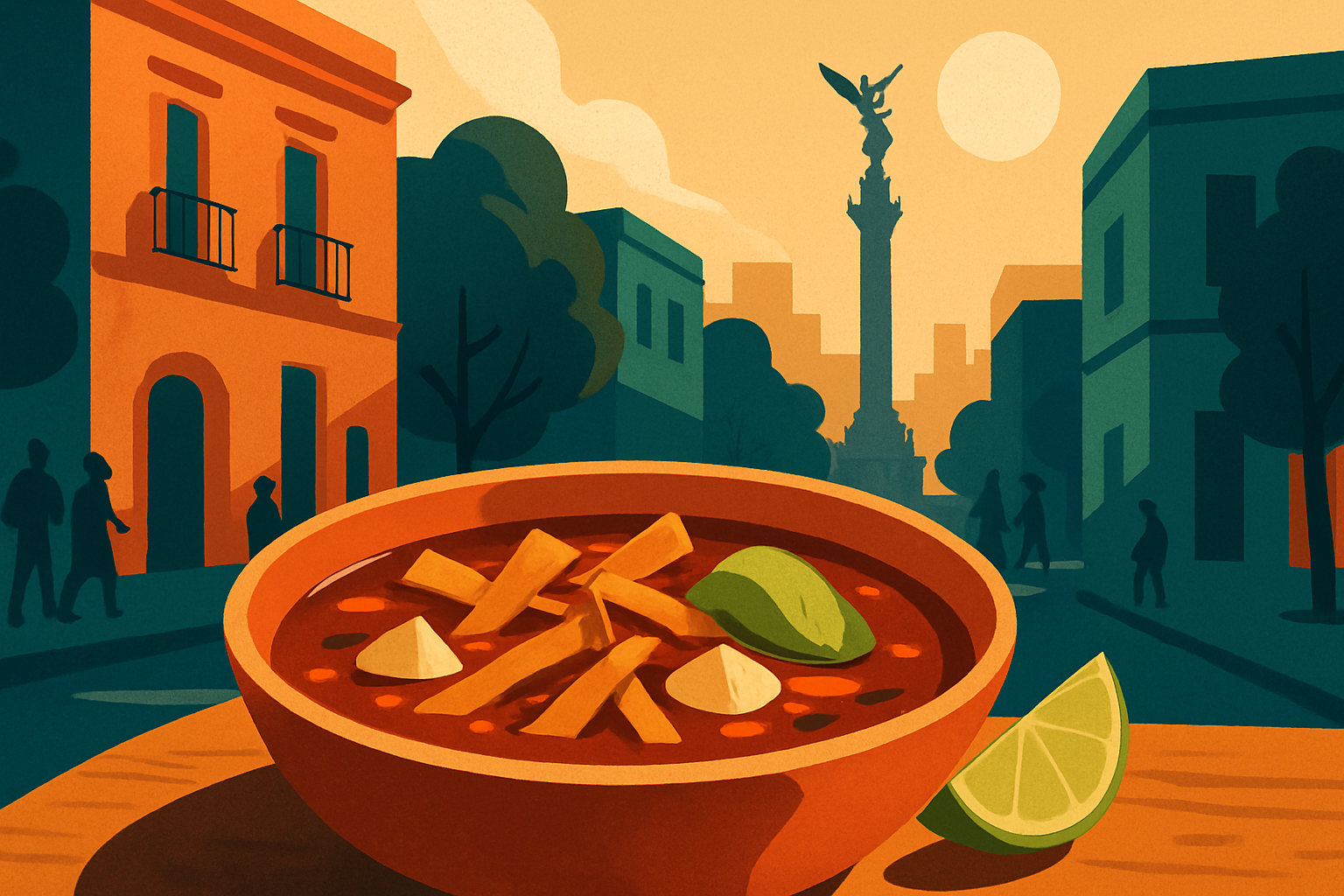
1. What sopa azteca actually is — and why the name doesn't mean what you think
The name suggests a dish straight from the Aztec empire, but the preparation as we know it today emerged in the colonial period, when Spanish techniques — roasted tomato broth, crema, queso fresco — merged with pre-Hispanic ingredients: corn tortillas, dried chiles, epazote. The 'Aztec' in the name refers to the corn tortilla base, not a recipe that predates the conquest.
The core structure of the dish is this: a tomato-and-chile caldo, deep in color and complex in flavor, into which freshly fried corn tortilla strips are dropped just before serving. The strips maintain their crunch for the first two or three minutes in the hot broth, then slowly soften into something halfway between a noodle and a cracker. You're supposed to eat it fast, which is why the bowl arrives at the table already assembled and very hot.
The garnishes sit on top: sliced avocado, a swirl of Mexican crema, crumbled queso fresco, a scattering of fried chipotle or pasilla chile strips, a few leaves of epazote or cilantro. Some versions add shredded chicken to the broth. Others are purely vegetarian. The broth color ranges from brick red to deep mahogany depending on the chile proportions — a darker bowl almost always means a more complex broth.
•The 'Aztec' name refers to the corn tortilla base, not an ancient Aztec recipe
•Tiras de tortilla: fried corn strips that start crunchy and soften in the hot broth over 2-3 minutes
•Standard garnishes: avocado, crema, queso fresco, fried chile strips, epazote or cilantro
2. The three chiles that define the broth
No element of sopa azteca is more personal than the chile blend, and understanding the three main options helps you decode what you're tasting in any given bowl.
Chipotle (smoked dried jalapeño) produces the smokiest version of the broth — earthy, slightly sweet, with moderate heat and a dark mahogany color. This is the most recognizable flavor profile for anyone who's eaten chipotle in other Mexican dishes. It's the dominant choice at many traditional restaurants in Centro Histórico.
Pasilla (also called chile negro — a dried, wrinkled chile with a long tapered shape) gives the broth a deeper, more complex flavor: notes of dried fruit, mild chocolate undertones, and gentle heat, with less smokiness than chipotle. Pasilla versions tend to be darker in color and more subtle in spice. Many cooks consider this the 'classic' broth base.
Guajillo (a mild, thin-fleshed dried chile with a fruity, slightly tart flavor) produces the brightest-colored broth and the most accessible heat level. The guajillo version is vibrant red, lighter in body, and suits the widest range of palates. Some cooks blend guajillo with chipotle or pasilla to build complexity without pushing the heat.
In restaurant kitchens, the exact chile proportion is the cook's signature — no two versions taste identical. Epazote, a pungent aromatic herb with a sharp, almost resinous edge that has no equivalent in European cooking, gets added near the end of simmering. If you smell epazote in the broth, the kitchen is paying attention.
•Chipotle: smoky, earthy, dark color — the boldest and most recognizable version
•Pasilla: complex, dried-fruit notes, moderate heat — often considered the 'classic' broth
•Guajillo: bright red, fruity, mild — most accessible; often blended with chipotle or pasilla
3. El Cardenal at Palma 23 — the institution worth knowing
The most reliable place to eat sopa azteca in Mexico City is El Cardenal on Palma 23, in Centro Histórico, five minutes on foot from the Zócalo. The restaurant has been serving traditional Mexican food since 1969 under the Briz-Garizurieta family, and the sopa azteca here is one of the reasons food writers keep returning to it.
The bowl arrives deep and dark — a chipotle-pasilla blend broth with a swirl of crema on top, fried chile strips arranged across the surface, two or three slices of fresh avocado, and a substantial portion of tortilla tiras that have been fried to a deeper crunch than most places manage. They hold their structure in the broth for longer than average, which means you can eat at a reasonable pace instead of racing the softening clock.
El Cardenal is open for breakfast and lunch, and the sopa appears on both menus. On weekday mornings, the kitchen sends a clay pot of café de olla or hot chocolate to the table before your food — an old-school hospitality gesture that signals the restaurant's orientation toward tradition. Before you've ordered a thing, you already know what kind of place this is.
The original Centro location at Palma 23 is about 5 minutes from Metro Zócalo (Line 2). The Polanco location at Presidente Masaryk 395 has the same menu with slightly more space. As a lunch starter, the sopa azteca runs about 130 to 160 pesos — also substantial enough to work as a light meal on its own.
•Palma 23, Centro Histórico — 5-minute walk from Metro Zócalo (Line 2)
•Open for breakfast and lunch; sopa azteca on both menus
•Polanco location: Presidente Masaryk 395, same quality, more elbow room
4. The comida corrida: where sopa azteca actually lives
To understand sopa azteca in Mexico City, you need to understand the comida corrida — the traditional set lunch that runs from roughly 1 to 4 p.m. and consists of four courses at a fixed price, typically 80 to 120 pesos.
The order is: starter (usually a small salad or a piece of fruit), sopa (the hot soup course), main dish (meat with rice and beans), and postre (a small dessert or agua fresca). Sopa azteca is one of the most common choices on the sopa del día rotation. Walk past any fonda in Mexico City between 1 and 3 p.m. and check the handwritten chalkboard outside — you'll see it listed two or three times per week.
The word 'sopa' in the Mexican meal structure doesn't translate exactly to the English 'soup.' It covers both liquid soups (caldo) and sopa seca — literally dry soup, which is pasta or rice cooked in broth until the liquid is absorbed. Sopa azteca is the liquid version, dense and substantial, designed to function as a serious first course that prepares the stomach for the main dish. At fondas, the sopa arrives in a generous bowl — not a small cup or amuse-bouche portion. It is part of the set price and is not negotiable.
5. Market fondas and the everyday version
The version served in a market fonda is often more interesting than the version at a sit-down restaurant — not because the technique is higher, but because the ingredients are fresher and the cook has been making this broth every week for twenty years.
[Mercado de San Juan](/mx/blog/mercado-de-san-juan-mexico-city-guide) on Ernesto Pugibet in Centro has fondas on the upper floor that serve sopa azteca as part of the comida corrida from about 12:30 p.m. The broth here tends toward the pasilla direction — deeper in flavor, less smoky — made fresh each morning from dried chiles rehydrated and blended with charred tomatoes from the market floor below.
Mercado Medellín in Roma Sur (on Campeche between Medellín and Monterrey) has a handful of lunch fondas with a mixed local and international regulars crowd. The sopa azteca appears on the rotation several days per week. Arrive before 2 p.m. for the best selection.
Mercado Jamaica in Doctores has some of the most serious fonda cooking in the city — inexpensive, fast, and deeply traditional. A full set lunch including sopa runs about 90 pesos. The fondas inside are not labeled or listed online; they're counters with eight stools and a cook who knows what they're doing. Walk in, sit down, say '¿Qué tiene de sopa hoy?' — what's the soup today?
The market fonda version is usually less garnished than the restaurant version — you might get crema and avocado but not the full El Cardenal assembly — but the broth is where the soul of the dish lives, and that's where the market cook's skill shows.
•Mercado de San Juan (Centro, on Ernesto Pugibet): upper-floor fondas, pasilla-leaning broth
•Mercado Medellín (Roma Sur, on Campeche): rotation includes sopa azteca several days per week
•Mercado Jamaica (Doctores): serious fonda cooking, full set lunch ~90 pesos
6. Sopa azteca vs. caldo tlalpeño — knowing which bowl is which
A common confusion at traditional Mexican restaurants in Mexico City: caldo tlalpeño is not the same dish, and both appear on lunch menus regularly.
Caldo tlalpeño is a clear broth soup originating from the Tlalpan borough in the south of Mexico City. The base is a lighter amber broth — chicken stock with charred chipotle chile, epazote, and chickpeas. The result is smokier and more transparent than sopa azteca, with no tortilla strips and no crema assembly on top. The colors tell you immediately which is which: caldo tlalpeño is amber to orange; sopa azteca is red to dark brown.
Both are legitimate and worth ordering on different visits. The practical distinction: if you want the bowl with the tortilla strips and the full garnish, ask specifically for 'sopa azteca' or 'sopa de tortilla.' If the menu lists 'caldo tlalpeño,' that's the lighter clear-broth version.
A third close relative worth knowing: crema de elote (corn cream soup), which appears on many traditional menus and uses the same chile-and-crema topping logic as sopa azteca but is built from blended corn rather than tomato broth. Heavier, sweeter, and completely different — but sometimes confused with sopa azteca by first-time visitors because of the similar garnish presentation.
7. Practical questions: timing, cost, and what to avoid
When is it served? Sopa azteca is a lunch dish — the comida corrida format runs 1 to 4 p.m. Most fondas will tell you 'ya no hay' (there isn't any left) after 4 p.m. At El Cardenal it's available during the full lunch and breakfast service. Dinner versions are rare — look for lighter soups or consomé if you're eating after 7 p.m.
What should I pay? In a fonda as part of the set comida, the sopa is included in 80 to 120 pesos total. At El Cardenal as an individual starter, 130 to 160 pesos. At mid-range traditional restaurants à la carte, 100 to 140 pesos.
How do I know if it's made fresh? The clearest indicator is flavor depth: a well-made sopa azteca has multiple distinct layers — tomato, dried chile, epazote, a slight sweetness from charred tomato skin. A broth made from powder tastes flat and one-dimensional, like tomato paste dissolved in hot water. The best market fondas make the broth fresh each morning; the worst tourist-facing restaurants use pre-made base. The smell of epazote rising from the bowl as it arrives is a reliable signal that the broth is real.
Is it vegetarian? Often yes, but not always — some versions add pollo deshebrado (shredded chicken) directly to the broth. Ask '¿Lleva pollo?' before ordering if it matters to you.
Can I find it outside restaurants? Occasionally at street food stalls around markets, usually on weekdays. It's not common as cart-based street food the way tacos are — the assembly requires too much tableside work. The fonda or restaurant is the natural habitat of sopa azteca.