1. Why Mexico City Spanish sounds like its own language
Mexico City draws migrants from every Mexican state — Oaxacans, Jaliscans, Veracruzanos — all carrying their regional speech patterns into a linguistic pressure cooker of 22 million people. Underneath all of it, Nahuatl, the language of the Aztec empire, never disappeared. It collapsed into the Spanish vocabulary of central Mexico and resurfaces constantly in words that chilangos use without thinking about their origin. Above that sits a layer of 20th-century urban slang invented in working-class neighborhoods like Tepito, which has historically exported more Mexico City street vocabulary than anywhere else in the city.
The result is a dialect that moves faster than standard Spanish, drops word endings, and treats profanity as punctuation among friends. A single taco de guisado counter conversation in Colonia Obrera can cycle through words of Arabic origin, Nahuatl origin, and Mexico City-specific coinages from the 1970s — all in four sentences. This guide focuses on the CDMX layer: words that are specific to Mexico City or used there with meanings that differ from what standard Spanish textbooks teach.
2. The 10 words you'll hear before finishing your first coffee
These are not obscure — they are the vocabulary of daily life in CDMX.
•Güey (wey): The single most common word in casual conversation. Dude, bro — used constantly between friends regardless of gender. You'll hear it 3-5 times at your first taco stand. Never use it first with strangers.
•Chido / chida: Cool, nice, great. 'Está chido' = it's cool. The default positive adjective for informal approval of anything.
•Órale: The most versatile word in Mexico City. Yes, OK, hurry up, wow, let's go — all depending on tone. Rising intonation = 'well then.' Flat = 'OK.' Emphatic = 'come on, let's move.'
•La neta: The truth; for real. 'La neta, no sé' = honestly, I don't know. Functions as a sincerity marker — signals the person is being direct, not just polite.
•Simón: Yes. Informal, rhythmic, more locally colored than a plain 'sí.' Used constantly across all casual conversations.
•Nel: No. Just as informal as simón. One syllable, no ambiguity.
•Chela: Beer — derived from the name 'Estela' via rhyming slang. Works at any casual bar, market counter, or street stand instead of the more formal 'cerveza.'
•Qué pedo: Literally 'what fart' — in practice, 'what's up' as a greeting or 'what's going on' about a situation. The tamer equivalent is 'qué onda.'
•Mande: 'Excuse me?' or 'What?' — the standard polite Mexican response to not hearing something. Not slang; used across all ages and social classes. Using it marks you as culturally literate.
•Va: OK, deal, agreed. Short and final — when a price is set, a plan is confirmed, or an order is placed.
3. Ahorita and four other words that will confuse you
Several common Mexico City words look like standard Spanish but have shifted meanings that create real misunderstandings.
Ahorita is the most notorious. 'Ahora' means now. 'Ahorita' technically means 'right now' — but in Mexican time it maps to: a few minutes (at a restaurant when your food is coming), thirty minutes to an hour (from a friend who's running late), or an indefinite future that may not arrive at all. The diminutive makes the timeframe smaller in theory and more flexible in practice. When a waiter says 'ahorita lo traigo,' your food is probably coming soon. When someone says they'll arrive 'ahorita' and they haven't left home yet, calibrate accordingly.
Padre means father. It also means cool or great — 'qué padre' means 'how great.' Context distinguishes them: 'qué padre eres' = what a great person you are; 'mi padre está en casa' = my father is home. No real confusion once you're in a conversation, but it surprises first-time visitors.
Lana and feria both mean money, but differently. Lana (literally 'wool') = money in general, like 'dough' or 'bread' in English slang. Feria = exact change or loose coins. When a vendor at Mercado de San Juan asks '¿tienes feria?' they need exact change — not a 500-peso bill.
Antro simply means nightclub in CDMX — no negative connotation despite sounding ominous in English. Chafa means cheap, low-quality, or fake: 'está muy chafa' = it's garbage quality. A useful word for navigating the line between genuine artisan goods at Mexico City markets and tourist-grade imitations.
4. The Nahuatl layer — indigenous words hiding in daily speech
Nahuatl did not die with the Aztec empire — it decomposed into the Spanish vocabulary of central Mexico and surfaces daily in words that Mexico City residents use without thinking about their origin. Linguists estimate several hundred Nahuatl loanwords remain in active everyday CDMX use.
The clearest layer is food. Almost every major ingredient in Mexican cooking has a Nahuatl name: chile (from chilli), elote (from elotl), aguacate (from ahuacatl), jitomate (from xitomatl), chocolate (from xocolatl), cacao (from cacahuatl), camote (sweet potato, from camotli), epazote (from epazotl). When you order at a taquería, you are speaking a language that predates Spanish by centuries without realizing it.
Beyond food: cuate (close friend, buddy) comes from coatl, meaning twin or snake — originally signifying someone as close as a twin. Escuincle (kid, little brat) comes from itzcuintli, the ancient hairless dog breed the Aztecs kept — extended over time to describe small children. Papalote (kite) comes from papalotl (butterfly or moth). Popote (drinking straw) comes from popotl, a reed used for drinking liquids long before plastic existed. The Aztec history guide covers what the empire actually was. The vocabulary you hear every day is its living residue.
5. What people actually say at the taquería and market
Street food exchanges in Mexico City follow a verbal script that visitors often find confusing the first time.
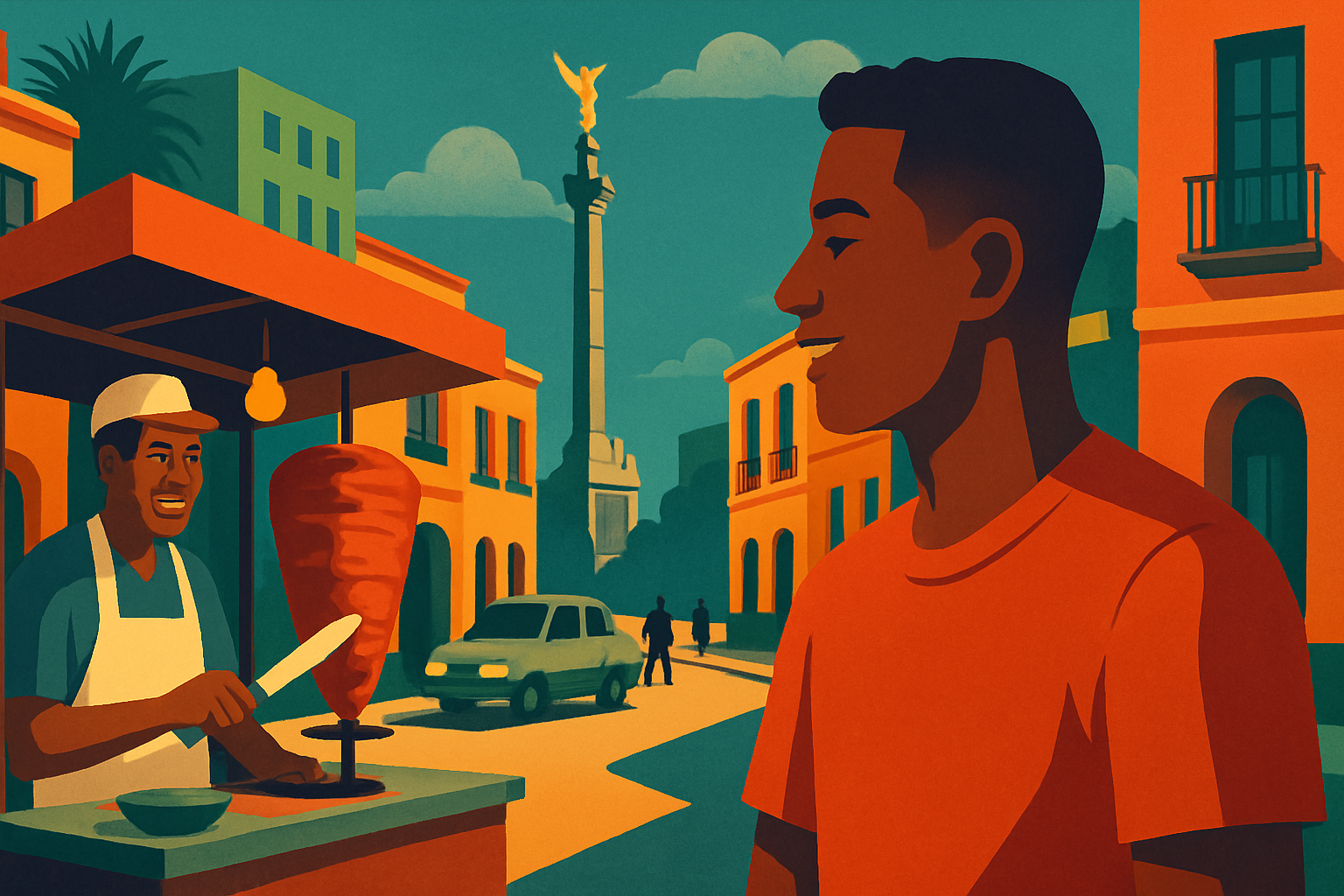
The taquero's opening line is usually '¿Qué le doy?' or '¿Le doy algo?' — 'What can I give you?' This is not aggressive; it is the standard opening. Respond with your protein: 'De pastor, por favor' or 'Dame tres de suadero.' Dame (give me) is completely acceptable at a street stand — no more abrupt than saying 'I'll have' in English.
'De volada' means right away or immediately. If the cook says 'te lo hago de volada,' your order is coming in under two minutes. 'Al tiempo' means at room temperature — said about drinks when ice is unavailable or unwanted. '¿A cómo?' is how you ask price per unit at a market stall: '¿a cómo el kilo?' or '¿a cómo las tres?' (how much for three?). It sounds more fluent than '¿cuánto cuesta?' and gets a more natural response from vendors. 'Échame más' — give me more — is standard when you want more salsa, more onion, or more of anything on your plate.
6. Reading the room: who you can say what to
Mexico City has clear social registers, and mixing them wrong is more jarring than not knowing the slang at all.
With vendors, taxi drivers, and most service workers, usted (formal 'you') is the respectful default. They will often shift to tú (informal) within seconds as a signal that the exchange is relaxed — matching their register once they've switched is fine. Initiating with tú in formal service contexts reads as presumptuous.
Güey should only travel in one direction first: the other person uses it, then you can reciprocate. Using it first with a service worker, anyone older, or in a professional context is jarring regardless of how often you've heard it on the street. The rule: wait for the other person to set the register, then match it.
Terms of address you'll be called that are not insults: jefe / jefa (boss) signals the vendor is treating you as someone in authority — often an upsell signal, never an offense. Maestro is respectful and collegial. Güero / güerita (light-haired or light-skinned person) is an extremely common descriptor for foreigners and lighter-skinned Mexicans — not derogatory, simply observational in Mexico City's direct descriptive tradition. Pinche (fucking, damn) is ubiquitous among close friends but severely out of place in any formal or new-acquaintance context — the fact that you hear it on every street corner does not make it universally appropriate.
7. Is 'chilango' an insult? Can I use güey with strangers?
Is 'chilango' an insult? Outside Mexico City, often yes — people from Guadalajara, Monterrey, and other cities have historically used it to mock CDMX residents as arrogant, wasteful, or culturally dominant. Inside Mexico City, the word has been largely reclaimed. Residents say 'soy chilango' with something between pride and irony. Calling someone chilango who is from CDMX lands neutrally to positively. Using it in a mocking tone that signals the negative connotation — that reads differently and people notice.
Can foreigners say güey? Yes, once the other person has used it with you. Using it first with a street vendor you've just met, with anyone older, or in any non-casual setting reads as overcasual at best. The moment someone drops it naturally in your direction, you're in the right register to reciprocate.
What to say when you don't understand: Don't stare blankly or fire back a sharp '¿qué?' — which can sound curt. The clearer, more polite option is '¿Me lo puede repetir?' (Could you repeat that for me?) — fluent, respectful, and gets a slower, cleaner response almost every time. You'll use it constantly. That's not a sign you don't know Spanish — it's a sign you're in a city that moves fast.