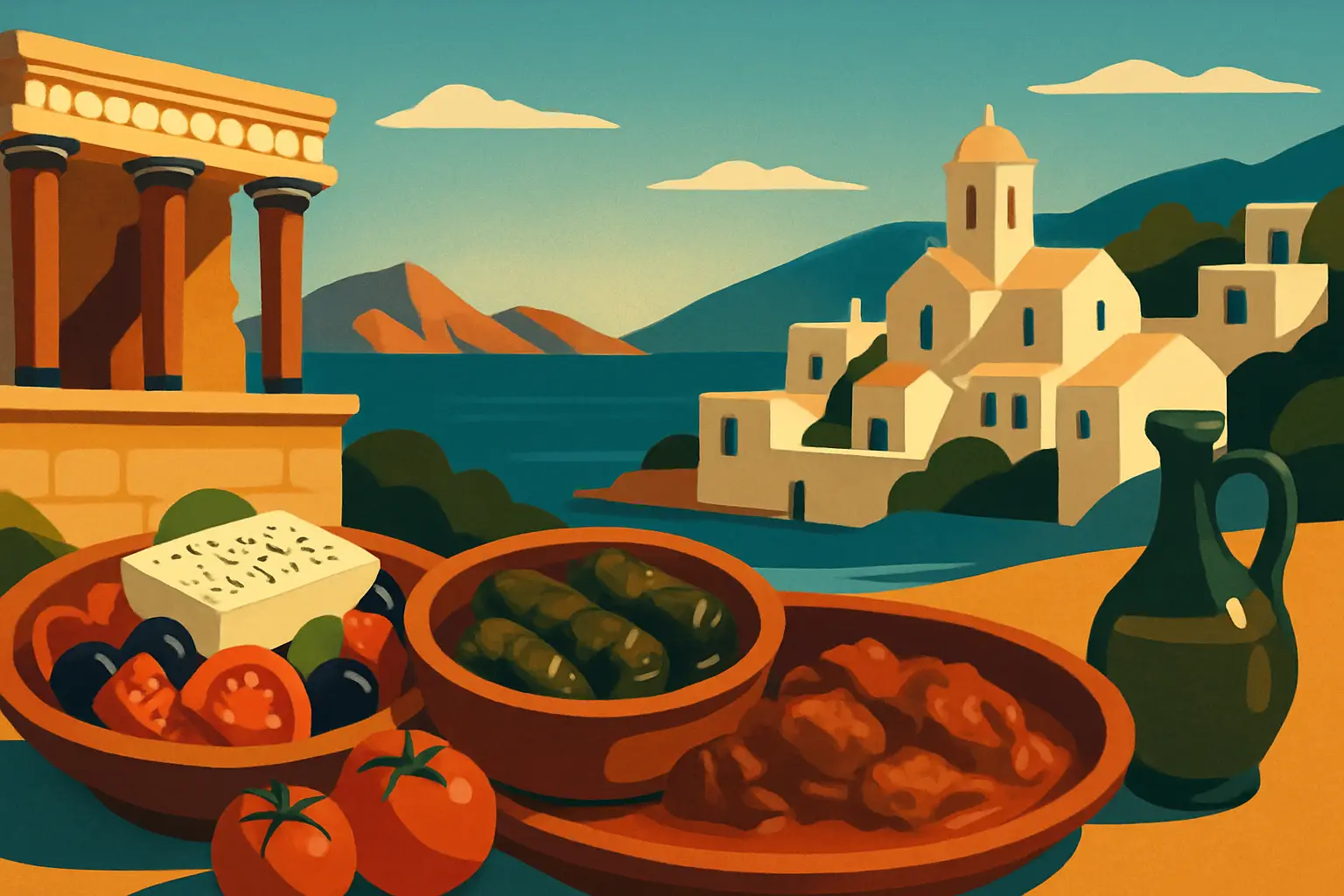
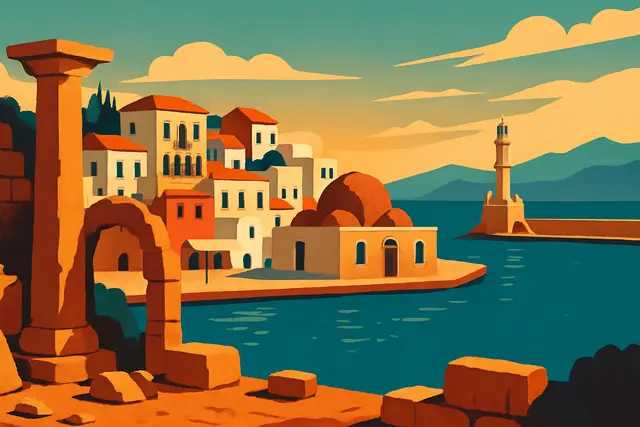
Cretan cuisine is often described as the purest expression of the Mediterranean Diet — the eating pattern that became famous in the 1950s when American physiologist Ancel Keys noticed that Cretan men had the lowest heart disease rates of any population he had studied. What Keys identified was not a diet in the modern sense but an agricultural system: abundant cold-pressed olive oil used in everything, wild greens foraged from hillsides, legumes eaten daily, meat reserved for celebrations, and almost no processed food.
That system is still largely intact on Crete in 2026. The island produces roughly 35% of all Greek olive oil output. Sheep and goats still graze the White Mountains above Chania. The specific black Tsounati olive variety grown in the Heraklion basin appears in no other olive oil on earth. When TasteAtlas ranked Crete third in the world — behind only Tuscany and Emilia-Romagna — it was this combination of living agricultural tradition and dish-level specificity that made the case.
What separates Cretan food from mainland Greek cuisine is exactly that specificity. Dishes here are tied to exact places: dakos uses the barley rusk from Crete, not a wheat cracker; antikristo uses lambs raised in the Sfakia mountains; gamopilafo uses the broth from a specific cut of goat slow-boiled for hours. You are not eating 'Greek food.' You are eating food from a 260-kilometer-long island that has been feeding itself the same way for four millennia.
Dakos is the first thing you will be served in Crete, and it is also the most revealing dish on the island. The foundation is a barley rusk — dried twice to remove nearly all moisture, hard enough to knock against a table. The barley rusk (called paximadi) developed because wheat doesn't grow well on Crete's rocky hillsides; barley thrives. The twice-baked process extended shelf life for months without refrigeration — essential for shepherds and sailors.
To make dakos, the paximadi is briefly soaked in cold water to soften the outer layer while leaving the center firm. Fresh tomato — usually the small, dense Cretan variety called ntomataki — is grated directly over the top, not sliced. The grating releases juice into the rusk, completing the softening. Over this goes myzithra — a fresh, crumbly white cheese made from sheep's milk whey — then a generous pour of cold-pressed extra virgin olive oil. Salt, dried oregano, optionally a few Kalamata olives.
The version you'll most often see on tourist-facing menus substitutes feta for myzithra. This is not wrong, but it changes the dish: feta is sharper and saltier; myzithra is milder and creamier, sitting closer in texture to ricotta. When you order dakos and want the original, ask specifically for myzithra. Most traditional tavernas will have both.
Get short, interactive stories that make each place easier to remember while you travel.
Antikristo means 'opposite the fire.' It is a cooking technique developed by the shepherds of the Sfakia region in the White Mountains above Chania. A young lamb or kid goat is butchered and its pieces mounted on long wooden stakes — traditionally mastic wood — arranged in a circle around a large central fire, not above it. The meat faces the flames at roughly a meter's distance and cooks slowly, for five to six hours, solely through radiant heat. No direct contact with coals, no turning, no basting. The meat seasons itself: fat renders down the stakes, salt is applied once, smoke coats the outside, and the interior stays almost impossibly moist.
Antikristo is reserved for large celebrations — Easter, weddings, village festivals — which is why it requires advance booking at any taverna that serves it. The most authentic way to encounter it is at a village panigiri (local festival), which run throughout the summer across Crete's interior villages. These are public events and visitors are genuinely welcome; ask locally about upcoming panigiria in whatever region you're staying in.
For a restaurant that makes it regularly, Taverna Sifis in the village of Anopolis — in the Sfakia mountains, accessible from Chania by a dramatic mountain road — has been cooking antikristo for decades and takes advance bookings by phone.
Gamopilafo translates as 'wedding rice' — it was the dish served at Cretan wedding feasts for centuries. A whole goat or sheep was slaughtered, boiled for hours in a vast cauldron, and the resulting broth used to cook rice until every grain was saturated with fat and gelatin. The meat was served separately; the rice, cooked in the reduction of the whole animal, was the celebration itself.
The technique is essentially the same as risotto, except the stock is richer and more deeply flavored than any restaurant stock will be — because it comes from an entire animal, bones and all, simmered for four to five hours with nothing but salt and mountain water. The finished gamopilafo is glossy, dense, and flavored in a way that is difficult to describe before eating it: slightly lamby, deeply savory, with a texture closer to wet polenta than to separate rice grains.
In Crete's rural interior, gamopilafo is still primarily a wedding dish — cooked in quantities measured by the kilogram for 200 guests at a time. In Heraklion and Rethymno, several traditional restaurants now serve it year-round. Peskesi at Kapetanaki 6–8 in Heraklion's old city, which operates from a restored Ottoman-era mansion and sources 100% of its ingredients from Cretan producers, serves gamopilafo when available — call ahead to confirm.
Cretan cheese is not a single category. The three you'll encounter everywhere — and that are most worth understanding before you arrive — are graviera, myzithra, and xynomyzithra.
Graviera Kritis is a hard, pale-yellow cheese made from sheep's milk (sometimes with a small addition of goat's milk), aged for a minimum of five months in Cretan aging caves. It has a lightly sweet, nutty flavor — closer to Swiss Gruyère than to any Italian hard cheese — with a firm texture that holds when sliced or fried. You'll encounter it as graviera saganaki, pan-fried until golden and served with thyme honey and sesame seeds, or sliced alongside fresh figs at the end of a meal. It is also the Cretan cheese most widely exported to the EU.
Myzithra is the fresh whey cheese — the byproduct of making harder cheeses — soft, white, and mild, sitting somewhere between ricotta and very fresh feta. It appears in dakos, inside sfakianopita, and as a simple dessert drizzled with Cretan thyme honey, which is arguably the best honey produced anywhere in Greece.
Xynomyzithra ('sour myzithra') is an aged version: tangy, crumbly, and spreadable, with a yogurt-like acidity balanced by fat and salt. It is used as a table cheese with bread and olive oil, and appears in the filling of sfakianopita. If you see it on a cheese board, it is the most distinctly Cretan thing on the plate.
Sfakianopita is a flatbread from the Sfakia region — the same remote mountain district that gave the world antikristo. The dough is simple: flour, olive oil, and either raki (the local Cretan firewater) or vinegar as the leavening acid. It's rolled thin, filled with xynomyzithra, folded over, and cooked on a dry griddle until the outside is spotted and crisp and the interior has melted into something between a crepe and a quesadilla. It arrives at the table warm, drizzled with Cretan thyme honey. This is the best example of the Cretan habit of combining fresh cheese and honey in savory contexts — a pairing that shouldn't work as well as it does.
Sfakianopita is available throughout Crete but most authentic in the Sfakia villages and in kafeneions around Chania's old harbor district, where several make them to order as a morning or late-morning snack.
Bougatsa in Crete is not the same pastry as the bougatsa of Thessaloniki. The Cretan version uses a thicker phyllo and comes in two forms: sweet (filled with semolina custard, dusted with icing sugar and cinnamon) and savory (filled with myzithra, served plain or with a drizzle of honey). Iordanis at Apokoronou 37 in Chania has been making bougatsa since 1924 — one of the oldest continuously operating food businesses in the city. They cut it to order from a large tray. The line forms before 9 a.m. and the freshest batches go first.
In Heraklion, start at Odos 1866 — the covered market street running south from the Morosini Fountain (the Lions Fountain) in the city center. This is one of the best food streets in Greece: spice stalls, cheese vendors with graviera wheels stacked to the ceiling, olive oil producers offering tastings from unlabeled bottles, jars of mountain thyme honey, dried herb bundles. Walk the full length before buying anything — the stalls nearest the fountain are tourist-facing and priced accordingly; the deeper covered-market end is wholesale-oriented and better value.
Peskesi at Kapetanaki 6–8 in Heraklion's old city is the restaurant that best represents the current Cretan culinary moment: every ingredient is sourced from Cretan producers, the space is a restored 19th-century mansion, and the menu rotates with the season. Stuffed lamb with stamnagathi (the wild Cretan chicory), hand-rolled pasta with aged graviera, gamopilafo when available. Not a budget meal — around €35–45 per person — but the most coherent expression of Cretan food culture in a single sitting.
In Chania, the old harbor district anchors the city's best eating. The Municipal Market (built 1913) on the south side of the harbor is the morning hub: cheese, honey, fresh produce, cured meats, raki sold by the bottle. For a meal, walk five minutes west to Tamam at 49 Zambeliou Street — a converted Ottoman hammam whose interior courtyard is one of Chania's most atmospheric dining rooms. The menu covers traditional Cretan and eastern Mediterranean preparations; the stuffed squid and the slow-cooked lamb with prunes both hold up. The side streets between the market and the Venetian harbor also concentrate Chania's best street food: sfakianopita shops, snail stalls, and souvlaki grills that are noticeably better than their Athenian equivalents.
Best time to visit? For food specifically, the shoulder seasons — May and early June, or September and October — are considerably better than peak July and August. Spring means mountain herbs are at their freshest, wild greens like stamnagathi are in season, and the previous autumn's olive oil is in prime condition. Autumn brings the grape harvest, chestnut season in the hill villages, and new-press olive oil production beginning in late October. In peak summer the food is reliable but menus compress toward what tourists expect.
June is an excellent window right now: warm weather (around 28–30°C by day), the sea swimmable at 24°C, manageable crowds compared to late July, and the long summer panigiri festival season just opening — which means the best chance of encountering antikristo as it was designed to be eaten.
Getting between Heraklion and Chania: The two main food cities are 148 kilometers apart by the E75 motorway. KTEL buses run every 30 minutes from Heraklion Bus Station A (at the port) to Chania, taking about 2.5 hours and costing around €15. If driving, the E75 is fast; the old national road through the hills is slower but passes through the interior villages where most of the food is actually produced.
Airport note: Heraklion (HER) receives direct international flights from across Europe throughout summer. Chania has its own airport (CHQ) with fewer connections but is the better arrival point for the western half of the island, including the Sfakia region, Chania's old harbor, and the best stretch of the island's white-mountain hiking territory.