1. What Spetses is — and what car-free means in practice
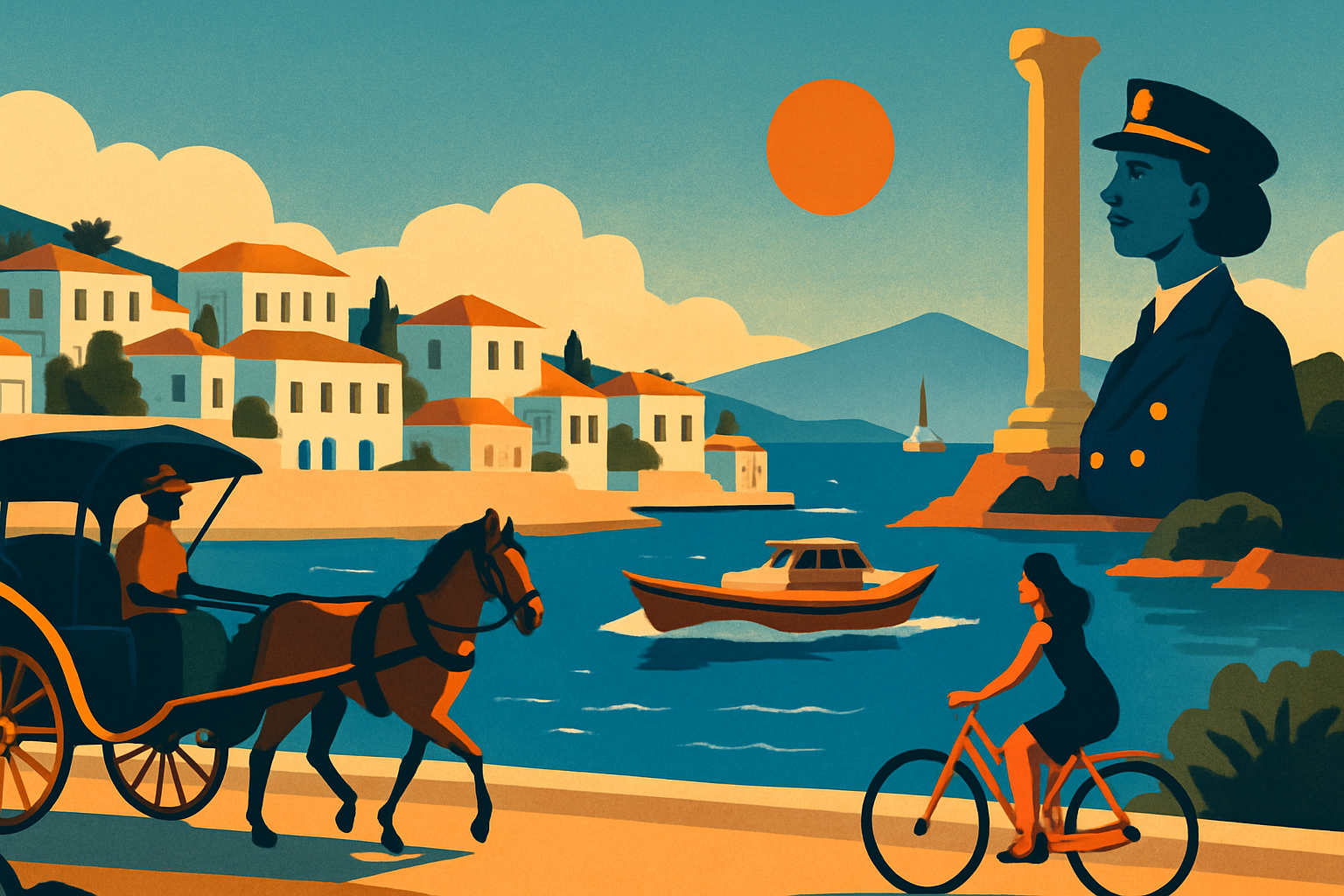
Spetses is the southernmost of the Saronic Gulf islands at roughly 22 square kilometers, with a year-round population of about 4,000 that swells dramatically in summer. Like Hydra, it has effectively banned cars from its town center, but the mechanics differ slightly: private vehicles are permitted on the island's outer roads with a resident permit, while the town itself is genuinely navigable only by horse-drawn carriages (karratzades), bicycles, and water taxis.
The karratzades are the defining image of Spetses Town. A fleet of horse-drawn buggies works the Dapia harbor, their drivers calling out destinations to passengers arriving from Athens. They carry luggage, tourists, and islanders. The sound of hooves on cobblestones fills the waterfront as morning boats arrive, then fades into afternoon when the heat sends everyone to the water.
The island is heavily forested — Aleppo pines cover most of the interior, a legacy of Sotirios Anargyros, a tobacco magnate born on Spetses who made his fortune in the United States and returned in the early 20th century to reforest the island (stripped bare by centuries of shipbuilding) and fund most of its major public works. The pines make Spetses distinctive among the Saronic islands: beaches are framed by forest rather than the bare rocky hillsides of Hydra, and the island stays noticeably cooler in summer afternoons.
2. Bouboulina: the widow who commissioned a warship and commanded it herself
The most important name associated with Spetses is Laskarina Bouboulina — born in a Constantinople prison in 1771 while her father awaited execution by Ottoman authorities, raised on Spetses, and twice widowed by her mid-forties after both husbands died at sea. Each death left her wealthier. She inherited merchant ships and trading networks and managed both with enough commercial competence to become one of the island's richest people.
When preparations for the 1821 Greek revolution began through the secret society called the Filiki Eteria, Bouboulina was among its earliest recruits. She used her own fortune to commission a corvette — the Agamemnon — built in secret at the island's shipyard, designed for war rather than trade. On March 13, 1821, twelve days before the revolution's official start, her ships raised the Greek flag at Spetses and blockaded the Ottoman garrison at Nafplio. She personally commanded operations from the quarterdeck for extended periods of the campaign.
After the revolution, the Russian Imperial Navy recognized her contributions by extending her the rank of admiral — a title based on her documented naval command. No other woman in history holds that rank in two navies.
Her mansion on Bouboulinas Street in Spetses Town is now the Bouboulina Museum, a private institution operated by her direct descendants. The guided tour — given by a family member — takes about 40 minutes and covers original letters, personal firearms, furniture, and documents from the revolutionary period. Entry is €6; tours run mornings from 9:30 a.m. in Greek and English. It is one of the most genuinely informative small museum experiences in the Saronic islands.
3. Spetses Town and the Dapia: where the revolution started
Spetses Town extends along the northeastern coast, with Dapia — the main harbor square — as its center. A cannon battery still stands on the small promontory at the harbor's edge: these are the guns fired on March 13, 1821, to signal Spetses' entry into the revolution. The marble-paved Dapia is the morning arrival point, the evening gathering square, and the departure hub for water taxis to the island's beaches.
The harbor's most imposing structure is the Poseidonion Grand Hotel, a neoclassical building constructed in 1914 by Anargyros, who modeled it on the Carlton in Cannes. Its white colonnaded terrace faces the sea directly. The hotel still operates as accommodation; if you are not staying, having a coffee on the terrace during the morning is the right way to orient yourself on a first visit. The rates for rooms are steep; the coffee is not.
Behind Dapia, streets rise through clusters of archontika — neoclassical mansions built by the shipowning families who controlled the island's economy in the 18th and 19th centuries. They are better preserved here than on most Greek islands. The Spetses Museum, housed in the Chatziyannis Mexis mansion a few minutes from the harbor, holds ship models, naval weapons, and exhibits on the island's revolutionary period — a useful companion to the Bouboulina Museum if you want the full picture of what Spetses contributed to 1821.
4. The Old Harbor (Palio Limani) and the quieter western side
About 1.5 kilometers west of Dapia, following the coastal path around the island's northwestern curve, is the Palio Limani — the Old Harbor. This was Spetses' original port, where the shipyards that built the Agamemnon operated, and where the caiques that blockaded Nafplio were constructed. Today it is a working fishing harbor with a handful of tavernas facing the water and a fraction of Dapia's crowds.
Tarsanas at the Old Harbor is the taverna most locals recommend for fresh fish and spetsofai — the island's signature sausage and pepper stew. Tables sit at the water's edge and the kitchen follows what arrived that morning. The Old Harbor is the side of Spetses that regular visitors tend to protect; it is genuinely worth seeking out rather than defaulting to the more obvious waterfront restaurants at Dapia.
The Anargyreios and Korgialenios School, the private boarding institution Anargyros funded and modeled on English schools, stands in the grounds between Dapia and the Old Harbor. The English novelist John Fowles taught here in the early 1950s and set his novel *The Magus* on a fictionalized version of Spetses — sending a generation of literary travelers to the island in the 1970s and 80s. The school's neoclassical buildings are visible from the coastal path.
5. The best beaches on Spetses
Spetses' beaches are distributed around the island's circumference, most accessible by sea bus or water taxi from Dapia. The island has meaningfully better sandy options than Hydra, which runs almost entirely to rock.
Agia Paraskevi, on the southwest coast, is widely considered the island's best beach — a long arc of sand and fine pebble backed by pine forest, with sun beds and a beach bar. The sea bus from Dapia takes about 20 minutes. Agioi Anargyroi, slightly further around the southwest coast, is a sand and pebble bay with water sports available and a younger crowd on summer afternoons.
Zogeria, on the northwest coast, is the most scenic cove: a natural bay enclosed by pine forest on three sides, with crystal-clear shallow water well suited to children and snorkeling. No beach infrastructure beyond shade from the trees — water taxi from Dapia or a 50-minute walk through the pine interior.
Xylokeriza, further west, is the most isolated option: a small pebble cove reachable only by water taxi or a long walk through the forest. The isolation is the point. Kaiki beach, just 10 minutes' walk from Dapia along the southeastern coastal path, is the correct choice if you want to swim without committing to a half-day excursion — small, pebbly, and usually quiet on weekday mornings.
6. How to get to Spetses from Athens
By hydrofoil from Piraeus: Take Metro Line 1 (green line) to Piraeus station — approximately 40 minutes from Monastiraki. Walk or take a short taxi to Gate E8 at the ferry port. Hellenic Seaways Flying Dolphin services run multiple times daily in summer; journey time 80 minutes, one way roughly €35-42. Book at hellenicseaways.gr or buy at the port.
From the Peloponnese: If you are traveling from the Argolid coast, local boats cross from Kosta — a small mainland port 10 minutes from Porto Heli — to Spetses in under 5 minutes. This is the route used by Athenians driving down for the weekend and the shortest sea crossing in Greece at roughly 200 meters of water.
Combining with Hydra: The standard Saronic circuit runs Piraeus → Hydra → Spetses, with the leg between them taking 30 minutes by hydrofoil. The two islands share the 1821 naval heritage but feel different: Hydra is more dramatically rocky with grander mansions; Spetses has better beaches, more pine forest, and a more livable cycling infrastructure. Together they make a strong two-day loop.
Best time: June is the optimal window for a first visit — full services, swimmable sea, uncrowded. September is a strong second choice and coincides with the Armata festival (third weekend of September): a harbor reenactment of the Battle of Spetses in which a replica Ottoman flagship is ceremonially burned, followed by fireworks. The Saronic Gulf's answer to Hydra's Miaoulia.
7. Spetses versus Hydra — and what to eat
How does Spetses compare to Hydra? The two islands are 30 minutes apart by hydrofoil and share the same revolutionary history, but the experience is different. Hydra's harbor is more immediately dramatic — steeper hills, the waterfront more compressed, the architecture grander. Hydra's car-free rule is also more absolute: no vehicles anywhere, versus Spetses' outer-road permit system. For a single day trip, Hydra's visual impact is higher. For a weekend stay, Spetses wins on beaches, cycling, and the pine-shaded interior paths. Bouboulina's story is specific to Spetses in a way that gives the island a distinct identity.
What to eat: The dish named for the island is spetsofai — a rich stew of spicy pork sausage, bell peppers, and tomatoes that arrived from the Pelion peninsula shepherds and stayed. Most tavernas in town serve it; Tarsanas at the Old Harbor does a reliable version alongside fresh catch. The other Spetsiot staple is pasta flora — a shortcrust pastry tart filled with apricot jam, baked in every bakery in town and sold for €2-3 at the shops near Dapia. It is a simple thing, entirely non-Italian despite the name, and the correct thing to eat on the ferry home.
Day trip or overnight? A long day trip covers the Bouboulina Museum, Dapia, the Old Harbor, and one beach. An overnight unlocks the early morning harbor before the day-trippers arrive and a proper evening at the Old Harbor tavernas — the specific quality of the island that a day trip can reach but not quite hold onto.