The Rhodes Old Town covers 45 hectares inside walls that are between 4 and 12 meters thick. The Knights Hospitaller — a Catholic military order — built and continuously reinforced those walls after capturing the island in 1309. They held Rhodes until 1522, when the Ottoman Sultan Suleiman the Magnificent took the island after a six-month siege. The Ottomans didn't demolish the medieval city; they moved in. They converted churches to mosques, built a bazaar along what became Sokratous Street, and added hammams and a medrese. Then came the Italians, who occupied Rhodes from 1912 to 1943 and conducted a large-scale reconstruction of the medieval buildings under Mussolini.
The result is a city with four architectural layers stacked on top of each other: Byzantine foundations, Gothic Knights' buildings, Ottoman additions, and Italian neo-medieval restorations. Walking the Old Town is an exercise in reading which century you're in.
The Old Town divides into three zones most visitors blur together. The Collachium (northern section) is where the Knights lived and governed — the Street of the Knights, the Palace of the Grand Master, and the Archaeological Museum. The Turkish Quarter fills the center and south, organized around Sokratous Street with its Ottoman-era shops, the Suleiman Mosque, and the hammam on Arionos Square. The Jewish Quarter (Ovraiki) occupies the southeastern corner around Plateia Martyron Evreon — the Square of the Jewish Martyrs, named for the 1,700 Rhodian Jews deported to Auschwitz in 1944, of whom fewer than 200 survived.
All three zones are still lived in. This is what separates Rhodes from most preserved medieval cities in Europe, which function as open-air museums. On Sokratous Street, the tourist shops close at night and a corner kafeneion opens for local regulars. On the side streets off Ippoton, Rhodians park scooters under Gothic arches.
Ippoton Street — the Street of the Knights — runs 200 meters from the Knights' hospital (now the Archaeological Museum) up to the Palace of the Grand Master. Both sides of the street are lined with the Inns of the Tongues: the administrative buildings where knights from different national groups (French, Italian, English, Spanish, German, Provençal, Auvergne) lodged and met. The facades are intact Gothic stonework with carved heraldic emblems still visible above doorways. There are no shops, no cafes, no signs. Early morning — before 8:30 a.m. — you can walk the full length in near-silence.
The Palace of the Grand Master at the top of Ippoton is enormous: 300 rooms, towers, battlements, and interior courtyards. The original Byzantine structure was expanded by the Knights, then almost entirely destroyed by a gunpowder explosion in 1856. What you visit today is largely a new building — Mussolini had it reconstructed between 1937 and 1940 as a summer residence, using the medieval foundations and salvaged stones but essentially building fresh on top of the ruins. Inside, the mosaic floors are genuinely ancient — moved from archaeological sites on the nearby island of Kos by the Italian administration. The result is simultaneously authentic and deeply strange: a real medieval fortress rebuilt by a fascist government to look like it was never damaged. The palace is open Tuesday through Sunday.
The Archaeological Museum in the Inn of the Knights of St. John holds the Aphrodite of Rhodes — a 1st-century BC marble statue of the goddess emerging from the sea, found by fishermen in the harbor. The museum courtyard, planted with roses under a Gothic loggia, is one of the more unexpectedly pleasant spots to sit in central Rhodes.
Get short, interactive stories that make each place easier to remember while you travel.
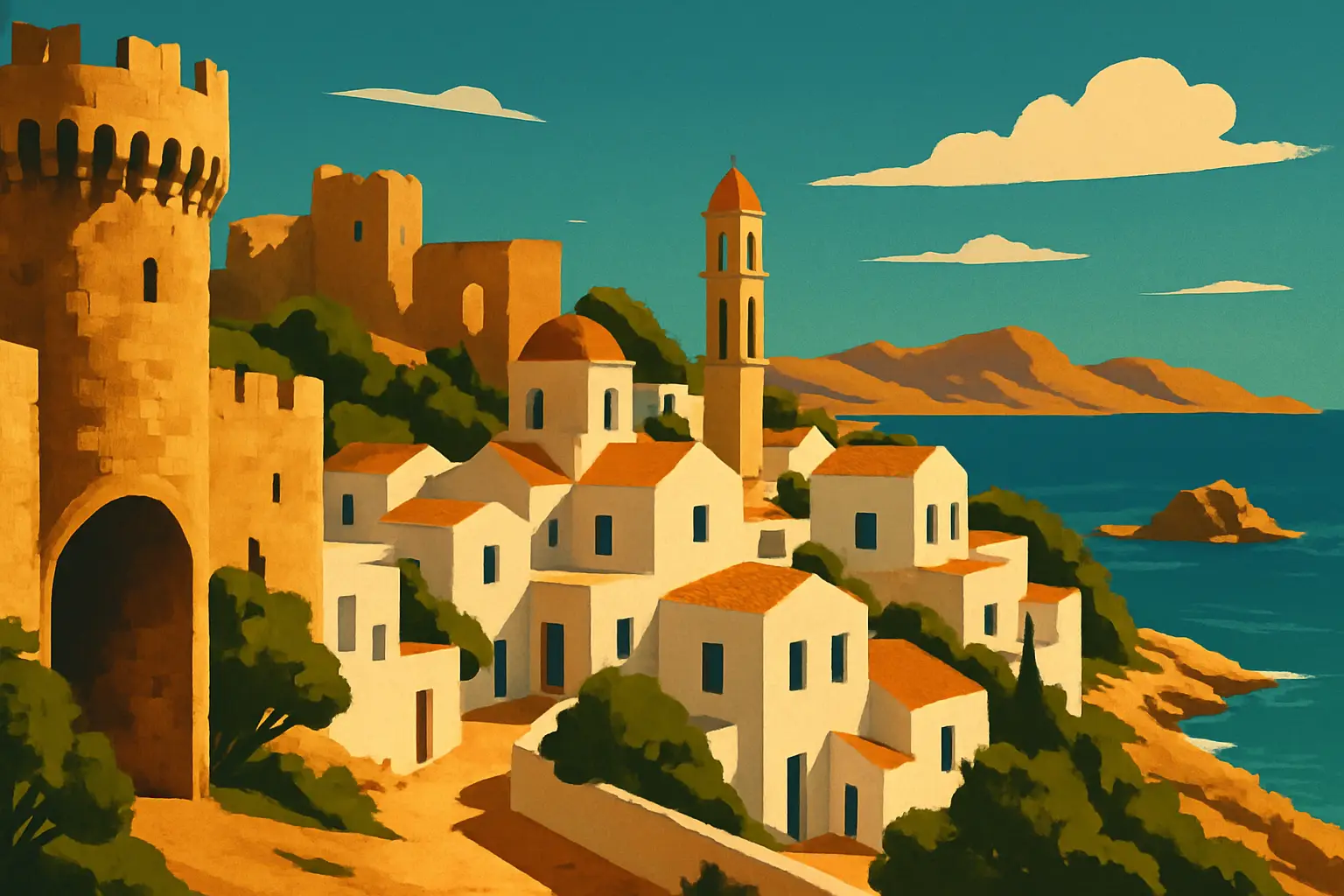
Lindos is 50 kilometers south of Rhodes Town along the eastern coast. The village is stacked white cubic houses on a hillside above St. Paul's Bay — a sheltered crescent of turquoise water where, by tradition, the Apostle Paul landed during a storm in 51 AD. The small Church of St. Paul sits at the water's edge.
Above the village, on a 116-meter sheer rock, is the Acropolis of Lindos — a Doric temple complex dedicated to Athena Lindia, built in the 4th century BC. The site was expanded by Greeks, Romans, and then the Knights of St. John, all of whom found the rock too strategically useful to abandon. The Temple of Athena Lindia's partially standing columns sit beside Byzantine chapel remnants and the Knights' fortification walls in a single uninterrupted site — 2,000 years of people using the same high point for different purposes, layered on top of each other the same way they are down in the Old Town.
The climb takes 20 minutes on foot through the village's cobblestone paths, or you can hire one of the donkeys that work the route each morning. The propylaeum at the top opens onto the temple platform with unobstructed views across the bay and, on clear days, the Turkish coastline. For the beach, St. Paul's Bay directly below the Acropolis is the right choice: small, sheltered, and with the chapel at the water's edge. The larger Lindos town beach to the north is busier and less interesting.
Rhodes has 300 kilometers of coastline and the character varies significantly by geography. The eastern coast — from Rhodes Town south to Lindos — receives more sun, clearer water, and better protection from winds. The western coast is windier and less developed.
Anthony Quinn Bay (officially Vagies Beach), 15 kilometers south of Rhodes Town near Ladiko, is named for the actor who filmed *The Guns of Navarone* on the island in 1960. The bay is a small sheltered cove with dramatic rocky outcroppings and water that shifts from turquoise to deep blue within 50 meters of shore. It gets crowded in summer but never reaches the industrial density of the main Faliraki beach to the north.
Tsambika Beach, 26 kilometers south, is a long arc of fine sand beneath a Byzantine monastery on the headland above — the most photographed beach-and-hillside pairing on the island. The sand is softer than most Rhodes beaches (which tend toward pebble and coarse sand) and the water is shallow, making it family-oriented in summer.
Kallithea Springs, 10 kilometers from Rhodes Town, operated as an Italian-built thermal spa from the 1920s until the 1960s. The Moorish-Italian neoclassical buildings are unlike anything else on the island. The springs no longer flow, but the cove operates as a beach club and the architecture alone is worth the taxi.
Prasonisi, at the island's southern tip — about 90 kilometers from Rhodes Town — is where the Aegean meets the Mediterranean. The collision of wind systems from both seas creates sustained conditions for windsurfing and kitesurfing that make Prasonisi one of Europe's top sites for both sports. In summer the sandbar connecting the main island to the Prasonisi headland is visible and walkable; in winter it floods.
The best fish restaurants cluster along the outer moat of the Old Town walls — the stretch between D'Amboise Gate and Freedom Gate, converted from a defensive ditch into a pedestrianized street with tables and string lights. The walls are illuminated at night; the setting is better than the food, but the food is good. Reserve outdoor tables in advance for July and August.
Inside the Old Town, Sokratous Street runs tourist-facing during the day, but the alley restaurants off Pythagora Street and Menekleous Street in the Turkish Quarter serve more straightforward Greek meze — grilled octopus, fried zucchini, fava, grilled cheese — at prices closer to what residents pay. The kafeneion on Arionos Square, next to the Ottoman hammam, is a neighborhood regular's coffee spot: Greek coffee and pastries in a building that has served food under several different civilizations.
For a market run, the New Town's market hall on Papagou Street near Mandraki Harbor is an Italian-era neoclassical building from the 1930s stocked with local honey, mountain herbs, cheeses, and produce. Mandraki Harbor itself is where the two bronze deer statues stand on columns at the harbor entrance — the site traditionally identified as where the Colossus of Rhodes once stood. The Colossus was one of the Seven Wonders of the Ancient World, erected around 280 BC and toppled by an earthquake 54 years later. Most archaeologists now doubt the 'straddling the harbor entrance' part of the story, but nobody is certain where exactly it stood.
Is summer worth it? Yes, with adjustments. July and August bring 35–40°C midday heat and the Old Town's narrow streets trap warmth efficiently. The practical adaptation is to move on a Rhodian schedule: nothing strenuous before 9 a.m. or between noon and 5 p.m., midday at the beach or a shaded cafe, evening walks and dinner from 9 p.m. The Old Town shifts character after dark: tour groups return to their buses, the streets quiet dramatically, and the restaurants and bars that serve year-round locals open properly.
June (the current month) is the optimal window: temperatures run 28–32°C, the sea is warm enough for comfortable swimming, and crowds are below the late-June-through-August peak. June also means the longest daylight hours — the Acropolis of Lindos stays open until 8 p.m. and the golden hour on the walls of the Old Town runs late.
September holds well — the sea is at its warmest, European school-year crowds drop sharply, and the light is at its most photogenic. October begins the transition: some beach clubs close, ferry frequency drops, but the Old Town reaches its least-crowded and most authentic state.
By air: Rhodes International Airport (IATA: RHO, officially Diagoras Airport) receives direct flights from most major European cities throughout summer — London, Amsterdam, Frankfurt, Rome, and Stockholm all have seasonal direct routes. From Athens, the flight takes 55 minutes; Aegean Airlines and Olympic Air run multiple daily departures.
By ferry: From Piraeus (Athens), Blue Star Ferries and Hellenic Seaways run overnight services that take 14–18 hours depending on the route. Overnight ferries are the practical choice: depart Piraeus around 9 p.m., arrive in Rhodes by morning. The route calls at intermediate islands including Kos, Kalymnos, and sometimes Patmos, making Rhodes the natural endpoint of a Dodecanese island-hopping circuit.
Where to stay: The Old Town has a growing number of small boutique hotels in converted medieval buildings. Staying inside the walls gives you the streets after the tour groups leave — waking up to a quiet 14th-century alley is a completely different experience from a New Town beach hotel. The trade-off is no pool and no easy parking. The New Town (Neohori), just north of the Old Town along Mandraki Harbor, has the majority of larger hotels and is close to the commercial center. Ixia and Ialyssos, west of Rhodes Town toward the airport, are the main resort strips — fine for beach access, less useful for exploring the city. Staying in Lindos village itself (small rental houses and boutique hotels inside the whitewashed lanes) is the most atmospheric option if the Acropolis and southern beaches are your primary goals.