1. What Patmos is — and why it is different from every other Greek island
Patmos sits at the northern end of the Dodecanese chain, a small island of 34 square kilometers with a permanent population of around 3,000. Its topography narrows into two halves at Skala, the main port: the northern half is hillier and more rugged; the southern half contains most of the beaches. There is no airport.
What separates Patmos from every other Aegean island is a single text. The Book of Revelation — the final book of the New Testament — opens with the line 'I, John, your brother... was on the island called Patmos.' According to the text, the apostle John was exiled here by Roman Emperor Domitian around 95 CE, and it was here, in a cave on the hillside above Skala, that he received the visions he recorded as Revelation: the Four Horsemen, the Seven Seals, the Beast, the New Jerusalem. The cave exists. The text identifies the island by name. Patmos has drawn Christian pilgrims since at least the 4th century.
In 1999, UNESCO listed the historic center of Chora, the Monastery of Saint John the Theologian, and the Cave of the Apocalypse as a single World Heritage Site, describing the island as one of few places where early Christian ceremonies continue 'unchanged.' The island has no mass-tourism infrastructure at its historic core, no cars in the upper village, and a pace shaped more by monastic hours than by high-season arrivals.
2. The Cave of the Apocalypse: where Revelation was dictated
The Cave of the Apocalypse sits halfway up the hillside between Skala and Chora, incorporated into the chapel complex of the Holy Monastery of the Apocalypse. From the port it is a 15-minute walk uphill along a marked path. The cave is built into a Byzantine chapel whose walls carry 11th and 12th-century frescoes — a small, low-ceilinged space that feels physically and historically compressed.
Three features inside are specifically marked and explained. The first is a silver-framed triple fissure in the rock — traditionally interpreted as a symbol of the Holy Trinity — from which, per the account, God's voice spoke and dictated the text. The second is a raised rock ledge that served as John's headrest. The third is a lower ledge where his disciple Prochoros sat writing down the words John dictated aloud.
What gives this cave unusual weight, even for visitors without religious interest, is its specificity: it is one of the only known, preserved, site-specific locations in the New Testament where the text itself names the place, and that place has survived in identifiable form for nearly two millennia. Admission is free. Photography is restricted inside the chapel. The adjacent museum holds icons and manuscripts and charges a small entry fee.
3. The Monastery of Saint John the Theologian: nearly 1,000 years of uninterrupted operation
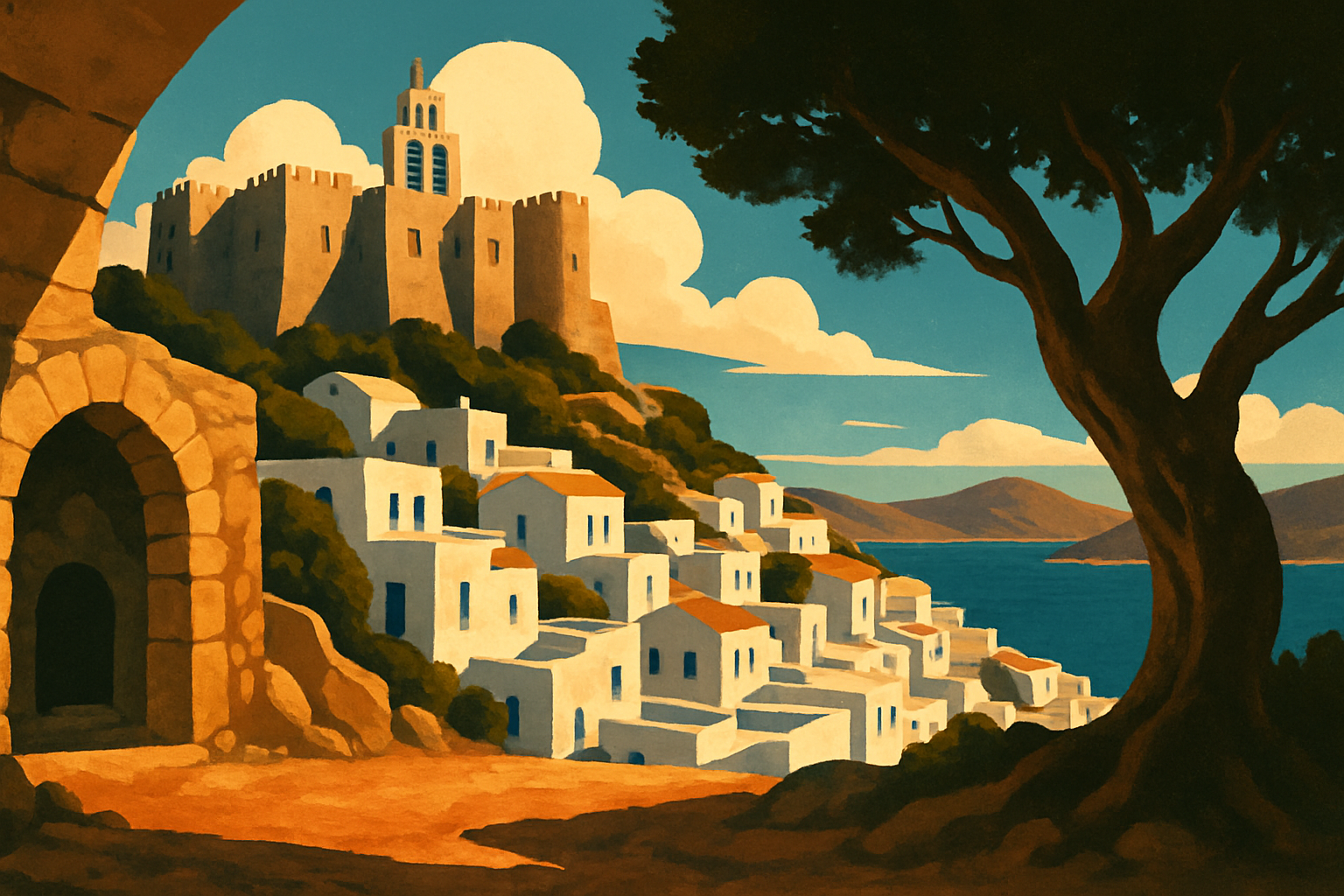
The Monastery of Saint John the Theologian dominates the summit of Chora's hill — its massive fortified walls visible from the ferry as you approach the island. It was founded in 1088 CE by the monk Christodoulos, who received the island from Byzantine Emperor Alexios I Komnenos under an imperial chrysobull (golden seal) granting the monastery self-governance and tax exemption. That document survives in the monastery's treasury.
Around 30 monks live here today. The institution has operated through Byzantine rule, Ottoman conquest in 1522, Italian rule from 1912 to 1943, and modern Greece — nearly a millennium without interruption. The main church, the Katholikon, contains 12th-century Byzantine frescoes and the marble sarcophagus of Saint Christodoulos. The adjoining Treasury Museum holds 890 handwritten manuscripts — including a 6th-century illuminated Gospel codex — 13,000 historical documents, and a collection of Byzantine icons that ranks among the finest outside Mount Athos.
From the outside, the monastery looks like a castle: squat, massive walls built to resist pirate raids across centuries. Inside, a colonnaded courtyard connects chapels, cells, and vaulted passageways. Museum entry costs around €6. The main church is free to enter when not in active use for services.
4. Chora: the medieval village that surrounds the monastery
The village of Chora wraps around the monastery on three sides — a dense medieval settlement of whitewashed cubic houses, arched stone passages, and carved doorways that has been continuously inhabited since the 11th century. The entire settlement is UNESCO-listed, and new construction is tightly regulated to preserve its historic character.
The lanes of Chora are carless and genuinely labyrinthine. Getting briefly lost is standard — the village is small enough that every alley eventually reconnects to the main square below the monastery gate or to a viewpoint over the Aegean. The windmills at Chora's edge date to the medieval period and still stand. From them, the islands of Leros and Lipsi are clearly visible on most days.
The best approach is to arrive in the late afternoon, when the pilgrimage groups of the morning have returned to Skala and the light on the white walls is at its most photogenic. Several small cafes and a handful of tavernas serve the village through the season. The walk from Skala to Chora takes 30 to 40 minutes uphill; taxis run the same route in 5 minutes.
5. Skala: the port, the waterfront, and daily island life
Skala is Patmos' social and commercial center — the port village where ferries dock, where most accommodation sits, and where the island's evening life concentrates. The waterfront promenade follows the harbor, lined with cafes, bakeries, and tavernas that run from breakfast through midnight. By July and August, the anchorage fills with sailing yachts working northward through the Dodecanese.
The beach at Skala is directly beside the port — sandy and shallow, clean enough for a morning swim, but crowded at peak season. Skala is also the starting point for boat excursions to nearby small islands: Arki, Marathi, and Lipsi are the regular half-day destinations, run by local operators from the harbor.
Practical note: Skala has a supermarket, ATMs, a pharmacy, and ferry ticket offices in close proximity to each other. Visiting in June — rather than August — means full infrastructure, all restaurants operating, and significantly lower accommodation prices. The evening atmosphere at the waterfront, especially when the ferry from Kos arrives and half the harbor comes to watch, is one of the better accidental spectacles in the Dodecanese.
6. Beaches: Lambi, Psili Ammos, and Grikos Bay
Lambi, at the northern tip of the island, is Patmos' most visually distinctive beach — a crescent bay covered not in sand but in multi-colored volcanic pebbles: black, red, green, grey, and white stones worn smooth by the Aegean. The effect is genuinely unusual. Two fish tavernas sit at the far end of the bay. The pebbles are legally protected and cannot be removed — an actual fine, not a suggestion.
Psili Ammos (Fine Sand), on the southwestern coast, is the island's most remote and most beautiful beach. Reaching it means a 30-minute boat ride from Skala or a 20-minute hike over rocky terrain. The reward is a deep arc of golden sand, clear turquoise water, and a single beach taverna with fish caught that morning. Go early or by boat in July and August — the spot is small and fills up.
Grikos Bay, on the southern coast, is the island's most developed beach area — a long sandy shore backed by a small resort village with water sports and the Patmos Aktis luxury hotel. It is calmer and more family-oriented than Lambi, and far more accessible than Psili Ammos. For visitors wanting a straightforward beach day without logistics, Grikos is the practical default.
7. How to get to Patmos — ferries, connections, and how long to stay
From Athens: The main route is overnight ferry from Piraeus — Blue Star Ferries and Hellenic Seaways both serve Patmos, crossing in roughly 8–9 hours. Ferries typically depart Piraeus early evening and arrive in Skala the following morning. Alternatively, fly to Kos and take the high-speed ferry north — a 2-hour crossing that makes Patmos a natural extension of any Kos itinerary.
From Rhodes: High-speed ferries connect Rhodes to Patmos in approximately 3.5–4 hours, calling at Kos, Kalymnos, and Leros en route. This is the most practical route for travelers island-hopping northward through the Dodecanese chain.
How long to stay: Two nights is the minimum that feels unhurried — morning for the Cave and Monastery, late afternoon for Chora, a full beach day at Lambi or Psili Ammos, and an evening on the Skala waterfront. Three nights is better. Patmos does not reward aggressive scheduling, and the island's appeal scales directly with how slowly you move through it.
8. Is Patmos worth the trip? Practical answers
Is Patmos worth the ferry journey? For anyone interested in Byzantine history, early Christian archaeology, or simply an Aegean island with genuine depth and a pace that hasn't been optimized for high-season throughput — yes. The UNESCO complex alone is one of the most historically specific destinations in the Mediterranean. The island itself is small, beautiful, and correctly proportioned for two or three days.
Best time to visit Patmos? June and September are the most comfortable windows. The monastery and cave run full hours, the beaches are in season, and crowds sit at a fraction of August levels. July and August bring peak pilgrimage traffic and the highest accommodation prices — the island handles the volume better than Mykonos or Santorini, but it is noticeably busier and more expensive.
Can you do Patmos as a day trip? A fast ferry from Kos makes a day visit technically possible, but the cave and monastery deserve more than a rushed morning. Staying one night — even at a simple guesthouse in Skala — lets you see Chora in the late-afternoon light and the waterfront in the evening, which is when the island reveals what it actually is.