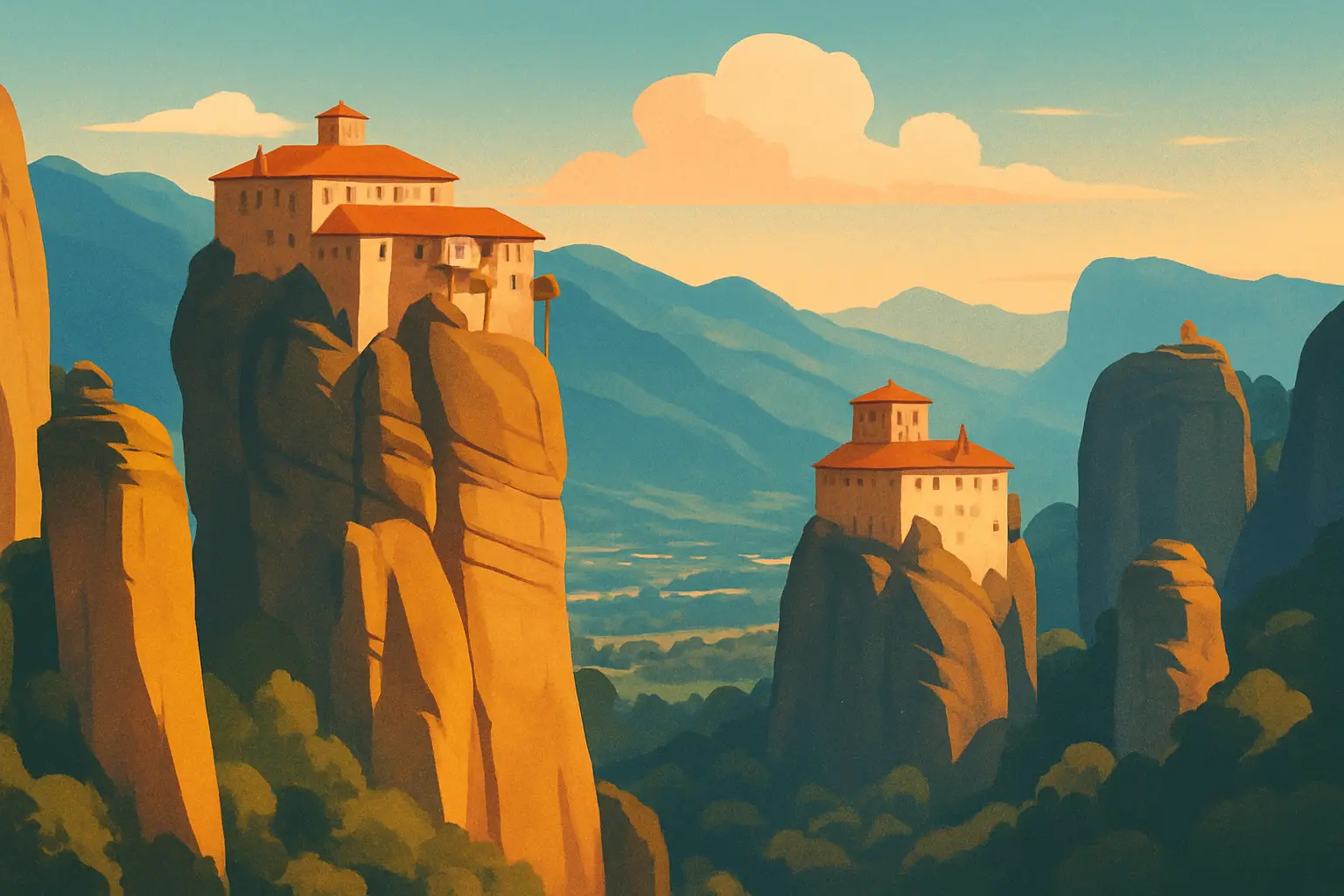
Meteora sits at the northwestern edge of the Thessaly plain, directly above the town of Kalambaka and the village of Kastraki. The landscape is unlike anything else in Greece: a forest of isolated sandstone and conglomerate pillars, left standing as the surrounding plain eroded over 60 million years from what was once the bed of a prehistoric inland sea. Some pillars are narrow and blade-like, some broad and dome-topped, most rising between 200 and 400 meters from flat farmland. The Greek word μετέωρα — meteora — means literally 'suspended in the air.'
The question the landscape provokes is not how beautiful it is (obviously: extremely) but how anyone built permanent structures on vertical rock faces with no roads, no cranes, and no flat approach. The answer requires understanding why anyone would try in the first place.
The first inhabitants were not builders — they were hermits. From at least the 9th century CE, Christian monks lived in natural caves carved into the pillar faces, accessible by rough climbing routes and rope ladders lowered from above. The isolation was the entire point: physical inaccessibility as protection from the Ottoman expansion that was progressively threatening Byzantine monasteries across Greece.
The first permanent monastery — Great Meteoron, the Monastery of the Transfiguration — was founded around 1344 CE by the monk Athanasios Koinovitis, who climbed a specific pillar with a group of followers and began construction on the summit. Everything — timber, stone, mortar, food, water — had to be hauled up by rope. A hand-cranked wooden winch, a net large enough to hold a person or substantial cargo, and manual labor at the top: this was the construction system and the supply chain, operating continuously for centuries.
The rope-and-net system remained the primary means of reaching several monasteries until the 1920s, when stairs were first cut into the rock. Roads to the summit sites were not built until the 1960s and 1970s. A 16th-century visitor who asked when the ropes were replaced was reportedly told they were changed 'when the Lord decided they needed replacing' — a phrase that is historically documented and summarizes the operating philosophy precisely.
At its peak in the 15th and 16th centuries, Meteora had 24 functioning monasteries. The Ottoman conquest of Constantinople in 1453 accelerated monastic construction at defensively inaccessible sites throughout Greece — the monasteries also functioned as storehouses for manuscripts, icons, and ecclesiastical treasure. Several were looted during World War II. Today six remain active.
Get short, interactive stories that make each place easier to remember while you travel.
All six charge €5 entrance per person, cash only at most gates. Each has its own opening days and hours, and they rotate — not all are open every day. On Saturdays and Sundays, all six are open. On weekdays, one or two are typically closed. Check the current schedule before going.
Great Meteoron is the oldest, the highest (613 meters above sea level), and the largest. Its main church dates from the 1480s. The on-site museum holds original manuscripts, Byzantine icons, and embroidered vestments, alongside an ossuary open to visitors. Plan at least 45 minutes.
Varlaam, a five-minute drive away, is second largest. Founded in 1518, it is best known for its Apocalypse frescoes — a vivid 16th-century depiction of the Book of Revelation covering the church's outer porch — and for preserving its original rope-winch tower: the wooden structure housing the hand-cranked mechanism and the net used before the stairs existed. It is the working equipment, not a reconstruction.
Roussanou (St Barbara) is a convent run by nuns since 1988. It sits on a narrow pillar with no spare summit space — the monastery occupies literally the entire top of its rock. Access is via a bridge, making the approach among the most vertiginous in the complex. Its Byzantine frescoes include a detailed depiction of saints' martyrdoms.
St Nicholas Anapafsas is the smallest of the six, overshadowed by the surrounding pillars from several angles. It contains frescoes by Theophanes the Cretan, one of the most significant painters of the post-Byzantine tradition, dated to 1527.
Holy Trinity (Agia Triada) requires climbing 140 rock-cut steps and was used as a filming location in the 1981 James Bond film *For Your Eyes Only*. The view from the courtyard across the Thessaly plain is unobstructed in every direction.
St Stephen's is the easiest to access — a bridge rather than stairs — and is also a convent. It sells locally made products (honey, jams, incense, painted icons) and offers one of the better views east toward Kalambaka.
Kalambaka is the main town (around 12,000 people) at the base of the rock formations. It has the train station, the majority of hotels, ATMs, and the widest range of restaurants. The main square — Plateia Riga Fereou — has several tavernas serving Thessaly food: lamb on the spit, local graviera cheese, loukaniko sausages grilled over charcoal. Meteora Restaurant on Plateia Dimarcheiou keeps a straightforward menu of grilled meats, village salads, and local wine.
Kastraki is the village immediately below the monasteries, built into the lower reaches of the rock complex. From here you can walk paths directly into the landscape at dawn before the tourist road fills. Several small guesthouses operate in the village. If your priority is the rocks at sunrise and sunset, Kastraki is the better base; if you are arriving by train, Kalambaka is the practical one.
Plan two full days to see all six monasteries without rushing — one day for Great Meteoron, Varlaam, and St Nicholas; the second for Roussanou, Holy Trinity, and St Stephen's. With only one day, prioritize Great Meteoron (museum and original history), Varlaam (rope winch and Apocalypse frescoes), and Holy Trinity (the dramatic staircase and views). Those three span the full range of what Meteora offers.
By car from Athens: Take the E75/A1 motorway north toward Thessaloniki. Exit at Trikala (approximately 280 km from Athens), then follow signs to Kalambaka, 22 km west. Total driving time is 3.5 to 4 hours depending on Athens traffic. The E75 is a toll motorway — bring cash or a credit card for the booths. Parking is available near each monastery entrance but fills by late morning on weekends.
By train from Athens: Trains depart from Athens Larissa Station (accessible on Metro Line 2, Attiki stop). The route runs north on the Athens–Thessaloniki main line to Paleofarsalos, where a branch line connects to Kalambaka. Journey time is approximately 4.5 to 5 hours. There is typically one direct morning departure; check the current Hellenic Trains schedule, as the Kalambaka branch has seen service adjustments in recent years.
From [Thessaloniki](/gr/blog/thessaloniki-travel-guide): By car, roughly 2.5 hours south on the E75. By train, the route runs via Larissa and Paleofarsalos and takes around 3 hours — a straightforward connection from northern Greece.
Is Meteora worth the trip from Athens? Yes — it is one of the genuinely distinctive landscapes in Europe. The combination of geological spectacle and living monastic history (these are not ruins; monks and nuns are here today) makes it unlike a standard archaeological site. That said, it is 330 km from Athens. The serious version of the visit requires at least one night in Kalambaka.
Can you do it as a day trip? Technically yes — leave Athens at 6 a.m. by car, arrive by 10 a.m., visit two or three monasteries, drive back. It is exhausting, places you at the sites during peak midday crowds, and misses the morning and evening light. If one day is all you have, a guided day tour from Athens (available through multiple operators) handles the driving and is a reasonable compromise.
Best time to visit? Spring (April–May) and autumn (September–October) offer the best conditions: mild temperatures, lower crowds, and good light on the rock formations. June is workable — warm but manageable at 26–30°C — and all six monasteries are fully operational. July and August bring 35°C+ heat and the highest visitor volumes; the monastery road and parking areas become genuinely congested by noon.
Dress code: Enforced at every entrance. Women must wear skirts below the knee — wraparound fabric skirts are available to borrow for free at each gate if needed. Men must wear long trousers; shorts are not permitted. No bare shoulders for either gender. Photography is generally allowed in courtyards; flash photography is prohibited inside the churches.