1. Three Manis — why the geography shaped everything
The Mani Peninsula divides into three informal zones that locals still distinguish. Exo Mani (Outer Mani) covers the northern coastal stretch between Kalamata and Areopoli — wetter, greener, with olive groves on the hillsides and pebble coves cut by seasonal rivers. Meso Mani centers on Areopoli and the western flank of the peninsula. Mesa Mani (Deep Mani) is the harsh southern section running toward Cape Tainaro: bare limestone, thorny phrygana scrub, and villages that look abandoned even when they are not.
The entire peninsula is flanked by the Taygetos mountain range — the highest in the Peloponnese, with peaks reaching 2,407 meters — which descends almost directly into the sea, leaving almost no flat agricultural land. This geography produced a specific kind of people. The Maniots paid tribute to the Ottomans sporadically at best and fought off pacification campaigns repeatedly between 1453 and 1821. When the Greek War of Independence began, it started here: the Maniots declared revolt in Areopoli in March 1821 before the flag was raised anywhere else in Greece. Their fortress villages, their code of hospitality extended to outsiders and of absolute hostility toward enemies, and the architecture of armed self-sufficiency are the direct inheritance of that three-century experience.
2. The tower houses of Vathia: clan warfare made permanent in stone
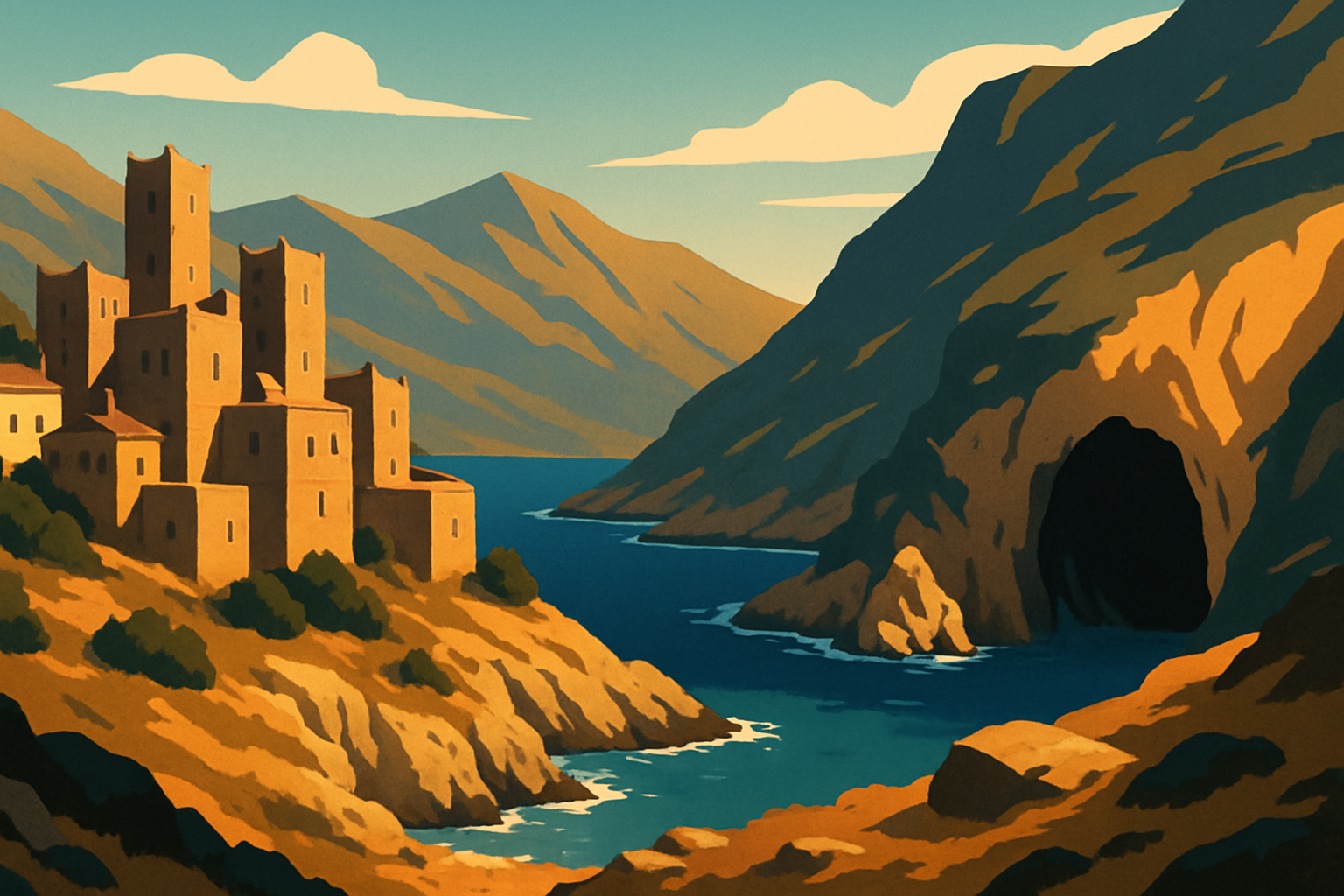
The signature feature of the Mani landscape is the pyrgospita — tower house — built from local limestone across the 17th, 18th, and 19th centuries. The towers emerged from a specific combination of threats: Ottoman raiding, pirates using the southern capes as waypoints, and the relentless vendettas between rival Maniot clans. Tower height was simultaneously structural and social: the tallest tower in a village declared the most powerful family. A tower of five or six floors was a statement of dominance that neighboring clans could not ignore, and frequently chose not to.
Vathia is the most intact tower village in the Deep Mani, sitting on a bare limestone ridge approximately 8 km north of Cape Tainaro. The towers are square, built from rough-cut stone without mortar, with windows so narrow they could be blocked with a single stone in times of conflict. Some doorways are elevated — originally reached by removable wooden ladders — to prevent attackers from forcing entry. Towers are built close enough together that neighboring families could fire from their upper floors directly into a rival courtyard a few meters wide. The village was largely emptied by 1960 as residents moved to Kalamata, Sparta, and Piraeus during the postwar economic migration. In the 1980s the Greek government funded preservation; several restored towers now operate as guesthouses. Walk the village in 40 minutes — it is small, quiet, and almost entirely unvisited outside summer weekends.
3. Areopoli: the town named after the god of war
The main town of Deep Mani is Areopoli, renamed in 1829 to honor Ares, the god of war, and to commemorate the Maniots who launched the independence revolt from this square. Before that it was called Tsimova. The town sits roughly 75 km south of Kalamata, is the practical base for the southern peninsula, and has enough concentrated architecture to spend a full morning before driving further.
Areopoli organizes around Athanaton Square, flanked by its own tower houses and the Church of Panagia and Agios Charalampos — a double-aisled Byzantine church built in the 18th century with carved stone reliefs and painted wooden iconostasis. One block south, the Church of Agios Ioannis contains frescoes dated to 1746, among the best-preserved examples of late Byzantine painting in the Peloponnese. The Byzantine Museum of Mani, housed in a restored tower complex just off the square, covers medieval Maniot history with unusual specificity — including a scale model of how the peninsula's tower villages functioned as military systems.
The local food specialty is sigklino — salt-cured pork, smoked over aromatic hardwood and then slow-cooked with olive oil and orange juice. The salt, smoke, and citrus produce something distinct to this landscape and its winter food culture. Pasto is the simpler relative: air-dried and smoked, eaten cold and sliced thin. Hilopites — handmade flat pasta served with local cheese or slow-cooked meat sauce — appear on nearly every menu. Both dishes are well-executed at Taverna Takis on the main square. The coastal village of Limeni, 4 km west of Areopoli on a turquoise inlet, is the better setting for fresh fish and octopus: three small tavernas operate at water level with boats moored directly outside.
4. The Caves of Diros: 15 kilometres of underground sea
The Caves of Diros (also called the Pyrgos Dirou Caves), located 11 km south of Areopoli near the village of Pyrgos Dirou, are among the most geologically dramatic natural sites in Greece — and among the most under-visited relative to their scale. The cave system extends over 15 kilometres of mapped tunnels, of which visitors tour approximately 1,500 metres by flat-bottomed rowing boat on an underground lake, with ceiling clearance dropping in some passages to 40 centimetres.
The accessible section is called Glyfada. The water is a clear green-blue; stalactites descend to within centimetres of the surface in places, and the guide navigates by memory through a route that reads as completely disorienting from a boat at that height. The tour takes about 25 minutes on the water and exits through a short walking section into the final chamber. A second section, Alepotrypa, is a larger cave with a separate entrance and archaeological museum attached; it is accessible on foot and worth the addition.
What makes Diros significant beyond geology: the cave was a Neolithic inhabited settlement from around 5000 BCE. It sat on the southern obsidian trade route running from Pylos along the coast through Cape Tainaro to Milos — the source of the prehistoric Mediterranean's most valuable cutting material. The Diros bay's shallow beach let ancient sailors beach their boats for repairs; the cave provided shelter during storms. Human remains, pottery, and stone tools from this period are displayed in the site museum. The underwater passages were not explored until the 1950s and 60s, when Greek archaeologists mapped them by free-diving. Adult tickets run around €14; arrive at opening (8:30 a.m.) in summer or expect queuing.
5. Cape Tainaro: the mythological entrance to Hades
The walking path from the parking area near Kokkinagia beach to the tip of Cape Tainaro covers about 2.5 km over bare white rock, taking 30 to 40 minutes in each direction. At the midpoint stands the Church of Agioi Asomati, built on the foundations of an ancient Spartan sanctuary and incorporating ancient masonry into its walls. Just past it, a mosaic floor preserved behind a low wire fence is believed to be from the ancient Temple of Poseidon — the sanctuary Sparta maintained here as a place of supplication where any person who entered was legally untouchable. The temple served as a kind of international neutral ground; Spartan generals negotiated here with Persian envoys, and at least one Spartan official was later executed for murdering suppliants inside it, violating that immunity.
At the far tip stands the lighthouse built in 1822, marking the southernmost geographical point of mainland Greece, the Balkan Peninsula, and the second southernmost point of continental Europe (after La Punta de Tarifa in Andalusia, Spain). The ancient Greeks called this place Tainaron and believed a cave on the promontory to be one of the entrances to the underworld. According to myth, this is where Orpheus descended to retrieve Eurydice, where Heracles dragged Cerberus to the surface during his labors, and where the boundary between the living and the dead was thinner than anywhere else on earth. The cave is accessible at low tide. It is small and shallow. The mythology is larger than the cave.
6. Kardamyli: the Leigh Fermor coast of Exo Mani
The northern Exo Mani coast between Kalamata and Areopoli is physically different from the Deep Mani — greener, with olive groves on hillside terraces and pebble coves where small rivers reach the sea. Kardamyli, the main town of Exo Mani, is where the British writer Patrick Leigh Fermor built his house and lived for much of his adult life.
Leigh Fermor — author of 'Mani: Travels in the Southern Peloponnese' (1958) and one of the major British travel writers of the 20th century — found land south of Kardamyli village in mid-1962 and spent the following years building a stone house with his wife Joan using local craftsmen and traditional Maniot techniques. In 1996 they bequeathed the property to the Benaki Museum in Athens with the condition that it host writers, scholars, and researchers working in residence. The house is occasionally open for guided visits; contact the Benaki Museum for current arrangements.
For swimming: Ritsa beach, a long pebble stretch 1 km north of Kardamyli village, is shaded by tamarisk trees and relatively quiet on weekday mornings. Stoupa, 8 km south, is the more developed option with organized sun loungers and beach bars. For the Kardamyli experience itself, the walk through Old Kardamyli — a preserved cluster of tower houses above the harbor that catches the late-afternoon light — takes about 30 minutes and is better than any beach.
7. Getting to Mani: from Athens and from Kalamata
Driving from Athens is the most flexible option: the E65 motorway via Tripoli covers 280 km to Areopoli in approximately 3 hours. KTEL long-distance buses run from Athens' Kifissos terminal to Areopoli via Kalamata (total journey 4 to 4.5 hours, several departures daily) — workable if you plan to base yourself in one town, but limiting for exploring the full peninsula. Kalamata has a regional airport with direct flights from Athens (40 minutes) and seasonal European connections; it is the easier point of entry if you are flying in.
From Kalamata to Areopoli is 75 km south on the main coastal road — about 1 hour by car. From Areopoli to Cape Tainaro via the main south road (through Vathia and Gerolimenas) is approximately 34 km, taking 45 minutes without stops. The roads are well-maintained but narrow and winding; two cars cannot always pass comfortably on the mountain sections. The Nafplio guide covers the northern Peloponnese if you are extending a longer Peloponnese loop — Nafplio to Areopoli via Sparta is about 2.5 hours.
8. Is Mani worth it? Best time, how long, and who it is actually for
Is Mani worth the effort? If you want beach facilities, smooth logistics, and easy restaurant access, stick to the Exo Mani coast around Kardamyli and Stoupa — the Deep Mani south of Areopoli rewards visitors specifically interested in history, landscape, and the kind of travel that involves occasional discomfort. If those are your terms, it is among the most irreplaceable destinations in Greece.
Best time to visit? June and September are the optimal months. June offers warm sea temperatures (around 24°C), long daylight for the cape hike, and manageable visitor volumes. July and August push temperatures in the Deep Mani to 36-38°C on bare rock with no shade — still fine for early-morning hiking and swimming, difficult for sustained exploration. Spring (April-May) brings wildflowers on the hillsides and cooler walking temperatures but some businesses are not yet open.
How many days? Two nights covers the essential southern peninsula: one day for Areopoli, Diros Caves, and Vathia; one day for Cape Tainaro. Add a third night to include the Exo Mani coast at Kardamyli. A four-day Mani trip allows a genuinely comfortable pace with daily swimming, unhurried meals, and time to walk the cape without scheduling pressure.
Is it safe? Completely. The historical isolation and clan vendettas are deep history. The hazards are the practical ones: driving narrow roads too fast, underestimating summer heat on exposed rock, and swimming alone at the more remote coves.