1. What Lefkada is — and why there is no ferry
Lefkada is the fourth-largest of the Ionian Islands, roughly 35 kilometers long and 15 kilometers wide, with a mountainous interior peaking at 1,158 meters on Mount Stavrotas and a coastline that divides into two entirely different personalities: shallow sandy bays on the sheltered eastern side, and the white limestone cliffs of the western coast that produce the island's famous beaches. The name means 'white' in Greek — the cliffs earn it.
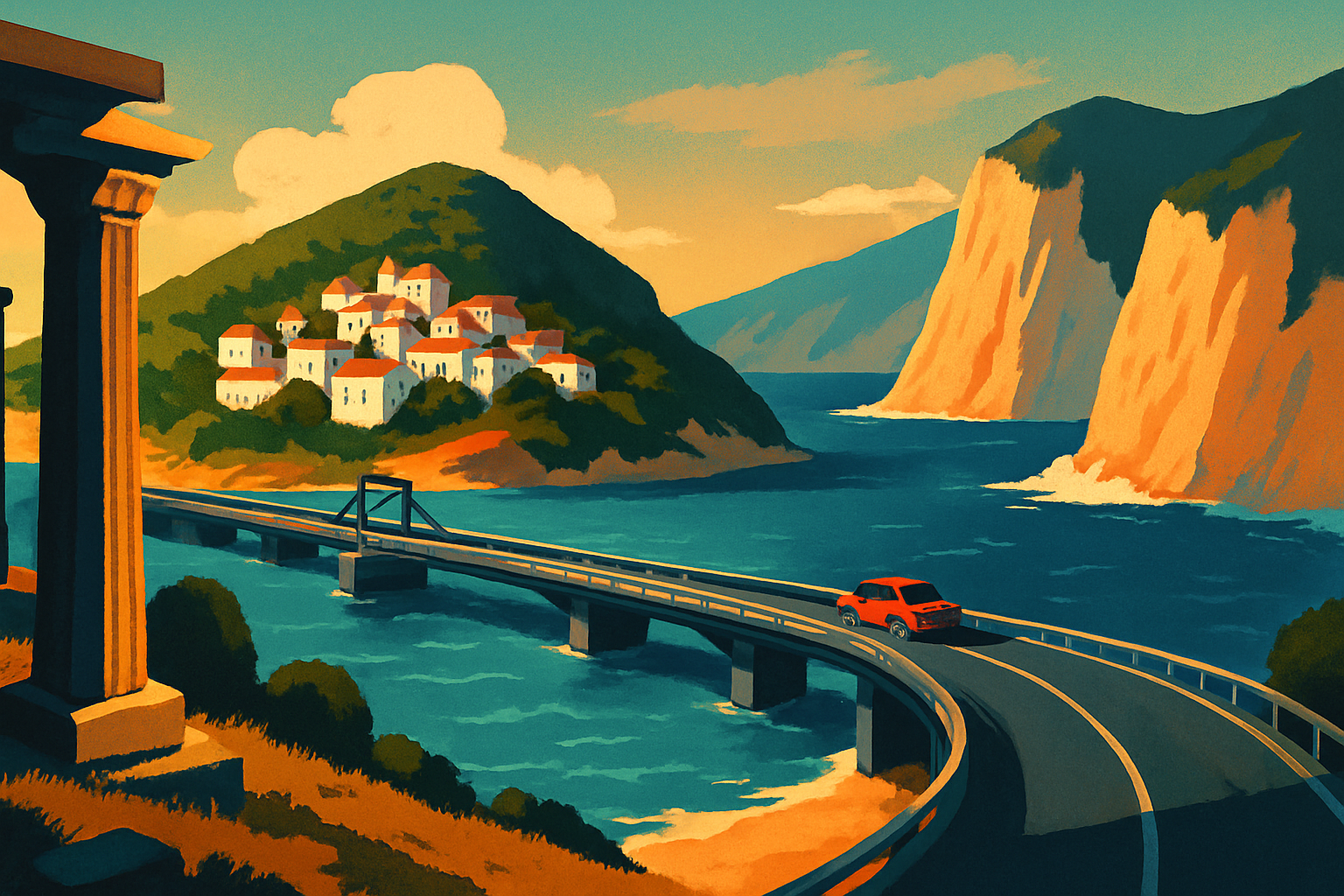
The bridge situation is what makes Lefkada functionally different from every other Greek island. A pontoon causeway and swing bridge connect the island to the mainland at its northern tip, crossing a shallow saltwater lagoon next to the village of Agia Mavra. Drive straight on — no ticket window, no waiting for a hull to load. This single fact reshapes the logistics: you can drive from Athens in about 4 hours, arrive when you want, and load a car with camping gear, surfboards, or a week's worth of groceries. Families with young children, cyclists, and travelers with medical equipment all use it differently than the ferry-island experience allows.
The island has roughly 23,000 permanent residents, a significant share of them still in the agricultural interior in villages that remain outside the main tourism current. Lefkada Town, the capital, occupies a sandy spit at the northern tip between the Paliolimnos lagoon and the strait, with a medieval castle visible right at the causeway's edge.
2. Porto Katsiki and Egremni: the two west-coast cliff beaches
Porto Katsiki is about 37 kilometers from Lefkada Town — a 50-minute drive through the island's interior and then along the cliff road at the southwestern tip. The parking area sits at the top of the cliff; you descend a long wooden staircase to the beach below. The essentials are obvious in every photograph: white pebbles, turquoise water graduating to deep cobalt, vertical limestone cliffs on both sides. In person the scale shifts the impression — the cliffs rise above 100 meters, and on a calm day water visibility reaches 8 to 10 meters. The beach has no natural shade, one seasonal kiosk, and basic umbrella rental at resort prices. In peak summer (late July to mid-September) the parking fills before 10:30 a.m. and the staircase queues in both directions. Coming earlier resolves both problems; the morning light on the limestone is better anyway.
Egremni beach, about 4 kilometers north of Porto Katsiki by road from the village of Athani, is the less-photographed but arguably more rewarding option. You reach it by descending a long metal staircase bolted to the cliff face — approximately 350 steps, rebuilt in 2021 with a safety mesh after the original stairs were destroyed in Lefkada's 2015 earthquake. There is no road down and no facilities at the bottom. The beach is longer and wider than Porto Katsiki and consistently less crowded. The descent takes about 15 minutes at a normal pace. Bring shoes with grip — flip-flops are genuinely uncomfortable on steep metal stairs in either direction.
3. Vassiliki: why Greece's best windsurfing happens in this specific bay
Vassiliki sits at the southern end of Lefkada in a large, almost entirely enclosed bay — the surrounding terrain creates specific wind conditions that have made it one of the best-known windsurfing destinations in Europe. The mechanics work like this: the bay is calm in the morning as the land is still cool. By midday a thermal wind called the Maistros builds from the northwest and funnels into the bay opening, strengthening through the afternoon to consistent 18–25 knot conditions. Experienced riders specifically time their sessions for 1–5 p.m. Beginners go out in the morning on flat water. It is genuinely rare to find a bay where both groups get what they need, which explains why the windsurfing industry settled here in the 1980s and never left.
Club Vass — the Vassiliki Windsurfing Club — operates at the northern end of the bay beach and has been running since 1989. They offer rental boards, lessons at every level, and a full daily program. Kitesurfing runs alongside the windsurfing operation for riders who prefer it.
The village is also a working harbor: charter yachts leave for day trips through the Ionian, and ferry services connect to Fiskardo on Kefalonia and to Ithaca. The tavernas on the waterfront — Sapfo and Meltemi are the most reliable — serve fresh catch and grilled octopus at prices reasonable for a harbor with significant boat traffic. In the last 30 minutes before dark the sun drops behind the western cliffs and hits the bay directly, making Vassiliki's evening light particularly good.
4. Nidri, Skorpios, and the German archaeologist who argued this was Homer's Ithaca
Nidri is Lefkada's busiest tourist settlement — the harbor town on the eastern coast where excursion boats depart for day trips to the surrounding islands, most accommodation is concentrated, and the main waterfront fills nightly. The strait offshore holds several small islands, with the larger landmass of Meganisi visible across the water.
Directly visible from Nidri is Skorpios, the private island Aristotle Onassis purchased in the 1960s. In October 1968, Jackie Kennedy married Onassis in the island's small chapel — an event reported across every major publication of that year. The island passed to the Niarchos family after Onassis died in 1975. You cannot land on it; excursion boats sail around its perimeter.
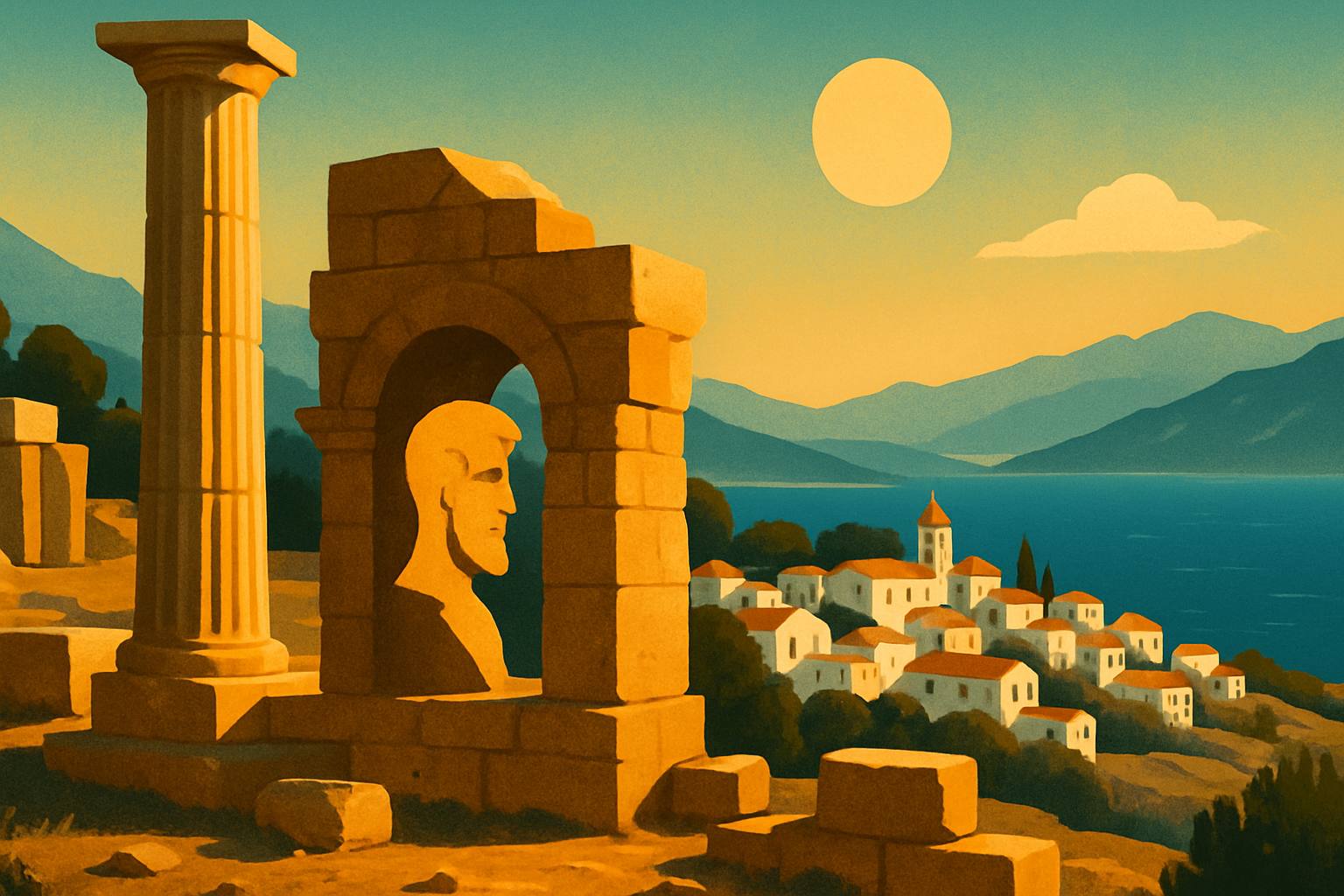
About 2 kilometers north of Nidri center on the road toward Vliho bay, a small olive grove holds the grave of Wilhelm Dorpfeld (1853–1940). Dorpfeld was a German architect and archaeologist who worked with Heinrich Schliemann on the excavations at Troy and was considered one of the finest archaeological minds of his generation. In his later career he became convinced — publicly and persistently — that Lefkada, not the island named Ithaca, was Homer's true Ithaca of the Odyssey. He spent a decade excavating on Lefkada and published his argument as *Alt Ithaka* in 1927. He died in Nidri and is buried here. Classicists have argued about the theory for nearly a century; the grave sits quietly unmarked beside the road.
5. Lefkada Town: the earthquake-proof architecture nobody talks about
Lefkada Town looks different from every other Greek island capital, and the reason is structural. The Ionian Islands sit on one of Europe's most seismically active zones — Lefkada alone has been struck by major earthquakes in 1825, 1948, and 2015. The local architectural response, developed over centuries of loss, was to build lower floors in heavy stone and clad the upper floors in corrugated metal sheeting or wood paneling, making them as light as possible. When the building shakes, the upper floors flex rather than crack. Painted in terracotta, mustard, pale blue, and green, these cladded upper floors give the town a layered, industrial-pastoral appearance unlike anything in the rest of the Aegean — not conventionally pretty by tourist-brochure standards, but entirely authentic and born of hard local experience.
At the entrance to town from the mainland bridge stands Castle Santa Maura (Agia Mavra), a medieval fortress begun by the Orsini family in the early 14th century and extended under successive Venetian and Ottoman rule. Its walls occupy the narrow strip of land at the causeway edge, visible from the road as you cross. Interior access is limited, but the exterior and the lagoon view from the road alongside it make a worthwhile stop arriving or departing.
The town center is Ioanna Mela Street, the pedestrianized main commercial strip, and the square fronting the Church of Agios Spyridon — notable for its Venetian-style campanile, a freestanding bell tower characteristic of Ionian island churches rather than the integrated towers found elsewhere in Greece. The covered market off the main square sells local olive oil, thyme honey, and preserved meats from the interior villages.
6. Agios Nikitas, Kathisma beach, and Cape Lefkatas
On the northwest coast, Agios Nikitas is the most attractive of Lefkada's smaller villages — built into a wooded gorge descending to a small beach, with the road for cars ending at the village's first houses. Everything beyond is on foot. The main street has a handful of tavernas and guesthouses; Poseidon is consistently recommended for fresh fish at prices that reflect a village not fully optimized for volume tourism. A seasonal boat taxi (€2–3 each way) connects the beach to Mylos, a small pebble cove along the cliff — one of those beaches that takes a bit of effort and rewards you for it.
Kathisma beach, about 3 kilometers south of Agios Nikitas along the coast road, is the longest and most accessible sandy beach on the western side — reachable by car, with a parking area, sun beds, and a beach bar. It faces the open Ionian Sea to the northwest, which means it catches swell in any north wind and can be rough when conditions build. On calm days it is excellent and considerably less crowded than Porto Katsiki.
At the island's southernmost tip, Cape Lefkatas ends in the same white limestone cliffs. The cape held an active temple of Apollo in antiquity — Strabo records it — and was associated with the 'Leucadian leap,' a ritual in which condemned criminals were reportedly thrown from the cliffs and rescued by boats below as a form of symbolic purification. The legend of Sappho leaping from the same cliff out of unrequited love is almost certainly later myth. The lighthouse at the cape dates to 1892 and is still operational; the walk from the parking area on the Vasiliki road takes about 45 minutes.
7. When to visit, how long to stay, and is a car necessary?
Best time to visit? June is the strongest window for most travelers. Sea temperature reaches 23–24°C, the windsurfing season at Vassiliki is in full swing, and the island has not yet hit the saturation it reaches in late July and August. Porto Katsiki and Egremni are manageable without queue planning, and the interior villages are open and operating at full local pace. September is an equally strong alternative — the water stays warm through late October, crowds drop off noticeably after August 20, and the afternoon light on the western coast cliffs in early autumn is particularly good.
How long should you stay? Four nights covers the essentials: one day for the west coast cliffs (Porto Katsiki and Egremni), one for Vassiliki and the south, one for Nidri and a boat trip to Meganisi island, one for Lefkada Town and the northwest coast. A full week allows the drive to Cape Lefkatas, mornings in Agios Nikitas, and the slower pace the island rewards.
Is a car necessary? Yes. Local buses connect the main settlements but run infrequently and do not reach Porto Katsiki or Egremni. Car rental is available at the mainland side of the bridge, in Lefkada Town, and from most accommodations. Budget €30–45 per day in June, €50–65 in peak August. Book in advance if visiting in July or August — availability tightens significantly.
Is Lefkada expensive? Less than Mykonos or Santorini, more than the mainland. Vassiliki and Nidri waterfront restaurants run €25–40 per person for a full meal with wine. Agios Nikitas and the interior villages are noticeably cheaper. The island's olive oil and thyme honey are worth buying directly from the covered market in Lefkada Town.