1. Three fingers on a map: why Halkidiki is not one destination
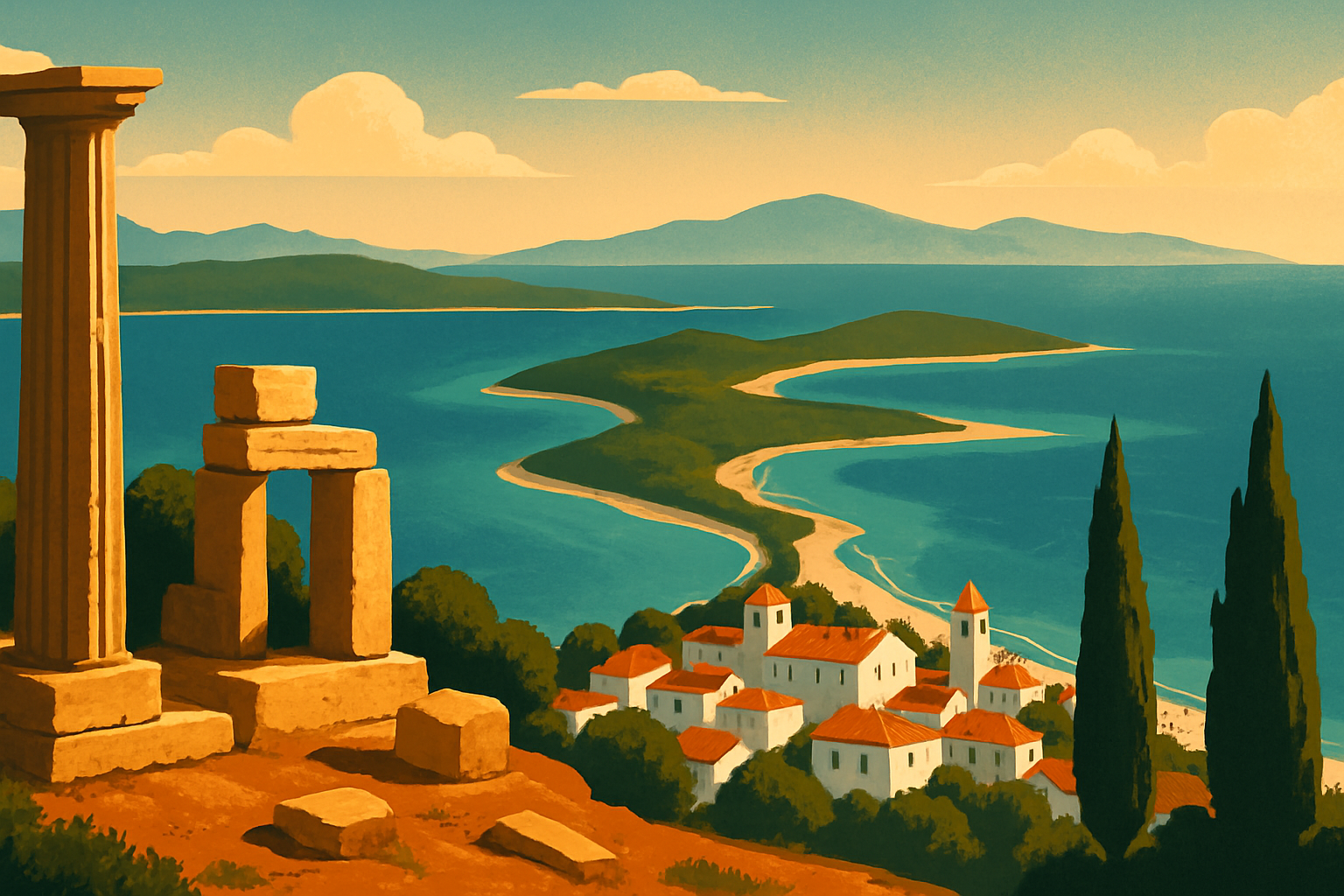
Halkidiki juts south from mainland Macedonia in three parallel peninsulas that Greeks call the 'fingers' — daktyla. From west to east: Kassandra, Sithonia, and Athos. The base of all three sits within an hour's drive of Thessaloniki, which is why Halkidiki functions as the city's de facto summer escape. On a July Friday afternoon, the road from Thessaloniki toward Kassandra is one long slow convoy of families with roof boxes.
The geography is not just trivia — it determines everything about your trip. Kassandra is the most accessible and most developed: the highway from Thessaloniki ends almost at its doorstep, and the peninsula's flat terrain is covered in resort hotels, beach bars, and water parks. Sithonia requires more effort (and a car), rewards that effort with dramatically wilder scenery, and still has serious infrastructure for beach holidays without the industrial-tourism feel of Kassandra's busiest strips. Athos is in a category entirely its own: an autonomous monastic republic under Greek sovereignty, governed by its own laws, where even female animals have been formally discouraged since the Byzantine era.
Most visitors pick one peninsula and stay. Spending 2-3 days on each is the move if you have the time.
2. Kassandra: resort energy, easy access, and the Afytos exception
Kassandra is where Halkidiki's mass tourism concentrates. The western coast runs a long string of beach towns — Kallithea, Hanioti, Pefkochori, Polychrono — that blend into each other across a stretch of flat sandy shoreline lined with hotels, beach clubs, and water-sport rentals. The Sani Resort complex in the north of the peninsula occupies its own private bay with white-sand beaches, a marina, and a summer festival program that runs jazz and classical acts in an open-air venue facing the sea. Sani is the kind of place that makes Kassandra feel like the Aegean Riviera rather than a resort strip.
The peninsula earns its place: the beaches are legitimately good — long, sandy, gently sloping — and the full infrastructure of restaurants, clubs, and supermarkets makes Kassandra the easiest Halkidiki entry point for families with young children. Blue Flag certifications cover dozens of beaches here.
The exception worth finding is Afytos (also spelled Afitos), a traditional hilltop village in the middle of the peninsula. Stone houses, cobblestone lanes, a central square with kafeneions, and a view straight down a cliff to the sea. It is exactly what every tourist brochure means when it says 'traditional Greek village,' and it is genuinely that — with a working community living in it, not a stage set. From Afytos you can walk to quieter beaches below the cliff that most resort guests never reach.
3. Sithonia: pine forests down to the sea and the best beaches in northern Greece
The middle finger is the one most travelers wish they had found on the first trip instead of the third. Sithonia's interior is pine-covered hills; its coastline is a sequence of coves where the forest edge and the water are sometimes separated by nothing more than a strip of sand. The peninsula has fewer residents, fewer highway-facing hotels, and significantly fewer beach bars playing commercial house music at noon.
Nikiti, at the northern tip of Sithonia's west coast, is the most practical base: an old stone village on a hill above a small harbor, with easy access to beaches in both directions. Fish tavernas on the harbor front do dinner until midnight. Neos Marmaras, further south on the same coast, is slightly larger and more resort-feeling, with a working port where fishing boats and yachts share moorings.
Vourvourou, on the northeast coast, deserves a specific mention: a shallow, sheltered bay dotted with small uninhabited islets close enough to kayak to. The water in Vourvourou bay is famously calm and transparent — it photographs like a tropical lagoon but is a 2.5-hour drive from Thessaloniki.
The beaches that define Sithonia's reputation are on the southern half of the ring road. Kalogria, seven kilometers south of Nikiti, has fine sand, a coral reef close enough for free-diving, and enough depth from the parking area to feel uncrowded even in August. Elia and Destenika beaches further south are framed by low pines and have gentle enough slopes to work for young children. The road connecting them winds above the sea with views that make the drive as good as the destination.
4. Armenistis: the kilometer-long beach and the campsite Greeks actually use
Armenistis sits on Sithonia's northwest coast, approximately 14 kilometers south of Nikiti. The beach itself is nearly one kilometer of golden sand with a gentle curve, pine trees providing shade at the back edge, and water that graduates from pale turquoise to deep blue. On a clear day, Mount Athos — the snow-capped peak of the third peninsula — is visible across the water, roughly 40 kilometers to the east.
What makes Armenistis unusual is the Camping Armenistis complex that manages it. This is not a scrappy campsite in a field behind the beach — it is one of Greece's largest and best-equipped organized camping parks, with bungalows, a supermarket, restaurants, water sports, and facilities that are maintained at a standard you would expect from a mid-range resort. Greek families book months ahead for July and August.
Day visitors pay an entrance fee at the main gate. The fee covers access to the full beach and amenities. It is a mild inconvenience that filters out some of the day-trip crowds that overwhelm comparable beaches on Kassandra. Go on a weekday morning in late June — the water temperature in the Aegean's northern arms runs about 23-24°C by mid-June, and the beach is a fraction of its August volume.
Armenistis is the beach that Sithonia regulars give as their reason for coming back every year.
5. Mount Athos: the third peninsula that most people cannot enter
The Autonomous Monastic State of the Holy Mountain — Athos — occupies the third and easternmost Halkidiki finger. It is governed independently under its own constitutional charter within Greek sovereignty, administered from the village of Karyes in the interior. Twenty monasteries operate here, some founded in the 9th and 10th centuries, including the Great Lavra (Megisti Lavra), established in 963 AD and the oldest on the peninsula.
Entry requires a diamonitirion — a formal residence permit issued by the Pilgrim's Bureau at 54 Egnatia Street in Thessaloniki (or through the online portal at imaathos.gr). The daily cap is 100 permits for Orthodox Christian men and 10 for non-Orthodox men. Women are not permitted under any circumstances, a prohibition that dates to the Byzantine era and has survived every attempt to challenge it in EU courts.
For visitors without a permit — which is most people — the practical option is a boat tour from Ouranoupolis, the last village on the mainland before the Athos border checkpoint. Tour boats circle the peninsula's coastline and pass within sight of monastery buildings that rise directly from the cliff faces above the water: white-walled towers, red-tiled domes, crumbling Byzantine walls. It is a genuinely arresting sight. Ouranoupolis itself has a Byzantine tower on the harbor front and tavernas facing the sea; it works as a half-day excursion from anywhere in Halkidiki.
For those who do hold permits, the ferry from Ouranoupolis to the port of Daphne departs at 6:30am and takes approximately two hours. Pilgrims stay in monastery guesthouses (archondarikia), where accommodation is typically offered in exchange for participation in evening services.
6. Getting to Halkidiki from Thessaloniki: what actually works
Halkidiki has no airport. The entry point for most visitors is Thessaloniki's Makedonia Airport (SKG), 30 kilometers east of the city center and 55 kilometers north of Kassandra's closest resorts. From SKG, car rental is the fastest option: the E75/A25 motorway runs south from Thessaloniki and forks near Nea Moudania, where Kassandra branches left and the road toward Sithonia continues south. Kassandra destinations (Sani, Kallithea, Hanioti) are 60-80km from the airport — about 50-60 minutes. Sithonia (Nikiti, Neos Marmaras) is 110-130km — 1.5 to 2 hours. Armenistis is roughly 2 hours. Ouranoupolis, the Athos access point, is about 1.5 hours from Thessaloniki via a separate northeast route.
KTEL Halkidikis buses depart from the Makedonia bus station at the eastern edge of Thessaloniki and serve most Kassandra towns with reasonable frequency (several daily in summer). Sithonia service is patchy and mostly limited to Nikiti and Neos Marmaras. If your itinerary puts you in Sithonia's southern beaches or along the ring road, buses will not get you there.
7. Is June or September a better time to visit Halkidiki than July or August?
Yes, significantly. July and August are peak season in Halkidiki — every beach bar is open, every restaurant is running, and every available accommodation is priced at its annual maximum. Kassandra in particular becomes genuinely congested: the main coast road slows to walking pace on Friday evenings and the beaches in front of resort hotels lose any sense of space by 10am.
June (from the second week onward) and September deliver a substantially better experience. The Aegean reaches swimmable temperatures (22-24°C) by mid-June. Most facilities are open. Prices are 25-40% lower than peak. And the beaches — including Sithonia's best coves — operate at a fraction of their August volume. Late September sees some beach bars close but the water stays warm until mid-October and the pace is genuinely relaxed.
Current timing: if you are reading this in June 2026 and have flexibility, the window between now and late June is possibly the best moment of the entire year to visit Halkidiki.
8. Is Halkidiki worth it if I have already been to the Greek islands?
Different in the right ways. The Greek islands deliver volcanic landscapes, white-cube architecture, and the romance of arriving by sea. Halkidiki delivers something the islands mostly do not: pine forests, green hills, and a coastline that feels lush rather than sun-scorched. The water quality — particularly in Sithonia and along the Athos coast — is comparable to the best Aegean island swimming, without the ferry journey.
The practical argument for Halkidiki over an island trip is efficiency: a base in Sithonia puts three completely different landscape types within a 40-minute drive. You can swim at Armenistis in the morning, drive the ring road to a cove near Sarti for the afternoon, and have dinner in Neos Marmaras while watching fishing boats come in.
Halkidiki is what most Greeks from Thessaloniki choose when they want a beach holiday with a car and their family, without the logistics of ferries and luggage. That is a credible recommendation — Greek families are not sentimental about inconvenience.