Crete stretches 260 kilometers from end to end and reaches 60 kilometers wide at its broadest point. Its size alone makes it fundamentally different from the Aegean islands: Crete has interior mountain ranges (the White Mountains, or Lefka Ori, peak above 2,400 meters), long river gorges, olive groves that have been productive for more than 3,000 years, and highland villages where the dialect and food traditions diverge noticeably from mainland Greece.
What sets Crete apart historically is that it was the center of the Minoan civilization — Europe's first advanced literate society, which flourished from roughly 2700 to 1450 BCE. The Minoans predated classical Greece by a thousand years. They built multi-story palaces with indoor plumbing and sophisticated drainage systems, produced elaborate polychrome frescoes, and traded across the eastern Mediterranean before any Greek city-state existed. Understanding Crete means starting with the Minoans, not with the Romans or Byzantines who arrived much later.
The island's layered history also includes Venetian rule (1204–1669), during which Crete became one of the most prosperous territories in the Mediterranean, producing olive oil, wine, and the Cretan school of Byzantine icon painting. The Venetians left harbor fortifications at Heraklion, Chania, and Rethymno — stone infrastructure so solid that much of it still stands. The Ottomans followed (1669–1898), then an independent Cretan state, then union with Greece in 1913. Each occupation left something visible.
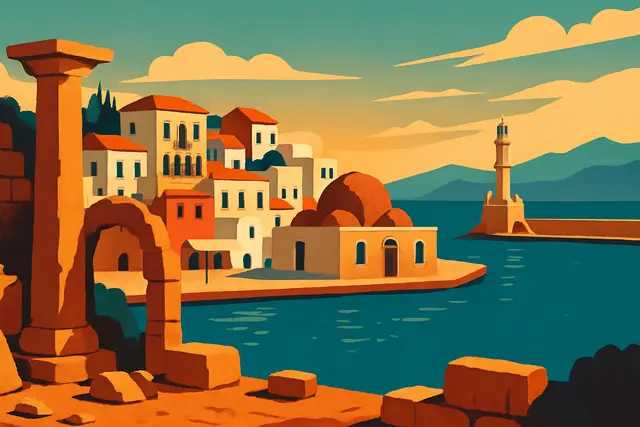
Chania (pronounced hahn-YAH) is consistently rated the most beautiful city in Crete, and the Old Venetian Harbor is the reason. The harbor front curves through late-medieval and early-modern architecture: Venetian arsenals (the long arcaded boathouses where war galleys were stored and repaired), a 16th-century lighthouse at the end of the stone breakwater, and the Mosque of Kioutsouk Hassan — a 17th-century Ottoman structure built directly onto the Venetian quayside after the Ottomans took the city in 1645. The mosque still stands, now functioning as an exhibition space.
Three zones are worth distinguishing. Walking the lighthouse breakwater — about 20 minutes from the eastern harbor mouth to the tip — gives you the essential Chania view back toward the city: best in morning light, before the day-tripper boats start running. The Splantzia quarter behind the harbor is the quietest and most intact historic neighborhood: Ottoman and Venetian buildings in varying states of repair, a small square shaded by a mulberry tree, a converted 14th-century Dominican church used for cultural events. The covered market (Agora) is a 1911 iron-and-glass cross-shaped hall modeled on Halles Centrales in Paris, selling Cretan olive oil, graviera cheese, mountain herbs, thyme honey, and cured pork from the surrounding villages. Arrive before 10 a.m. when the stalls are full and the sellers are still dealing with locals.
The best day excursion from Chania is Balos Lagoon at the far northwestern tip of the island on the Gramvousa Peninsula: an almost-enclosed bay of pale turquoise water with pinkish-white sand formed from crushed shells. Ferries run from Kissamos port (30km west of Chania) twice daily in summer. A gravel road from Kaliviani village reaches the clifftop in a standard car; the 20-minute descent on foot is steep but straightforward.
Get short, interactive stories that make each place easier to remember while you travel.
Heraklion is Crete's capital — a working port city rather than a tourist destination, with a different energy from Chania. Most visitors treat it as a transit stop, but it deserves a half-day minimum. The Heraklion Archaeological Museum on Xanthoudidou Street holds the world's largest collection of Minoan artifacts: the reconstructed bull-leaping fresco from Knossos (showing athletes vaulting over a charging bull, the dominant competitive sport of Minoan Crete), the Snake Goddess figurines (faience statuettes from around 1600 BCE, each holding snakes in raised hands above a tiered skirt and bare chest), and the Phaistos Disc — a fired clay disc covered in undeciphered hieroglyphic symbols, one of the unresolved mysteries of ancient writing. The museum is organized chronologically and yields its best material in 90 minutes.
The Palace of Knossos, 5km south of the city, was the administrative and ceremonial heart of Minoan civilization for roughly a thousand years. What visitors see today is partly original — the stone foundations, the storage rooms with their giant pithoi storage jars, the drainage channels — and partly the controversial reconstructions made by British archaeologist Arthur Evans between 1900 and 1935. Evans had reinforced concrete columns painted terracotta-red and installed fresco reproductions at the original sites. Archaeologists dispute his interpretations; his 'throne room' likely reflects his own ideas about Minoan royalty rather than historical fact. But Knossos without his work would be foundations and rubble.
The site covers 150,000 square meters. Highlights: the Grand Staircase (four flights of original alabaster steps descending through the west wing, still structurally sound after 3,500 years), the Room of the Olive Press (with pithoi that once held olive oil), and the north entrance fresco of the charging bull. Peak crowd window is 10 a.m. to 2 p.m. — arrive at opening to see it properly.
The Samaria Gorge in the White Mountains of western Crete is 16 kilometers long and drops 1,200 meters in elevation from the Omalos plateau to the Libyan Sea. It is one of Europe's longest gorges and the most popular single-day hike in Greece — on peak summer days, around 1,000 people walk it.
The route runs one-way, downhill, from Xyloskalo (the plateau trailhead, reached by bus from Chania in 1.5 hours) to Agia Roumeli on the south coast, which has no road access — you leave by ferry to Hora Sfakion or Sougia, then catch the bus back to Chania. Budget a full day: 5 to 7 hours walking, 45 minutes to an hour for the ferry, plus the bus return. The gorge opens at 7 a.m. daily from early May through October 31; last full-route entry is at 3 p.m.
The walk is not technical — no ropes, no scrambling — but it is long and the lower gorge has significant loose stone. Closed-toe shoes with ankle support matter. The Iron Gates section near the end, where the gorge narrows to 3–4 meters across and the walls rise 300 meters overhead, arrives after the hardest descent is already behind you. Carry 2–3 liters of water; the spring water in the upper section is potable, but the lower gorge has no reliable water sources.
For those who can't commit to the full route: the walk from Agia Roumeli northward through the lower gorge to the Iron Gates and back takes about 2 hours from the south entrance and reaches the most photogenic section without requiring a sunrise bus and full-day coordination. This 'short Samaria' option skips the full logistics entirely.
East Crete operates at a different pace from the north-coast tourist strip. The Gulf of Mirabello — a deep bay enclosed by the mountains of the Lasithi plateau — is one of the most visually dramatic settings on the island. Elounda is the main village on the bay's western shore: a quiet fishing village that grew into an upscale resort zone, with the island's clearest water for swimming and Crete's highest concentration of five-star hotels.
The essential trip from Elounda is Spinalonga Island, ten minutes by boat from the village of Plaka (directly opposite) or fifteen minutes from Elounda. Spinalonga was fortified by the Venetians in 1579 to guard the entrance to the gulf, held by the Venetians until 1715 — nearly half a century after the Ottomans had taken the rest of Crete — then used as an Ottoman settlement. In 1903, the Greek state established it as a leper colony: compulsory quarantine for people with Hansen's disease, Europe's last active leper colony, operating until 1957. At its peak it housed more than 400 residents who built a functioning settlement with a bakery, cafe, church, cinema, and social structure organized by the residents themselves.
The ruins of that settlement are the site today. Visitors walk the stone lanes past roofless houses, a Venetian gate, and the Church of St. Panteleimon (still intact), with information panels that treat the colony's history with the dignity it deserves. Victoria Hislop's 2005 novel The Island, set on Spinalonga and winner of the British Book Award for Best Newcomer, has been translated into more than 15 languages and remains the best preparation for a visit. Boats from Plaka depart roughly every 30 minutes from 9 a.m. to 4 p.m. in summer; round-trip tickets run approximately €10.
Crete has two international airports: Heraklion Nikos Kazantzakis Airport (HER) in the center-north, and Chania International Airport (CHQ) in the west. Both have significantly expanded summer 2026 schedules with direct connections from most major European cities from May through October, no Athens connection required. Flying into one airport and out of the other — with a one-way car rental — eliminates the need to double back across the island.
From Athens, the overnight ferry from Piraeus to Heraklion takes approximately 9 hours, departing around 9 p.m. and arriving at 6 a.m. A cabin berth on ANEK Lines or Minoan Lines runs €55–90 per person in summer. The ferry delivers you to the city center at a practical hour and is considerably more relaxing than the airport option. The equivalent Piraeus-to-Chania route takes about 8 hours.
How long is enough? A meaningful Crete trip requires at minimum 5 days — Heraklion and Knossos on day one, Chania by day two, the Samaria Gorge on day three, and east Crete from a base in Elounda or Agios Nikolaos on days four and five. Three days produces a driving-heavy experience where the island passes at windshield speed. A week matches Crete's actual character. For the food side of the trip, the full Cretan cuisine guide covers dakos, slow-roasted lamb, wild greens, snails, and the regional olive oil culture that makes eating here unlike anywhere else in Greece.
June is the peak of the reasonable season: the sea has warmed to 24–25°C, daytime temperatures on the coast run 26–30°C, and the Samaria Gorge is open with its best spring-water levels. Tourist volumes are high but not yet at the August maximum.
July and August bring full summer crowds and temperatures that regularly exceed 35°C inland. Crete manages summer better than most Greek destinations because the sea breeze moderates coastal heat, but midday hikes should be avoided and accommodation prices reach their highest point.
September and October are arguably the best months: the sea is still warm from summer (22–24°C), temperatures drop to a more comfortable range, tourist volumes fall noticeably after mid-September, and the harvest season begins — grapes and figs in September, olive oil pressing starting in November, village markets with a specifically seasonal quality that the summer rush never reaches.
Spring (April–May) is excellent for hiking — gorges running with water, hillsides green, the Minoan sites best seen in cool morning air. Sea temperatures (17–19°C) are cold for swimming, but spring Crete is the best version for anyone more interested in landscape and history than beaches.
Is Crete safe? Yes, straightforwardly. Crete is a Level 1 travel destination for virtually all foreign governments, with a low violent crime rate. The actual summer risks are practical: sunstroke during the gorge hike and midday beach visits; wildfire alerts in July and August in inland areas (monitor local fire authority advisories and follow park closures); petty theft at beach access points where bags are left unattended. Mountain roads between coastal villages and interior plateaus can be narrow, unlit, and shared with goats and sheep — drive carefully after dark.
Do I need to speak Greek? No. Crete is one of the most tourism-oriented places in Europe. English is understood at essentially all hotels, restaurants, car rental offices, and archaeological sites. Some village tavernas in the interior run menus in Greek only — point at what neighboring tables are eating, or ask the kitchen to bring whatever they recommend.
Cash or card? Cards are accepted at most hotels, larger restaurants, and car rental desks. Village tavernas, small kafeneions, and beach-side snack bars frequently operate cash-only. Keep €40–60 in cash when moving away from the main cities. ATMs are common in Heraklion, Chania, Rethymno, and Agios Nikolaos; much less reliable in east coast villages and mountain settlements.