1. What Chios actually is — and why it feels different
Chios is the fifth largest Greek island, at 842 square kilometers — comparable in size to Rhodes but far less built-up. It sits in the North Aegean, part of the Northeastern Aegean island group, with the Turkish coast visible eight kilometers to the east on a clear day. The year-round population is approximately 52,000, concentrated in Chios Town on the eastern coast, with the rest spread across villages that reflect the island's stratified history: Byzantine, Genoese, Ottoman, and modern Greek in distinct architectural layers.
What immediately separates Chios from the Cycladic islands most visitors associate with Greece is the absence of the caldera-and-whitewash formula. There is no single defining view here. Instead, the island presents a sequence of very different zones: the flat, citrus-planted north; the dramatic forested interior with Nea Moni hidden in the hills; the specific, protected world of the Mastichochoria in the south; and a coastline that ranges from organized sandy beaches near town to volcanic black pebble coves at the island's southern tip.
Chios has no international airport, no cruise ship megaport, and — unlike Lesvos, its larger North Aegean neighbor — has never fully crossed into mainstream European tourism. The visitors who come are largely Greeks (Athenian families have been summering here for generations), regional European travelers who have done the Cyclades and Dodecanese and are looking for something different, and a steadily growing number of food and culture-focused travelers drawn specifically by the mastic story.
2. Mastic: the resin that built an entire civilization in the south of the island
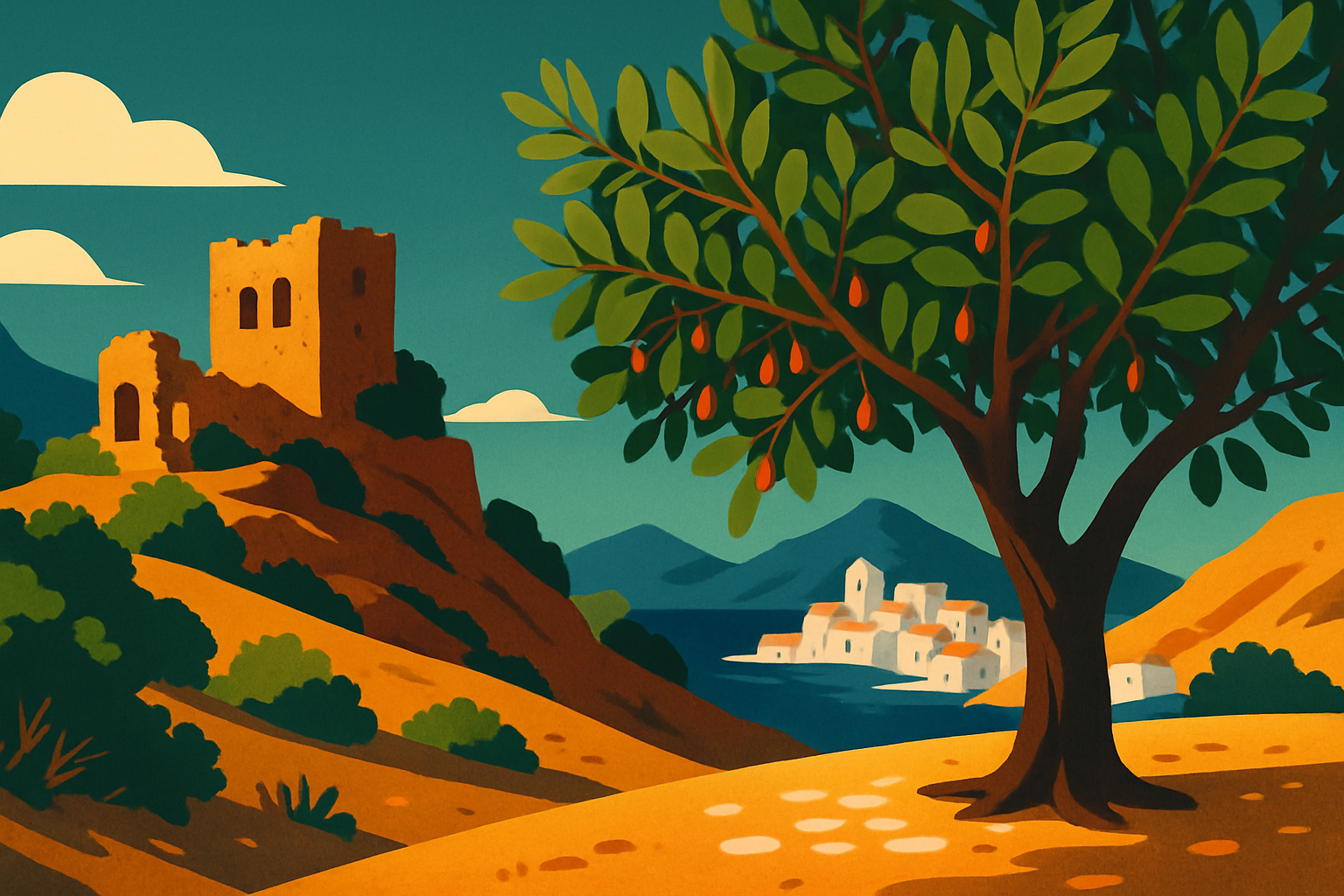
The Pistacia lentiscus tree grows across the Mediterranean basin. In every location except the southern fifth of Chios, it produces nothing usable. On the southern slopes of Chios — in a zone of particular soil composition, humidity, and temperature — the same tree produces mastiha: a resin that forms as crystalline droplets when farmers score the bark with iron tools each summer. The resin hardens in contact with air into translucent, pale-yellow pieces called 'tears,' collected from the ground on a bed of white calcium carbonate spread beneath the trees to keep the resin clean.
The harvest runs from July through October. Each tree yields between 60 and 180 grams of resin per season. A mature mastic grove requires scoring every tree individually, by hand, typically every five to seven days through the harvest period. A working mastiha farm is labor-intensive in a way that has changed very little since antiquity — there is no mechanization that can replicate the precision of the scoring process or the judgment required to read each tree's readiness.
Why Chios and nowhere else remains a question without a fully settled scientific answer. The Pistacia lentiscus var. Chia variety is genetically distinct from trees growing elsewhere in Greece and Turkey, and attempts to cultivate it outside southern Chios have consistently failed to produce resin in useful quantities. The EU granted Chios mastic Protected Designation of Origin status in 1997 — one of the few agricultural products that is genuinely geographically confined to a single island. Attempts to establish equivalent production in North Africa and the Levant during the Ottoman period, when the empire controlled the island specifically to control the mastic trade, produced no viable alternatives.
The resin appears today in digestive health supplements (multiple clinical studies have linked mastic consumption to reduced H. pylori bacteria), in high-end cosmetics, in Wrigley's chewing gum formulations, in liqueur (the Skinos Mastiha Spirit produced by the Chios Mastiha Growers Association is the most widely distributed), and in the traditional mastic-flavored loukoumi — the Greek delight — sold in every shop in the island's southern villages.
3. The Mastichochoria: Pyrgi's painted walls and Mesta's medieval fortress
The Mastichochoria are the 24 southern villages built by the Genoese from the 14th century onward to house the mastic farmers and protect the harvest. The Giustiniani family, which administered Chios from 1346 to 1566 under a commercial arrangement with Genoa, engineered the villages to serve a single function: maximum security for minimum footprint. Each village was built within a continuous outer wall, with no windows on the exterior face, a single gate, and a central watchtower for spotting approaching pirate fleets. The layout has been continuously inhabited — and largely preserved — for 700 years.
Pyrgi is the village that stops people in their tracks. Every building in the settlement's center is decorated in xysta — geometric patterns created by coating walls with dark volcanic cement, applying white plaster over it, and then scratching designs through the plaster to reveal the dark layer beneath. The result is a village where every surface reads as a dense, interlocking composition of diamonds, zigzags, flowers, and spirals in high-contrast black and white. No two buildings use exactly the same pattern. The technique has no direct parallel anywhere else in Greece or Europe. The motifs appear to have developed locally over several centuries, with earlier patterns simpler and later ones more elaborate; some buildings in the village center have not been re-done since the early 20th century and have a weathered quality that makes the patterning more rather than less striking.
Mesta, 10 kilometers west of Pyrgi, is the most fully intact of the Mastichochoria in its original structural logic. The entire village is enclosed within its medieval outer wall — walking in through the main gate, the lanes immediately narrow and begin to bend in directions designed to disorient an attacker who had breached the gate. From above, the village traces a rough pentagon. The central tower, Megalo Kastello, still stands. The lanes are barely wide enough for two people to pass, roofed in places by stone arches that connected buildings across the gap to further reinforce the defensive perimeter. Several families live here year-round; the village has a small cluster of tavernas and kafeneions operating in the vaulted central square.
Olympi, between Pyrgi and Mesta, preserves a functioning olive press dating from the Genoese period and has seen less tourist traffic than either of its neighbors. Its interior lanes have the same medieval logic but are quieter and somewhat more decayed — in a way that makes the antiquity of the place more immediately legible.
4. Nea Moni: the UNESCO mosaics in the hills above Chios Town
Nea Moni ('New Monastery') sits in the forested hills about 15 kilometers west of Chios Town, at an elevation of around 350 meters, accessible by a winding mountain road that passes through a landscape of pine and maquis unlike anything in the flat, sunbaked south of the island. The monastery was founded in the 11th century — specifically, tradition holds, by the Byzantine Emperor Constantine IX Monomachos in gratitude for a miraculous icon discovered on the site by three hermit monks.
What the emperor funded was exceptional: a team of mosaicists working in the most refined style of middle Byzantine art, producing a program of gold-ground mosaics across the katholikon (main church) that remains among the finest 11th-century Byzantine work surviving anywhere. The mosaics depict scenes from the New Testament — the Baptism of Christ, the Transfiguration, the Crucifixion — in a style that prioritizes volumetric figures and spatial depth over the flatter, more hieratic form of earlier Byzantine art. The gold tesserae backgrounds catch and shift with the movement of visitors through the space in a way that photographs do not capture.
Nea Moni was designated a UNESCO World Heritage Site in 1990, in a joint listing with the Daphni Monastery near Athens and Hosios Loukas in central Greece. The monastery suffered significant damage in the 1881 earthquake that destroyed much of Chios Town, and the cupola of the main church collapsed; the mosaics it destroyed are now documented only in 19th-century drawings. The ossuary — a bone-house containing the remains of victims of the 1822 Ottoman massacre of Chios — is preserved in a side chapel and is a sobering companion to the monastery's artistic splendors.
The site is open to visitors daily except during liturgical services. A modest dress code applies (shoulders and knees covered). A small café operates in summer near the monastery gate. The drive up from Chios Town in the early morning, with the Aegean visible below through the trees, is one of the better road experiences on the island.
5. Chios Town: the waterfront, the medieval castle, and the Giustiniani Palace
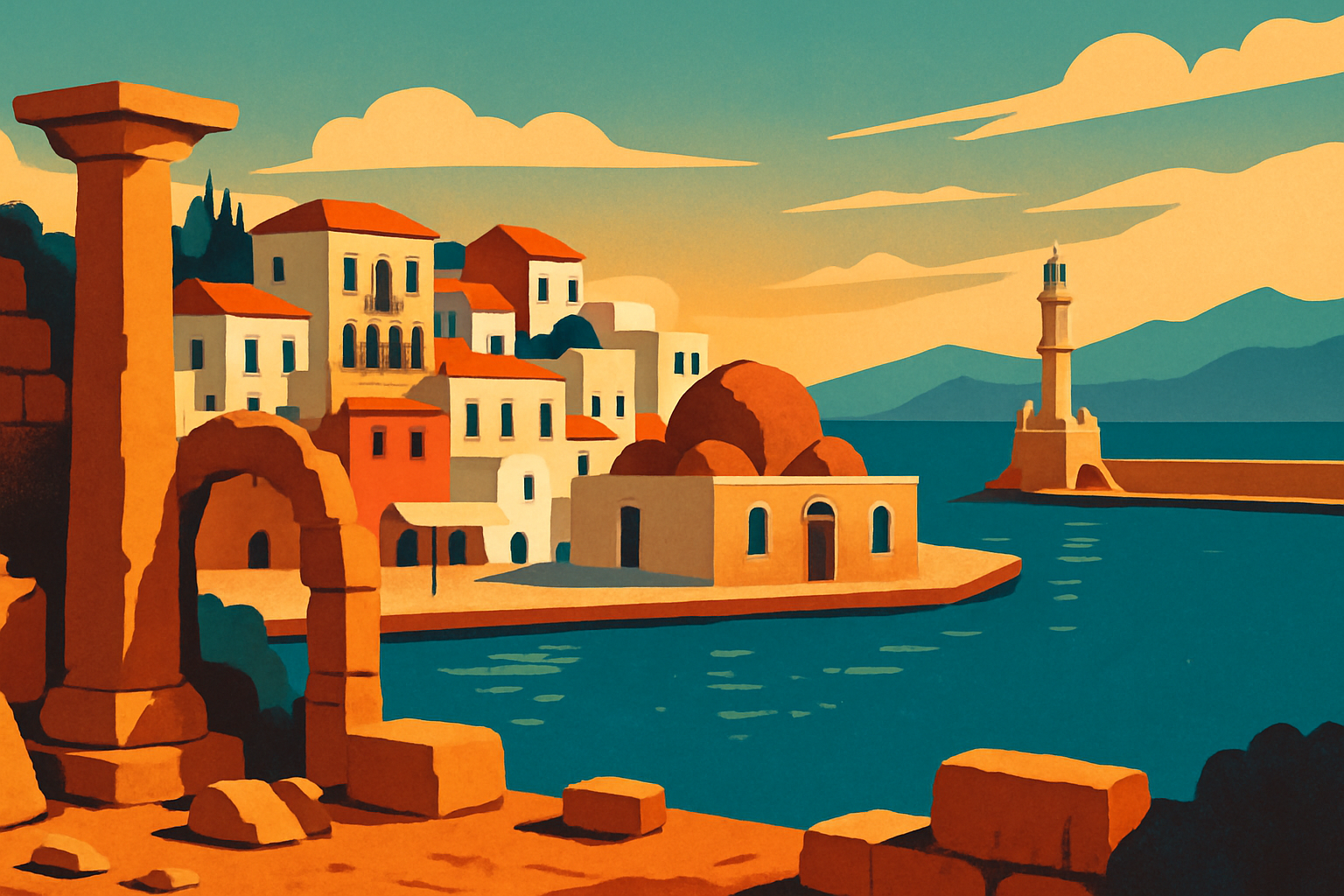
Chios Town — called simply Hora by locals — is the island's capital and the landing point for both ferries and travelers coming from the airport, 4 kilometers to the south. The waterfront (the paralia) is the social center: a broad promenade of kafeneions, ouzeris, and restaurants facing the harbor, with the medieval castle visible to the north of the port entrance.
The Castle of Chios dates in its current form largely from the Genoese period, 14th to 16th centuries, built on Byzantine foundations. The castle walls enclose a residential quarter — the Kastro neighborhood — where a small number of buildings from the Genoese and early Ottoman periods survive alongside later construction. The Giustiniani Palace, a 15th-century building within the Kastro walls, has been restored and now operates as the Giustiniani Museum, with exhibits covering Chios's Byzantine and Genoese periods including architectural fragments, coins, and medieval ceramics. The museum is a serious scholarly presentation rather than a tourist attraction — small rooms, careful labeling, genuinely interesting objects.
The Philip Argenti Museum, on the ground floor of the Koraes Public Library building near the waterfront, is worth an hour for the collection of folk costumes and pre-modern paintings of the island, including works related to the 1822 massacre that Eugene Delacroix depicted in his famous 1824 painting 'The Massacre at Chios.' The original painting is in the Louvre; the museum holds contemporary documentation of the events it depicts.
For eating in Chios Town, the tavernas along the southern stretch of the paralia and on the lanes running immediately behind it are where locals eat — To Apomero on Neorion Street and the ouzeris near the fishermen's dock on the north harbor consistently receive good word of mouth from returning visitors.
6. The beaches: three very different ways to swim on Chios
Chios's coastline is long, varied, and less crowded than the beaches of the major Cycladic islands at equivalent summer periods — partly because the island lacks the volume tourism that fills Paros or Mykonos to capacity in July.
Mavra Volia (Black Pebbles) near the village of Emporio in the far south is the most visually arresting beach in the North Aegean. The beach is composed entirely of rounded black volcanic pebbles — some as small as marbles, others fist-sized — against which the Aegean water appears an unusual deep turquoise, darker and more vivid than the pale blues of sandy beaches. The volcanic rock outcrops at either end of the bay are striped red and black. There are no sunbeds and no beach bars; you bring your own shade or go without. The contrast between the dark ground, the vivid water, and the bleached rock walls behind the beach is genuinely unlike anything else in Greece. The village of Emporio, a five-minute walk inland from the beach, has a small archaeological site and a couple of kafeneions open in summer.
Karfas, 8 kilometers south of Chios Town, is the island's main organized beach: fine sand, sunbed and umbrella rental, a range of beachfront hotels, and the infrastructure for a standard full beach day. It is accessible by local bus from Chios Town (the only beach on the island with reliable public transport). Water sports rentals operate in peak summer.
Nagos, on the island's northeastern coast near the village of Kardamyla, is a large pebble beach set in a deep bay backed by high cliffs and plane trees — an unusual combination that keeps the beach shaded in the morning and cool even in August. The water is clear and deep close to shore. A stream empties into the bay from the hills behind, creating a small freshwater pool at the beach's inland edge. Kardamyla itself is the main village of northern Chios, architecturally distinct from the Mastichochoria — the north of the island has a different economic history (shipping rather than mastic) and its large neoclassical houses reflect 19th-century maritime wealth.
7. What to eat on Chios: mastiha, mastelo, souma, and Chios mandarins
Chios has a specific food culture built around its two most unusual products: mastic resin and Chios mandarins.
Mastiha liqueur is the drink to order on arrival. The most widely available is Skinos, produced by the Chios Mastiha Growers Association — clear, mildly sweet, with a pine-and-citrus aroma that is unlike any other Greek spirit. It is drunk chilled, neat or on the rocks, and is the correct companion to the island's meze. A second label, Pytheas, is produced by a small distillery in Chios Town and is available primarily on the island. Souma — a spirit distilled from figs, specific to Chios and the surrounding North Aegean — is rougher, stronger (typically 40–45%), and the drink of choice in the northern villages. It resembles Italian grappa in function but has its own character and is essentially unavailable outside Chios.
Mastelo is a fresh semi-soft cheese produced on Chios, aged briefly and characterized by a mild, slightly tangy flavor and a washed rind. It appears on taverna meze plates alongside the usual feta and is worth ordering specifically. The island's mastic-flavored pastries — mastihopita (mastic and cream-filled pastry) and mastic-flavored loukoumi — are available in every village shop and are the standard souvenir.
Chios mandarins (the local variety, called Chios mandarin or Chios tangerine) are grown in the island's northern plain and have a PDO designation. The harvest runs October through January, so they are not in season during summer visits — but the mandarin groves in the northern flatlands are visible from the road, and the mandarin-flavored products (liqueur, jam, dried peel) are available year-round in specialty shops in Chios Town's market.
For sit-down eating in the south of the island, the tavernas in Pyrgi and Mesta both operate through summer, with menus built around grilled meats, fresh fish from the nearby Emporios bay, and mastic-accented sweets. The portions are generous and the prices are noticeably below what comparable food costs in Athens.
8. Getting there, when to go, and is Chios right for you?
Getting there: Chios National Airport receives daily flights from Athens on Aegean Airlines and Sky Express (35 minutes, typically €50–90 one way). Book 3–4 weeks ahead in July and August. Blue Star Ferries operates the Piraeus–Chios overnight crossing (approximately 8 hours, €35–55 passenger fare), useful if you want to bring a car. From Chios, the same ferry line continues to Lesvos and Lemnos, making a multi-island trip feasible.
Best time: June delivers optimal conditions — full schedules, open restaurants and beaches, and the Mastichochoria at their most atmospheric before peak-summer heat arrives (Chios Town regularly hits 34–36°C in August). The mastic harvest begins mid-July and runs through October; visiting then means seeing scored trees with resin collecting on the white-powder ground beneath them. September is the locals' preferred month: warmest sea, thinned crowds, and harvest in full swing.
Is it crowded? Far less than the major Cycladic islands. No international airport and no cruise ship stops eliminate the two biggest crowd-generating mechanisms. Even at peak, Pyrgi and Mesta are less trafficked than comparable medieval villages in Tuscany or Croatia.
Is it expensive? Noticeably cheaper than Santorini and Mykonos. A taverna dinner for two in Pyrgi or Mesta with mastiha liqueur runs €40–55. Accommodation in Chios Town ranges from €70 (comfortable guesthouse) to €150 (small waterfront boutique hotel). There are no mega-resort properties on the island.
How long to stay? Three to four nights allows a proper circuit: a day for Nea Moni and Chios Town, a day for the Mastichochoria (Pyrgi, Mesta, Olympi), and a half-day at Mavra Volia. What Chios does not have is the beach resort infrastructure of Mykonos or the caldera drama of Santorini. What it has — mastic groves, geometric medieval villages, Byzantine mosaics, and a food culture built on a geographically irreplaceable product — is not replicated anywhere else in the Aegean.