1. A museum built around a single argument
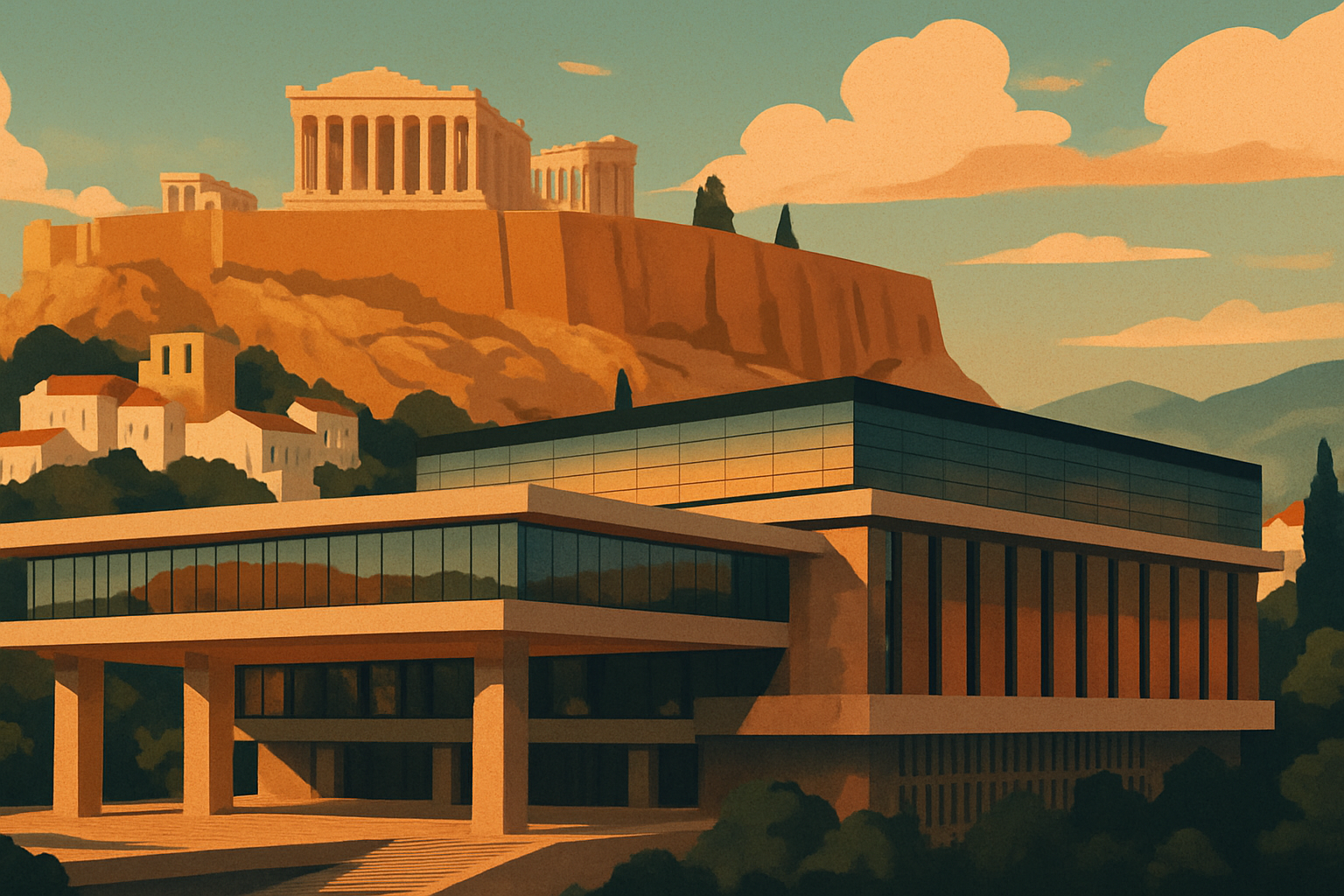
The Acropolis Museum exists because of the Parthenon sculptures. That is not the official description, but it is the accurate one. The building opened in 2009 specifically to house the original carved stones from the Parthenon and its surrounding monuments — and to demonstrate, in architectural fact, that Athens has a world-class facility capable of conserving and displaying the sections of those sculptures currently held at the British Museum in London. Every design decision in the building reflects that intention.
Architect Bernard Tschumi oriented the top-floor Parthenon Gallery on precisely the same axis as the Parthenon on the hill above, aligned with the cardinal points of the temple itself. The gallery's floor-to-ceiling glass walls frame the actual Parthenon 200 meters away as you move through the display. The building steps over and around an ancient neighborhood excavated during construction rather than removing it. The restaurant terrace on Level 2 faces the Acropolis rock directly. None of this is incidental. The building was designed to make an argument that words alone cannot make as efficiently: that the Parthenon frieze belongs here, in sight of the building it was carved for.
This context matters before you walk in. Without it, the Acropolis Museum is a very good archaeological museum. With it, it is one of the most purposeful buildings constructed in the 21st century.
2. Ground floor: walking over an ancient neighborhood
The entrance level of the museum is, structurally, a glass bridge suspended above an archaeological excavation. When the foundations were dug in the early 2000s, the construction team encountered a dense section of ancient Athens spanning roughly the 1st through 7th centuries AD — workshops, houses, water channels, streets, public structures, all preserved in overlapping layers beneath what had been a residential block of modern Athens.
Rather than remove the site, Tschumi's design incorporated it. Glass panels in the floor at the entrance let visitors walk directly over the uncovered structures while looking down into Byzantine-era houses and late Roman workshops. Objects recovered from the layers — terracotta figurines, everyday ceramics, coins, votive offerings, iron tools — are displayed around the perimeter of the entrance hall. These are not Parthenon-era objects; they date from approximately 300 to 700 AD and establish that Athens was a living city continuously through Roman and Byzantine occupation, not just a monument to the 5th century BC.
The Archaic Gallery begins on this level and continues to the next floor. Photography is not permitted in the Archaic Gallery — this surprises most visitors since the rest of the museum allows cameras freely. The restriction protects painted surfaces that are sensitive to repeated light exposure, and staff enforce it consistently.
3. The Archaic Gallery and the colors of ancient Greek sculpture
The conventional image of ancient Greek sculpture is white marble — clean, unpainted, monumental. That image is wrong, and the Acropolis Museum's Archaic Gallery is the most concentrated place in Europe to understand exactly how wrong.
The collection spans roughly 700 to 480 BC — the century-plus before the Persian army destroyed the Acropolis in 480 BC and ended the Archaic building phase. Three pieces stand out:
•Moschophoros (calf-bearer, c. 570 BC): a bearded man carrying a young calf on his shoulders as a votive offering to Athena. His face shows the 'archaic smile' — the slight upward curve at the corners of the mouth that appears across Greek sculpture of this period. It represents not emotion but a technical achievement: the sculptor's ability to give stone the appearance of living breath.
•Peplos Kore (c. 530 BC): a female votive figure wearing a peplos, a heavy woolen garment. She retains faint but unmistakable traces of red and blue paint on her garment border and her hair. This is direct physical evidence that ancient Greek marble sculpture was painted in vivid polychrome color. Reading about painted Greek sculpture is one thing; standing in front of actual 2,500-year-old pigment on a stone surface produces a different kind of understanding entirely.
•Kritios Boy (c. 480 BC): the last piece in the Archaic Gallery and the first statue in the Western tradition to distribute weight on a single supporting leg — contrapposto, which became the default for all subsequent classical and Renaissance sculpture. He was carved just before the Persian sack of the Acropolis in 480 BC, which means his creation and burial in the same event were separated by a matter of months.
4. The Caryatids at eye level
The south porch of the Erechtheion on the Acropolis has six draped female figures serving as architectural columns — the Caryatids. From the ground below the building, they stand approximately 6 meters overhead; the detail in their carving is invisible at that distance. In the Acropolis Museum, five of the six originals are displayed at approximately eye level, roughly 2.3 meters tall, in a dedicated hall with lighting calibrated to the texture of their stone.
At close range, the quality of the carving is extraordinary. Each Caryatid wears a Doric peplos, and the sculptors differentiated how the fabric falls above and below the belt: taut where it is held, cascading freely below. The weight distribution in each figure — bearing the roof of the porch on her head — is resolved by a pose that rests the load on one straight leg while the other bends slightly at the knee. The result is a structural column that reads, from any angle, as a woman in motion.
The sixth Caryatid is not here. It was removed from the Erechtheion in 1801 by Thomas Bruce, 7th Earl of Elgin, and sold to the British Parliament in 1816. It is now in the British Museum in London. In this hall, the five originals stand with a visible gap where the sixth should be — a display decision that requires no caption to explain. The five Caryatids on the building itself are precise cement reproductions installed to protect the originals from acid rain.
5. The Parthenon Gallery: 160 meters of frieze reassembled
The third floor is the reason the museum was built. The Parthenon Gallery occupies the full footprint of the top floor, oriented on the same compass axis as the Parthenon on the hill above. Large glass walls on both long sides frame the Acropolis rock and the temple as you walk through the display.
The Parthenon's carved decorative program had three components: the pediment sculptures (triangular groups at the east and west ends of the roof), the metopes (92 square relief panels in the horizontal band above the outer columns), and the frieze (a continuous carved band approximately 160 meters long running around the interior walls of the building, above the inner colonnade). The Parthenon Gallery is built around the frieze.
The frieze depicted the Panathenaic procession — the great civic festival held every four years to celebrate Athena's birthday. The carved procession gathered outside Athens, moved through the city, and delivered a newly woven peplos garment to the statue of Athena Parthenos at the top of the Acropolis. Around all four sides of the building you can follow: cavalry assembling at the start, then horses being mounted, then chariots moving, musicians playing, elders walking, animals led to sacrifice, young women carrying ritual vessels, and finally at the east end, above the main entrance to the building, the gods of Olympus seated and receiving the procession while Athenian officials present the folded peplos.
In the Parthenon Gallery, the surviving original frieze sections are displayed in their original cardinal sequence. The sections held at the British Museum — roughly 75 meters' worth — are represented by white plaster casts placed immediately beside the warm honey-toned originals. The tonal difference between cold plaster and 2,500-year-old Pentelic marble is immediately legible, and the gap between them is the point.
6. The Elgin Marbles: what happened, where things stand in 2026
Thomas Bruce, the 7th Earl of Elgin and British Ambassador to the Ottoman Empire, removed a substantial portion of the Parthenon's sculptural decoration between 1801 and 1812. The collection included 17 figures from the pediments, 15 metopes, and approximately 75 meters of the Panathenaic frieze. Elgin sold the collection to the British Parliament in 1816 for £35,000 — less than he had spent acquiring it. It has been held at the British Museum since, where it is displayed in Room 18 as the Elgin Marbles.
The Greek government's position is that Elgin obtained permission from Ottoman officials — who governed Greece under occupation at the time — without the authority to authorize the permanent removal of monuments from a subjugated territory. The British Museum's position is that the acquisition was legal under the law and convention of the period, that London's climate and conservation expertise have preserved the sculptures, and that displaying them in one of the world's most visited museums makes Greek culture accessible to audiences who could not travel to Athens.
In 2023 and 2024, a series of high-level diplomatic discussions between Greece and the United Kingdom produced several proposals, including long-term loan arrangements where sections of the frieze would travel to Athens temporarily in exchange for other Greek antiquities going to London. As of June 2026, no formal return or permanent loan agreement has been finalized, though the discussions have been more sustained than in any previous decade.
The Parthenon Gallery makes the Greek argument visually rather than verbally. Standing in a room with the originals in formation, white plaster marking the London sections, and the Parthenon itself in the window behind, the question of whether the dispersal is appropriate becomes harder to frame as purely administrative. You do not need to have an opinion to notice what the room is saying.
7. Tickets, timing, photography, and the museum restaurant
Tickets: The Acropolis Museum is included in the €30 combo ticket (7 sites, valid 5 days — book at hhticket.gr). The museum-only ticket is €15, reduced to €10 for EU students and seniors over 65. Free admission applies on March 6, April 18, May 18, and the first Sunday of each month November through March — these dates draw significantly larger crowds.
Reservations: The museum does not require timed-entry booking. Walk-in is available throughout summer, which makes it a reliable fallback on days when the Acropolis hill is fully booked. Arrive before 10 a.m. or after 5 p.m. in June and July to avoid the busiest hours.
How long to spend: Budget a minimum of two hours. The Parthenon Gallery alone needs 45 to 60 minutes if you walk at the pace the frieze deserves. The Archaic Gallery and Caryatid hall together need another 45 minutes to stop in front of individual pieces. The ground floor excavation display is easily underestimated — 30 additional minutes if you read the labels.
Photography: Permitted throughout the museum including the Parthenon Gallery, where the combination of original frieze sections and the Parthenon visible through the glass wall is the standout photograph. Prohibited in the Archaic Gallery on the lower floors — applies to all devices, enforced by staff.
The restaurant: The museum restaurant on Level 2 has a direct south-facing terrace with an unobstructed view of the Acropolis hill. It operates as a full sit-down restaurant — not a cafeteria — with lunch dishes running €12 to €20. Reserve ahead in summer or arrive before noon. Eating here with the Acropolis above you and the frieze visible inside through the glass behind you is the most architecturally coherent meal in Athens.