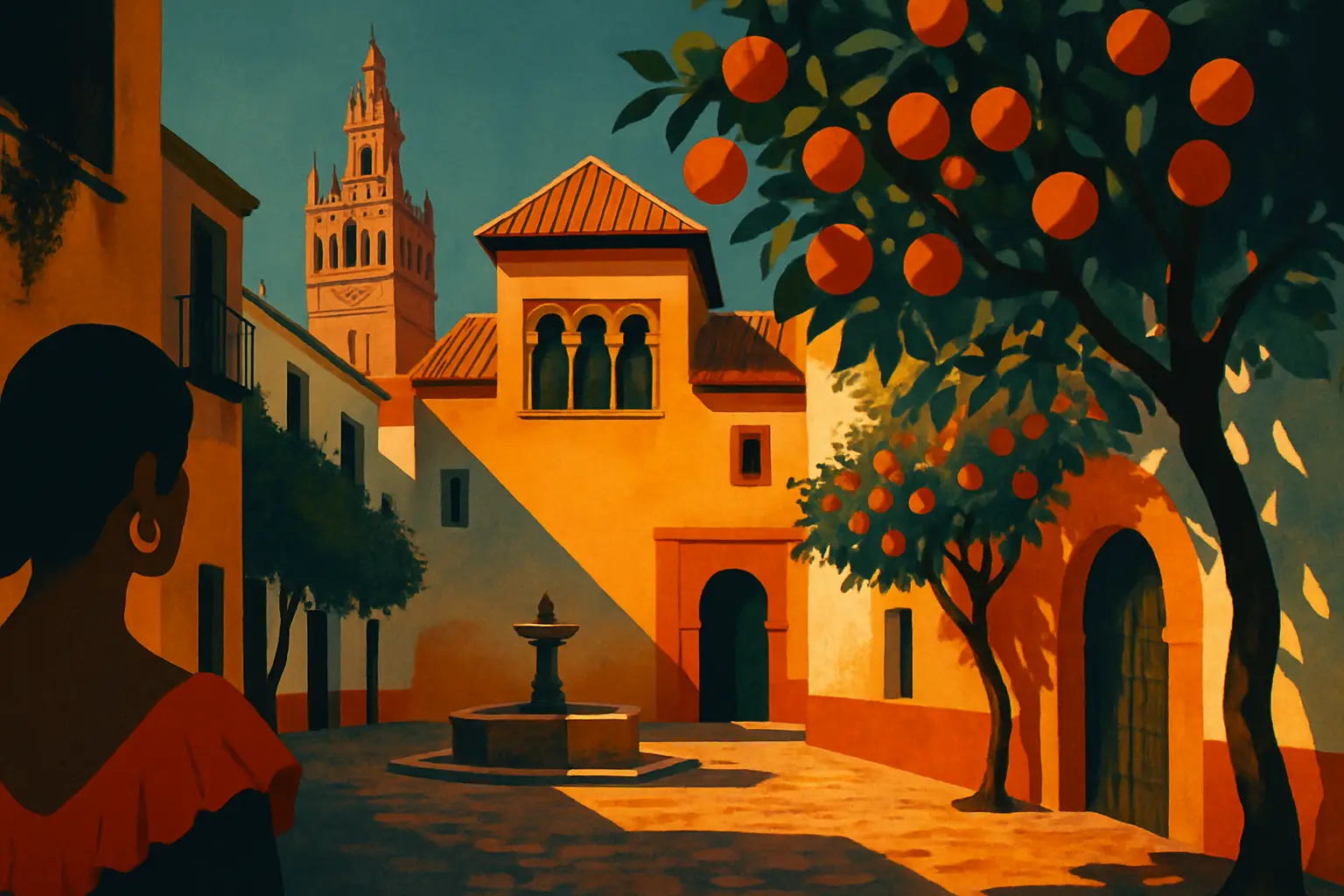
Santa Cruz began as the Juderia — Seville's Jewish quarter — walled off from the rest of the city in 1391 after a pogrom organized by the archdeacon Ferran Martinez killed thousands of Jews and forced survivors to convert or flee. The quarter sat tightly against the Alcazar's eastern walls, a bounded enclave by design.
When Isabella and Ferdinand expelled all remaining Jews from Spain in 1492, the quarter emptied overnight. Christian families moved into the winding streets, and the neighborhood was renamed after its central church — the Church of Santa Cruz — a 16th-century building that French troops demolished in 1810 during Napoleon's occupation of Seville. Only a tall iron cross, the Cruz de la Cerrajeria, now stands in the orange-tree-lined plaza where the church once rose. Most visitors photograph it without knowing what it marks.
The maze is intentional. Medieval Jewish quarters were designed with deliberate dead-ends and tight bends to slow mounted cavalry and give residents time to barricade. A survival architecture that now makes Santa Cruz one of the most photographed neighborhoods in Europe without most visitors understanding why the streets are shaped the way they are.
Callejon del Agua (Water Lane) is the most atmospheric passage in the barrio — barely two meters wide, running along the Alcazar's exterior wall. The name comes from an aqueduct that once carried water into the royal palace above; look up at the wall and you can still see the sealed arch where it entered. Washington Irving lived at Callejon del Agua 2 in 1828 while writing *Tales of the Alhambra*, a book that effectively invented modern tourism to Andalusia and made Granada a household name across Europe.
Calle Susona carries a grimmer legend. According to Inquisition-era accounts, a young woman named Susona — daughter of a Jewish converso — fell in love with a Christian knight and betrayed her father's conspiracy against the Inquisition to protect him. Consumed by guilt afterward, she reportedly requested that her skull be displayed above her doorway after death. A ceramic tile skull still marks the spot. The story is almost certainly embellished, but it captures the impossible position of converso families in 15th-century Seville: suspected by the Inquisition regardless of their conversion, and caught between two worlds they could never fully inhabit.
Get short, interactive stories that make each place easier to remember while you travel.
Plaza de Dona Elvira is the barrio's quietest square and the one locals actually use. Orange trees, a small central fountain, and benches that fill with residents rather than tour groups in the early evening. Named for a noblewoman tied to Don Juan mythology, it is the correct answer when someone asks where in Santa Cruz you should sit and do nothing for an hour.
Plaza de los Venerables anchors the neighborhood's center and gives its name to the 17th-century Hospital de los Venerables Sacerdotes, built to house elderly retired priests and now home to the Fundacion Focus-Abengoa's collection of Baroque Spanish paintings — including Velazquez works rarely seen outside the Prado. The entrance fee (around €10) grants access to rooms that most people walking through Santa Cruz never enter. The courtyard alone, a classic Sevillano patio with a central fountain and orange trees, justifies stopping.
Plaza de Santa Cruz itself is quieter than its reputation suggests. The iron Cruz de la Cerrajeria stands at its center; the surrounding buildings are residential. In the evenings during September and October, the Seville theater company occasionally stages outdoor performances in the square — worth checking the local listings if you are in the city on a weekend.
The restaurants facing Calle Mateos Gago — the main artery tourists pour down from the Cathedral — are generally mediocre at tourist prices. Two blocks deeper, the options shift significantly.
Bodega Santa Cruz (Calle Rodrigo Caro, 1a) is a standing-room bar that fills with an equal mix of locals and repeat visitors. House vermouth on tap, *montadito de pringa* (slow-roasted pork on a small roll) for around €1.50, and an atmosphere that resists gentrification despite being 100 meters from the Cathedral. Arrive at noon when it opens and you will find space; arrive at 2pm and you will be shoulder-to-shoulder.
Bar Europa on Calle Siete Revueltas has been serving simple Sevillano cooking since the 1960s — no English menu, honest prices, and the rotating daily specials written on a chalkboard. The street itself is worth finding for its name alone: *Siete Revueltas* means Seven Turns, a reference to how many direction changes the lane makes in under 100 meters.
For serious tapas, La Azotea has a location near the barrio and is widely considered among the top modern tapas restaurants in Seville. The cured tuna belly and the slow-cooked egg with truffle oil are benchmarks. Reservations make sense for dinner; lunch is easier to walk into.
Beyond the Velazquez foundation at Los Venerables, Santa Cruz contains art-related surprises that most visitors compress into footnotes.
The Museo del Baile Flamenco sits just at the barrio's edge, founded by the dancer Cristina Hoyos — one of the defining flamenco performers of the 20th century. The permanent collection covers flamenco's Andalusian roots, its traveling showmen past, and its codification as a recognized art form. Evening performances in the museum's interior courtyard hold around 80 people, making them the most intimate flamenco experience available in Seville — a different category from the large commercial tablaos near the Cathedral. Book in advance; they sell out.
The Jardines de Murillo border Santa Cruz to the east — a long formal garden built in 1911 and named after the Baroque painter Bartolome Esteban Murillo, who lived in the neighborhood until his death in 1682. Murillo's paintings of Immaculate Conceptions and street children defined the image of Seville for Northern European collectors in the 17th and 18th centuries; his house on Calle Santa Teresa is marked by a plaque. A monument to Christopher Columbus stands at the garden's north end — a reminder that Seville was the administrative capital of the Spanish empire's New World trade, and that Columbus finalized the paperwork for several of his voyages from the Casa de la Contratacion inside the adjacent Alcazar.
The honest answer is: yes and no. The central streets near the Cathedral exit are crowded to the point of frustration in July and August, and the tourist-facing tapas bars reflect the captive audience. The neighborhood has become a stage set in places — the whitewashed walls and flower-draped balconies are real, but several of the 'traditional' bars are recent recreations.
But Santa Cruz is large enough that five minutes of deliberate walking in almost any direction reveals something quieter. The deeper critique is that the neighborhood's status as a preserved medieval quarter is partly genuine and partly maintained for tourism. What survives is a real medieval street plan in a neighborhood with genuine history — the Juderia boundary walls, the authentic layout of a walled enclave — layered with modern café culture.
The practical answer: treat Callejon del Agua, Patio de Banderas, Plaza de los Venerables, and the Flamenco Museum as your anchors, use the maze between them rather than photographing every doorway, and eat at least one meal on a street you found by wrong turn rather than by map.
September and October are the best months. Daytime temperatures in early September drop from the brutal 38-42°C of July and August to a manageable 28-32°C. The tourist volume thins noticeably — not empty, but navigable. The orange trees are still leafy, the light is long in the evenings, and the terraces fill with people who have time to sit rather than push through.
July and August are workable only in the early morning (before 9am) or after 9pm. Seville locals essentially cede the midday heat to tourists and return to the streets after dark; by 10pm on a summer night, Santa Cruz is busier than it was at 2pm. If you are visiting in peak summer, structure the day around this rhythm rather than fighting it.
May and early June are the other sweet spot — after Semana Santa crowds but before the heat becomes severe. The city's Feria de Abril happens in late April in a separate fairground district, which means Santa Cruz in April sees a particular kind of Sevillano energy on the streets. Spring is also when the neighborhood's orange trees are in blossom — the scent along Callejon del Agua in April is genuinely worth a trip.
Santa Cruz is walkable from anywhere in central Seville. The nearest Metro stop is Puerta de Jerez (Line 1), a 5-minute walk to the barrio's western edge. From the Santa Justa train station, a taxi takes roughly 10 minutes and costs €8-10. No cars enter the barrio itself — the streets are pedestrianized and most are too narrow for vehicles anyway.
A half-day is the minimum for a real visit: long enough to cover Callejon del Agua, Los Venerables, a lunch stop, and the Jardines de Murillo. A full day allows the Flamenco Museum, the Alcazar (technically adjacent but worth its own several hours), and a proper sit-down dinner. The Triana neighborhood across the Guadalquivir makes a natural second half of a day in Seville — the walk from Santa Cruz over the Puente de Triana takes about 20 minutes along the riverfront and passes the Torre del Oro on the way.