The entire identity of Colonia Hipódromo — the oval street, the park at its center, the Art Deco apartment buildings lining its curves — descends from a decision made in 1910. That year, the Jockey Club de México opened the Hipódromo de la Condesa, a horse racing track built for Mexico City's elite who wanted something more European than bullfighting: a velvet-grass oval, grandstands, the ritual of watching thoroughbreds run in circuits. The track operated for only fifteen years. By 1925, the sport had lost its audience and the land was worth more as real estate. Entrepreneur José G. de la Lama bought the property and commissioned architect José Luis Cuevas to convert it into a residential neighborhood. Cuevas made one critical decision: instead of imposing Mexico City's typical grid, he traced the new street plan around the oval of the track itself. The result was Avenida Ámsterdam — originally called Avenida del Hipódromo — a boulevard that curves back on itself in a complete ellipse, enclosing what would become Parque México in 1927. The 1910 racetrack lasted fifteen years. The street it left behind has defined a neighborhood for a century.
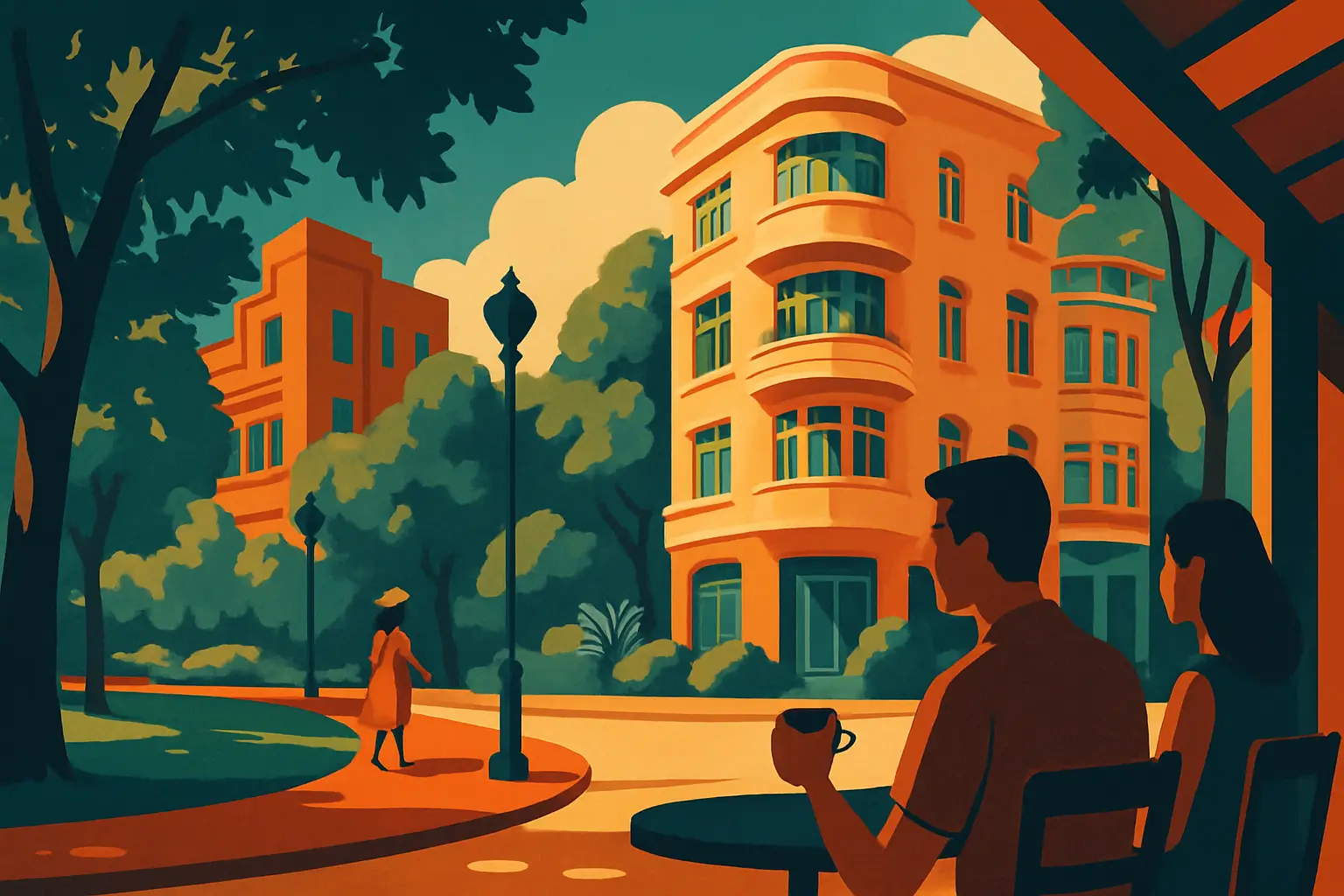
Avenida Amsterdam is the organizing principle of Hipódromo, and walking it is the single best way to understand the neighborhood. The street runs as a wide boulevard on both sides of a tree-lined pedestrian median — it is the median that matters. The central walkway traces the exact curve of the old racetrack, 2.1 kilometers in a gentle ellipse, shaded by ficus and jacaranda trees whose canopy closes overhead to create a tunnel of green. Mornings belong to joggers, cyclists on the separated bike lane along the outer edge, and an extraordinary density of Mexico City dogs — Hipódromo is among the dog-friendliest neighborhoods in the city, and the Amsterdam loop is the morning circuit for several hundred dogs and their owners at any given hour. The cafés place tables directly against the walkway. Maque Café, housed in a preserved Art Deco building, has outdoor tables with unobstructed views of the tree line and the apartment facades across the street. Lázaro Focacceria, a few blocks along, pairs serious single-origin espresso with sourdough focaccia sandwiches — one of the better morning combinations in the city. Walking the full loop takes about 25 minutes without stops; most locals do it twice.
Get short, interactive stories that make each place easier to remember while you travel.
The most common geographical mistake in this part of Mexico City is crediting Parque México to Condesa. The park sits at the center of Avenida Amsterdam's oval — which means it falls within the colonia boundaries of Hipódromo, not Condesa proper. Parque México was built in 1927 on the site of the old grandstands. It has a small pond at its center, Art Deco kioscos (covered bandstands) at several intersections, and an outdoor theater — the Teatro al Aire Libre de Parque México — that hosts free performances on weekend evenings. On Sunday mornings, a small organic market sets up near the main entrance on Avenida México, selling flowers, cheese, artisan bread, and tamales. The park's scale is neighborhood rather than civic: it is the size of a long city block, primarily used by people who live within a five-minute walk of it. That intimacy is the point. Bosque de Chapultepec is where you go to feel like you are in a great city. Parque México is where you go to feel like you live in a specific neighborhood inside one. Plaza Popocatépetl, just north of the park, anchors the neighborhood's secondary gathering point — its central fountain is nicknamed La Bomba by locals for the force with which water erupts from it.
Hipódromo contains the greatest concentration of Art Deco architecture in Mexico City. The building stock dates almost entirely from the 1920s and 1930s — the period immediately after the racetrack closed and residential lots went on sale to developers courting the city's professional class. The style of the moment was Art Deco: geometric ornamentation, curved facades, decorative ironwork, pastel stucco finishes with vertical fins and porthole windows. The 1985 earthquake destroyed significant Art Deco inventory in other colonias — Doctores and parts of Centro Histórico lost entire blocks. Hipódromo's lower-rise, structurally independent buildings weathered the earthquake more intact, which is part of why such a complete inventory survives. The buildings to look for specifically: Edificio San Martín and Edificio México, both along the Amsterdam curve, are the most-cited examples — curved corner facades, decorative vertical fins running floor to ceiling. On Avenida México (the street cutting through the interior of the oval), the Hipódromo Building from 1929 is a four-story apartment block with geometric stucco reliefs and a symmetrical entrance that reads as mid-century Miami via Mexico City. Look also at the details: decorative tile work on entryway floors, iron balcony railings, and the hanging gardens on second-floor terraces that are a specifically Hipódromo design tradition.
The restaurant and bar corridor runs primarily along Avenida Ámsterdam, the connecting Avenida Michoacán, and the blocks immediately surrounding Parque México. Mendl, on Ámsterdam near Parque México, is a Jewish deli in the New York style — bagels, pastrami sandwiches, latkes. It is an oddity in Mexico City that works because of the neighborhood's long history of attracting European immigrant populations and its particular appetite for international cooking done seriously. Restaurant Matisse on Avenida Amsterdam is one of Hipódromo's established gourmet addresses, with a menu that changes seasonally and a dining room in a former Art Deco residential building. Nonna Cucina Bar at the corner of Michoacán and Amsterdam brings housemade pasta and a wine list tilted toward natural and orange wines. For drinks: Baltra Bar is the cocktail bar with the longest reputation in the neighborhood — a martini-focused list in a small dining room that books out on weekends, so arrive before 8 pm or you are standing. Disco Café & Bar runs the most interesting daily split: specialty coffee and sourdough in the morning, natural wine and bar bites come evening with no physical transformation of the space, just a shift in what is poured. La Xampa Bar at Avenida Nuevo León 66 has live music on weekend evenings and a terrace that stays occupied until late.
Sunday morning is the correct entry point for any first visit to Hipódromo. The neighborhood's rhythms are strongest from about 9 to noon: the Avenida Amsterdam pedestrian median fills with joggers, cyclists, families, and more dogs per square meter than almost anywhere else in the city; the Parque México market sets up near the Avenida México entrance with local flowers, artisan bread, cheese, honey, and tamales; café terraces along Michoacán begin filling with residents treating Sunday brunch as a two-hour minimum. The area around Amsterdam and Aguascalientes is the best starting point — walk the full oval counterclockwise, stop at Maque Café for coffee, continue to Parque México's north end to see the Art Deco kiosko at its best in morning light. From there, exit east toward Álvaro Obregón, which forms the unofficial boundary between Hipódromo and Roma Norte. The walk across takes about ten minutes and is one of the best urban transitions in the city — the Art Deco curves of Hipódromo give way, almost imperceptibly, to Roma Norte's more eclectic building stock from the 1940s through 1990s. Sunday afternoon in either neighborhood follows the same logic: lunch stretches well past 3 pm and no one is in a hurry.
Are Hipódromo and Condesa the same neighborhood? Technically no. La Condesa as a concept refers to three officially distinct colonias: Colonia Condesa (the western portion, centered on Parque España and Avenida Ámsterdam's outer edge), Colonia Hipódromo (the oval interior centered on Parque México), and Colonia Hipódromo Condesa (a narrow strip between them). In practice, locals who live in Hipódromo often say they live 'en la Condesa' because Condesa is the name outsiders recognize. The neighborhoods have a real character difference: Condesa proper around Parque España is slightly quieter and more residential; Hipódromo is where the café density, restaurant corridor, and bar scene concentrated. Is Hipódromo safe? Yes — it is among the most continuously trafficked by tourists and expats of any Mexico City colonia, with active foot traffic throughout the day and a nightlife that keeps streets populated late. Standard CDMX awareness applies: keep your phone in a pocket on Amsterdam after midnight, use Uber or Cabify rather than walking to metro stations at 1 am. Getting there by metro: Line 9 (orange) stops at Metro Patriotismo — walk east on Patriotismo, turn left on Sonora, and you hit Amsterdam in five minutes. Metro Chilpancingo on the same line puts you at the northeast corner. Ecobici docking stations run along Amsterdam every few blocks and the oval terrain is flat enough to make the bike the obvious choice.