Tepache is a lightly fermented drink made from pineapple rind, water, piloncillo (raw cane sugar), and spices — typically cinnamon and clove. It ferments naturally over one to three days, fed by wild yeasts on the pineapple skin. The result is slightly carbonated, golden-brown, and tastes somewhere between pineapple juice and a dry cider: fruity up front, lightly sour, with a mild funkiness that depends on how long the batch has been fermenting. The longer it sits, the more alcoholic and less sweet it becomes.
The version you have seen on craft cocktail menus in the United States is a pasteurized, shelf-stable approximation — useful for mixing, engineered for consistency, and stripped of the wild-yeast character that makes the street version interesting. Several Mexican brands now export commercially, and some are genuinely good. But they are not what Mexico City street vendors sell from a barrel to commuters and market shoppers at 10 a.m. on a Tuesday. That version is alive in the literal sense — still fermenting, slightly different every day — and it is the one worth understanding before you visit.
Made from pineapple rind (not the fruit flesh), piloncillo sugar, water, cinnamon, and clove — fermented 1–3 days
Natural fermentation: wild yeasts on the pineapple skin do the work, no added starter culture needed
ABV typically 0.5–2% depending on fermentation time — well below beer, above kombucha
The word tepache comes from the Nahuatl *tepiātl* — a compound of *tepitl* (tender corn) and *atl* (water). The original drink had nothing to do with pineapple. It was a fermented corn beverage prepared by the Nahua peoples of central Mexico, used for centuries before contact and documented in codices as a ceremonial and everyday drink. Corn tepache was thick, mildly fermented, and consumed communally at religious festivals in communities across what is now Guerrero, Oaxaca, and Veracruz — where some Mixtec, Zapotec, and Chinantec communities still prepare traditional corn-based tepache for *mayordomías* (community feast days).
The shift from corn to pineapple happened gradually after the Spanish introduced *piña* through Caribbean trade routes in the 16th century. Pineapple was cheaper to ferment than corn, its rind offered abundant wild yeast, and the result was sweeter and more accessible. By the 18th century, pineapple tepache had spread through central Mexico's market culture and largely displaced the corn version in urban areas. This trajectory — indigenous fermentation tradition adapting to colonial ingredients — is a pattern that runs through most of Mexico's traditional food and drink history. Tepache, like pulque, belongs to a pre-Columbian category of fermented drinks that survived colonization partly by changing form.
Nahuatl root: *tepiātl* means 'tender corn water' — the original was a corn ferment, not pineapple
The pineapple version replaced corn after Spanish trade routes made *piña* widely available across central Mexico
Traditional corn tepache still exists in Mixtec, Zapotec, and Chinantec communities in Oaxaca and Guerrero for religious festivals
Get short, interactive stories that make each place easier to remember while you travel.
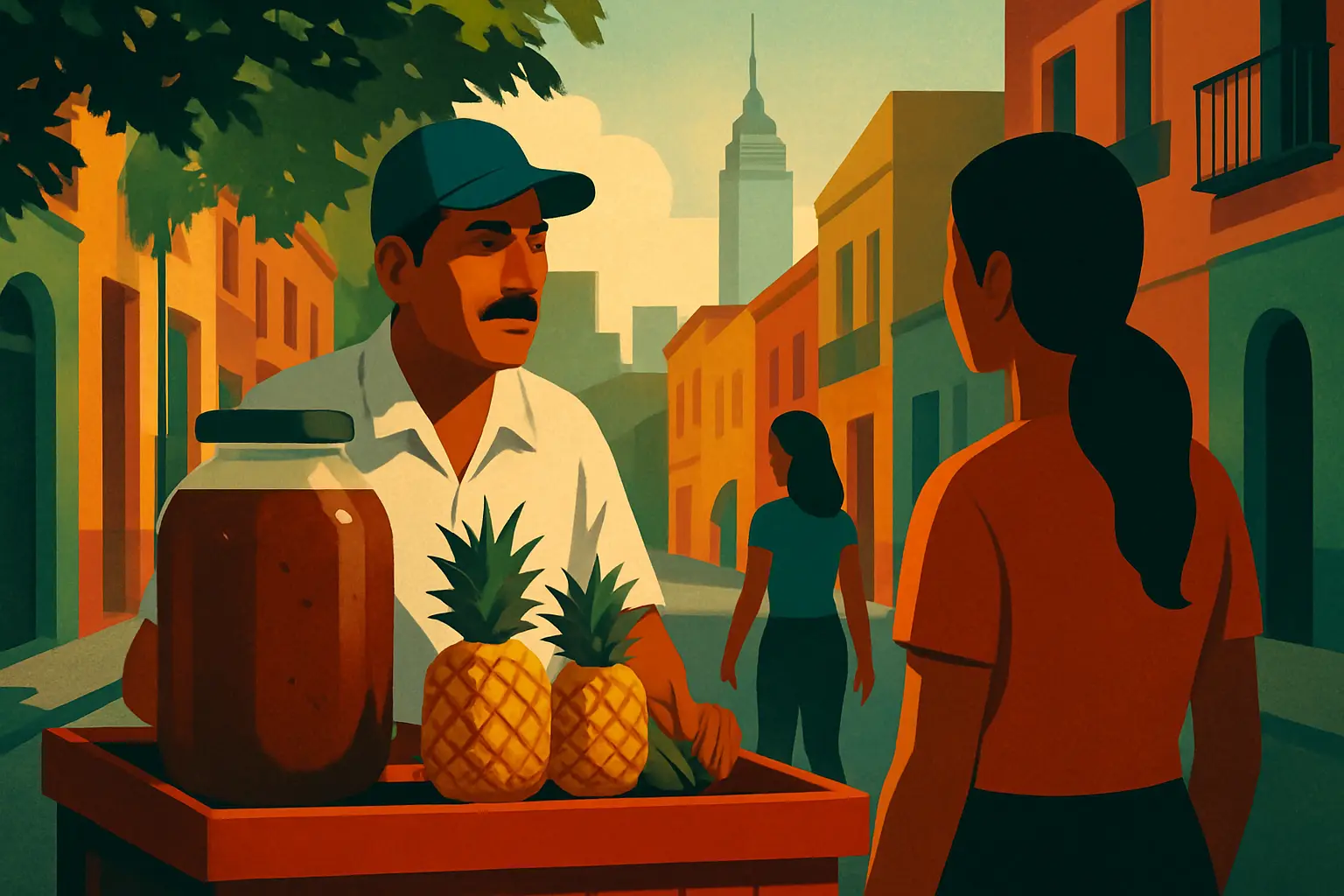
The most cited tepache vendor in Mexico City operates under the name El Oasis inside Mercado Hidalgo in Colonia Doctores — and what makes it notable is that it runs two separate stalls inside the same building, one on the Dr. Arce side and one on the Dr. Andrade side. The market sits two blocks from Arena Mexico on Dr. Balmis street, divided between a hardware wing and a food wing. El Oasis operates in the food section, selling tepache prepared with pineapple, apple, and tamarind — a combination that tilts the flavor toward something slightly tart and more complex than a straight pineapple batch. It is served cold from large containers, priced well under 30 pesos, and draws a crowd of market workers, hospital staff from Hospital General nearby, and regulars who treat it as an afternoon staple the same way other people treat coffee.
The Colonia Doctores location is worth visiting both for the tepache and for the neighborhood itself. If you are going to a lucha libre show at Arena Mexico, arriving early for comida corrida and tepache at Mercado Hidalgo is the logical pairing — both the experience and the timeline work together. See our guide to Colonia Doctores for the full picture of the barrio.
El Oasis: two stalls inside Mercado Hidalgo on Calle Dr. Balmis, Colonia Doctores — tepache made with pineapple, apple, and tamarind
Under 30 pesos per serving; peak hours are 11 a.m.–3 p.m. when market food traffic is highest
Two blocks from Arena Mexico — pairs naturally with the pre-show comida corrida lunch at the market stalls
Beyond Mercado Hidalgo, tepache appears at several other markets and on street corners throughout the city — though less systematically than tacos or aguas frescas, and less visibly than pulque, which has its own dedicated bar format. The best approach is to look for it at markets where vendors sell fermented and traditional drinks alongside fresh produce.
Mercado Jamaica on Congreso de la Unión in Iztacalco — the city's wholesale flower market — has tepache vendors operating from early morning alongside flower stalls, serving market workers before most of the city is awake. This is one of the least tourist-facing tepache experiences in the city. Mercado de San Juan on Ernesto Pugibet in Centro Histórico carries it in the drink section alongside other traditional beverages, in a market context where the clientele is mixed between tourists and local regulars. The Mercado de San Juan is already on most visitor itineraries; the tepache counter is easy to miss because it doesn't announce itself the way the imported cheese stalls and the juice bar do.
Street-level tepache also exists outside of formal markets — typically from a vendor with a cooler or large plastic barrel on a busy pedestrian corner, often near Metro exits or alongside taco carts in working-class neighborhoods. Tianguis (weekly street markets) in Doctores, Tepito, and Iztapalapa frequently have tepache vendors. The pattern to follow: wherever you see a vendor selling aguas frescas from large glass or plastic containers, there is a reasonable chance one of those containers holds tepache.
Mercado Jamaica (Congreso de la Union, Iztacalco): early-morning tepache for wholesale flower market workers — one of the least tourist-facing options in the city
Mercado de San Juan (Ernesto Pugibet, Centro): tepache available in the drink section alongside horchata and agua de jamaica
Weekly tianguis in working-class colonias regularly include tepache vendors — look for large opaque barrels or clay containers at drink stalls
The key detail about tepache production that surprises most people: the fruit flesh is almost never used. The fermentation comes from the rind — the outer skin and core of the pineapple — where wild yeast populations live. This makes tepache one of the few traditional drinks that uses a part of the fruit most kitchens throw away. A vendor or home cook combines the rind with water, piloncillo sugar, a cinnamon stick, and cloves in a sealed container, then lets it sit at room temperature for 24 to 72 hours. Longer fermentation means more alcohol, more sourness, and more complexity. Shorter fermentation produces something closer to a lightly fizzy pineapple juice with just enough ferment to give it depth.
At the end of fermentation, the liquid is strained, chilled, and sold. Nothing is added for carbonation — the fizz comes from CO2 produced naturally during fermentation and trapped in the liquid. This is also why the commercial versions taste different: pasteurization kills the live cultures, carbonation is added externally, and the wild-yeast character that gives street tepache its particular flavor is gone. Neither version is wrong, but they are answering different questions.
The pineapple rind — not the fruit flesh — provides the wild yeast that drives fermentation
Standard recipe: rind, piloncillo sugar, water, cinnamon stick, cloves — no added yeast or starter culture
Natural carbonation from CO2 produced during fermentation; commercial versions use forced carbonation after pasteurization
Mexico City has a specific vocabulary for traditional drinks, and tepache occupies a distinct position within it. Agua fresca — fruit blended with water and sugar, unfermented — is the category most visitors recognize first. Tepache starts as agua fresca but adds fermentation time, which moves it into a different sensory register entirely: less sweet, slightly sour, mildly alcoholic, with a depth that plain fruit water doesn't have.
Pulque is the other major pre-Columbian fermented drink in Mexico City, made from the fermented sap of the maguey plant rather than fruit, with a thicker consistency and a more aggressively funky flavor. Pulque typically runs 4–8% ABV and has its own dedicated bar format — the *pulquería* — covered in detail in our pulque guide. Tepache is lower alcohol, cleaner-tasting, and far easier to find from street vendors rather than dedicated bars. Tejuino — a cold corn-based fermented drink mixed with lime and chili — is tepache's closest cousin and is more commonly found in Guadalajara and western Mexico than in Mexico City.
Think of tepache as the entry point into Mexico's fermented drink tradition: lower stakes, approachable flavor, easy to find without seeking out a specialist venue, and priced such that you can try it once without commitment and come back for more if you like it.
Agua fresca: unfermented fruit drink; tepache = agua fresca with 1–3 days of wild fermentation added
Pulque: maguey sap fermented to 4–8% ABV, thicker and funkier — covered in our pulque guide
Tejuino: corn-based cold fermented drink with lime and chili — more common in Jalisco and the west than in Mexico City
Yes — tepache from established market vendors in Mexico City is safe by the same standard that makes eating tacos from a busy street cart safe: high turnover, consistent sourcing, and a product that fermentation itself makes inhospitable to harmful bacteria. The acidity and alcohol content of properly fermented tepache create an environment where pathogens don't survive. A vendor who goes through a full barrel per day is replacing it with a fresh batch every night — the product is never sitting long enough to spoil.
The practical caveat applies here the same way it does everywhere: a new vendor with low foot traffic who has been fermenting the same batch for a week in summer heat is a riskier proposition than El Oasis at Mercado Hidalgo, which runs a high-volume operation with visible turnover. Trust busy markets, established vendors, and containers that look well-maintained. Tepache that has gone genuinely wrong will smell obviously off — more like vinegar or alcohol than fruit. Your nose is the relevant instrument. If the smell is inviting, the tepache is safe.
Fermentation's natural acidity and low alcohol content protect against harmful bacteria — the same principle that makes traditional fermented foods safe
Trust high-turnover vendors at established markets; avoid low-traffic stands that may have old batches sitting
Off tepache smells sharply of vinegar or alcohol — if the aroma is inviting and fruity-sour, the batch is fine
Tepache is primarily a daytime drink — a morning or midday refreshment at a market, not a late-night bar order. The right time is when you are already at a market during peak hours: Mercado Hidalgo between 11 a.m. and 2 p.m., Mercado Jamaica between 7 and 10 a.m., Mercado de San Juan any time the market is active. Street vendors near major market zones often have it from mid-morning through mid-afternoon.
Ordering is simple: ask for 'un tepache' or 'una tepache de piña' and specify size if options exist. You will likely receive it in a clear plastic bag with a straw — the standard street-drink format for drinks that don't warrant a cup. Some vendors offer clay mugs. The temperature should be cold. If you want it sweeter and lighter, ask for *poco fermentado* — the vendor scoops from the fresher end of the barrel. Ask for *bien fermentado* if you want more depth and sourness.
One combination worth knowing: tepache mixed with beer (*a cubazo*) is a common street modification, usually with a light lager like Modelo Especial or Victoria. It produces something in the flavour profile of a shandy — more carbonation, the tepache tartness balanced by the cereal notes of the beer. Many vendors will mix on request.