Colonia Doctores sits directly south of Centro Historico and one avenue east of Roma Norte — but most travelers who know both neighborhoods have never crossed into it. The reason is Avenida Cuauhtemoc, which runs north-south as a hard dividing line: west of it, the restored mid-century apartments and wine bars of Roma Norte; east of it, Doctores, which has been a working-class barrio since the early 1900s and shows no particular urgency about becoming anything else. The streets here are named after physicians — Dr. Balmis, Dr. Arce, Dr. Andrade, Dr. Rio de la Loza, Dr. Lucio — a naming convention from a 19th-century urban plan that locals have used ever since to give directions. The neighborhood has absorbed decades of gentrification predictions and remained largely itself, quietly accumulating one of the most authentic street food cultures in the city along the way. Arena Mexico, on Calle Dr. Lucio, is not a venue that happens to be here. It is the reason here matters.
Bordered by Avenida Cuauhtemoc (west), Eje Central (east), and Eje 3 Sur Jose Peon Contreras (south)
Streets named after famous physicians — an 1880s naming convention that stuck and became the neighborhood's identity
One Metro stop from Centro Historico — centrally located but almost never crowded with tourists
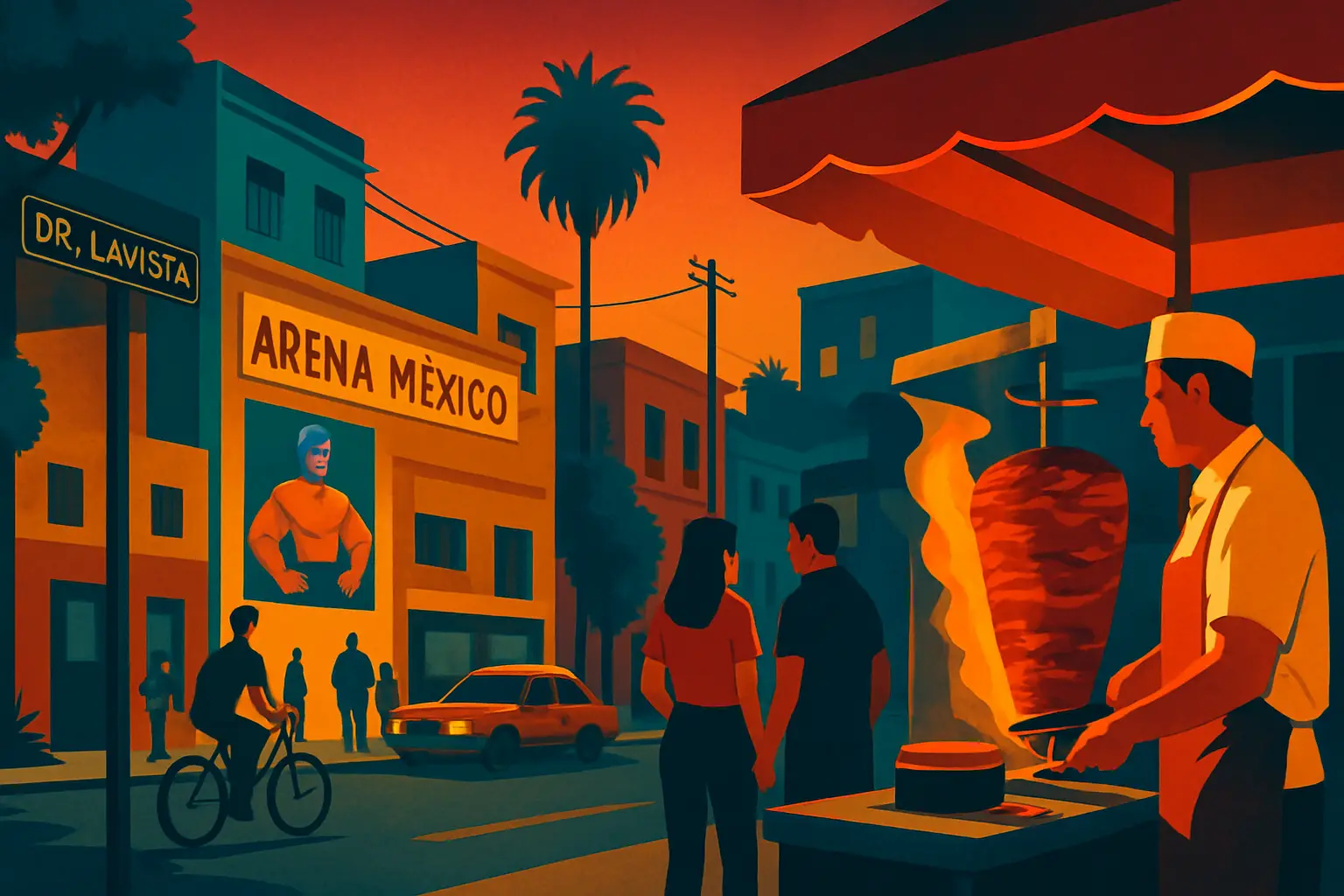
The building at Dr. Lucio 197 holds around 16,000 people and is the home of CMLL — Consejo Mundial de Lucha Libre — the world's oldest active professional wrestling promotion, founded in 1933. On show nights, the surrounding streets transform: mask vendors set up on the sidewalks selling the real thing (hand-stitched, not tourist-market replicas), food carts fire up, and fans in face paint fill Dr. Lucio from the Metro exit to the box office. Inside, the atmosphere is unlike any sporting event you have attended — técnicos (heroes) and rudos (villains) working a crowd that knows every character arc and cheers each aerial dive with genuine, generous noise. The building also carries 1968 Olympic history: it was used as the boxing venue for the Mexico City Games, one of the most politically charged Olympics in history — the same summer as the Tlatelolco massacre ten days before the opening ceremony. Going to a show here is among the best 200 pesos you will spend in this city. Our lucha libre explainer covers the técnico/rudo dynamic, mask history, and what to eat inside before you go.
CMLL — Consejo Mundial de Lucha Libre — is the world's oldest active professional wrestling promotion; Arena Mexico is its home
Used as the 1968 Olympic boxing venue — the same building, the same summer as Tlatelolco, one of Mexico's most contested historical moments
General admission (gradas) tickets sold at the box office day-of; reserved ringside available through the CMLL website in advance
Get short, interactive stories that make each place easier to remember while you travel.
Two blocks from Arena Mexico, Mercado Hidalgo sits in two adjacent buildings separated by Dr. Balmis street. The division is clear from the entrance: one building is entirely hardware — locks, PVC pipe, electrical tape, drill bits sold by the handful — and the other is food: produce vendors, butchers, and a row of small comedores serving comida corrida, the fixed-price lunch that Mexico City runs on (soup, rice, main course, agua fresca, somewhere between 60 and 90 pesos). El Oasis, a tepache stand that has operated here for years, actually runs two locations inside the market — one on the Dr. Arce side, one on the Dr. Andrade side — selling naturally fermented pineapple drink at prices that have not caught up to the Roma Norte tepache trend. This is the neighborhood's daily market, not a curated experience. The mechanics from the auto shops on Dr. Vértiz, the hospital workers from Hospital General, and the market vendors themselves eat here every afternoon. Going during lunch hour means sitting next to people who know exactly what they ordered and exactly why.
El Oasis tepache: two locations inside Mercado Hidalgo, on opposite sides of Dr. Balmis — fermented pineapple drink, properly made, under 30 pesos
Comida corrida at the food stalls: soup, rice, main, and agua fresca for under 90 pesos — the lunch the neighborhood runs on
Peak hours are 1–3 p.m.; most food stalls wind down by 5 p.m., so plan accordingly
The neighborhood's late-night food culture traces back to the early 1900s, when Colonia Doctores operated as a major trainyard for the Compañía de Tranvías — Mexico City's electric streetcar network. Workers pulling overnight shifts created demand for food in the small hours, and vendors responded with soup: caldo de pollo, cheap and warming, ladled out before dawn. That late-night food economy never disappeared. Today Doctores is one of the most taquería-dense colonias in the city — estimates put it at 130 or more registered spots, not counting the street carts that appear after 7 p.m. on show nights. The canonical order is suadero: beef brisket cooked low and slow in its own fat in a large copper cazuela, browned slightly before it hits the tortilla. El Progreso, on Dr. Enrique González Martínez, is consistently cited among the better suadero references in the city. Los Migueles is the carnitas institution — pork cooked in copper pots, sold by weight, popular enough that you want to arrive before 6 p.m. on weekends. Both are worth the detour even if you are not going to the arena.
Suadero: brisket cooked in copper cazuelas in its own fat, browned to order — the taco cut that Doctores handles better than most of the city
Los Migueles carnitas: sold by weight from copper pots, sells out on weekend evenings — arrive by 6 p.m.
Caldo de pollo at midnight: still a living tradition in the neighborhood, a direct inheritance from the trainyard worker culture of the 1900s
The case for spending more than two hours in Doctores is the neighborhood itself. The street grid between Eje Central and Avenida Cuauhtemoc is compact and walkable — the whole colonia is about a 20-minute walk across. A walk along Dr. Rio de la Loza from east to west passes old vecindades (working-class apartment blocks built around interior courtyards), auto repair shops with their roll-up doors propped open, corner stores with hand-painted signs, and boxing gyms in converted ground-floor spaces. Hospital General de México at Cuauhtemoc 32, in the far southwest corner of the colonia, is worth seeing from the street — a mid-20th-century public health complex whose scale signals what it was supposed to represent: a postwar bet on universal public medicine. It marks the boundary where Doctores ends and the Roma Norte border begins. Cross Avenida Cuauhtemoc heading west and the neighborhood changes completely within half a block — the kind of stark urban transition that is rare even in a city known for abrupt contrasts.
Dr. Rio de la Loza, east to west: the best single street to walk through the neighborhood — 20 minutes, entirely local, no tourist infrastructure
Hospital General de México (Cuauhtemoc 32): the building's scale reveals its ambition — mid-century Mexico's most serious public health project
The contrast at Avenida Cuauhtemoc is visible within half a block — Doctores and Roma Norte are adjacent but genuinely different worlds
The honest answer: yes, with the same common sense you would apply in any dense Latin American city. Doctores has a rougher reputation than Roma or Condesa, and some of that reputation is earned — the eastern portion, near Eje Central, feels different from the blocks immediately around Arena Mexico. On show nights, the streets around the arena are busy, vendor-patrolled, and well-lit — in practice, safer than many parts of the tourist circuit after dark. During the day, Mercado Hidalgo and the Dr. Balmis corridor are ordinary and unremarkable to navigate. What to avoid: wandering unfamiliar streets east of Eje Central alone after midnight, displaying your phone openly in crowds, and hailing cabs off the street late at night. The reliable pattern is this: visitors who come for a lucha libre show and street tacos, navigate by Metro and Uber, and stay within the arena zone report consistently positive experiences. People who come specifically to wander off-route alone late at night are making a different calculation. Stick to the plan, use rideshare for the ride home, and Doctores will deliver.
Around Arena Mexico on show nights: busy, vendor-heavy, security present — the crowd itself is the safety infrastructure
Use Uber or InDriver to leave after a night show; street cabs near the arena after midnight are not recommended
Daytime in Mercado Hidalgo and the Dr. Balmis area is unremarkable to navigate for any experienced city traveler
Metro Line 2 (blue line) stops at Doctores station — exit onto Dr. Vértiz and walk five minutes north on Dr. Lucio to reach Arena Mexico at number 197. Metro Line 3 (green line) stops at Hospital General if you are coming from the south or from Coyoacan. Most first-time visitors find Sunday the most accessible entry point: the matinee starts at 5 p.m. (versus 7:30–8 p.m. on weeknight shows), runs to about 8 p.m., and draws a broader mix of families and casual fans alongside serious regulars. Weeknight shows pull larger crowds for bigger cards and more theatrical productions — check the CMLL schedule online for featured matches. General admission tickets can almost always be bought at the box office the day of — walk up, pay in cash or by card, and take any seat in the upper gradas section for the best energy in the building. The ideal Doctores day: arrive at Mercado Hidalgo by 1 p.m. for comida corrida and tepache, walk Dr. Rio de la Loza west to east, get to Arena Mexico by 4:30 p.m. for the Sunday doors, and find suadero tacos on Dr. Lucio on the way to the Metro.
Metro Line 2 to Doctores station — 5 minutes on foot to Arena Mexico at Dr. Lucio 197
Sunday matinee (5 p.m. start) is the most accessible first show; check CMLL's website for featured match nights
The ideal itinerary: Mercado Hidalgo lunch → walk the Doctor Streets → Arena Mexico matinee → suadero tacos on Dr. Lucio → Metro home