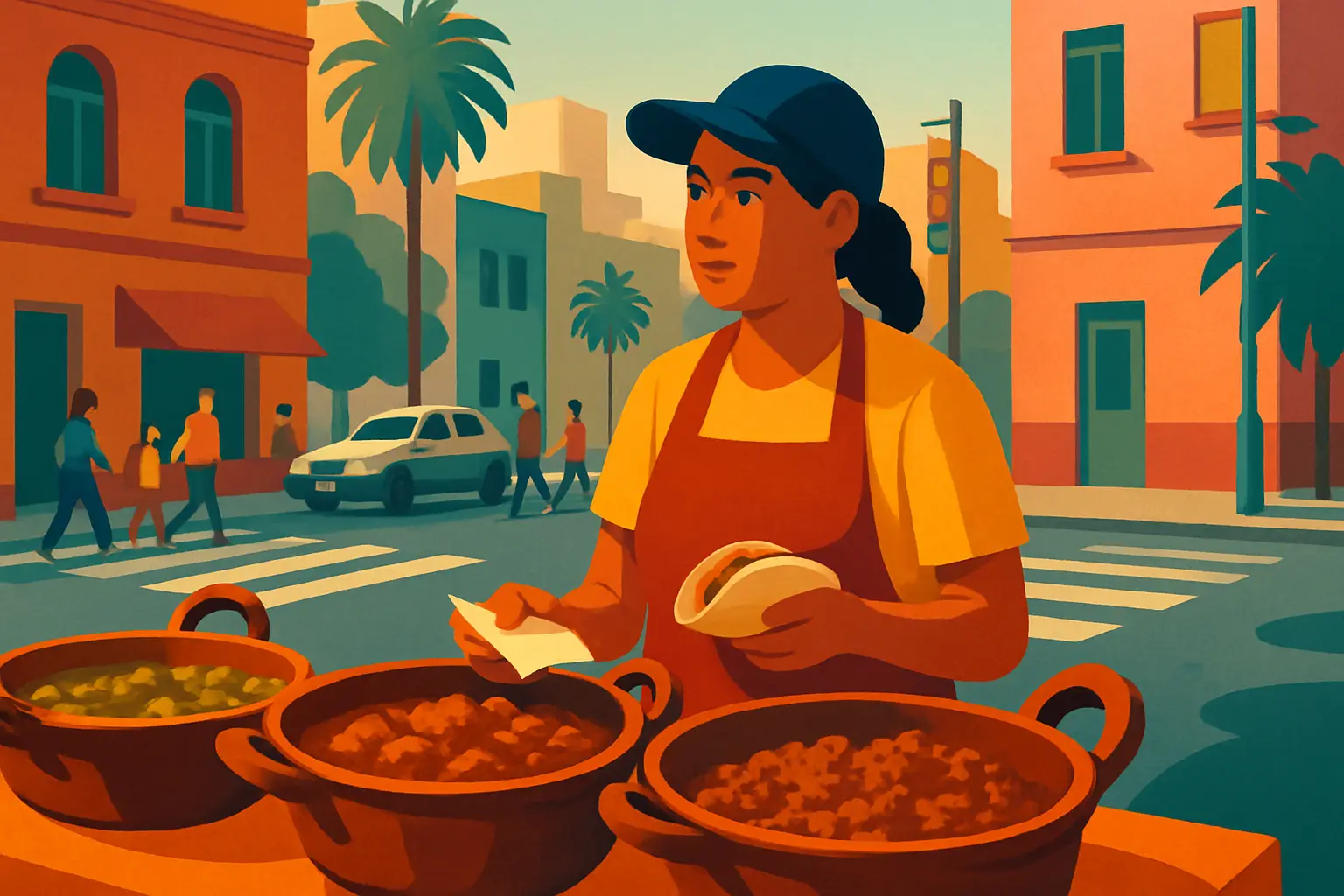
The word guisado means 'stew' — but in CDMX taco culture it refers to something specific: a taco filled with comida casera, the same home-cooked dishes a Mexican grandmother puts on the lunch table. Not grilled meat, not marinated pork on a rotating spit, not birria braised overnight in a clay pot. Guisados are the quotidian food of Mexico City — potato with chorizo, chicken tinga, nopales with onions, chicharrón in salsa verde, picadillo, rajas with cream — made in large batches every morning and kept warm in cazuelas (terracotta or aluminum pots) behind the counter until they're gone. The taquería de guisados looks completely different from every other taco stand in the city: instead of a grill or a trompo, you see a row of pots and a handwritten chalkboard listing the day's options. The corn tortillas are heated to order on a comal, two per taco, and the server spoons whichever filling you point at. Add salsa, onion, and cilantro from the condiment setup, squeeze a lime wedge over everything, and that's it. It is not fancy. It is extraordinarily good.
The key skill at a guisado counter is reading the board and pointing — you don't need more Spanish than a few basic words. The chalkboard or handwritten menu (often just a sheet of paper taped to the wall) lists that day's options. Common fillings include tinga de pollo (shredded chicken with chipotle and tomato), chicharrón en salsa verde (pork cracklings cooked in tomatillo sauce until soft and silky), rajas con crema (roasted poblano strips with cream), picadillo (ground beef with potato and tomato), papas con chorizo, nopales con cebolla (cactus with onion), and sometimes a mole rojo. Not everything is available every day — the cook decides based on the season, the market, and what they made that morning. Point at the pot, hold up fingers for the number of tacos, and say the name if you know it. Salsas — usually a verde and a roja — sit in small containers on the counter and are self-serve. The whole transaction takes about 30 seconds.
Tinga de pollo: shredded chicken with chipotle and tomato — the safest entry point for first-timers
Chicharrón en salsa verde: pork cracklings simmered in tomatillo sauce until soft — nothing like fried chicharrón
Rajas con crema: roasted poblano strips with Mexican cream — the best vegetarian option on most boards
Get short, interactive stories that make each place easier to remember while you travel.
Most guisado fillings fall into three categories: protein-forward, vegetable-based, and the pork offcuts. Protein-forward options include tinga de pollo, picadillo, bistec en salsa, and res en caldillo (beef in broth). Vegetable-based options — nopales, calabacitas con queso (zucchini with cheese), hongos en salsa (mushrooms), rajas — are more common here than at almost any other taco style. The pork offcuts category covers chicharrón en salsa, longaniza (Mexican fresh sausage), and moronga (blood sausage), which you'll see more often in Centro Histórico and working-class markets than in Condesa or Roma. The chicharrón de guisado deserves special mention: simmered in tomatillo salsa until the fried pork cracklings become gelatinous and soft, it's completely different from the crunchy version — more like a porky slow-cooked ragu than a snack. If you see mole rojo on the board, order it. Guisado mole is rarely the complex 30-ingredient restaurant version, but it's the version most Mexicans grew up eating at their grandmother's table on Sundays.
The most-cited name in conversations about tacos de guisado in Mexico City is Tacos Hola el Güero at Calle Atlixco 38 in Condesa, a few blocks south of Parque México. The counter has been operating since 1968, which means it outlasted at least five waves of Condesa gentrification without changing much. The setup is standard guisado arrangement — a row of cazuelas, a handwritten board, a comal running non-stop — except with a longer menu than most and a consistency that makes it the benchmark other spots are measured against. The chicharrón en salsa verde here is the version people name first when describing what they ordered; the tinga de pollo and picadillo are equally reliable. Open 10am to 6pm daily, it has a longer window than most competition. Seating is limited to a counter facing the kitchen and a few tables on the sidewalk. The neighborhood makes it easy to build a full morning around Condesa: Parque México is three blocks north, the Amsterdam circle is walkable, and the coffee bars on Álvaro Obregón are a ten-minute walk east.
Address: Calle Atlixco 38, Condesa — 3 blocks south of Parque México
Hours: 10am to 6pm daily — later than most guisado spots
Order: chicharrón en salsa verde first, then tinga de pollo if you're still hungry
Los Barriles is one of the city's most respected guisado operations, run by a husband-and-wife team with stands at the Sullivan Tianguis — the Sunday market along Paseo de la Reforma near Parque Sullivan, between Insurgentes and Reforma — and at the Mercado Narvarte on Dr. Liceaga. Their guisados rotate with the season, lean toward vegetable-heavy options, and are frequently cited by food writers as the best in the tianguis circuit. In Narvarte, the market itself is worth the trip: the interior market on Dr. Liceaga has guisado counters alongside fresh produce stalls, making it easy to see exactly where the ingredients come from. Beatricita in Zona Rosa — operating for over a century on Génova — is the oldest guisado taquería still running under the same family. The recipes trace to the early 1910s. Mercado de San Juan at Ernesto Pugibet 21 in Centro Histórico has several guisado counters toward the back of the market, far from the imported cheese and wine stalls near the entrance that food press tends to photograph. Those back counters are where the neighborhood's office workers eat lunch.
Every neighborhood in Mexico City has guisado spots, but some make the hunt easier. Condesa is the easiest starting point for visitors: Tacos Hola el Güero is consistent, well-known, and near Parque México. Roma Norte has several counters along Orizaba and around Mercado Medellín on Campeche — arrive at Mercado Medellín at noon on any weekday and you'll find at least three guisado options inside and one more on the street outside the main entrance. Centro Histórico has the most variety at the lowest prices: walk any block between the Zócalo and Alameda Central between 11am and 2pm and you will encounter multiple guisado stands, many operated out of folding tables with a single burner and a pair of pots. Narvarte has Los Barriles at the market and several street counters along División del Norte. In every case, the signal is the same: a row of pots, a handwritten board, and people eating on plastic stools or standing up.
Condesa: Tacos Hola el Güero on Atlixco 38 — most consistent for visitors
Roma Norte: Mercado Medellín on Campeche — three to four guisado options at noon
Centro Histórico: highest density of street guisados, lowest prices — anywhere between Zócalo and Alameda
By 3pm, most guisado counters in Mexico City are closing or completely sold out. The best ones — El Güero, Los Barriles, the Mercado Medellín counters — often run out of the most popular fillings an hour before the stand closes, leaving only the less popular options on the board. Noon to 1pm is the sweet spot: fillings are fully stocked, the comal is hot, and you can choose from the full menu. If you arrive late and the board is stripped down to one or two options, you haven't failed — you've identified a spot worth returning to the next morning earlier. The exception is market guisados on Sunday: the Sullivan Tianguis runs until about 3pm and Los Barriles keeps pace with the market crowd. Guisados are a fundamentally morning-and-lunch food in CDMX culture — trying to find them at dinner is like looking for breakfast burritos in a city where dinner starts at 9pm. The rhythm is part of the experience.
You don't need Spanish to order guisados, but a few phrases remove friction. '¿Qué tiene hoy?' (What do you have today?) works even if you can already read the board — it invites the cook to tell you what's fresh and what they'd recommend. '¿Cuál recomienda?' (Which do you recommend?) almost always gets a genuine answer. 'Con salsa verde' or 'con salsa roja' tells them which salsa to add; 'con todo' means onion, cilantro, and salsa together. A full order in seven words: 'Tres tacos de tinga y uno de chicharrón' — three tinga and one chicharrón. Pay when you're done, not before. Coins and small bills are appreciated; handing over a 50-peso note while walking away without a word is completely normal. One more thing: if you ask what something is and the cook explains it in fast Spanish, nodding and pointing at the pot you meant to order anyway is a perfectly valid response.