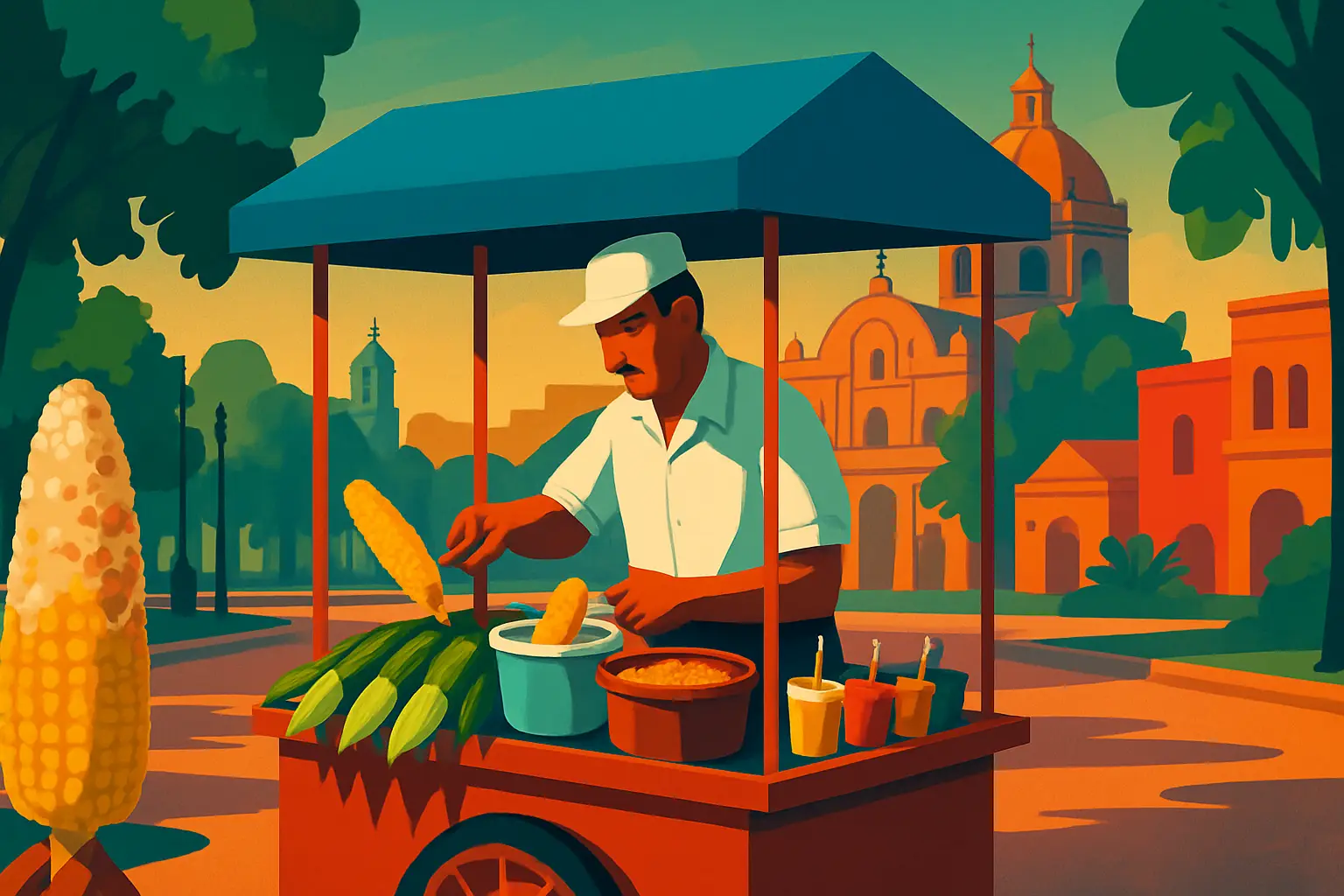
The single most important thing to understand before you approach an elotero cart is that elote and esquites are not the same food in two formats. Elote — from the Nahuatl word elotl, meaning tender cob — is corn served on the cob, usually staked on a wooden stick or held upright in the cup of your hand. Esquites (from the Nahuatl izquitl, meaning toasted or cooked corn) are kernels removed from the cob, placed in a foam cup with a generous ladle of the hot, herb-infused liquid the corn has been simmering in all afternoon, and then finished with the same toppings. The difference between the two isn't just presentation — it's texture, temperature, and most critically, the presence or absence of the caldo. The broth in a proper cup of esquites is starchy, herbed, and carries the accumulated flavor of everything that's been simmering in the pot since the vendor set up. It keeps the kernels moist, it carries heat, and it makes esquites a hybrid between a snack and a cup of soup. A cup of esquites without adequate caldo is considered a shortcut by serious vendors and by the locals who eat from these carts regularly. When you order, always say 'un vaso con caldo' and watch the vendor ladle the liquid into the cup before the toppings go on — if they skip it or pour very little, you can ask for more.
The word elote is Nahuatl that survived Spanish conquest intact: elotl, meaning the tender, fresh ear of maize before it dries. The entire category of Mexico City street food built around corn — tacos on corn tortillas, tamales, tlacoyos, huaraches, esquites, pozole — traces back to the agricultural revolution that unfolded in this specific valley. Mexico City sits in the Valley of Mexico at 2,240 meters elevation, the same basin where the Aztec capital of Tenochtitlan was built on a lake island in the 14th century. The cultivation of maize in central Mexico dates to approximately 5,000–7,000 years ago, and the varieties grown in the valley developed in a direct relationship with this altitude, this climate, and the volcanic soils of this particular basin. What this means practically: corn sold from an elotero cart in Mexico City is often grown within 200 kilometers of the cart, from varieties that have been selected and refined in this environment for generations. The cacahuazintle corn — a large-kerneled, starchy, white heirloom variety from the Toluca valley in the State of Mexico, directly adjacent to CDMX — is the variety most associated with esquites and pozole in central Mexico. It is a fundamentally different ingredient from the sweet yellow corn Americans know from grocery stores: denser, starchier, slightly earthier in flavor, and substantially more interesting when slow-cooked in an herb-infused pot. When you eat a cup of esquites in Mexico City, you are tasting a corn variety and a cooking tradition that developed in this valley before the Aztecs built Tenochtitlan.
Elote comes from the Nahuatl elotl — the same language spoken in Tenochtitlan before the Spanish arrived
Cacahuazintle: the starchy, large-kerneled white heirloom corn from Toluca used in CDMX esquites — denser and more flavorful than US sweet corn
Corn cultivation in central Mexico dates to 5,000–7,000 years ago — the elotero cart is the most recent chapter in a very long story
Get short, interactive stories that make each place easier to remember while you travel.
The elotero cart is a standard fixture in every neighborhood of Mexico City — a modified bicycle or pushcart with a large cylindrical metal container of hot water, beneath which sits a gas burner or coal setup that keeps everything at a constant simmer. Inside the container: whole ears of corn submerged in the liquid, along with a handful of epazote — a pungent native Mexican herb with a sharp, slightly resinous smell that has no clean Western equivalent — and sometimes dried chile or garlic. The corn simmers for hours, kept warm and ready throughout the afternoon and evening. The vendor also typically carries a smaller secondary vessel for esquites: loose kernels simmering in the same herbed liquid. The condiment station is arranged within easy reach: a jar of mayonnaise or crema Mexicana (tangier and thinner than US sour cream), a block of cotija cheese for grating directly onto the corn, powdered chile piquín or tajín (a commercial dried chile-lime-salt blend that is ubiquitous in Mexico), cut lime wedges, and increasingly, chamoy — a savory-sweet-sour-spicy condiment made from pickled fruit that has become standard at many carts. The sequence in which these toppings are applied matters and has a logic: mayo or crema goes on first (it sticks to warm corn and creates a surface for dry toppings to adhere to), then cotija is grated or crumbled on, then chile powder, then lime is squeezed over the top. Chamoy, if used, typically goes on last.
The elotero interaction moves fast and has its own vocabulary. For elote on the cob: say 'uno con todo' — with everything — and the vendor will apply crema or mayo, cotija, chile, and lime in sequence. This is always the correct default. If you want extra chile, say 'con más chile'; if you want it without mayo, say 'sin mayonesa, con crema.' For esquites: say 'un vaso de esquites con caldo' — a cup of esquites with broth. Watch that the caldo goes in first, then toppings. If you want to understand what you're tasting, ask for the toppings on the side and try the corn with just the caldo first — the epazote note is most detectable before the chile and lime mask it. Key ingredient notes: cotija is the correct cheese — a dry, salty, crumbly cow's milk cheese from Michoacán that does not melt. Its job is saltiness and textural contrast, not creaminess. Oaxacan quesillo would be wrong here. For heat, tajín is the mild, crowd-pleasing option (familiar to most Americans from the mango cups at US Mexican restaurants). Chile piquín is hotter and more traditional. Chamoy is polarizing — some Mexicans apply it liberally, others consider it an abomination on corn. If you're unsure, ask the vendor to put chamoy on half the cup first so you can taste before committing.
Con todo = mayo/crema + cotija + chile + lime — the standard full preparation, always the correct default
Cotija is a dry, non-melting cheese — its role is salt and crunch, not creaminess
Tajín = mild commercial chile-lime-salt; chile piquín = hotter and more traditional — know which you're getting
The most reliable signal for a good elotero is a line. A cart that's been in the same spot for years builds a neighborhood reputation that's visible immediately. Specific fixed reference points: Near Parque Lincoln in Polanco (between Emilio Castelar and Julio Verne), several elotero carts set up from around 3 p.m. onward — one of the densest concentrations of carts in the city and a reliable first-time experience. Elotes de la Villa, in the streets surrounding the Basílica de Guadalupe in the northern part of the city (near Metro La Villa-Basílica on Line 6), has a serious local reputation as among the best in the city. The pilgrimage is worth it: the lines can be long, the setup is spartan, and the corn is usually noticeably better. The streets around Mercado de Jamaica (Metro Jamaica, Line 9) have several strong vendors using corn and herbs sourced directly from the wholesale market adjacent to the food stalls — provenance that close to the source translates to flavor. The area near Reforma 222 (where Avenida Reforma intersects with Niza, a short walk from the Insurgentes roundabout) has a well-known esquites vendor with a deep caldo and a house peanut oil salsa that is genuinely different from the standard lineup. In Roma Norte and Condesa, elotero carts operate in Parque España and Parque México from late afternoon — reliable, convenient, and often lighter on the caldo than the neighborhood-institution carts farther north.
Parque Lincoln, Polanco: high cart density starting around 3 p.m. — a good reference point for a first experience
Elotes de la Villa near Basílica de Guadalupe (Metro La Villa-Basílica, Line 6): local reputation for some of the city's best, with lines to match
Mercado de Jamaica area: vendors sourcing corn and epazote directly from the adjacent wholesale market
The detail most visitors miss entirely is the epazote added to the elotero's pot. Epazote (Dysphania ambrosioides) is a native Mexican herb with a smell that can only be described as: nothing you've encountered before. It's sharp, slightly resinous, with a faint petroleum-adjacent quality in large doses — qualities that in moderated amounts translate into a clean, herby complexity in the cooking water. Pre-Hispanic Mexicans used epazote medicinally as a digestive aid and as a culinary herb for beans and corn. Its presence in the elotero pot means the corn gradually absorbs a faint herbal note as it simmers — subtle on the cob, much more present in a cup of esquites with caldo, where you're drinking the liquid directly. Epazote also appears in CDMX-style black beans, in certain quesadillas (quesadillas de elote con epazote are a genuinely local preparation), and in soups. The caldo in your esquites cup should have a slight greenish tinge and a distinct herbal note before the toppings are added — this is the signal that the vendor is using it. If your esquites caldo tastes only of starchy corn water with no herbal complexity, epazote was either skipped or used in negligible amounts. That's a corners-cut signal, the same as insufficient broth in the cup.
The corn itself is one of the safer street food options in Mexico City — it has been simmering in actively hot liquid for hours, well above any food safety temperature threshold. The cheese is also generally low-risk: cotija is a dry-aged cheese with very low moisture content that doesn't spoil quickly, and at a serious cart it's kept as a fresh block and grated to order. The mayonnaise is where judgment matters. Look for a vendor using a commercial sealed jar and keeping it in a cool spot — a jar of mayo that has been open and sitting in direct afternoon sun at 30°C for hours is a genuine risk. Many experienced carts keep their mayo in a small insulated bag or covered container for exactly this reason. Vendors with high turnover are always lower-risk because the jar is being actively used rather than sitting open. The lime, chile powder, and tajín are all shelf-stable and pose no risk. Practical approach: the corn, caldo, cotija, chile, and lime are all safe calls. For the mayo question, look at the vendor's setup before ordering — a busy cart with good hygiene practices is visible at a glance. If unsure, order with crema or simply ask for the cheese and chile without the creamy element on your first visit.
The corn and caldo are among the safest street food options — continuous hot liquid keeps them at cooking temperature throughout the day
Cotija (dry-aged cheese) is low-risk; open mayonnaise in direct sun is the one variable worth checking
High-turnover carts are always safer — an active jar of mayo is lower-risk than one sitting open for hours
Elotero carts operate primarily from the late afternoon into the evening — roughly 3 p.m. to 9 p.m. in most neighborhoods. Morning elote is rare in Mexico City; this is not a breakfast food in the local tradition. The ideal window is 4–7 p.m.: the corn has been simmering long enough to be fully soft and epazote-infused, the vendors are at peak freshness, and the afternoon heat of the city makes the salty-spicy-creamy combination specifically satisfying. A seasonal note relevant right now: May through September is CDMX's rainy season. Afternoons frequently bring sudden, heavy showers around 4–6 p.m. This doesn't shut down the elotero carts, which typically operate from a covered spot or under a small awning, but it does mean that carts positioned under a building overhang, inside a market entrance, or beneath a tree-lined street will maintain heat better than exposed curbside setups. The rain also drives more customers to covered spots, increasing turnover — which is good for corn quality. In the dry season (November through March), colder evenings make esquites particularly popular as a warming cup-soup-snack hybrid. A foam cup of hot esquites with caldo on a 12°C Mexico City night is one of the most specifically satisfying eating experiences the city offers.
Best hours: 4–7 p.m. — the corn is fully simmered and epazote-infused, and vendors are at peak setup before the evening slowdown
Rainy season (May–September): look for carts with covered setups — they maintain heat better during afternoon showers and get more customers
Cold-season esquites: the hot caldo makes them function as a warming cup-soup-snack on chilly CDMX evenings — peak comfort food