In 1811, the New York State Legislature adopted the Commissioners' Plan — the blueprint that imposed the numbered street and avenue grid on nearly all of Manhattan. It was a bold and efficient act of urban planning. It was also applied to land that was mostly farmland and forest north of the existing settlements at the tip of the island.
Greenwich Village was already there. The original Village had developed organically since the 1600s, when Dutch settlers established a tobacco plantation called 'Noortwyck' north of the colonial town, and its lanes, paths, and property lines were already entrenched. The commissioners exempted the Village from the grid. The streets kept their old angles.
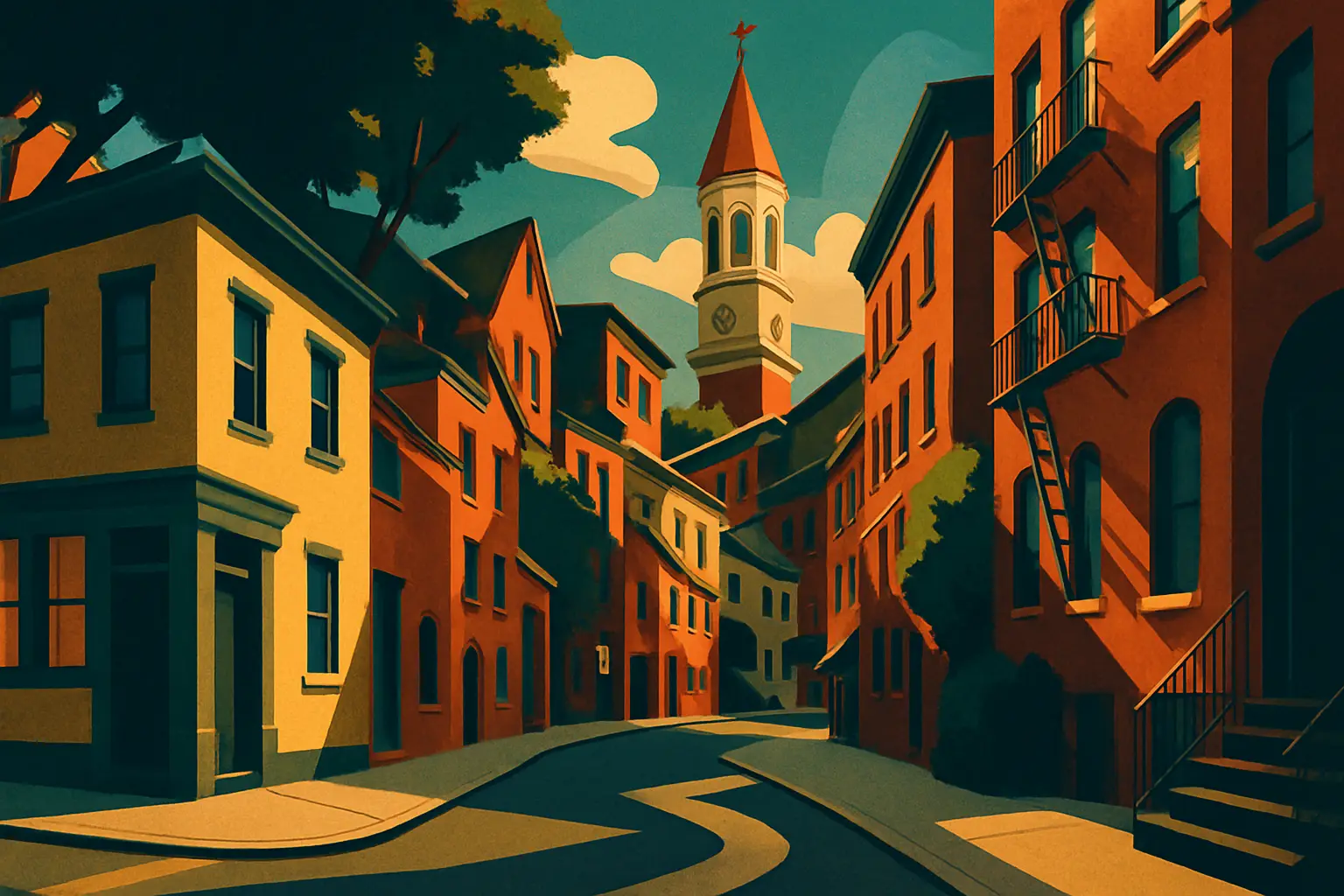
The result, particularly in the blocks west of 7th Avenue South — the area now called the West Village — is a street map that looks like it belongs to a European city. Bleecker Street and West 4th Street intersect at an angle and then intersect *again* a few blocks later. Grove Street enters the picture diagonally. Christopher Street runs southeast to northwest at about 45 degrees before the grid catches it. There is an intersection of West 10th, West 4th, and 6th Avenue that reliably confuses people who navigate by the numbered system.
This is not a design flaw. It is the physical record of a village that existed before the plan. Walking the West Village is the only place in Manhattan where the street layout tells you something true about the history of the island under your feet.
In the 1950s, New York's master builder Robert Moses proposed the Lower Manhattan Expressway — a raised ten-lane highway that would run along Broome Street from the Holland Tunnel to the Manhattan Bridge, cutting through SoHo and the southern edge of Greenwich Village, demolishing roughly 2,000 buildings and displacing 10,000 residents. Moses had already done this across the Bronx with the Cross Bronx Expressway, and the model had worked in his terms: the highway got built.
Jane Jacobs lived at 555 Hudson Street, at the corner of Morton Street, two blocks east of the Hudson River. She was not an urban planner by training — she was a writer and editor who had moved to the West Village in 1947 and spent years watching how her street actually worked. She observed that Hudson Street was alive because it had mixed uses on mixed schedules: a tobacco shop opened early, an Italian restaurant brought in evening foot traffic, the school and the locksmith and the bar each drew different people at different hours. The street felt safe because it was always occupied by someone.
When the Expressway was proposed, Jacobs organized the Joint Committee to Stop the Lower Manhattan Expressway and testified before the Board of Estimate in 1958 and again in 1962. The highway was rejected both times and officially killed in 1969. Moses, who had never lost a major project before, lost this one.
Jacobs published 'The Death and Life of Great American Cities' in 1961, while the fight was still ongoing. The book, written largely from her observations of Hudson Street and Christopher Street, became the foundational text of modern urban planning criticism. It is still read in urban planning programs. The block of Hudson Street between Morton and Barrow is now named Jane Jacobs Way.
SoHo, which Moses would have demolished, became one of the most valuable neighborhoods in the country. The West Village, which he would also have touched, survived intact.
Get short, interactive stories that make each place easier to remember while you travel.
Christopher Street ran through the center of New York's gay neighborhood long before the word 'neighborhood' applied to such a thing. Through the 1950s and 1960s, gay bars in New York were illegal — the State Liquor Authority could revoke a bar's license for 'disorderly conduct,' which included serving gay customers. Police regularly raided bars in the West Village, arresting patrons, sometimes photographing them, and turning their names over to employers and family members.
The Stonewall Inn at 53 Christopher Street was owned by the Genovese crime family, which paid off police to let it operate. On June 28, 1969, police conducted a routine raid. The patrons — transgender women, gay men, lesbians, many of them homeless youth who had nowhere else to go — did not comply. They resisted. The resistance turned into three days of protests that drew hundreds of people into Christopher Street and Sheridan Square.
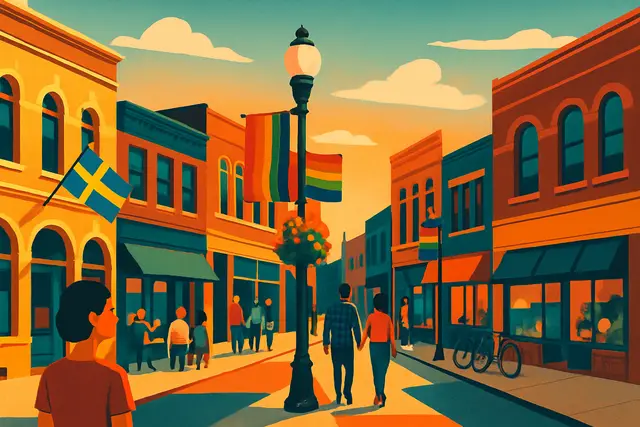
The Stonewall Riots did not create the gay rights movement, but they transformed its character. Within months, the Gay Liberation Front and the Gay Activists Alliance had been founded in New York. Within two years, Pride marches were being organized in cities across the country. The first took place on Christopher Street in June 1970.
The Stonewall Inn was designated a National Monument in 2016 — the first in U.S. history to honor LGBTQ history. The surrounding Christopher Street–Sheridan Square plaza has a series of historical markers and the 1992 George Segal sculpture 'Gay Liberation,' which shows two same-sex couples standing and sitting in quiet conversation, placed directly across from the bar. Christopher Street itself, once the commercial heart of gay New York, has lost many of its historic businesses to rising rents — but the street's physical geography, from the bar at number 53 to the Christopher Street pier at the Hudson River, tells the whole story if you know where to look.
Stonewall Inn: 53 Christopher Street; open noon daily; admission free, cover charge for some events; National Monument designation covers the building, the plaza, and the Christopher Street pier
Christopher Street–Sheridan Square: the plaza outside the bar has historical markers and the George Segal sculpture 'Gay Liberation' (1992)
The Christopher Street pier at the Hudson River has historically served as a gathering space for LGBTQ youth who were not welcome elsewhere — the pier is now part of Hudson River Park
At 113 Jane Street, between Washington Street and West Street, there is a narrow brick building that looks like it was designed for a different century — because it was. The Jane Hotel opened in 1908 as the American Seamen's Friend Society Sailors' Home and Institute, a nonprofit organization that provided cheap lodging for merchant seamen arriving in New York. Rooms were small by design — bunks in a building built to the dimensions of a ship's berth.
On April 15, 1912, the RMS Titanic sank in the North Atlantic. The surviving crew members — 212 sailors who had lost their ship — arrived in New York four days later aboard the Carpathia. The American Seamen's Friend Society took them in. The survivors stayed at 113 Jane Street.
The building spent most of the 20th century as a single-room occupancy hotel (SRO), serving transient residents at low cost. By the 1980s and 1990s it was in serious decline. In 2008, it was renovated by hotelier Sean MacPherson into a boutique hotel — but the room sizes were kept essentially as they were. The Captain's Cabin rooms are about 50 square feet, with bunk beds and a shared bathroom down the hall. They are deliberately maritime. The ballroom, preserved from the original building, operates as an event space.
The Jane is not cheap by the standards of what you get. It is one of the stranger and more specific hotels in New York, and the corner of Jane Street and West Street — where the original seamen's home received sailors from the piers directly outside — is worth knowing about regardless of whether you stay there.
White Horse Tavern at 567 Hudson Street has been open since 1880. It is one of the oldest continuously operating bars in New York City, and through the 1950s it was the main literary bar in the Village — the place where writers who couldn't afford the Cedar Tavern scene in East Village came to drink cheap beer and argue about literature.
Dylan Thomas was its most famous regular. The Welsh poet had a habit of drinking past his limits, and on November 3, 1953, after returning from a poetry reading at the Poetry Center on 92nd Street, Thomas reportedly told people at the bar: 'I've had 18 straight whiskies, I think that's the record.' He went back to the Chelsea Hotel, collapsed into a coma, and was taken to St. Vincent's Hospital, where he died four days later at 39. A portrait of Thomas hangs in the bar.
Jack Kerouac, Hunter S. Thompson, Norman Mailer, and Bob Dylan (who named himself after Thomas) all drank at White Horse. The bar became so associated with the Beat writers that it started charging an admission fee in the early 1960s to filter out tourists — a decision it eventually reversed.
The tavern today is a neighborhood bar that happens to be 145 years old. There is no velvet rope, no $22 cocktail menu. Order a draft beer. The Dylan Thomas corner is marked. The room has not changed significantly since the 1950s, and the lack of renovation is exactly the point — it is one of the few places in the West Village where you can sit in something close to the original atmosphere of the neighborhood before the money arrived.
White Horse Tavern: 567 Hudson Street; open daily from noon; cash preferred but cards accepted; no reservations
Dylan Thomas portrait is on the wall to the right of the entrance bar — ask the bartender if you cannot find it
St. Vincent's Hospital, where Thomas died, stood at 153 West 11th Street; the site is now a condo development, but a plaque remains
The West Village has more good restaurants per block than almost any neighborhood in New York, and almost none of them take walk-ins easily on a weekend evening. Plan accordingly.
Via Carota (51 Grove Street) is the benchmark. Italian, seasonal, no reservations, full house every night. Rita Sodi and Jody Williams opened it in 2014 and it immediately became one of the most influential restaurants in New York — not for novelty but for precision. The cacio e pepe, the grilled branzino, the pinzimonio (raw vegetables with dipping sauces), the tiramisù. The trick is to arrive before 5:30 p.m. and ask for the bar counter.
Buvette (42 Grove Street), also by Jody Williams, is the smaller, earlier project — a French-ish wine bar that opens at 8 a.m. and serves café au lait in the morning and natural wine at night, with charcuterie and egg dishes all day. It has about 25 seats and one of the best breakfast atmospheres in Manhattan.
Chumley's at 86 Bedford Street is a former Prohibition-era speakeasy (no sign, unmarked entrance through a courtyard — look for the door at the alley entrance on Barrow Street). During Prohibition, police raids meant guests escaped through one door while the bartender was on the phone telling them to '86' the place. The phrase entered the English language here. Chumley's closed, was renovated, and reopened as an upscale American restaurant in 2016. The speakeasy atmosphere is preserved.
Corner Bistro at 331 West 4th Street is the antidote to Via Carota's pricing — a $10 burger, a $5 McSorley's beer, vinyl bar stools, wood-paneled walls, and a cash-only policy since 1961. The Bistro Burger with bacon is the order. It is, by multiple serious estimations, one of the best burgers in New York.
For cocktails: Employees Only (510 Hudson Street) is a prohibition-themed bar with some of the best craft cocktails in the city, behind a psychic shop storefront. It opens at 5 p.m. and fills up. The kitchen stays open until 3:30 a.m., which is when the neighborhood's restaurant workers arrive after their shifts.
How is the West Village different from Greenwich Village? They share history and were once considered one neighborhood, but the West Village — roughly the blocks west of 7th Avenue South and north of Houston Street — has developed its own identity: more residential, more expensive, quieter, with a higher density of townhouses and fewer NYU students. The Greenwich Village guide covers Washington Square Park, Bleecker Street's music history, and the MacDougal Street café scene, which are worth reading together.
How do I get around? The West Village is best navigated on foot. The blocks are short and the streets change direction often enough that a map helps — use it, and accept that you will get turned around at least once. The neighborhood is roughly bounded by 14th Street to the north, Hudson Street to the east, West Houston to the south, and the Hudson River to the west. From end to end it takes about 25 minutes to walk.
Is it walkable from the High Line? Yes. The High Line ends at Gansevoort Street, which is the northern border of the West Village and the heart of the Meatpacking District. Walk south on Washington Street from the High Line's terminus and you're in the neighborhood within two blocks.
Best time to visit? September and October. The brownstone-lined blocks — Perry Street, Jane Street, Charles Street — are at their best in early fall, when the street trees are beginning to turn and the afternoon light hits the facades at a low angle. The tourist crowds thin in September, restaurant waits shorten slightly, and the neighborhood's residential character asserts itself again after August.
Is it expensive? The West Village is one of the most expensive neighborhoods in Manhattan. Expect restaurant prices to run $60–$120 per person at dinner. Corner Bistro and White Horse Tavern are the reliable cheap options.