The name is a real-estate abbreviation invented in 1966 by local activists trying to prevent highway construction: Triangle Below Canal Street. The shape is roughly accurate — the neighborhood is bounded by Canal Street to the north, Broadway to the east, the Hudson River to the west, and Chambers Street to the south. It's small, roughly 40 blocks, easy to walk end to end.
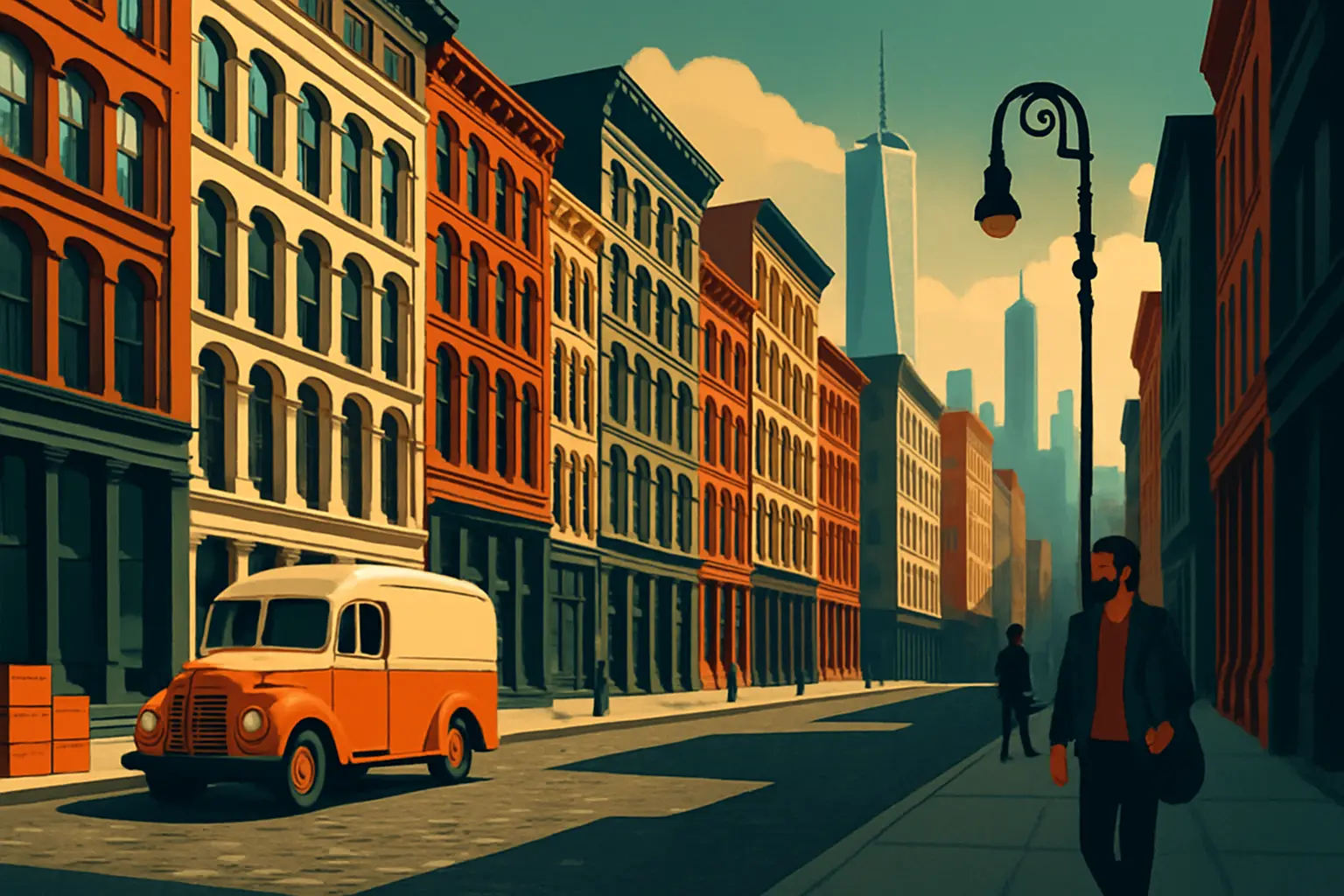
For a century, Tribeca existed as a wholesale distribution district. The cast-iron buildings along Hubert, Harrison, and White Streets were built between 1860 and 1900 specifically for commercial storage and shipping — high ceilings to stack goods, open floors for sorting, loading bays at street level. By the 1960s, the food-distribution businesses had relocated to Hunts Point in the Bronx and the textile firms had moved overseas. The warehouses sat empty.
The same sequence that made SoHo — one neighborhood to the north, also cast-iron, also industrial — happened in Tribeca a decade later, with less spectacle. Artists priced out of SoHo in the late 1970s moved south and found even more space for even less money. Robert De Niro was among them; he moved to the neighborhood in the 1980s when industrial space could be had for nearly nothing and never left.
The art world followed the artists. The money followed the art world. By the early 2000s, the average condo in Tribeca sold for more per square foot than Park Avenue. The neighborhood that nobody wanted became the neighborhood everyone pays for — and the cast-iron warehouses that survived because they were worthless are now worth more than almost anything else in the city.
The most striking single image in Tribeca is a pedestrian skybridge connecting two buildings at 9 and 11 Staple Street — a narrow lane tucked between Harrison Street and Jay Street, easy to miss if you're not specifically looking for it. The bridge is a simple iron arch, built in the late 19th century to move goods between warehouses without descending to street level. In a city that demolished virtually every piece of working industrial infrastructure from that era, Staple Street survived because it fell through the gaps of successive urban renewal campaigns. The Tribeca Historic District designation, established in 1992, locked in protection for the surrounding blocks just as developer pressure was peaking.
The buildings along Harrison Street — specifically the row of Federal-style houses between Greenwich and Hudson Streets — are a different kind of architectural anomaly. The nine houses were built between 1804 and 1828 in what was then a residential neighborhood, but by the 1960s they were encircled by warehouses and slated for demolition. The Landmarks Preservation Commission intervened in the 1970s, and the houses were physically moved — intact, on flatbed trucks — to their current alignment on Harrison Street, where they now form a perfect early-19th-century streetscape set in a neighborhood from a completely different century. No other block in Manhattan looks like it.
The best walking sequence: exit the 1 at Franklin Street, walk south on Varick to Staple Street (turning left on Jay), find the skybridge, then loop back north through Harrison Street Row. Add the cast-iron facades on Hubert Street and White Street on the way — the details in the columns and lintels repay looking up.
Staple Street skybridge: between 9 and 11 Staple Street, open 24 hours — best photographed in morning or late-afternoon light
Harrison Street Row: Federal-style houses at the corner of Harrison and Greenwich Streets, a Landmarks Preservation Commission intervention from the 1970s
White Street and Hubert Street: the most intact stretches of cast-iron warehouse facades in the neighborhood
Get short, interactive stories that make each place easier to remember while you travel.
The Odeon opened in 1980 at 145 West Broadway in a former cafeteria space that still had the original 1930s neon sign outside and the terrazzo floors inside. The owners — brothers Keith and Brian McNally — kept the bones of the room exactly as they found them. They added a kitchen, a bar, and a policy of staying open until 4 a.m.
Within a year, the Odeon had become the room where 1980s New York happened. Andy Warhol, Jean-Michel Basquiat, Julian Schnabel, and Madonna ate there after gallery openings. Jay McInerney set crucial scenes of *Bright Lights, Big City* in the dining room. The photographer Robert Mapplethorpe was a regular. This was Tribeca in its artist era, in one room, late at night, in a neighborhood that had almost no other restaurants.
Keith McNally eventually left to open Balthazar, Pastis, and Minetta Tavern — building a restaurant empire on the same formula: take a room with bones, leave the bones, add great food and a bar. The Odeon is still open at 145 West Broadway, still keeps late hours, still has the neon sign and the terrazzo floors. Most visitors to Tribeca don't find it, which is part of the reason it still feels like something.
Nobu Downtown (195 Broadway, inside the Woolworth Building's former bank vault) is the original Nobu, opened in 1994 by Robert De Niro and chef Nobu Matsuhisa in a space that had already outlasted several other restaurants. The black cod with miso — lacquered, served in a cedar box — became one of the most-imitated dishes in fine dining over the following decade. The bar seats walk-ins; the dining room requires reservations.
Locanda Verde (377 Greenwich Street) is Andrew Carmellini's Italian restaurant at street level of the Greenwich Hotel, which De Niro also owns. The sheep's milk ricotta toast is ordered at nearly every table at brunch. Dinner is the stronger meal: house-made pasta, whole-roasted fish, Italian wine poured generously. The room has the look of a place that was built to feel like it's always been there — worn wood, warm light, impeccable service without stiffness.
Bubby's (120 Hudson Street) has been open since 1990, and the Saturday brunch line at 10 a.m. confirms that Tribeca residents treat it as a neighborhood institution. Thick-cut French toast, strong coffee, eggs cooked the way you asked. The menu is a document of what a New York diner would look like if someone decided to do it well.
The Odeon: 145 West Broadway, dinner and late-night; the terrazzo floors and neon sign are original 1930s
Nobu Downtown: 195 Broadway; bar seats walk-ins; reservations required for the main dining room
Locanda Verde: 377 Greenwich St (inside the Greenwich Hotel); best for brunch or a weeknight dinner
Bubby's: 120 Hudson St; expect a wait on weekend mornings — worth it
Tribeca sits at the northern edge of the immediate impact zone from September 11, 2001. The World Trade Center stood 10 blocks south. Within hours of the collapses, the city established a hard perimeter at Canal Street, severing the neighborhood from the rest of Manhattan. Residents were evacuated for weeks. When they returned, the air quality remained degraded for months. Foot traffic, which had fueled Tribeca's restaurant revival, dropped nearly to zero.
Robert De Niro and his producing partner Jane Rosenthal founded the Tribeca Film Festival in 2002 with an explicit purpose: to bring people back to Lower Manhattan and demonstrate that the neighborhood was open and functional. The first festival featured 150 films and drew roughly 150,000 attendees to a part of the city that New Yorkers were still hesitant to visit. The cultural signal mattered as much as the economic one.
The festival has since grown into one of the major film events in North America, with premieres, panel discussions, an industry market, and outdoor screenings at Hudson River Park and Brookfield Place. It now runs each June across the neighborhood, centered at Spring Studios at 50 Varick Street. The founding context remains worth knowing: the Tribeca Film Festival wasn't started to launch films or careers — though it does both. It was started to restore a neighborhood. That it became something bigger is a specific kind of New York story.
Beyond the main Staple Street and Harrison Street stops, the neighborhood has two more buildings worth finding specifically.
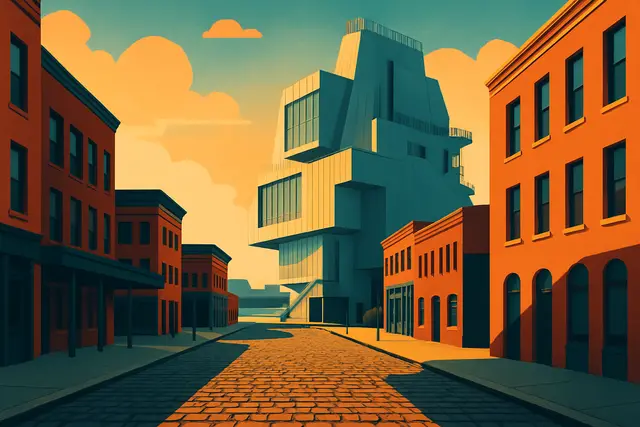
56 Leonard Street — the Jenga Tower, as it's called by locals — opened in 2017 after a decade-long construction saga. The 60-story residential tower designed by Herzog & de Meuron stacks cantilevered glass and concrete floors in a deliberate asymmetry that makes the building look structurally improbable from street level. It is, visually, unlike anything else in Manhattan and specifically unlike anything in its surroundings. Whether that's an achievement or an intrusion is a debate that's still running in Tribeca.
The former AT&T Long Lines Building at 33 Thomas Street — one block east of Tribeca proper — is a windowless concrete skyscraper from 1974, built to be hardened against nuclear attack. It's 550 feet tall, has no windows, and continues to operate as a telecommunications hub. The building was reportedly used as an NSA surveillance facility. It looks like a prop from a dystopian film and is, in any objective assessment, one of the most unsettling buildings in the city. It is completely worth seeing.
56 Leonard Street (Jenga Tower): the cantilevered glass tower by Herzog & de Meuron, best seen from Leonard Street looking south
33 Thomas Street: the windowless AT&T Long Lines Building, hardened nuclear-era architecture; one block east of Tribeca proper
Reade Street Park: a small green space between Church and Broadway that gives you a view back toward Tribeca's low-rise streetscape
How do I get to Tribeca from Midtown? The 1 train to Franklin Street is the direct route — about 25 minutes from Times Square. From the East Side, take the 4/5/6 to Fulton Street and walk west 10 minutes. From Brooklyn, the A/C/E to Canal Street or the 1/2/3 to Chambers Street both work.
Is Tribeca easy to walk? Very. The neighborhood is roughly 10 blocks north-south and 8 blocks east-west. The grid is regular, blocks are short, and the most important spots — Staple Street, Harrison Street Row, the Odeon, Nobu Downtown — sit within a 20-minute walking radius of the Franklin Street subway exit.
What's immediately nearby? SoHo is directly north, across Canal Street — the cast-iron architecture continues seamlessly, with the added galleries, shopping, and restaurant density. See our guide to SoHo's history and what to do there for what's worth seeing north of Canal. The 9/11 Memorial and Oculus at Fulton Center are a 10-minute walk south on Greenwich Street — an easy addition to the same morning.
Is Tribeca good for tourists or mainly a residential neighborhood? Both, which is what makes it unusual. The neighborhood has world-class restaurants and specific architectural landmarks, but it also has the rhythm of a residential block rather than a tourist district. You'll share the streets with residents walking dogs, not with tour groups. That's the point.