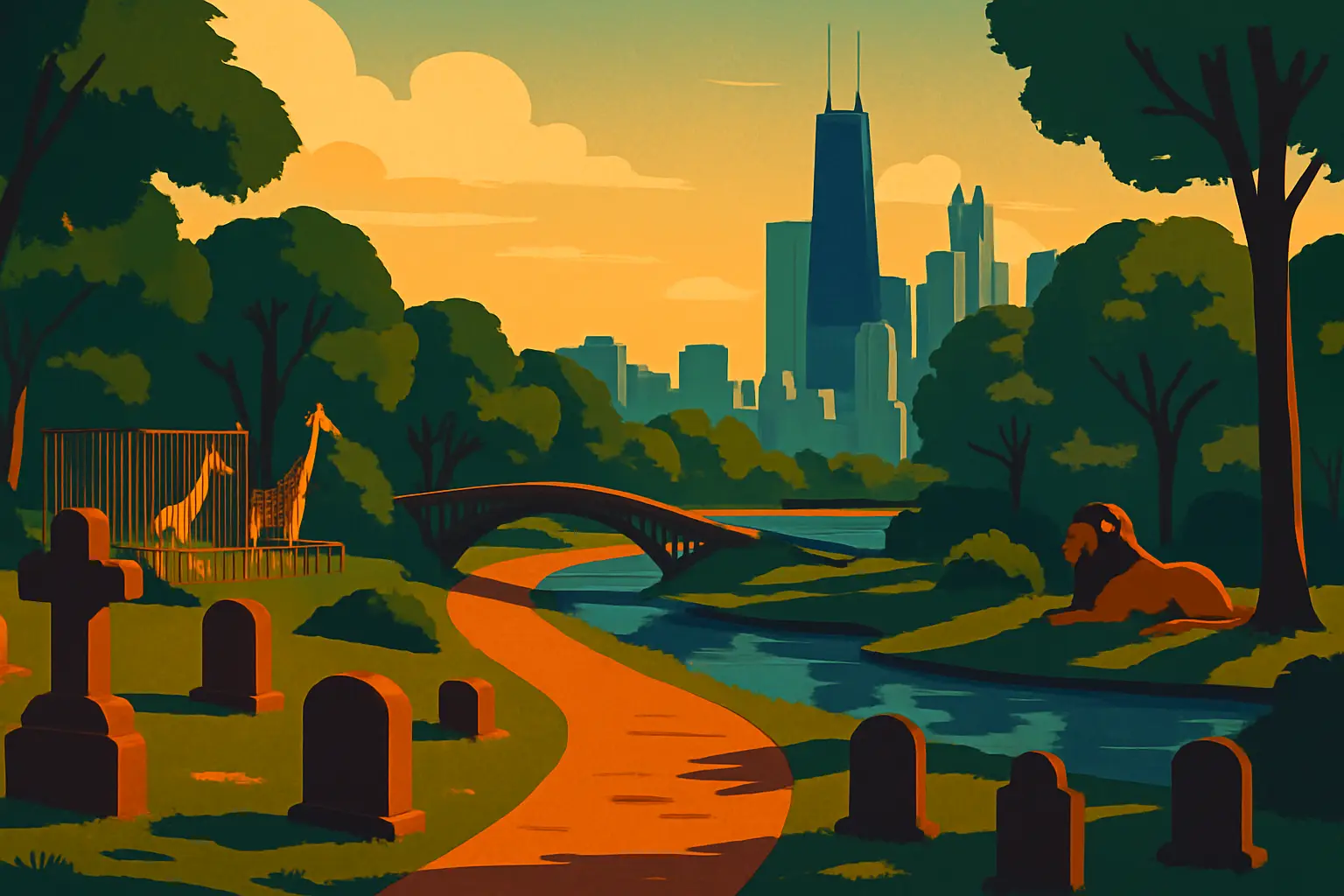
In 1843, Chicago designated a stretch of lakefront land north of the city limits as the Chicago City Cemetery — a practical solution for a fast-growing city that had ballooned from 4,000 to over 100,000 residents within a generation. The cemetery filled with soldiers, immigrants, and early civic figures on land that now sits in the heart of Lincoln Park, between North Avenue and Fullerton Parkway.
By the 1860s, the cemetery had become a public health crisis. Coffins were washing into Lake Michigan during storms, and the city's drinking water — drawn from the same lake — was being contaminated. Chicago's park commissioners began the long project of relocating the dead to cemeteries further north, including Graceland Cemetery and Rosehill Cemetery. The relocation took decades and was never fully complete: historians estimate tens of thousands of remains were never moved, left in unmarked graves beneath what is now parkland and the zoo's grounds.
One structure survived: the Couch Mausoleum, a stone tomb built in 1858 for the family of Ira Couch, a prominent hotel owner. The Couch family refused to pay for their relatives' removal, and the city left it where it stood. Today the mausoleum sits near the Chicago History Museum — a small Egyptian Revival stone building, still containing its original occupants, completely incongruous among the picnickers and joggers who walk past it daily without looking up.
The Lincoln Park Zoo opened in 1868 when the Central Park Zoo in New York donated a pair of swans to the city — a gift that arrived before anyone had built a zoo to receive them. Chicago accepted the birds, enclosed land at the southern end of the new park, and built exhibits around them. Within a decade a collection of mammals and reptiles had assembled, and the zoo has operated continuously since.
Today it covers 35 acres inside the park and houses more than 200 species. Admission is free. This is not a promotional period or a gimmick — the Lincoln Park Zoo is one of roughly a dozen major accredited zoos in the United States that charge nothing to enter, supported through private philanthropy and the Lincoln Park Zoological Society. The zoo's free status has never changed in its 158-year history.
The Regenstein Lion House (1912) is the architectural centerpiece — a large Beaux-Arts building holding African lions, snow leopards, and tigers. The Regenstein Center for African Apes houses gorillas and chimpanzees in one of the more naturalistic great ape environments in any urban zoo. The South Pond Nature Boardwalk, opened in 2010, wraps the zoo's southern pond with a native plant corridor and elevated viewing platforms. In September and October, this boardwalk becomes a genuine birding destination as warblers, shorebirds, and raptors move south along the Lake Michigan corridor.
Lincoln Park Zoo: 2001 N Clark St — free, open daily; weekdays 9 a.m.–5 p.m., weekends 9 a.m.–6 p.m.
South Pond Boardwalk: open dawn to dusk, free — best during fall migration in September and October
ZooLights (November–January) is a ticketed evening event; daytime zoo admission remains free year-round
Get short, interactive stories that make each place easier to remember while you travel.
At 1723 N Halsted Street, Grant Achatz opened Alinea in 2005. It has held three Michelin stars since the Michelin Guide first rated Chicago restaurants in 2011 — one of a handful of restaurants in the United States to maintain that rating continuously. Alinea's approach applies modernist technique to American ingredients in ways that have influenced restaurant kitchens worldwide: dishes that arrive as edible balloons, desserts painted directly on the table, courses built around temperature and texture contrasts.
The three-star designation puts Alinea alongside Le Bernardin and Per Se in New York. It is also on a residential street in Chicago, flanked by a wine shop and a taqueria. Achatz has received offers to move to New York and Las Vegas and has declined. The restaurant stays in Lincoln Park.
Boka at 1729 N Halsted (one Michelin star) operates a quieter, farm-sourced menu a single door down from Alinea — easier to book and less theatrical, but serious cooking from the same block. R.J. Grunts (2056 N Lincoln Ave, opened 1971) is the neighborhood institution at the opposite end of the register: a casual American diner credited as the first restaurant opened by Lettuce Entertain You, now one of Chicago's largest restaurant groups. The salad bar has been there since opening day.
North Avenue Beach sits at the southern edge of Lincoln Park where the park meets Lake Shore Drive and Lake Michigan. Chicago's lakefront is publicly owned and permanently protected from private development — a quirk of 19th-century planning that means every mile of Lake Michigan shoreline within city limits is accessible on foot. North Avenue is the most popular lakefront entry point on the north side, with a sand beach, volleyball courts, and a beach house designed to resemble a 1930s streamlined ocean liner.
September is when locals stop avoiding the lake. The summer's heat and humidity have eased, the tourist peak from the Fourth of July through mid-August has cleared, and the lake temperature holds at around 65–68°F — still warm enough for swimming, with the beach population at a fraction of July's. The Lakefront Trail running north from the beach through the park, past the zoo and the Conservatory, is one of the better urban walking routes in the country when it isn't crowded.
Clark Street is Lincoln Park's commercial spine — a north-south corridor where bars, coffee shops, independent restaurants, and bookshops are most concentrated between Wrightwood Avenue and Armitage Avenue. Armitage Avenue running east-west is the neighborhood's higher-end boutique corridor, where independent retailers have held space for decades serving Lincoln Park's affluent residential base.
The streets between Armitage and Dickens Avenue, running west of Clark toward Halsted, hold some of the best-preserved 19th-century residential blocks in Chicago — greystone two-flats and Queen Anne frame houses built in the 1880s for the workers and merchants who settled north of downtown after the Great Fire. Walking these blocks is worth the detour from the commercial strip.
The Wieners Circle (2622 N Clark St) is Chicago's most deliberately confrontational hot dog stand: the walk-up window staff are known for responding to customers in kind, a dynamic that has made it a late-night institution for decades. The char dog — an all-beef frankfurter charred on the grill, served on a poppy seed bun with yellow mustard, sport peppers, tomato, onion, pickle, relish, and celery salt — is the order. The theater is optional.
Lincoln Park Conservatory (2391 N Stockton Dr) is free, open year-round, and consistently uncrowded. Four Victorian glass houses hold a palm room, fern room, orchid house, and seasonal show house. In September the orchid house is worth a dedicated visit.
The Wieners Circle: 2622 N Clark St — cash preferred, late-night hours; the char dog is the correct order
Lincoln Park Conservatory: 2391 N Stockton Dr — free, Thu–Mon 9 a.m.–5 p.m.
Oz Park at 2021 N Burling St: bronze statues of Wizard of Oz characters, honoring L. Frank Baum who lived in Chicago when he wrote the book
The Chicago History Museum at 1601 N Clark St is the oldest cultural institution in Chicago, founded in 1856 — twelve years before the zoo. Its permanent collection covers Fort Dearborn (1803), the Great Fire of 1871, the 1893 World's Columbian Exposition, the Haymarket affair, Prohibition-era Chicago, the blues and soul music tradition, and the city's long history of urban planning and architecture.
The most specific artifact in the collection is Abraham Lincoln's deathbed — transported from the Petersen House in Washington, D.C., where Lincoln died on April 15, 1865. The deathbed is not a reproduction. The mattress shows its age; the footboard is broken from where the 6'4" president's feet extended past the edge. The museum also holds an original elevated rail car from Chicago's L train system — a physical piece of transit history that occupies a full room and remains one of the more underreacted-to exhibits in any Chicago museum.
Admission is $19 for adults, $6 for children. Most visits run 2 to 3 hours.
Chicago History Museum: 1601 N Clark St — Tue–Sun 9:30 a.m.–4:30 p.m.
Lincoln's deathbed is in the permanent collection — it is the most arresting artifact in the building
The museum sits adjacent to the Couch Mausoleum — both are visible from the same park path
Is Lincoln Park expensive to visit? A full day in the neighborhood — the zoo, the Conservatory, North Avenue Beach, and the park itself — costs nothing. The Chicago History Museum is $19. Restaurants run from Alinea ($350+ per person for the full tasting experience) to R.J. Grunts ($15–$20) to a char dog at The Wieners Circle ($5). The neighborhood skews upscale in its retail and residential character, but the public amenities are completely free.
What is Oz Park? Two blocks west of the zoo at 2021 N Burling St, Oz Park commemorates L. Frank Baum's time in Chicago, where he wrote *The Wonderful Wizard of Oz*. Bronze statues of Dorothy, the Scarecrow, the Tin Man, and the Cowardly Lion stand throughout the park. It is a five-minute detour and consistently delights people who had no idea it existed.
What's immediately south of Lincoln Park? Old Town is the next neighborhood south along Wells Street. Second City at 1616 N Wells St — the comedy club that launched John Belushi, Bill Murray, Tina Fey, and Stephen Colbert — runs multiple shows nightly, tickets starting around $25. Old Town Ale House (219 W North Ave) has operated on the same corner since 1958 and is one of the better reasons to walk the 10 minutes south from the zoo.
From the Loop: The Red Line from any downtown stop to Fullerton takes 12–15 minutes. For the zoo and the restaurant district, Fullerton is the stop. For North Avenue Beach and the southern park, exit at North/Clybourn instead. The Brown Line to Armitage or Sedgwick (about 20 minutes from the Loop) deposits you directly into the neighborhood's dining and shopping corridor.
On foot from River North: Lincoln Park begins at North Avenue, roughly 1.5 miles north of the Merchandise Mart. Walking north on Clark Street through Old Town takes about 30 minutes and passes Second City and the Old Town strip — many visitors walk up and take the Red Line back.
By bike: Divvy bike-share stations are throughout the neighborhood. The Lakefront Trail runs along the park's eastern edge — 18 miles of flat, car-free path along Lake Michigan — and connects Lincoln Park directly to Millennium Park, Navy Pier, and Hyde Park to the south. For TourMe's other Chicago neighborhood guides, see Hyde Park, Wicker Park, and Logan Square.