1. Six Corners and the Geometry of a Neighborhood
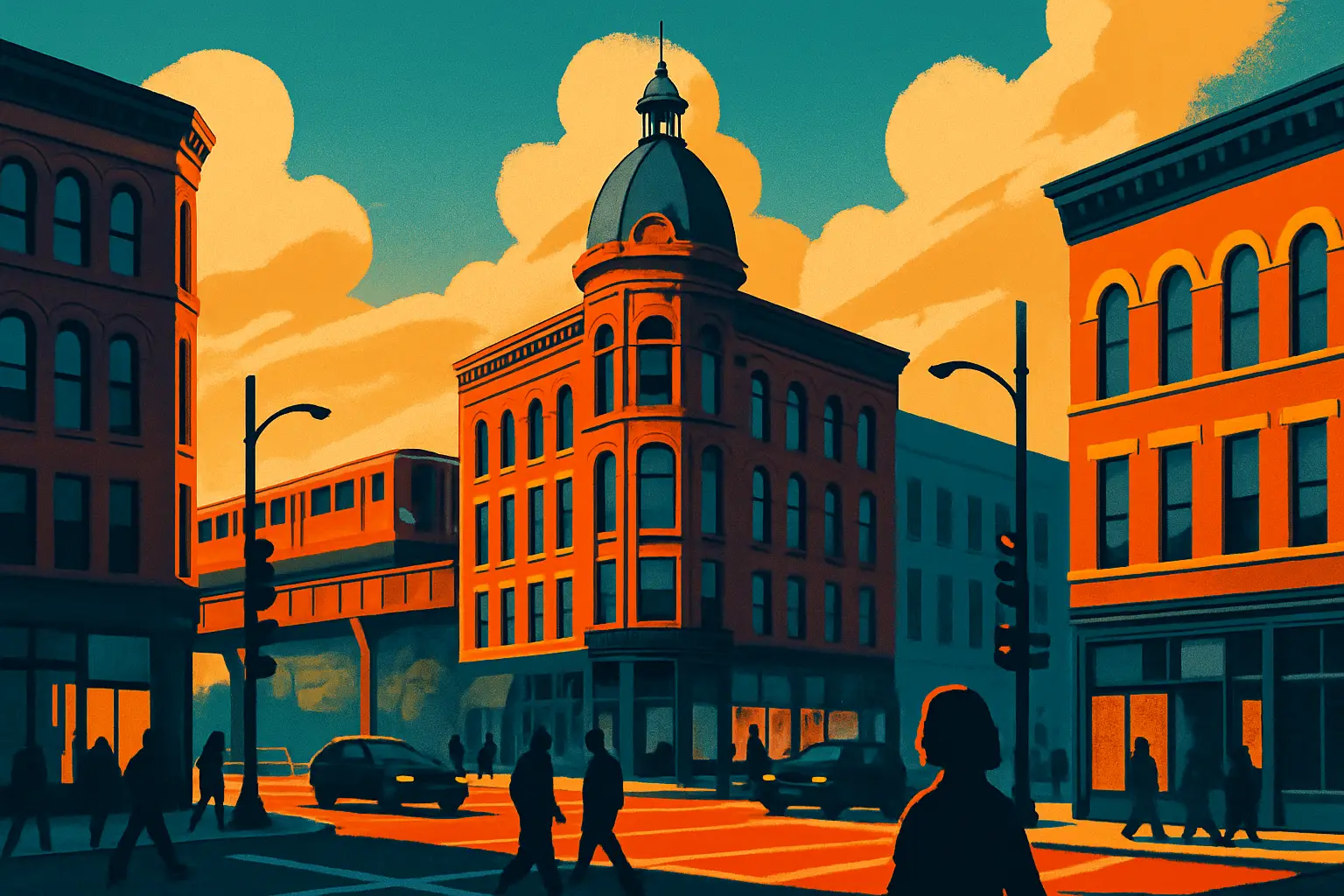
Milwaukee Avenue arrives from the southwest at an angle, cuts across the Chicago grid, and collides with North Avenue and Damen Avenue at a six-pointed intersection Chicagoans call Six Corners — the literal and symbolic center of Wicker Park. Three commercial corridors radiate outward: Milwaukee heads northwest toward Logan Square, Damen runs north-south through the restaurant district, and North Avenue cuts east toward Humboldt Park. The shape encodes something true about the neighborhood. Wicker Park was built on a diagonal, and it has never quite straightened out.
The park itself — a small triangle bounded by Schiller, Wicker Park Avenue, and Damen — sits a few blocks north of Six Corners. Around it, the Victorian houses that Polish and Scandinavian immigrants built in the 1880s and 1890s still line the residential streets: ornate woodwork, wraparound porches, second-floor flats. It is one of the best-preserved 19th-century housing stocks in Chicago and almost entirely off the architectural-tour radar.
The Flat Iron Arts Building (1579 N Milwaukee Ave), built in 1916 in a narrow wedge shape at the convergence of Milwaukee, North, and Damen, has held artist studios and galleries since the 1990s. The building's geometry forces every floor into a succession of tapered rooms — useful for none of the obvious commercial purposes, which is part of why artists found it first. It still functions as one.
2. Polish Broadway and the Quarter That Built This Block
Before Wicker Park was fashionable, it was essential. From the 1880s through the mid-20th century, Milwaukee Avenue between Wicker Park and Logan Square was one of the largest concentrations of Polish speakers in the world outside Warsaw. Division Street was known as Polish Broadway. The neighborhood ran on its own commercial and civic infrastructure — Polish-language newspapers, mutual aid societies, parish schools — and had little need to look east toward downtown.
St. Stanislaus Kostka Church (1351 W Evergreen Ave, established 1867) is the oldest Polish parish in Chicago and the anchor of what was once the Polish Triangle. Holy Trinity Church (1118 N Noble St), a few blocks away, was designed by Louis Sullivan in 1906 — one of his few church commissions and the only one on the near northwest side. Its interior is worth fifteen minutes even if you're not visiting for the service.
By the 1970s, Polish families were moving to the suburbs and deindustrialization had cut into the near-northwest side economy. What the community left behind was dense, affordable Victorian housing stock in good structural condition — exactly what attracts artists in every American city before rents rise to price them out. This transition happened in Wicker Park as predictably as it does everywhere, but the timing made it one of the defining moments in Chicago's cultural geography.
3. Nelson Algren's Neighborhood
Nelson Algren lived at 1958 W Wabansia Avenue and wrote about the streets within walking distance — the Division Street taverns, the alley card games, the overnight holds at the old town hall precinct. His novel "The Man with the Golden Arm" (1949), set in Wicker Park's working-class Polish blocks, won the first National Book Award in 1950. The Frank Sinatra film adaptation followed in 1955 and introduced the story to a wider audience, but Algren's prose remains the most accurate document of what this neighborhood looked and felt like before gentrification reordered it.
Algren's Wicker Park was the city of the dispossessed: steelworkers, card sharks, and addicts who couldn't afford to live anywhere with less friction. He wrote about Division and Milwaukee and Damen with a granularity that city planning documents never achieve. "Chicago: City on the Make" (1951) is his compressed prose-poem about the city as a whole, and it holds up better than most urban writing from any decade because it doesn't flinch from the specific.
His house on Wabansia still stands. There is no plaque. The Chicago literary establishment had a complicated relationship with Algren — he was openly contemptuous of institutions, and the feeling was often mutual. His books remain the best existing map of what this neighborhood was before it became what it is.
4. The 606: Chicago's Elevated Rail Trail
The most consequential piece of public infrastructure built in Wicker Park in the 21st century opened in 2015: The 606, a 2.7-mile elevated trail running east-west on the former Bloomingdale freight rail line through Wicker Park, Bucktown, Logan Square, and Humboldt Park. It is named for the prefix shared by every Chicago ZIP code.
The trail runs on a berm roughly 15 feet above street level, cutting through the neighborhood's north edge between Ashland and Damen avenues. From this height, the view of Chicago is unusual: you see rooftop gardens, the backs of two-flats, the industrial remnants of the city's manufacturing era, and the horizon at an elevation that isn't available from the street or any elevated train. Access ramps descend at Ashland, Western, Leavitt, Wood, and Damen avenues.
The 606 has had documented effects on property values along its corridor — studies published in academic journals on green infrastructure tracked the appreciation in the years immediately after opening. The same effect contributed to the displacement of lower-income residents in adjacent Humboldt Park. The trail itself is one of the city's best public spaces. The political legacy is more complicated, and Chicagoans are not finished debating it.
•Enter at the Damen Avenue ramp (north of the Blue Line station) for the Wicker Park access point
•Walk or bike west to Logan Square in about 20 minutes; continue to Humboldt Park in another 15
•The trail is most scenic mid-corridor through the Wicker Park and Bucktown stretch — the views open up above the two-flat rooflines
5. Where to Eat: Damen, Milwaukee, and Division
The restaurant district runs along Damen between Milwaukee and North, with secondary clusters on Milwaukee itself.
Big Star (1531 N Damen Ave) is the neighborhood's defining restaurant: corn-tortilla tacos, house-made salsas, a 100-plus whiskey list, and a concrete patio that fills every warm evening. It is owned by One Off Hospitality, the same group behind Avec and The Publican — the restaurants that defined Chicago's 2000s dining wave. No reservations. Order the pork belly taco and a Lone Star in a can and plan to wait if you arrive after 5:30 p.m.
Dove's Luncheonette (1545 N Damen Ave) is two doors north of Big Star and serves Southern-Mexican crossover food in a counter-and-booth setup modeled on Texas-border diners: fried chicken with chile honey, Tex-Mex huevos rancheros, hominy soup. Opens at 9 a.m. on weekends and is one of the better breakfast options in the neighborhood.
Taxim (1558 N Milwaukee Ave) serves regional Greek cooking — lamb with herbs, whole fish, spreads made with fermented ingredients — and is one of the most consistently underrated restaurants in Chicago. It opened before the city's Greek food scene expanded beyond the obvious and has held its quality without moving toward the mainstream. Reservations recommended.
Wormhole Coffee (1462 N Milwaukee Ave) was among the first wave of serious specialty coffee shops in Chicago. There is a DeLorean in the dining room. The coffee is not a joke.
6. Music Venues and What Survived
Wicker Park's music infrastructure dates to the early 1990s, when artists and musicians moved into warehouse storefronts on Milwaukee and Division, attracted by cheap rent and the cultural energy of a neighborhood in transition. Most of the original venues closed as rents rose through the 2000s and 2010s. Two have survived.
Subterranean (2011 N Damen Ave) is a two-floor venue in an 1891 building with a bar on the ground floor and a 300-person standing room above. It books indie rock, hip-hop, and touring acts that haven't yet grown into 1,000-seat rooms. The booking calendar is genuinely good; check the website before your visit rather than arriving hoping for something.
Empty Bottle (1035 N Western Ave) is technically in Ukrainian Village, one neighborhood east, but it draws the same crowd and functions as part of the same ecosystem. It has operated since 1992 and books experimental, independent, and avant-garde music with a consistency that Chicago music audiences trust. The room is minimal, the beer is cheap, and the programming punches above every measure of what a neighborhood bar should be booking.
7. Getting There, What to Expect, and What's Nearby
How do I get to Wicker Park from downtown? The Blue Line to Damen is fastest — about 12 minutes from Clark/Lake, 20 from O'Hare. The exit puts you at Milwaukee and Damen, a block south of Six Corners and within walking distance of most restaurants. The 56 Milwaukee bus is useful for reaching the North Avenue corridor.
Is it worth visiting if it's already gentrified? Yes, with realistic expectations. The artist-squat era ended two decades ago. But the physical neighborhood — the Victorian housing stock, the Flat Iron building, The 606, the Louis Sullivan churches, the restaurant corridor — is genuinely good and rewards walking. A useful Saturday itinerary: walk The 606 from the Damen ramp west to Logan Square, come back to eat at Dove's or Big Star, spend the afternoon in the record shops and bookstores on Milwaukee.
What's nearby? Bucktown adjoins to the north with similar character and slightly quieter streets. Logan Square is a 20-minute walk west along The 606 and has its own strong restaurant scene. For a different angle on Chicago's neighborhood history — deeper, more architecturally layered, and anchored in the University of Chicago's campus — see the Hyde Park guide. For the Mexican-American cultural heart of the near-southwest side, the Pilsen neighborhood guide covers it in detail.