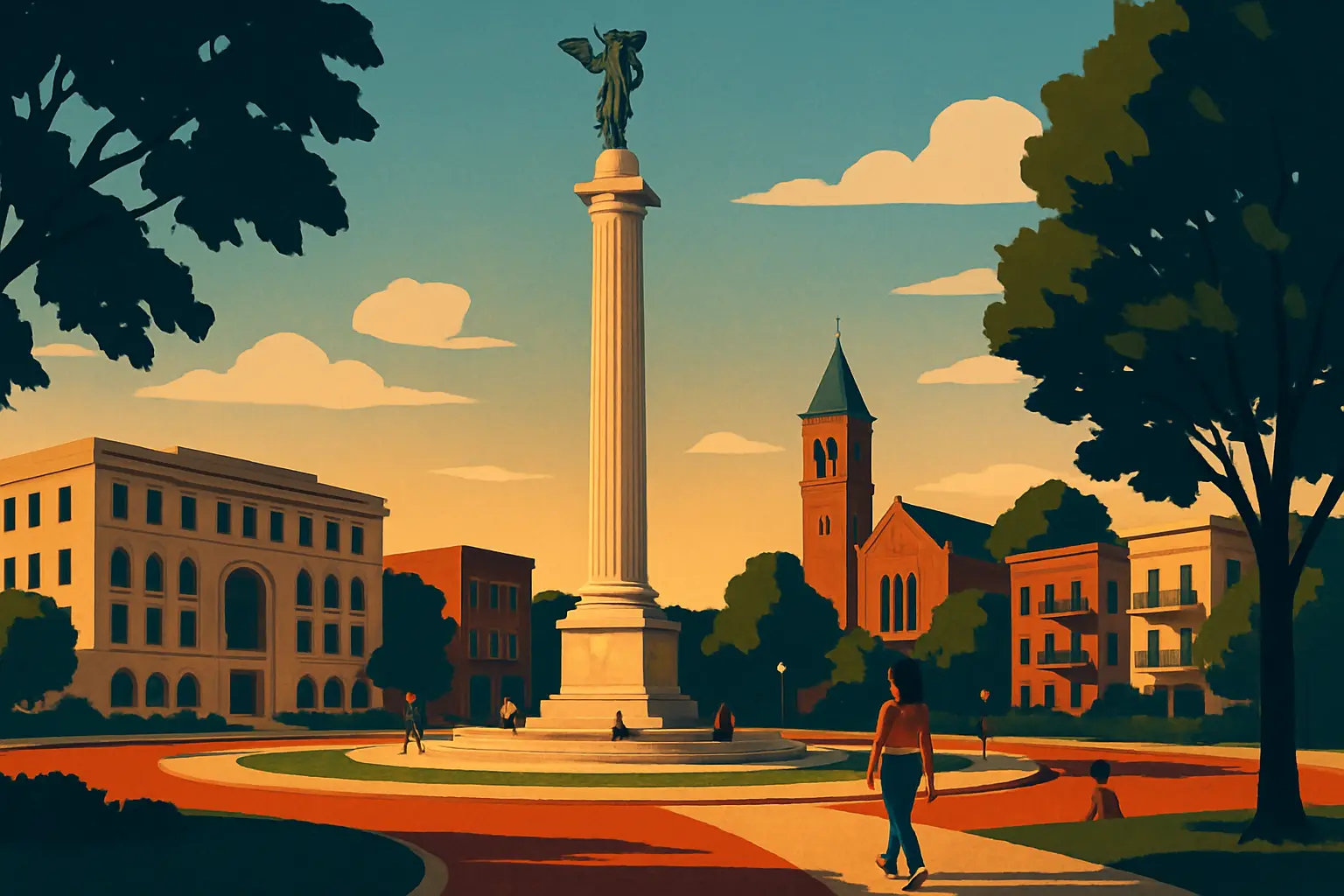
Stand at the intersection of Logan Boulevard, Milwaukee Avenue, and Kedzie Boulevard and look up. The Illinois Centennial Monument, completed in 1918, is a 42-foot Doric column designed by Henry Bacon — the same architect who designed the Lincoln Memorial in Washington, D.C. Bacon based the column's proportions on the Parthenon colonnade atop the Acropolis in Athens, which makes it one of the more quietly ambitious pieces of civic architecture in the Midwest.
The monument commemorates the 100th anniversary of Illinois statehood. Evelyn Beatrice Longman — one of the few female sculptors of her era to receive major public commissions — designed the reliefs surrounding the base. They depict Native Americans, French explorers, frontier farmers, and industrial laborers in sequence, tracing the transformation of the land through its first century under American governance. The figures are specific and detailed; the central female figure representing Illinois was reportedly modeled after a Chicago teacher.
The column sat in an empty traffic circle for years, barely noticed. It rewards a close look: the relief carving is museum-quality, and the column's scale relative to the surrounding boulevard trees creates an accidental grandeur that most purpose-built tourist attractions can't match.
Logan Square exists because of Chicago's 19th-century boulevard planning. In the 1870s, the city commissioned a network of wide, tree-lined parkways connecting the major parks — Logan Boulevard, Kedzie Boulevard, and Palmer Boulevard converge at the Logan Square monument, creating a traffic circle surrounded by a corridor of grass and elm trees.
The boulevards attracted money. From the 1890s through the 1930s, Chicago's upper-middle class built Greystone row houses and single-family mansions along the parkways — limestone-faced buildings, two to four stories, with ornate cornices and deep front porches. The architectural consistency of Logan and Kedzie boulevards is unusual for Chicago: most of the original buildings survive, which gives the corridor a coherent streetscape more common in older Eastern cities than in the Midwest.
A walk north on Logan Boulevard from the monument to Western Avenue takes you past some of the finest examples — block after block of Greystone facades with carved limestone details, many now converted to condominiums but externally intact. The boulevard median, maintained by the Chicago Park District, is wide enough to have its own benches and shade trees. Bring a coffee from Intelligentsia (3123 N. Broadway, a short walk south) and do it slowly.
Logan Boulevard: walk north from the monument for the best concentration of Greystone architecture
Kedzie Boulevard: more residential, fewer restaurants — better for the architecture than the food
Palmer Boulevard: connects toward Humboldt Park, with views of that neighborhood's boathouse and lagoon
Get short, interactive stories that make each place easier to remember while you travel.
Lula Cafe (2537 N. Kedzie Ave) opened in 1999, when Logan Square was still cheap and mostly overlooked by the food media. Owners Jason Hammel and Amalea Tshilds built a menu around what they could source locally and seasonally — a fairly radical proposition in late-1990s Chicago — and created a dining room that felt like someone's apartment: mismatched furniture, rotating art on the walls, a room that made dinner feel unhurried.
Twenty-seven years later, Lula is still there. It received a James Beard Award Foundation nomination and spawned a generation of Chicago restaurants in its image, including many of the neighborhood's current roster. The menu changes constantly — there is no permanent dish, only what's in season — but the format is consistent: vegetable-forward small plates, interesting pasta, proteins treated as accents rather than anchors.
Lula gets to why Logan Square's food scene is different from Wicker Park's, a mile or so east: the neighborhood's restaurants tend to be owner-operated, idiosyncratic, and built for long stays rather than the quick Instagram visit. See also Wicker Park Chicago for comparison — they're adjacent in geography but distinct in character.
Longman & Eagle (2657 N. Kedzie Ave) opened in 2010 and changed the neighborhood's food profile overnight. The restaurant earned a Michelin star in its first year of eligibility — an unusual achievement for a gastropub with a deliberately casual atmosphere. The founders, Pete Toalson and Bruce Finkelman (who also co-founded the music venue the Empty Bottle), built the restaurant around a bar with one of Chicago's most serious American whiskey selections: over 150 bottles, with a focus on independent bottlings and allocated releases that rarely appear by the glass anywhere else.
The menu is loosely described as farm-to-table — the sourcing is real, the dishes are ambitious, and the prices are significantly lower than what the cooking would command in a more formal room. The dining room is intentionally rough-edged: worn wood, good lighting, noise. The upstairs inn has six rooms, each designed differently, with rates around $150–$200 per night — the only hotel option in the neighborhood and an unusual one anywhere in Chicago.
What to order: the whole roasted chicken changes preparation seasonally and is consistently the best thing on the table. The whiskey list is organized by style and region; the staff can walk you through it without condescension.
Milwaukee Avenue runs diagonally through Logan Square's commercial core — northwest from Wicker Park through Logan Square toward the northwest suburbs — and has served as the neighborhood's main street since Chicago's postwar decades, when Puerto Rican and Mexican families settled the area and opened the businesses that still anchor the corridor.
Old-school standbys: La Boulangerie (2754 N. Milwaukee Ave) has been baking Mexican sweet breads since the 1980s, and the window display of pan dulce changes daily. Bombon Cafe (2702 N. Milwaukee Ave) is a vegan Puerto Rican restaurant that has been listed as one of Chicago's best Latin restaurants for several consecutive years — the mofongo and the rice dishes are the draws.
New arrivals alongside the old: Cafe Mustache (2307 N. Milwaukee Ave) is a bar with a rotating art installation, an oddly good coffee program, and a vintage jukebox. Reckless Records relocated its north location to Milwaukee Avenue and remains one of the best used-record stores in Chicago for jazz, soul, and international pressings.
The mix of long-established Latino businesses and newer arrivals is the defining tension of modern Logan Square — a story of rapid change that has made the neighborhood both more visible and more expensive than its longtime residents anticipated.
La Boulangerie: 2754 N. Milwaukee Ave — window pan dulce, cash preferred, arrive mid-morning for the best selection
Bombon Cafe: 2702 N. Milwaukee Ave — vegan Puerto Rican, dinner reservations recommended on weekends
Reckless Records: Milwaukee Ave — deep used inventory in jazz, soul, Latin, and international
The Logan Square Farmers Market (2755 N. Milwaukee Ave) runs every Sunday from late May through October, 10 a.m. to 3 p.m., in the parking lot of the Comfort Station — a restored 1917 public facility (restrooms and a community gathering space, now operated as a small arts venue) at the corner of Milwaukee and Kedzie.
The market has about 50 vendors and is genuinely farmer-led: produce from Illinois and Wisconsin farms, eggs, honey, cheese, and a prepared food section that includes tamales, pupusas, Korean rice bowls, and coffee. The tamale vendor consistently draws the longest line; arrive by 10:30 a.m. for full selection.
Pair the market with a walk through the boulevard: from the Comfort Station, Logan Boulevard begins its residential corridor heading east toward the monument. The whole loop — market, boulevard walk, monument, then south on Kedzie to Longman & Eagle for a late lunch — takes about four hours and hits every register of the neighborhood without requiring a car or a plan.
Comfort Station: 2579 N. Milwaukee Ave — the small arts venue hosts free weekday programming, check their calendar
Market Sundays: May–October, 10 a.m.–3 p.m.; street parking on side streets, or Blue Line to Logan Square is easier
Full neighborhood loop: market → boulevard → monument → Lula Cafe (Sunday brunch) or Longman & Eagle (lunch from 11 a.m.)
Is Logan Square safe for visitors? The neighborhood around the Logan Square CTA station, Milwaukee Avenue, and the boulevards is consistently safe during daylight hours and during evenings at the restaurants. As with any Chicago neighborhood, situational awareness applies, but Logan Square does not have a reputation as a high-risk area for visitors.
How does it compare to nearby neighborhoods? Wicker Park is denser, louder, and more commercialized — it's Logan Square's energy at higher volume. Pilsen is further south on the 18th Street Pink Line stop, more focused on murals and Mexican-American culture, with a different restaurant profile. Logan Square splits the difference: it has genuine depth on food and history without the tourist traffic of Wicker Park or the specific focus of Pilsen. Hyde Park, much further south, is its own world — see our Hyde Park guide for the University of Chicago neighborhood.
How long do you need? A focused half-day covers the monument, a boulevard walk, the farmers market (if Sunday), and one sit-down meal. A full day lets you do the market, a slow walk through the Greystone blocks, and dinner at Longman & Eagle. You don't need two days unless you're staying at the inn and building a longer Chicago trip around it.
Best time to visit: Late May through September is when the neighborhood is most active — the farmers market runs, boulevard trees are full, and outdoor seating is open everywhere. October adds fall color to the boulevard walks. The neighborhood doesn't slow down in winter (Chicago restaurants are built for year-round customers), but the outdoor experience disappears.
How to get there from downtown: Blue Line CTA from Clark/Lake in the Loop, or from O'Hare Airport — the Logan Square stop is on the same line in either direction, making it the rare neighborhood that is genuinely easy to reach from both the airport and downtown in a single unbroken train ride. The ride from the Loop is about 20 minutes. The station exit places you at Milwaukee and Logan Boulevard, steps from the monument.
Getting around within the neighborhood: Walkable. The commercial stretch of Milwaukee Avenue is about a mile long; the boulevard walk from the monument to the market along Logan and Kedzie adds another mile. Divvy bike share has stations at the Logan Square CTA station and along Milwaukee. No car needed for anything in this guide.