Koreatown occupies roughly four square miles of mid-Los Angeles, bounded by Vermont Avenue to the east, La Brea Avenue to the west, Beverly Boulevard to the north, and Olympic Boulevard to the south. The main spines are Wilshire Boulevard running east-west and Western Avenue running north-south — the intersection of Wilshire and Western is the neighborhood's effective center.
A basic fact surprises most visitors: despite the name, the majority of Koreatown's 120,000 residents are Latino, predominantly Central American and Mexican. Korean Americans are concentrated in business ownership, and Korean-owned businesses line nearly every commercial block. The neighborhood is simultaneously one of the most densely Latino districts in LA and the largest Koreatown outside of South Korea itself.
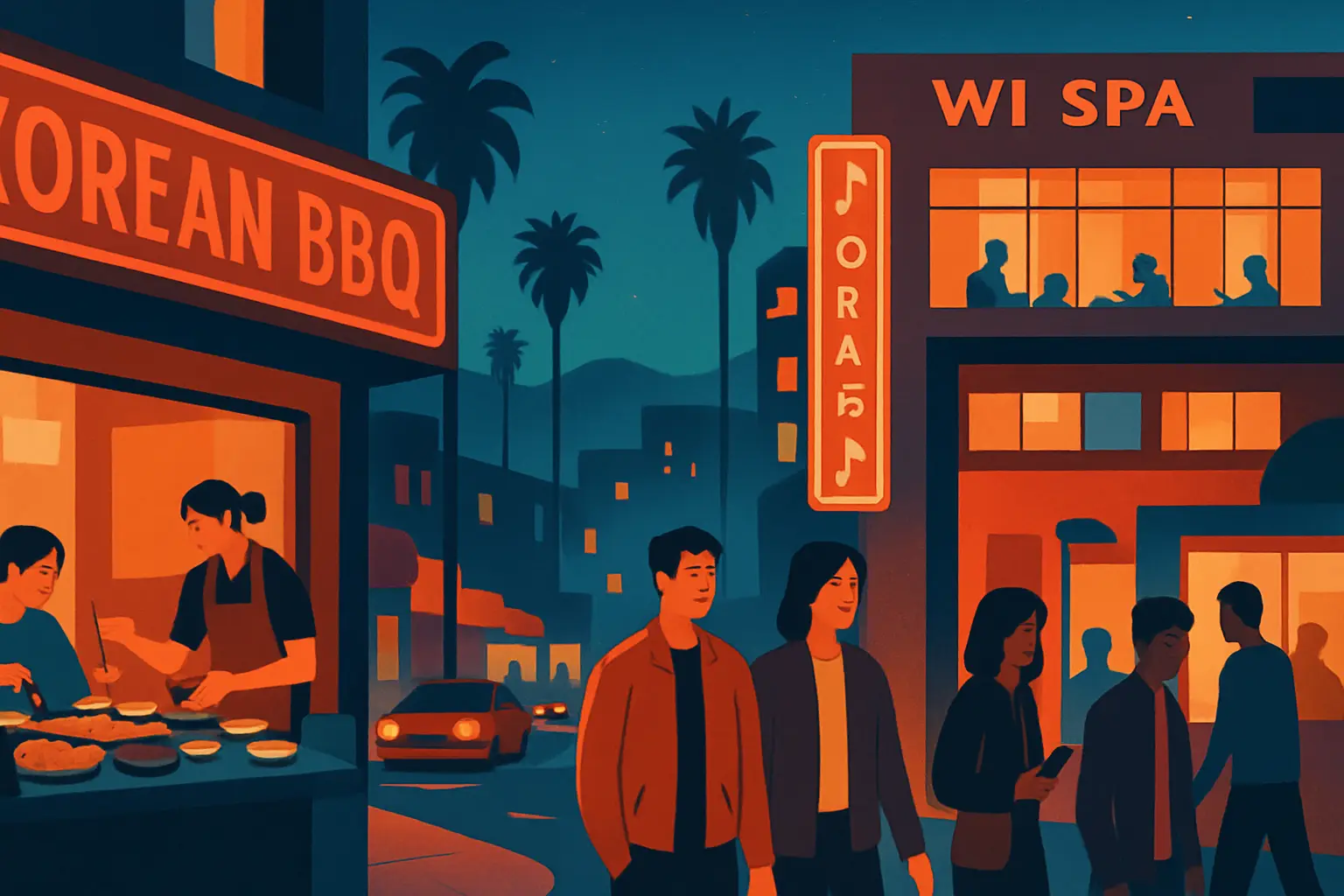
What makes it distinctive beyond demographics is the pace. LA shuts down early — bars close at 2am by state law, most restaurants stop seating by 10pm, and the city's car-dependent layout discourages late-night walking. Koreatown ignores all of this. Korean culture treats late-night dining as social norm rather than exception. The 6th Street corridor between Vermont and Western stays busy past midnight on weekdays. The neighborhood's unusual density for Los Angeles means pedestrian life continues long after the rest of the city goes dark.
On April 29, 1992, a Los Angeles jury acquitted four LAPD officers in the beating of Rodney King despite video evidence broadcast across the country. Within hours, the most destructive urban uprising in American history since the 1967 Detroit riots spread across the city.
The LAPD deployed its resources to protect Beverly Hills, downtown, and wealthy communities on the city's west side. Koreatown was left largely unprotected for four days. Korean-owned businesses in the neighborhood were looted and burned while owners called 911 and received no response. The estimated property damage to Korean-owned businesses exceeded $400 million — nearly half of all riot-related property losses in the entire city. Korean Americans who had built small businesses through decades of 12-hour workdays watched them burn.
Korean Americans call it Sa-I-Gu — April 29 in Korean. Shop owners armed themselves and organized rooftop neighborhood watches. The photographs — Korean Americans with rifles protecting their businesses while smoke rose behind them — became some of the most iconic images of 1990s Los Angeles.
The aftermath transformed the community politically. Before 1992, Korean Americans in LA were largely invisible in city politics. After 1992, the community organized into a civic force that now shapes city council races, school board elections, and DA campaigns. Many businesses rebuilt without insurance payouts that never fully arrived. The rebuilding itself was an act of defiance. The neighborhood you walk into today is the neighborhood they rebuilt.
Get short, interactive stories that make each place easier to remember while you travel.
Korean BBQ is not like dining at a restaurant where food arrives plated. You are the cook. Cuts of raw meat arrive at a gas or charcoal grill embedded in your table; you grill them to preference, cut them with scissors, wrap them in lettuce leaves with garlic and fermented soybean paste (ssamjang), and eat them in one bite. The server at most full-service restaurants will manage the grill and cutting for you.
Banchan arrives before the meat: small dishes of kimchi, spinach, fish cake, pickled vegetables, and bean sprouts that vary by restaurant. They're free and can be refilled as many times as you want. The banchan spread is often the clearest indicator of a kitchen's quality.
Park's BBQ (900 S Vermont Ave) is the most respected table in the neighborhood. Order the prime galbi — short rib marinated in soy and Asian pear, grilled tableside — and the prime chadolbaegi, thinly shaved brisket that cooks in under 90 seconds. Dinner runs $50–$80 per person; reservations are strongly recommended on weekends.
Kang Hodong Baekjeong (3460 W 6th St), named after a Korean celebrity wrestler turned television host, is known for beef intestine (gopchang) and has a following that drives people from across Southern California. Order the beef set, the intestines, and a doenjang jjigae (fermented soybean stew) on the side.
For a lower-stakes introduction, Gen Korean BBQ on Wilshire runs the all-you-can-eat format: a flat per-person rate (roughly $27–35 depending on tier), an extensive menu you order from repeatedly, and a grill you manage yourself. High volume, less personal — but the quality is consistent and the format is easy to learn.
A jjimjilbang is a Korean communal spa — gender-separated bathing areas with pools at different temperatures, dry and wet saunas, and a shared common area where people sleep on heated stone floors in matching cotton gowns. It's not a luxury day spa. It's a social institution; Korean families use them the way other cultures use parks.
Wi Spa at 2700 Wilshire Blvd is the most famous example in the United States. Five stories, open 24 hours with no closing time. The layout: check in at the front desk, receive a gown and locker key, and change in the gender-separated locker room. The wet floors have pools — cold, warm, hot, very hot — along with scrub stations where the Korean Italy-towel exfoliation treatment is offered as an add-on service. The shared common area upstairs has heated floors for sleeping on mats, a small café, and an ambient quiet maintained by social convention.
The day pass is approximately $30. Towels, gowns, and slippers are provided. Phones stay in the locker in the wet areas. On a weekend night after 2am, the clientele at Wi Spa becomes a cross-section of Los Angeles that is hard to find elsewhere: people coming from Koreatown dinners, people who work late shifts downtown, travelers who wanted to do something genuinely local. It costs less than a movie ticket and is one of the more authentic cultural experiences the city offers.
Olympic Spa (3915 W Olympic Blvd), women-only and slightly smaller, is considered by many regulars to be the better facility — quieter, less crowded, and with a more attentive scrub service.
Before Koreatown was Koreatown, the Wilshire Boulevard corridor was one of the most glamorous addresses in 1930s and 40s Los Angeles.
The Ambassador Hotel, which stood at 3400 Wilshire Blvd from 1921 until its demolition in 2005, hosted the Academy Awards six times between 1930 and 1943. Its Cocoanut Grove nightclub was the most exclusive entertainment venue in Southern California — Frank Sinatra, Bing Crosby, Nat King Cole, and the Beatles all performed there. It was the physical center of old Hollywood.
On June 4, 1968, Senator Robert F. Kennedy won the California Democratic presidential primary. Shortly after midnight on June 5, he was shot in the Ambassador Hotel's kitchen — the Colonial Room — by Sirhan Sirhan while walking through after giving his victory speech. Kennedy died the following day at Good Samaritan Hospital several miles west. He was 42.
The hotel declined through the 1970s and 1980s, closed in 1989, and was demolished in 2005 after a long preservation battle. Robert F. Kennedy Community Schools, a public school campus, opened on the site in 2010. A bronze plaque near the school entrance marks where Kennedy was shot. It's a five-minute walk from the Wilshire/Normandie Metro station — most people who walk past it don't know what happened there.
The Line Hotel at 3515 Wilshire, a converted former Radisson one block away, is now one of LA's better boutique hotels. Its ground-floor Commissary restaurant operates inside a greenhouse structure and serves California-seasonal food worth a stop before or after the spa.
A noraebang is not what most Americans picture when they hear karaoke. There is no stage, no audience of strangers judging your performance. Noraebang is private-room karaoke: you rent a room by the hour with your group, choose songs from a library of thousands, and sing to each other. The rooms are small, the systems are good, and tambourines are standard equipment.
Along the 6th Street corridor between Vermont and Western, a dozen noraebang venues operate past midnight. The format: negotiate a room for one to two hours, pay an hourly room rate (roughly $15–25 per hour), order drinks from the in-house menu (usually cheap beer and soju), and cycle through the catalog until you lose track of time. Songs include English-language pop alongside a large Korean and Japanese catalog. Most venues have bilingual touch-screen interfaces.
The experience differs from bar karaoke in the ways that matter: no performance anxiety, actual sustained singing rather than one-song shots, and a setting where the point is enjoyment rather than spectacle.
The 6th Street corridor is the natural anchor for a Koreatown night: Korean BBQ for dinner, noraebang from 11pm, Wi Spa if you're still going after 2am. The sequence is what gives the neighborhood its reputation as a genuine destination rather than a food stop you drive to from somewhere else in the city.
How do I get to Koreatown from elsewhere in LA? The Metro D Line (Purple Line) serves the neighborhood at Wilshire/Western and Wilshire/Normandie stations. The 2023 westward extension put Koreatown about 15 minutes from downtown's Pershing Square by rail. From Silver Lake and Echo Park, the 720 Rapid Bus runs along Wilshire. Driving on weekend evenings means absorbing the neighborhood's own density plus cars arriving from all over LA — park once and walk.
Is Koreatown safe at night? Yes. The 6th Street corridor and Western Avenue near Olympic are busy past midnight on weekends; consistent foot traffic and businesses staying open keep the street-level scene active. Standard urban awareness applies.
When is the best time to visit? Koreatown peaks Thursday through Saturday nights — BBQ restaurants fill after 9pm, noraebang rooms book up after 11pm, and Wi Spa's common floor becomes social after midnight. For a calmer visit with shorter waits, lunch on a weekday at Park's BBQ or the Koreatown Galleria food court (corner of Western and Olympic) is the best low-pressure introduction to the food: a dozen stalls, picture menus, and an atmosphere that feels closer to Seoul than to the rest of Los Angeles.
Do I need to speak Korean? No. English menus are standard across the neighborhood, service is bilingual, and the Galleria food court runs picture menus at every stall. Most noraebang venues have English song libraries that are larger than the Korean catalog.