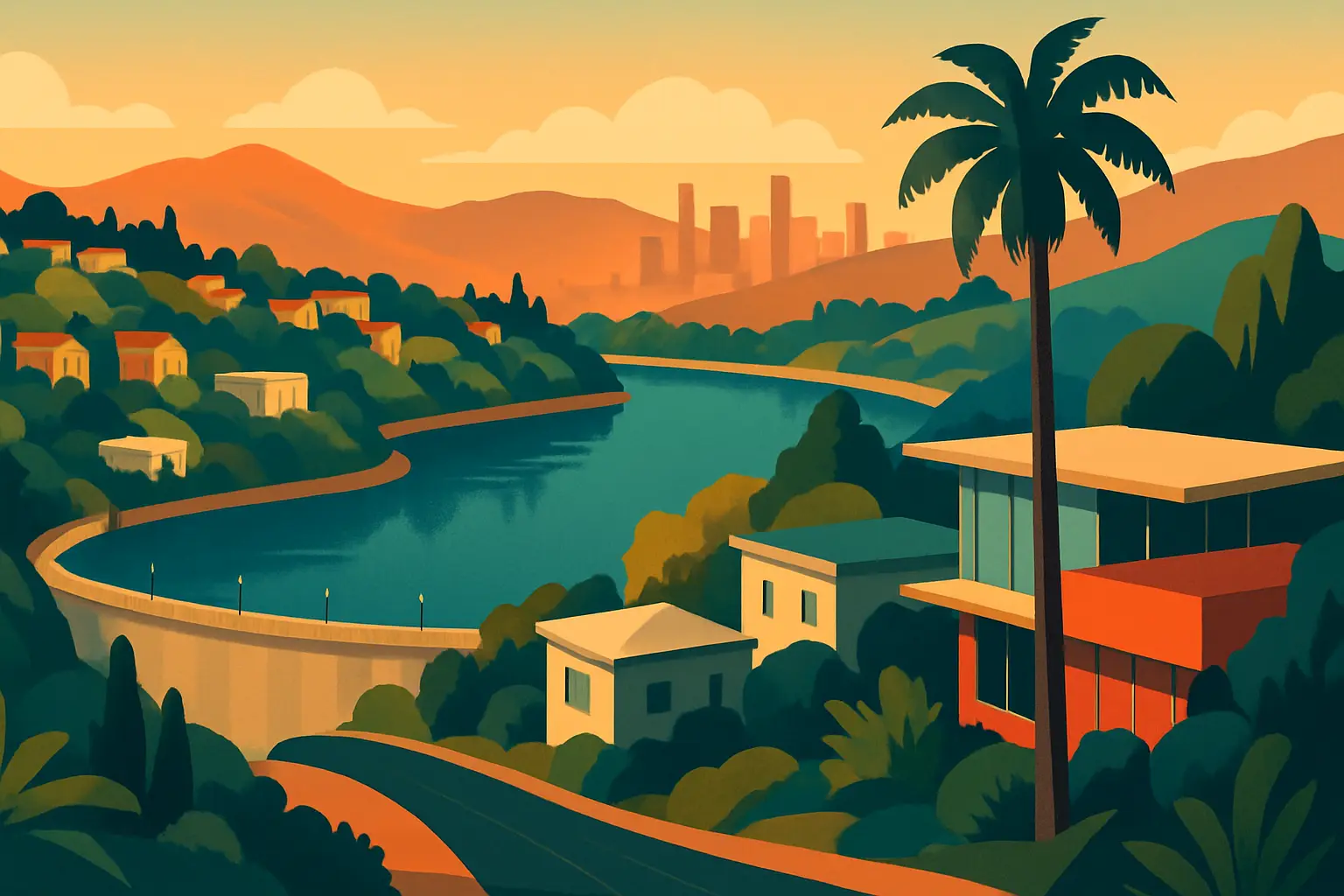
The Silver Lake Reservoir was built in 1906 as part of the early Los Angeles water infrastructure, expanded through the 1920s and 1930s as the city grew. It is named after Herman Silver (1837–1913), a Los Angeles city water board commissioner who served during the years when the city was laying the groundwork for its first real period of rapid growth. Silver never intended the reservoir to become a neighborhood focal point; it was a functional storage facility behind a concrete embankment, largely invisible from the streets around it.
The neighborhood that grew around it took the reservoir's name the way LA neighborhoods often do — casually, after a prominent local feature or a long-forgotten civic figure. The reservoir was taken offline for drinking water in 2008 under federal regulations about open-air storage. The water visible from the loop path today is maintained as a wildlife habitat, drawing great blue herons, double-crested cormorants, and during migration season, waders and shorebirds that have no business being this far inland. The Los Angeles Audubon Society runs periodic bird walks along the embankment.
The 2.2-mile paved loop along the reservoir's embankment is the neighborhood's central pedestrian infrastructure — a circuit where Silver Lake residents visibly do their thinking. In wet years the reservoir fills close to the rim. In dry years a mudflat perimeter appears. Either way, walking it on a September morning with the hills reflected in the water is about as good as free public space gets in Los Angeles.
The most important building in Silver Lake sits at 2300 Silver Lake Boulevard, overlooking the reservoir's eastern bank. Richard Neutra — who had emigrated from Vienna in 1923 and became the most influential figure in California Modernism — built the VDL Research House in 1932 as his personal home and studio.
The 'VDL' stands for C.H. van der Leeuw, a Dutch industrialist who provided a $3,000 loan that made the project possible. Neutra named the house after him as acknowledgment that became permanent. The building was a working experiment: Neutra believed a well-designed house could demonstrably improve the psychological well-being of its occupants, and he used the VDL House as a living laboratory — hosting visiting architects, revising the interiors over decades, testing ideas he'd publish and lecture on worldwide.
In 1963, a neighbor's burning debris fire destroyed much of the original structure. Neutra was 81 years old. He rebuilt it in 1964 with his son Dion, incorporating a glass wall extension that opened the interior to the reservoir view more directly than the 1932 version had ever allowed. The second VDL House — the one standing today — is in some ways more radical than the original.
Cal Poly Pomona stewards the property and opens it to the public on select Saturdays, typically the first Saturday of the month from 11 a.m. to 3 p.m. (check the Cal Poly Pomona website for current dates and free timed ticket reservations). The interior is largely intact: Neutra's built-in furniture, the rooftop terrace with reservoir views, the integration of indoor and outdoor space that influenced every California Modernist house built in the following three decades.
Two blocks away at 2138 Micheltorena Street, John Lautner completed Silvertop in 1963 — a sweeping concrete residence for a Silver Lake hillside client. It is a private home and not open to the public, but the curved roofline is visible from Micheltorena Street and unmistakable.
Get short, interactive stories that make each place easier to remember while you travel.
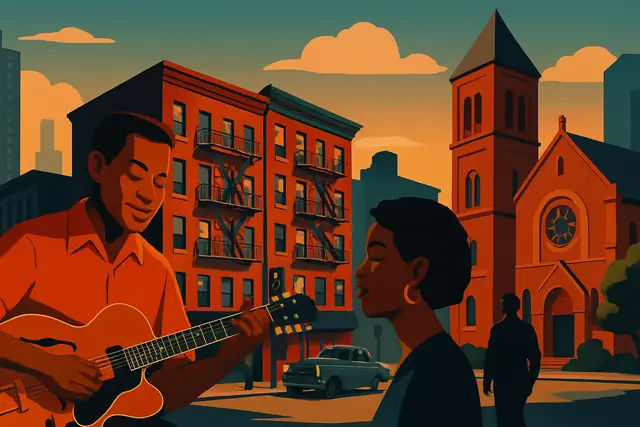
In the late 1990s and early 2000s, a cluster of Los Angeles bands emerged from the venues along and near Sunset Boulevard in Silver Lake and Echo Park. The scene was loose enough that 'Silver Lake sound' was applied retroactively, but the geography was specific: bands rehearsed in Silver Lake, played at Spaceland (1717 Silver Lake Blvd), recorded on shoestring budgets in Echo Park, and built regional followings before national press noticed.
Silversun Pickups drew their name from Silver Lake Liquor, a store near Sunset and Maltman that locals called 'the Silver Lake pickup' for the habit of stopping there before parties. The band formed in 2000, played Spaceland repeatedly in its early years, and signed to Dangerbird Records — a label also based in Silver Lake — in 2005. Their debut album *Carnavas* (2006) is the document most associated with the scene's peak.
Rilo Kiley played the same circuit. Elliott Smith lived in Silver Lake during parts of the early 2000s; a mural near the Silver Lake–Echo Park border on Sunset Boulevard has become an informal memorial that fans still visit.
Spaceland closed in its original form and the space went through several names and programming changes. The Silverlake Lounge at 2906 Sunset Boulevard is the neighborhood's oldest continuously operating music bar — a divey room with a stage in the back, a booking calendar that skews toward local acts and small touring bands, and a crowd that has not tried to be anything other than what it is.
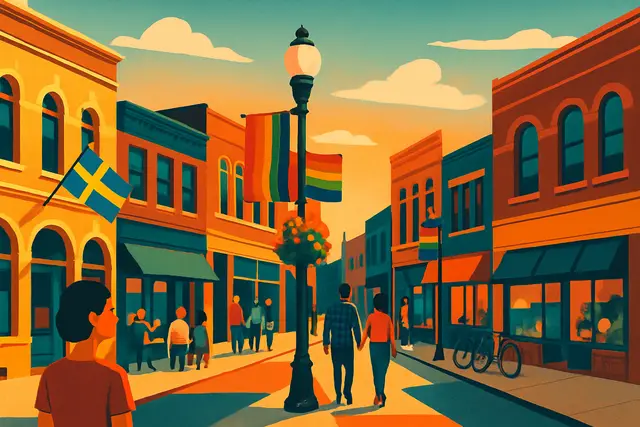
The Silver Lake stretch of Sunset Boulevard — roughly from the Sunset Junction intersection with Santa Monica Boulevard northwest toward the Los Feliz border — packs more into a single walkable mile than most neighborhoods offer in a dozen blocks.
Intelligentsia Coffee at 3922 W Sunset Blvd has been here since 2007. Intelligentsia began in Chicago in 1995 and was one of the first US coffee companies to build direct-trade relationships with coffee farmers and publish the prices paid — a practice that became the template for what the industry now calls third-wave coffee. The Silver Lake bar is a reference point for pour-over in LA. If you want to understand what the approach actually tastes like, this is one of the clearest examples.
Cliff's Edge at 3626 Sunset Blvd is the neighborhood's most enduring outdoor restaurant — a garden behind a low-key facade with a mature oak canopy, string lights, and seasonal California cooking. Open since 2003, it has survived four different chef regimes without losing the garden, which is the entire point of the restaurant.
Mohawk General Store at 4011 W Sunset Blvd is Silver Lake's defining lifestyle boutique: a 1,200-square-foot room curating clothing, accessories, and objects from independent designers worldwide. The selection runs toward Scandinavian and Japanese brands not widely distributed in LA, and changes frequently enough that repeat visits reward.
Stories Books & Café at 1716 Sunset Blvd combines a used and new bookshop with a small café. The format that failed in most cities has thrived on Silver Lake's Sunset for years, because the customer who buys a novel and sits with a coffee for an hour is exactly who lives here.
Silver Lake's restaurant shift happened between roughly 2010 and 2016, when the neighborhood moved from cheap tacos and dive bars to a cluster of serious kitchens that drew diners from Westside neighborhoods they'd never driven to before.
Pine & Crane at 1521 Griffith Park Blvd serves Taiwanese food in an unfussy room with fast, precise cooking. The three-cup chicken, scallion pancakes, and dan dan noodles are the consistent orders. No reservations; the line forms by 6:30 p.m. on weekend nights.
Botanica at 1620 Silver Lake Blvd is a seasonal restaurant with a wine bar that built a devoted following by doing one thing well: sourcing from small California farms and building the menu around what is actually excellent that week. In September, the farm produce is at peak and the brunch menu reflects it. Reservations on Resy; bar seats are walk-in.
Pijja Palace at 1400 Glendale Blvd opened in 2022 and immediately complicated every description of what Silver Lake dining is. The concept is Indian-Italian: pizzas with toppings drawn from the Indian pantry, pastas reworked through South Asian spice profiles, cocktails built across both traditions. It works because the kitchen is precise, not because the concept is novel.
Pine & Crane: 1521 Griffith Park Blvd — no reservations; arrive before 6 p.m. on weekends; three-cup chicken and scallion pancakes
Botanica: 1620 Silver Lake Blvd — Resy reservations; wine bar walk-in; September brunch is the peak-season visit
Pijja Palace: 1400 Glendale Blvd — take reservations; the saag pizza and tamarind-dressed Caesar are the right entry points
Sunset Triangle Plaza — the small paved triangle at the intersection of Sunset, Griffith Park Boulevard, and Edgecliff Drive — hosts a farmers market every Tuesday from 3 to 7 p.m. This is not a destination market on the scale of the Hollywood Farmers Market. It is a neighborhood market: smaller vendors, locals rather than tourists, produce priced for people who shop there every week.
In September, the market carries late-season heirloom tomatoes, corn, stone fruit at the tail end, and early winter squash coming in from the Central Valley. The honey and egg vendors are consistent year-round. The market is a 10-minute walk from the reservoir loop's southern access point — the combination of a reservoir walk followed by the Tuesday market is the default Silver Lake afternoon.
The Silver Lake Meadow, the grassy area at the south end of the reservoir between Silver Lake Drive and Ivanhoe Elementary School, is less formal than a destination park and draws a lower-key crowd: neighborhood dogs, parents who have been coming to the same spot for years, people reading. It doesn't photograph well and isn't on anyone's itinerary. It is the best version of what a park is actually for.
How do I get to Silver Lake from downtown LA without a car? The Metro Rapid 2 bus runs along Sunset Boulevard from downtown through Echo Park into Silver Lake, stopping at the commercial corridor near Sunset and Maltman. From the 4th/Hill stop downtown, expect 25–30 minutes depending on traffic. Rideshare from Hollywood typically takes 10–15 minutes. There is no Metro rail stop in Silver Lake.
How does Silver Lake connect to other neighborhoods? The neighborhood borders Los Feliz to the northwest — Griffith Observatory, the Greek Theatre, and the Los Feliz Village restaurant cluster are 10–15 minutes on foot from the north end of the Sunset corridor. Echo Park borders Silver Lake to the south and shares much of the same music and cultural history; the two neighborhoods are functionally one walkable zone.
Is Silver Lake safe to walk around? Yes. The commercial corridor on Sunset is densely trafficked during the day and through the evening. The reservoir loop is populated and well-lit through early evening. Standard urban awareness applies on residential blocks late at night, as in any LA neighborhood.
What about parking? Street parking on residential blocks east of Sunset is free and usually available outside of weekend afternoon peaks. For an all-day visit: park on a residential block in the morning, walk the reservoir loop, get coffee on Sunset, eat somewhere in the evening, and check if your day falls on a Tuesday for the market.