1. Where the Name Comes From: The Shad Fisheries of the Delaware
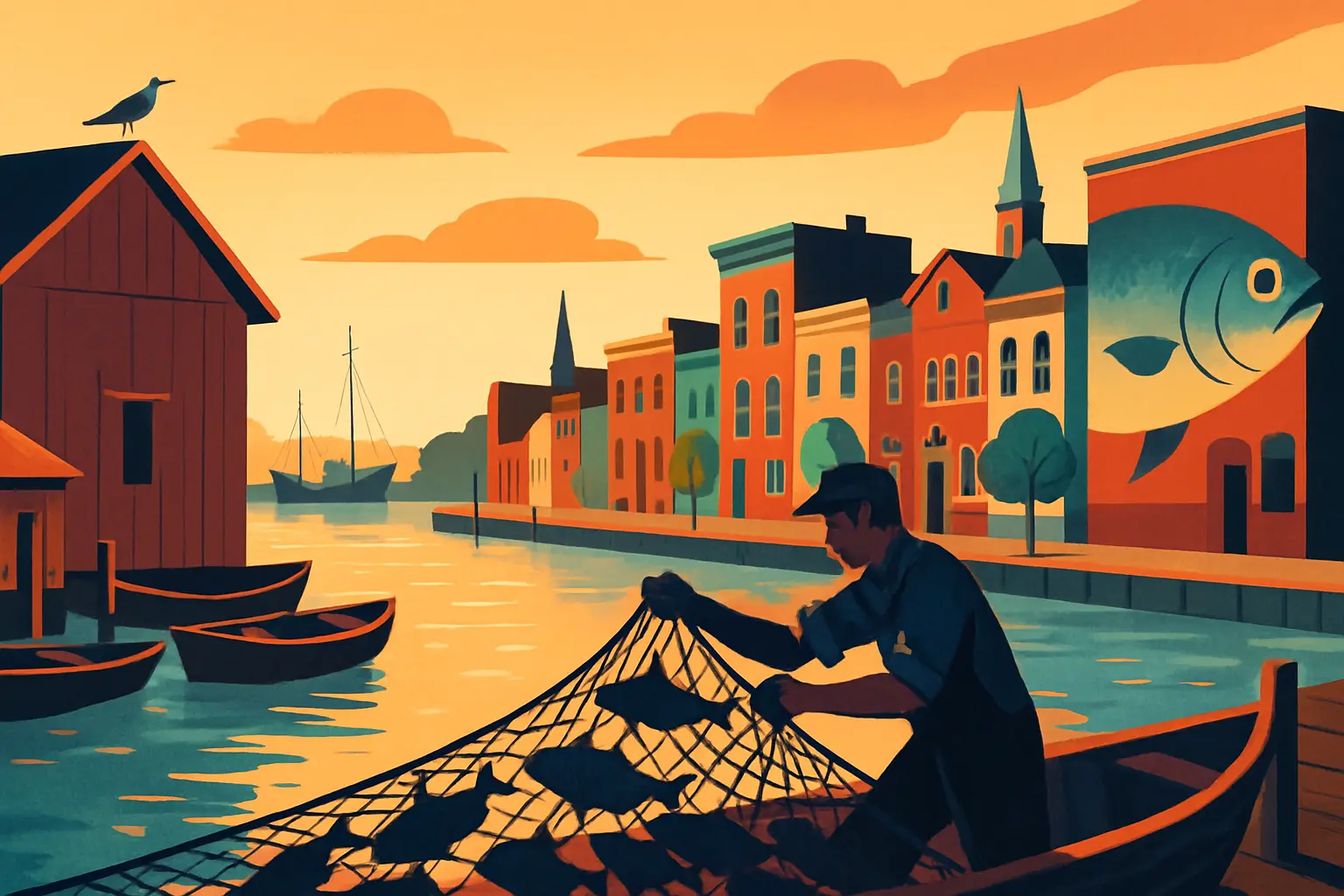
The American shad (Alosa sapidissima) was the most commercially valuable river fish in colonial North America. Every spring, shad migrated in dense schools from the Atlantic up the Delaware River to spawn, and by the late 1700s the waterfront community now called Fishtown had developed a network of haul-seine operations — large nets drawn by teams of workers onto the riverbank — that supplied fish markets in Philadelphia and as far away as New York.
The fisheries made the neighborhood. Watermen's cottages, net-drying sheds, and fish processing houses clustered along the Delaware waterfront. The community that formed around these operations was mixed — German, English, and Scots-Irish workers who pulled nets and sold their catch at the Old City markets downtown. The street names embedded the trade: Shackamaxon Street (named for the Lenape settlement that preceded the fisheries) and the grid of numbered streets along the river still carry the bones of that era.
By the 1870s, both overfishing and industrial pollution from Kensington's textile and sugar mills had gutted the shad population. The commercial fisheries collapsed over roughly two decades, and the riverfront shifted from fishing to manufacturing. The name Fishtown stuck long after the fish were gone — a habit of American cities to preserve in place names what they've already lost in practice. The Delaware River's shad population has partially recovered since the Clean Water Act protections of the 1970s, but commercial haul-seine fishing has not returned to this stretch of river.
2. The Working-Class Century and the Slow Turn
After the fisheries closed, Fishtown became manufacturing territory. Kensington's textile mills drew Irish Catholic workers from the 1880s onward, and the neighborhood immediately south filled with the rowhouse blocks that defined Philadelphia's working-class geography. By 1920, Fishtown was largely Irish Catholic, politically connected to the ward machine, and home to dockworkers, factory hands, and small shopkeepers whose families would stay for generations.
Deindustrialization hit hard from the 1970s onward. Kensington's mills closed, populations declined, and by the 1990s Fishtown had the combination of deteriorating housing stock and low rents that signals a neighborhood in transition.
The transition began in Northern Liberties, directly to the west along Frankford Avenue. Artists and young professionals moved into Northern Liberties in the late 1990s, built a gallery and bar scene along that corridor, and then — as Northern Liberties rents rose — pushed east into Fishtown. The first wave of Fishtown bars and restaurants opened between 2004 and 2008. By 2015 the neighborhood appeared on national best-neighborhood lists. By 2020 it was consistently cited among the fastest-appreciating residential markets in the country. The longtime residents who stayed through the lean decades now coexist, unevenly, with the restaurants and boutiques that followed the artists in.
3. September 13, 2006: How Johnny Brenda's Defined a Music Scene
Johnny Brenda's (1201 N. Frankford Ave) has two floors. The bar on the ground level is a neighborhood bar in the fullest sense — pool table, long bar, open late, no pretension. The upstairs venue holds about 200 people and has a sight line from nearly every position in the room. That combination proved to be exactly what Philadelphia's indie rock community needed in 2006.
The opening night bill, on September 13, 2006, included four local acts. One was a neighborhood band fronted by a songwriter named Adam Granduciel, performing under the name the War on Drugs. Another performer that night, playing a solo set, was a young guitarist named Kurt Vile — who had been part of the early War on Drugs lineup before building his own career. Granduciel later called Johnny Brenda's "ground zero for my musical life in Philly," describing it as the room where he and Vile made recordings and developed the sound that would produce *Lost in the Dream*, the War on Drugs album that won the 2015 Grammy Award for Best Rock Album.
The venue's programming has remained independent of trend cycles. Most shows are general admission, all-ages before 9 p.m., and priced for the lower end of the touring circuit — acts on the way up rather than established draws. The War on Drugs return each December for a holiday benefit concert series raising money for Philadelphia public schools. Those shows sell out within hours of the announcement and have become one of the most anticipated annual events in the city.
4. Frankford Avenue: Walking the Main Corridor
Frankford Avenue is Fishtown's spine. The half-mile between Girard and York Street concentrates most of what makes the neighborhood worth visiting.
La Colombe (1335 Frankford Ave) runs its flagship roasting operation in a high-ceilinged former industrial space. La Colombe now has cafes in dozens of cities, but the Fishtown location is where the company developed the draft latte — cold-pressed espresso with aerated milk, served from a tap — that became its signature product. Coffee only, no food, open daily from 7 a.m.
Frankford Hall (1210 Frankford Ave) is a German beer hall-style bar with one of the largest outdoor seating areas in the city. The draft list runs to about 20 taps with an emphasis on German and Belgian styles. The kitchen serves soft pretzels, sausages, and pierogies. Open until 2 a.m. on weekends; the patio hits its best form on weekday afternoons when the midweek crowd is a fraction of the weekend volume.
Harriet's Bookshop (258 E. Girard Ave) is a Black woman-owned independent bookshop named for Harriet Tubman, curating work by Black women authors, artists, and activists. The store operates as both a retail space and a community hub, hosting readings and events throughout the year. For anyone who knows the story of Harriet Tubman and the Underground Railroad, walking into a bookshop built in her name — in a neighborhood whose library of stories runs deep — lands with a different weight.
5. Where to Eat: Specific Picks on Specific Streets
Fishtown's restaurant scene turns over fast, but these have enough history and consistent reputation to recommend with confidence.
•**Suraya** — 1528 Frankford Ave. Lebanese restaurant opened in 2017 by the Khoury family, with a market on one side and a full-service restaurant on the other. The mezze spread — hummus, fattoush, kibbeh nayeh — is the right way to eat here. Weekend dinner reservations book 1–2 weeks out. The weekend brunch market format is walk-in friendly and works well as a first visit.
•**Wm. Mulherin's Sons** — 1355 N. Front St. The building is a former whiskey blending and bottling facility from the 1860s. Wood-fired pizza and pasta in a room where original brick and reclaimed timber have been kept largely intact. Four hotel rooms above the restaurant, each named for a whiskey type, if you want to stay in the neighborhood.
•**Pizzeria Beddia** — 1313 N. Lee St. A small pie shop with a years-long reputation as one of the best pizzas in Philadelphia. Counter service, no reservations. Arrive before 6 p.m. to avoid the longest wait.
•**Frankford Hall** — 1210 Frankford Ave. Beer hall with a large outdoor patio, German and Belgian draft list, simple food. Best on weekday afternoons when the crowd is local rather than weekend-tourist.
•**La Colombe** — 1335 Frankford Ave. Flagship of a national roaster. Draft latte developed here. Coffee only. Open 7 a.m. daily.
6. Penn Treaty Park and the Delaware Waterfront
At 1341 N. Delaware Avenue, at the eastern edge of Fishtown where the land meets the river, a 7-acre park was built around one of the most disputed meetings in colonial American history.
Penn Treaty Park marks the site of the alleged meeting between William Penn and Chief Tamanend of the Lenape nation in 1682 or 1683. The meeting was said to have taken place under a large elm tree in the Lenape settlement of Shackamaxon — a name that survives today in the Fishtown street grid. Penn reportedly signed a treaty of friendship guaranteeing peaceful relations between the European settlers and the Lenape people who had occupied the region for centuries.
Historians have debated nearly every element of the story. The 1682 date is unlikely given Penn's otherwise documented schedule after arriving in America. No primary source treaty document has ever been found — the evidence comes from later accounts and secondhand records. The elm tree itself collapsed in a storm in 1810, and a stone obelisk was installed to mark the site. The city formally opened the surrounding land as Penn Treaty Park in 1894.
What makes the park worth visiting is not the unverifiable history but the geography: the view of the river, the Ben Franklin Bridge stretching south, and the rare sensation of standing at the actual water's edge in a city where most of the Delaware River waterfront is blocked by industrial infrastructure. The park is quiet on weekday mornings and is one of the few places in Fishtown where the river is visible at all.
7. Getting There, How Long to Stay, and Other Practical Questions
Is Fishtown safe for visitors? The commercial corridor along Frankford Avenue is busy and well-lit; the neighborhood is heavily trafficked by visitors on weekend evenings. Property crime — car break-ins, package theft — runs higher than in lower-crime Philadelphia neighborhoods. Violent crime in Fishtown itself is relatively low compared to the broader city average. Blocks east of Frankford, closer to the river, are quieter at night — stick to the main corridor after dark if you're unfamiliar with the area.
How long should I spend here? A focused visit — one meal, a walk of the Frankford Avenue corridor, and Penn Treaty Park — takes about three hours. If you're catching a show at Johnny Brenda's or the nearby Fillmore Philadelphia (1100 Canal St, about a 10-minute walk south), add two to three hours for the venue plus dinner beforehand.
How do I get there from Center City? The Market-Frankford Line (El) runs east from Jefferson Station to Girard Station in about 10 minutes. The Route 15 trolley on Girard Avenue is the slower but more scenic surface option. Walking from Old City takes about 20 minutes along Girard.
Can I combine Fishtown with other Philadelphia neighborhoods? Easily. Northern Liberties shares Fishtown's western border — a 10-minute walk along Frankford Avenue. Old City and Independence Hall are a 20-minute walk or one quick El ride southwest, worth pairing into a full Philadelphia day.
When is the best time to visit? Late spring and early fall for outdoor spaces — particularly Frankford Hall's patio and Penn Treaty Park. August evenings are warm and active, with long sidewalk hours that spill out of the bars. The December War on Drugs holiday shows at Johnny Brenda's are a specific reason to visit in winter if tickets can be had.