Tom Kiradjieff arrived in the United States from Macedonia around 1920, part of a wave of Southern and Eastern European immigrants settling in the industrial cities of the Midwest. He and his brother John opened a small stand in Cincinnati in 1922, near the Empress Burlesque Theater on Vine Street — a lively strip in the city's entertainment district where performers, stagehands, and theatergoers needed cheap, filling food at odd hours. They named the spot Empress Chili.
Kiradjieff called his meat sauce 'chili' because chili con carne was becoming widely recognized in American cities at the time. But his recipe came from somewhere else entirely. The spice profile — cinnamon, allspice, Worcestershire sauce, cumin, a trace of unsweetened cocoa — drew on the braised meat dishes of his home region. Mediterranean cooks had been adding warm, sweet spices to savory meat preparations for centuries. Kiradjieff transplanted that instinct into a dish American diners could recognize by name.
He served it over spaghetti because dry pasta was cheap, widely available, and produced by Italian immigrant communities in the same Midwest cities. The combination was practical before it became canonical. Within a decade, Cincinnati chili had established itself as a regional staple — served at counters across the city's working-class neighborhoods, always over noodles, always with the option to add onion, beans, and cheddar.
Empress Chili still operates today, with multiple Cincinnati-area locations, and is considered the original template from which every subsequent Cincinnati chili chain developed. The dish Kiradjieff built in 1922 is essentially unchanged: ground beef simmered in seasoned water (never browned), thin enough to pour, spiced with cinnamon and allspice, served over spaghetti.
Texas chili purists hold two rules: no beans cooked in the pot, no tomatoes. Cincinnati chili violates both — but adds a third deviation that no Texan would have anticipated: no browning the meat at all.
At a Cincinnati chili parlor, raw ground beef goes directly into seasoned water and is broken up as it simmers. There is no sear, no Maillard reaction. The cooking process is entirely about spices — cinnamon, allspice, cumin, chili powder, Worcestershire, sometimes a square of unsweetened baking chocolate — working into the broth and the meat simultaneously. The result has a silkier, more uniform texture than any browned-meat chili, and a depth of flavor that comes from warm spice layers rather than char.
The cinnamon is always the first thing first-timers notice. It reads as sweet and slightly herbal to palates expecting the smoky, cumin-forward heat of Tex-Mex chili. Longtime Cincinnati eaters stop registering it — the cinnamon is background structure, not a flavor note. But it is definitionally present in every authentic version.
Comparing Cincinnati chili to Texas chili is like comparing cassoulet to baked beans because both have legumes. They share a name and almost nothing else. The useful comparison is to the slow-simmered meat sauces of Balkan and Eastern Mediterranean cooking — spice-layered, built for serving over a starchy base. In that context, the spaghetti is obvious. The confusion comes from the American label applied to a Macedonian recipe.
Get short, interactive stories that make each place easier to remember while you travel.
Every Cincinnati chili parlor operates on the same ordering system, called 'the ways.' Each number specifies exactly what is on the plate. Knowing the system before you walk up to the counter is the minimum local knowledge expected.
2-way: spaghetti topped with chili. The entry-level order. Most regulars consider it incomplete.
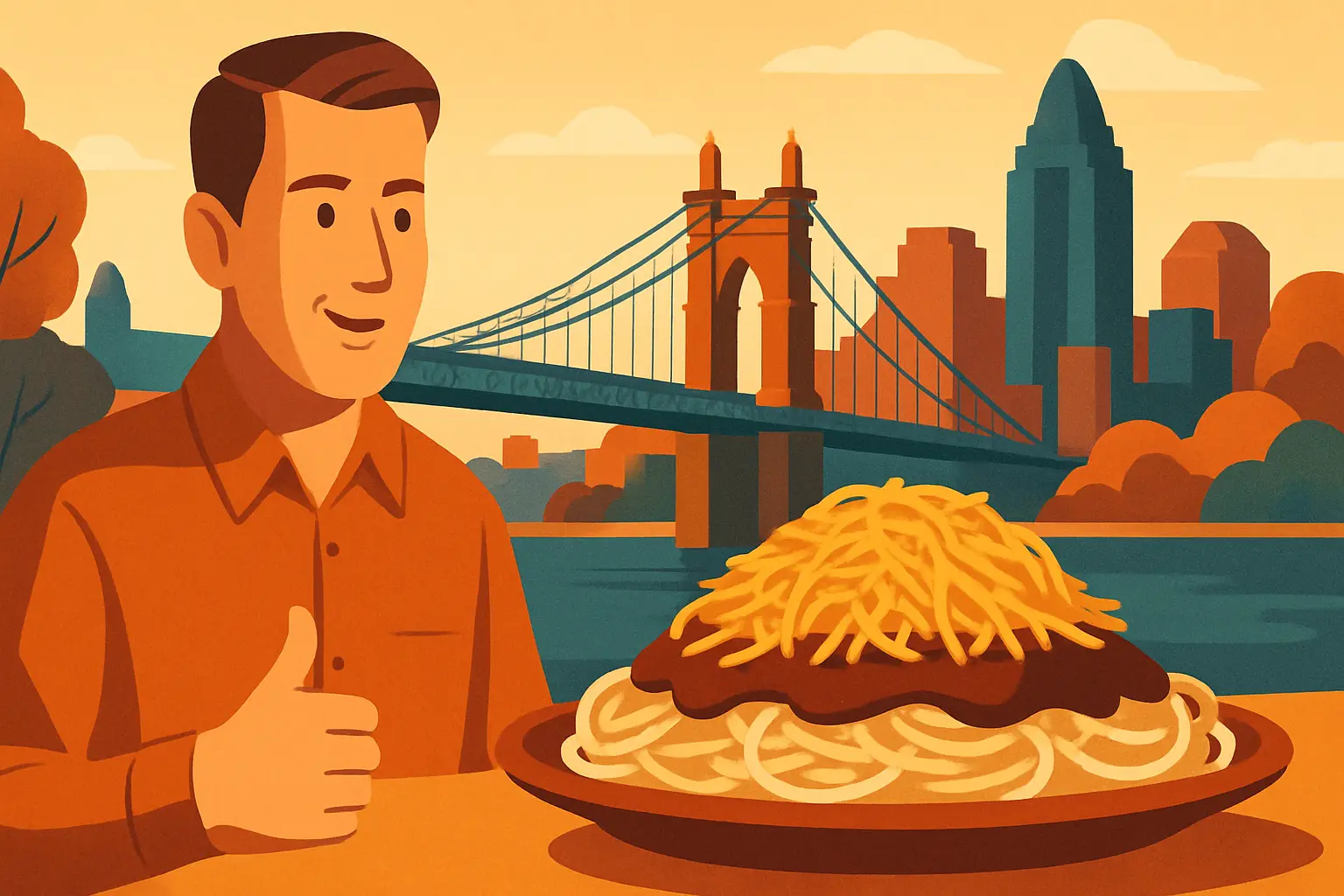
3-way: spaghetti + chili + a mountain of finely shredded mild yellow cheddar. This is the benchmark order — the cheese transforms the dish entirely, adding fat, salt, and a creamy buffer between the spiced sauce and the noodles.
4-way: spaghetti + chili + cheddar + *either* diced raw onion *or* kidney beans. The counter worker will ask which. Most people choose onion.
5-way: spaghetti + chili + cheddar + diced raw onion + kidney beans. The complete version. On your first visit, order this — not because it's necessarily the best, but because you cannot have an informed opinion on Cincinnati chili until you've had the full assembly at least once.
Beyond 'the ways,' every parlor also serves Cincinnati Coneys: a hot dog in a steamed Wonder-style bun, dressed with yellow mustard, a spoonful of chili, finely diced raw onion, and a stripe of shredded cheddar. The Coney is the snack version of the dish — portable, fast, and an excellent side order with a 3-way. Two Coneys is a standard lunch.
Oyster crackers arrive automatically with every order. Locals add them directly to the plate, where they absorb the chili and soften slightly. This is not a garnish decision. Add the crackers.
Skyline Chili was founded in 1949 by Nicholas Lambrinides, a Greek immigrant who had worked at Empress Chili before striking out on his own. He opened his first counter at what was then 643 Vine Street — up on a hill in Mt. Adams with a view over the Cincinnati skyline, which is where the name came from. Skyline now operates roughly 100 locations across the Cincinnati metropolitan area and parts of Dayton, making it by far the most visible institutional presence of the dish in the region.
Gold Star Chili was founded in 1965 by the Daoud family, Iraqi brothers who had also worked in Cincinnati's chili industry before opening their own chain. Gold Star is slightly more cinnamon-forward and marginally sweeter than Skyline, though the differences are subtle enough that out-of-towners rarely notice on a first visit. Gold Star operates roughly 25 locations today.
Long-term Cincinnati residents divide along Skyline and Gold Star lines with the conviction of sports team allegiances. Families split at the grocery store when both brands sell canned chili for home use. Neither side concedes meaningful superiority to the other; the debate has been running since at least the 1970s and shows no sign of resolution.
For visitors, the practical instruction: pick one chain for your first visit, try the other before you leave. Both serve an honest version of the dish. Skyline's higher location count means it will statistically be the first one you encounter.
Skyline Chili: landmark location near the University of Cincinnati at 3714 Clifton Ave; also a busy downtown spot at 643 Vine St
Gold Star Chili: main Cincinnati presence at 2218 Central Pkwy; several suburban locations throughout Hamilton County
Empress Chili: the original; the Mt. Lookout location at 3849 Observatory Rd is the address most frequently cited by food writers
The best Cincinnati chili is not always in the most famous places. Three independent parlors represent the dish at its highest level.
Camp Washington Chili at 3005 Colerain Avenue in the Camp Washington neighborhood is the most decorated independent chili parlor in the country. It opened in 1940 — nine years before Skyline — and was awarded a James Beard America's Classics citation in 2000, the most significant recognition any chili parlor has received from the food world. The dining room is a genuine 1940s diner, unchanged in structure: counter stools, a neon sign, fluorescent lighting, and a line that runs out the door on winter weekdays. The chili here is darker and more complex than the chain versions — spice balance leaning slightly more toward cumin and Worcestershire, with less sweetness from cinnamon. Open Monday through Saturday.
Blue Ash Chili at 9565 Kenwood Road in the suburb of Blue Ash is the choice of Cincinnati chili enthusiasts who want independence without the historic-landmark atmosphere of Camp Washington. The 5-way here is consistently cited by local food writers as the best in the metro. The parking lot fills on weekday lunches, which tells you most of what you need to know. Order the combo plate — 5-way plus two Coneys — on your first visit.
Price Hill Chili at 4920 Glenway Avenue in the Price Hill neighborhood has operated since the 1960s. The recipe follows the Empress-era tradition closely — slightly less sweet, more herbal — and the clientele is the neighborhood, not tourists. Most out-of-towners don't find it, which is part of its appeal.
Camp Washington Chili: 3005 Colerain Ave; Mon–Sat 9 a.m.–10 p.m.; James Beard America's Classic, cash preferred
Blue Ash Chili: 9565 Kenwood Rd; open daily for lunch and dinner; most-cited 5-way in the metro
Price Hill Chili: 4920 Glenway Ave; neighborhood institution with an Empress-era recipe
First-time visitors make two consistent mistakes: they push the shredded cheese aside, and they ignore the oyster crackers. Both errors change the dish in ways that are difficult to reverse mid-meal.
The cheddar used on Cincinnati chili is mild yellow, always shredded fresh — never pre-processed, never sliced. The fine-shred texture is specific: it creates a matrix of cheese strands that partially melts on contact with the hot chili below while staying cool and airy at the top. The result is three distinct cheese textures in a single bite — warm and creamy at the base, slightly firm in the middle, cool and fluffy at the surface. Taking the cheese off removes the fat and salt register of the dish entirely. The chili alone, without cheese, tastes thin and incomplete. This is why every local will tell you: the cheese is not optional.
Oyster crackers — the small, round-ish crackers found in New England chowder houses — arrive in a small dish or cellophane packet. Locals add them directly to the 5-way, where they absorb the chili and add a neutral, starchy crunch. The crackers are not decorative. They are edible structural material that changes the texture of every bite.
The fork technique locals use: swirl to pick up noodles, chili, cheese, and crackers in a single bite, the way one eats pasta. The dish is assembled architecture, not ladled soup. Eating it with a spoon, or picking at the components separately, is technically possible but misses the point of the construction.
Is this actually chili? By the standards of Texas chili competitions, no. By Cincinnati's own century-long definition, yes. The Texas-or-not debate is less interesting than the dish itself — Macedonian immigrant food traditions plus a Midwest pantry plus American commercial framing equals Cincinnati chili. It is its own category, and arguing about whether it belongs in the category 'chili' is roughly as useful as arguing whether a tomato is a fruit.
Should I go to Skyline or Gold Star first? Skyline is the pragmatic choice because its locations are more numerous. The Clifton Avenue Skyline near the University of Cincinnati campus tends to draw a local-heavy crowd rather than tourists. For the full independent experience, Camp Washington Chili is the historic-landmark choice; Blue Ash Chili is the food-quality choice.
Is there a vegetarian version? Traditional parlors do not offer one. Some will serve a plate of spaghetti and cheese on request, but that is a different dish. The Cincinnati restaurant scene — particularly in the Over-the-Rhine neighborhood — has a range of non-chili options for travelers who don't eat meat.
When is the best time to visit? Cincinnati chili is a year-round institution, but September is an excellent month: the city hosts Oktoberfest Zinzinnati along Fifth Street downtown — typically the third weekend of September, one of the largest Oktoberfest celebrations in North America — and chili parlors are reliably busy in cooler fall weather. Lines at Skyline and Gold Star are shortest on weekday mornings.
Can I take it home? Both Skyline and Gold Star sell canned chili in grocery stores throughout Ohio, Kentucky, and Indiana. Camp Washington sells frozen portions to go. The canned versions are a legitimate product — Cincinnati residents stock them at home for weeknight meals — though they don't match the parlor experience.