1. The 1920s and the Wedding Feast Problem
Italian immigrants who settled on Chicago's Near West Side — in the neighborhoods around Taylor Street and the Maxwell Street market — came primarily from southern Italy, where large family celebrations meant slow-cooked meat served communally. In Chicago, working-class families held multi-day wedding celebrations sometimes called 'peanut weddings,' named for the peanuts scattered on tables as low-cost filler. The real challenge was meat: a single beef roast might feed a dozen people sliced at normal thickness. That wasn't enough for a wedding.
Thin-slicing on a deli slicer — a technique Italian butchers brought from home — stretched a single roast to feed forty or fifty guests. The beef was seasoned with Italian herbs, slow-roasted until just done, then sliced so thin each piece was nearly translucent and simmered in the cooking juices to stay moist. From wedding kitchens, the recipe moved to outdoor stands, then to storefronts.
Pasquale Scala, an Italian immigrant who set up shop on South Western Avenue after World War I, is among the earliest documented commercial sellers of thinly sliced beef sandwiches in Chicago. He established the Scala Packing Company in 1925 on Harrison Street, which became one of the city's major suppliers of seasoned beef, providing product to stands and restaurants for decades. His son Pat Scala later operated the company and helped standardize the recipe across Chicago's beef counter culture — Pat died in May 2025 at age 77, with the Chicago Sun-Times noting his role in carrying the tradition forward.
By the 1930s, Italian beef sandwiches were appearing on menus throughout Chicago's Italian neighborhoods, particularly along Taylor Street in Little Italy and along Milwaukee Avenue and Armitage Avenue on the Northwest Side.
2. The Technique: Why Thin-Sliced and Jus-Soaked Works
The Chicago Italian beef sandwich is built around a specific sequence that most people eating it for the first time take entirely for granted.
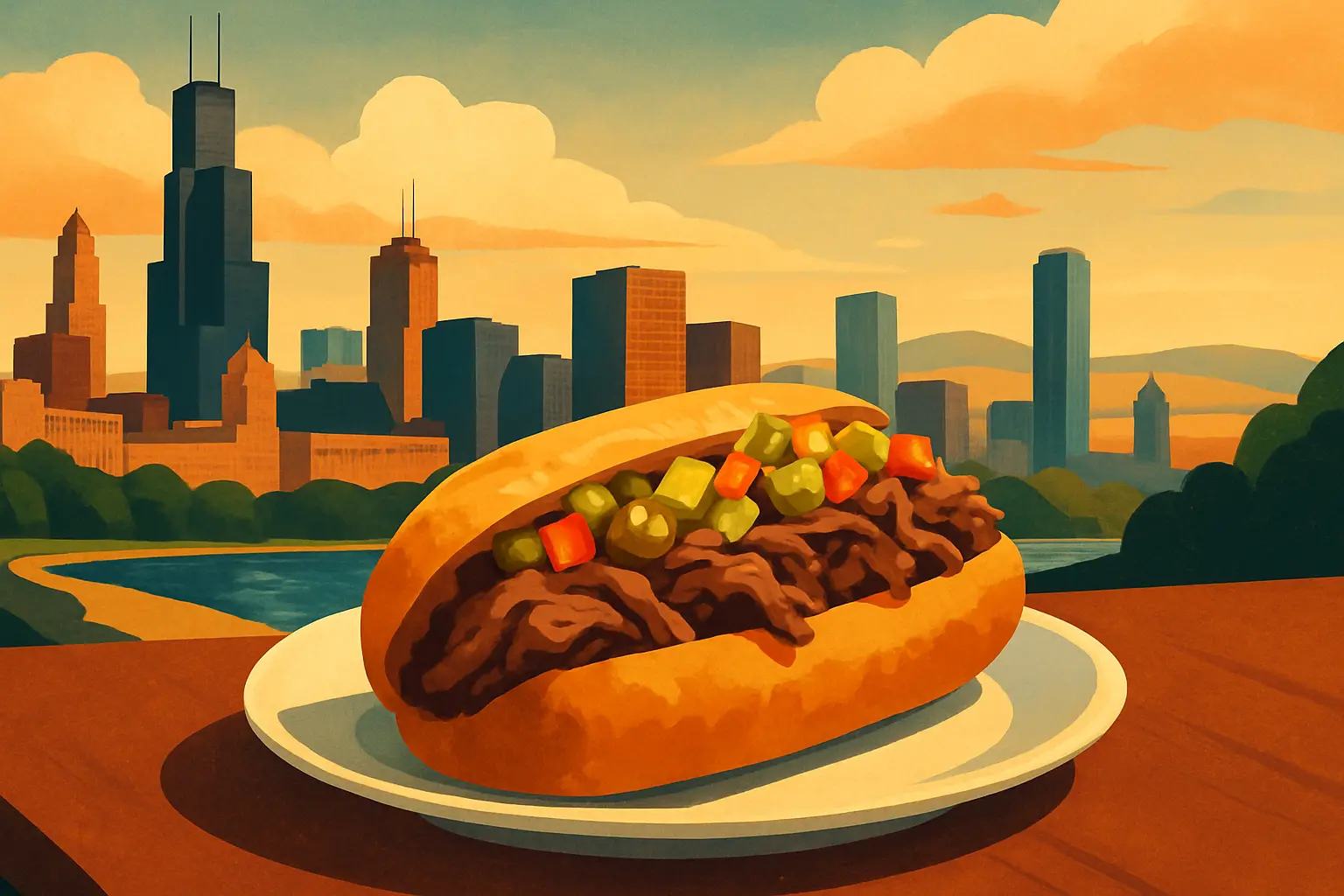
The beef — typically a bottom round or top sirloin — is rubbed with Italian seasoning (garlic powder, oregano, basil, black pepper, crushed red pepper) and slow-roasted until it reaches medium doneness. This low-moisture cooking method concentrates flavor in the exterior crust. Once out of the oven, the roast is refrigerated — cold meat slices cleanly on the deli slicer. After cutting to near-paper thinness, the beef goes into the cooking juices (called 'the juice' or 'the gravy' in Chicago), where it simmers and absorbs the seasoned liquid until service.
The practical effect: the beef carries flavor from three separate layers — the dry seasoning rub, the roasting process, and the jus soak. No single step would achieve the same result. The thin slicing is not a labor-saving shortcut. It's the delivery mechanism. Thicker slices would require chewing through dense meat; at the proper thickness, each bite is pure seasoned-beef flavor without resistance.
The roll — a French-style Italian loaf from Gonnella Baking Company or Turano Baking Company, both Chicago bakeries operating since the early twentieth century — is split and either loaded dry, soaked with a ladle of jus poured over the top, or dunked entirely into the jus pan. The bread is specifically built for absorption: firm outer crust, tight crumb. Chicago bakeries whose business depends on the beef-stand industry make these rolls to exacting specs.
3. The Vocabulary Every First-Timer Needs
Ordering Italian beef in Chicago requires knowing three things before you step up to the counter, because the counterperson will ask all of them in rapid succession and you're expected to answer fast.
Wet, dry, or dipped: 'Dry' means the sandwich as assembled, no extra juice. 'Wet' means a ladle of jus is poured over the meat before the roll closes. 'Dipped' means the entire assembled sandwich is fully submerged in the jus pan — bread, beef, everything — pulled out and served immediately. Most regulars order dipped. The bread doesn't disintegrate the way you'd expect; the tight crumb absorbs liquid at the surface while the interior stays intact. Eating a dipped sandwich requires two hands and no clean-shirt ambitions.
Sweet or hot: Sweet peppers are thin-sliced roasted green bell peppers, cooked until soft. Hot means giardiniera — the pickled vegetable condiment Chicago made its own (see next section). Most experienced eaters order both, sometimes called 'combo.' The sweet peppers add richness; the giardiniera adds vinegar and heat. They're better together.
Size: Most stands offer a standard sandwich (roughly six to eight ounces of beef) or a combo that pairs it with a hot dog or Italian sausage. On your first visit, the standard beef sandwich is the right order.
4. Giardiniera: The Ingredient Nobody Talks About Enough
Giardiniera — pronounced 'jar-di-NAIR-a' — originated in Italian home preserving, used to keep vegetables through winter in oil and vinegar. In Chicago, it evolved into something distinctly local: chopped sport peppers, celery, olives, cauliflower, and pickled vegetables suspended in oil, with heat levels ranging from mild to genuinely intense.
Chicago's giardiniera is oilier than the Italian original. The oil carries the heat across the sandwich and seasons the bread from the inside. The sport peppers used in Chicago giardiniera — small, round, and firm — deliver a clean, immediate heat rather than a slow burn. At around 10,000–23,000 Scoville units, they're hotter than jalapeños but nowhere near habanero territory.
Commercial producers include Vienna Beef (which supplies many stands) and Marconi Foods. But the best giardiniera in Chicago tends to be house-made. J.P. Graziano Grocery at 901 W. Randolph Street in the West Loop — a fourth-generation family market open since 1937 — makes a version available by the jar that most Chicago food writers treat as the benchmark. Their sandwich counter also uses it, making the detour worthwhile for both the condiment and the food.
The giardiniera varies noticeably between beef stands. Al's Italian Beef uses a celery-based version that deviates from the standard pepper mix, giving Al's a distinct texture. Mr. Beef historically ran milder-than-average giardiniera, which is part of why that sandwich was considered more accessible. Noticing these differences is how you know you're paying attention.
5. Al's Italian Beef: The Founding Counter on Taylor Street
Al's Italian Beef at 1079 W. Taylor Street in Little Italy is the commercial anchor most historians of the sandwich point to. Al Ferrari and his family opened a stand in 1938, and the Taylor Street location has operated continuously since — through ownership transitions and neighborhood changes — without meaningfully altering the recipe.
Taylor Street in the Near West Side is where Chicago's Italian immigrant community concentrated itself commercially in the early twentieth century. The stretch from Halsted to Morgan still carries Italian-American restaurants, bakeries, and delis that defined the neighborhood at its peak, though the construction of the University of Illinois at Chicago campus in the 1960s displaced some of the original residential housing and changed the neighborhood's character. Al's is the oldest surviving piece of that commercial landscape.
Al's has expanded to multiple Chicago locations and suburban outposts, but the Taylor Street original is the address regulars specify. It opens at 9 a.m., closes mid-evening, and the counter crew has the ordering process timed to the second. The celery-based giardiniera, the thin-sliced beef dark with jus, and the Gonnella roll are as they have been for decades. The line moves — this is not a place where you linger at the counter.
6. Mr. Beef, Jay Leno, and The Bear: 90 Years to the State Sandwich
Mr. Beef at 666 N. Orleans Street in River North was a different kind of institution. Not in Little Italy or on the Northwest Side beef corridor — it was in what became one of Chicago's most expensive restaurant neighborhoods, occupying a no-frills counter space from the 1970s. The sandwiches were large, the service was direct, and the jus ran freely.
Comedian Jay Leno discovered Mr. Beef in the 1980s and made it a habit of shipping sandwiches back to New York. When he had his television show, he reportedly had them flown in by courier. He eventually bought a stake in the restaurant and became its most prominent outside promoter, giving Mr. Beef a national food-media footprint well before it had a second reason to be famous.
That second reason was The Bear, the FX/Hulu drama created by Christopher Storer that premiered in 2022. The show is set at a fictional Italian beef stand called The Original Beef of Chicagoland, and Mr. Beef is the acknowledged real-world inspiration — the cast and crew spent time at the counter during production, and the visual language of the fictional kitchen directly references the River North location.
By the time the fifth and final season of The Bear premiered on June 25, 2026, the Illinois General Assembly had passed a resolution naming the Italian beef the Official State Sandwich of Illinois, explicitly citing the show with introducing 'the immigrant working-class roots' of the dish to a global audience. State Representative Kam Buckner of Chicago's South Side introduced the legislation; the signing ceremony in Springfield included an Italian beef truck. Mr. Beef's original River North location had closed by 2025 — but its legacy is intact in the show and in the dozens of counter spots around the city operating in the same mode.
7. Where to Eat Italian Beef in Chicago
With Mr. Beef's original River North space closed, these are the spots locals and informed visitors go to in 2026.
•**Al's Italian Beef** — 1079 W. Taylor Street, Little Italy. The founding address. Celery-based giardiniera, Gonnella rolls, beef soaked dark in the jus. Opens 9 a.m. daily. Order it dipped with combo peppers. The Taylor Street location is the historically significant one; the suburban branches are good but not the same.
•**Johnnie's Beef** — 7500 W. North Avenue, Elmwood Park (about 20 minutes west of downtown). A 1960 counter that most Chicago food writers rank as the best Italian beef in greater Chicago. The jus at Johnnie's is darker and more deeply seasoned than average. Cash only. Italian ice on the side. Lines that move efficiently.
•**J.P. Graziano Grocery** — 901 W. Randolph Street, West Loop. A fourth-generation grocery and sandwich counter open since 1937. The Italian beef sandwich here benefits from house-made giardiniera that's widely considered Chicago's benchmark. Pick up a jar to take home.
•**Portillo's** — multiple Chicago locations; River North flagship at 100 W. Ontario. The chain that scaled the sandwich without ruining it. Consistent beef, reliable jus, capacity to handle large groups. Best choice for a first visit if you want a low-stakes introduction before committing to a specific counter.
•**Buona Beef** — multiple Chicago-area locations. A 1981 chain that functions as the default lunch option for many Chicago office workers. Fast, reliable, unremarkable decor. The 'Buona Way' — dipped with both sweet and hot peppers — is worth ordering as specified.
8. FAQ: How to Order, What to Expect, How It's Different
What should I order the first time? One Italian beef sandwich, dipped, with combo peppers — both sweet roasted peppers and hot giardiniera. That's the full expression of the dish. Don't start with a modified version.
Is the giardiniera actually hot? Real but not extreme. The sport peppers carry more bite than the oil-brined vegetables. Somewhere between a hot salsa and a medium-hot Thai dish. If you're heat-sensitive, get just the sweet peppers the first time. Most people handle it fine.
Why doesn't the bread fall apart? A properly made Gonnella or Turano roll has a tight crumb designed for absorption. The crust slows the soak enough that the bread holds its structure for the duration of a meal. If it's collapsing early, the bread is wrong or the sandwich sat too long. Eat a dipped sandwich immediately.
How is this different from a French Dip? A French Dip (originated in Los Angeles) is thin-sliced beef on a roll with a dipping sauce served on the side — you dip each bite yourself. Chicago Italian beef is soaked in the jus before service, meaning the meat and bread absorb the liquid as part of preparation. The seasoning profiles are completely different, and the giardiniera topping has no equivalent in the French Dip tradition.
Is there a vegetarian version? Not at traditional stands. This is a beef sandwich, and the dish doesn't have a vegetarian analogue with the same logic. If you're with someone who doesn't eat beef, Portillo's offers a broad enough menu to accommodate both.