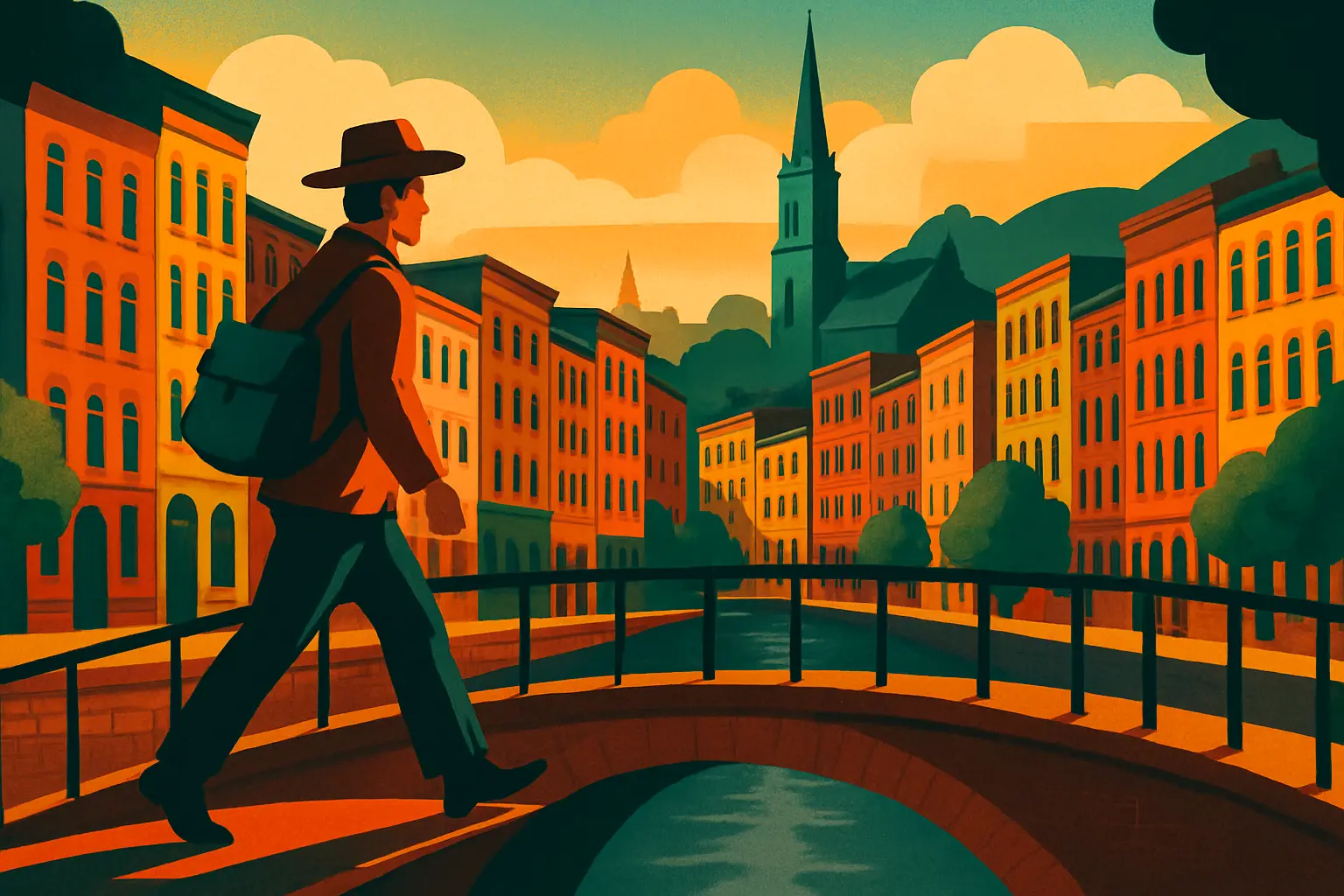
The Miami and Erie Canal ran through Cincinnati along what is now Central Parkway, a wide arterial road that separates OTR from downtown. In the 1830s and 1840s, German immigrants settled in large numbers on the hills north of the canal. To reach their jobs in Cincinnati's warehouses, slaughterhouses, and river docks, they crossed the canal every morning — and the daily walk reminded them of crossing the Rhine River to work in the German countryside. By 1850, they were calling the neighborhood Over-the-Rhine.
By 1880, Cincinnati was the sixth-largest city in the United States, and Germans made up the largest share of its population. The neighborhood they built reflected both prosperity and cultural confidence: breweries, churches, concert halls, market houses, and row after row of brick commercial buildings in the Italianate style fashionable for American business blocks at the time.
That world largely ended after World War I. Anti-German sentiment swept through American cities between 1917 and 1919 — German-language newspapers closed, German street names were renamed, and communities that had maintained distinct cultural identities for two generations assimilated with deliberate speed. The people moved out of OTR toward the suburbs. The buildings stayed.
More than 900 19th-century buildings survive in Over-the-Rhine, with most dating from the 1860s through the 1890s. The National Trust for Historic Preservation recognizes OTR as the largest concentration of intact Italianate commercial architecture in the country — and the neighborhood's status on the National Register of Historic Places covers some 360 acres.
The reason they survived is not preservation activism. It is poverty. Urban renewal programs in the 1950s and 1960s cleared enormous swaths of American cities, replacing historic neighborhoods with housing projects, highways, and parking garages. Cincinnati lacked the civic investment appetite — or the federal funding to match — for large-scale demolition in OTR. The buildings sat vacant through decades of disinvestment, deteriorating slowly enough that replacing them never became a priority.
Walk Vine Street from 12th to 15th Streets today and you see the result: a nearly unbroken sequence of three- and four-story brick facades with bracketed cornices, arched windows, and cast-iron storefronts. Individual buildings were constructed across three decades by different owners with different budgets, but they share an architectural vocabulary — the same proportional rules, the same detail language — that makes the streetscape feel designed rather than accumulated. This is exactly what was demolished in almost every other American Midwestern city.
The 3CDC (Cincinnati Center City Development Corporation), founded in 2003, has driven the physical rehabilitation of most of OTR's buildings, working through a combination of tax credits, low-interest loans, and direct investment. By 2026, the ratio of vacant to occupied storefronts along Vine and Main is essentially reversed from what it was two decades earlier.
Vine Street from 12th to 15th Streets: best continuous block for architecture
Main Street between 12th and 15th: parallel corridor with more bars and music venues, slightly less foot traffic
Brewery District (OTR's south end, below 12th Street): larger-footprint industrial buildings that now hold restaurants and event spaces
Get short, interactive stories that make each place easier to remember while you travel.
Cincinnati was one of America's great brewing cities before Prohibition. The German community that named OTR built more than 30 breweries within its borders by the 1880s. Christian Moerlein was the largest — by the 1890s his operation had become the first American brewery to export lager to Europe. The canal system that gave the neighborhood its name also moved Moerlein's beer to market.
Prohibition ended the Cincinnati brewing industry in 1920. The Moerlein complex was abandoned. The bottling plant at 1910 Elm Street, built in 1895, sat empty for decades after.
Rhinegeist Brewery opened in that bottling plant in 2013. The founders kept most of the building's original industrial character visible: original tiling, exposed structural elements, and the full height of the production floor open to the ceiling joists. The main room is organized around long communal tables and a central bar, with fermentation tanks visible through glass walls at the back. The space feels like what it is — a functional industrial building that has been turned over to a new industrial purpose.
The flagship Truth IPA anchored Rhinegeist's identity early and remains the easiest recommendation: a West Coast-style IPA with a clean bitterness that suits the room. The rotating tap list runs to 20-plus beers. The rooftop patio — elevator or stairs at the back of the building — offers views over OTR's roofline toward downtown Cincinnati.
Rhinegeist is open Sunday through Tuesday from 11 a.m. to 10 p.m., Wednesday and Thursday until 11 p.m., and Friday and Saturday until midnight. Taft's Ale House (1429 Race Street), which operates inside a converted 1850 Greek Revival church, is the other essential brewery stop — the building alone justifies the walk.
Findlay Market (1801 Race Street) opened in 1852. Every other covered market Cincinnati established across its neighborhoods has closed. Findlay has operated continuously for 174 years — through the Civil War, two world wars, the collapse of OTR's surrounding economy, and the urban renewal programs that demolished comparable markets in other cities.
The market operates in the original market house: a long shed-roof structure with iron columns and open sides that was built for exactly this use. Indoor vendors — butchers, fishmongers, specialty cheese sellers, spice merchants, prepared food makers — occupy permanent stalls inside. The Saturday outdoor market, when additional produce vendors and food stalls ring the building and spill into the surrounding blocks, is the market at its best. The Cincinnati Reds' season means Saturday mornings in summer are particularly animated; OTR residents, downtown workers, and visitors from across the metro all converge.
Taste of Belgium (401 Race Street) started as a waffle stand at Findlay Market in 2007 before expanding to multiple Cincinnati locations — the original storefront a half-block from the market is still the best place to eat a Liege waffle before working through the produce stalls.
The market building itself is worth a look even outside market hours. The iron column structure, the worn concrete floor, the vendor nameplates above stalls — it reads as a working 19th-century urban infrastructure that has never stopped being used.
Cincinnati Music Hall (1241 Elm Street) opened in 1878 as a combined concert hall and exhibition building. The commission came from the May Festival Association, which wanted a permanent home for a choral festival that had been running since 1873. The architect, Samuel Hannaford, produced one of the most ornate High Victorian Gothic buildings in the American interior: twin pointed towers flanking a massive central stained-glass window, brick with stone banding, decorative gabled dormers running the full facade.
The hall became a National Historic Landmark in 1975 — one of the few in Cincinnati. It is home to four resident companies: the Cincinnati Symphony Orchestra (founded 1895, one of America's oldest), the Cincinnati Pops, the Cincinnati Opera, and the Cincinnati Ballet. The concentration of four major performing arts organizations in one building is unusual even among major American cities.
A $143 million renovation completed in 2017 restored the exterior to its 1878 appearance, upgraded mechanical and acoustic systems throughout, and recovered original decorative elements that had been painted over or removed during mid-century updates. The renovation also uncovered a series of original basement vaults that had been sealed. The result is a performance hall that reads as genuinely 19th century while functioning as a world-class modern room.
Washington Park, directly across Elm Street, was redesigned in 2012. The renovation added underground parking beneath the park (which financed the project), a dog run along the western edge, and a small performance stage used for free summer concerts. On evenings when Music Hall has a performance, the park fills between 6 and 7 p.m. as audience members arrive early — one of the more pleasant pre-show rituals in any American city.
OTR's dining and bar corridor along Vine Street and Main Street (both running north-south between roughly 12th and 15th Streets) represents one of the denser concentrations of independent restaurants in the Midwest. The revitalization began with food businesses willing to take ground-floor leases in buildings that had been vacant for years; by the mid-2010s those early operations had validated the market for a second wave.
The Eagle Food & Beer Hall (1342 Vine Street) is the neighborhood's most reliable recommendation: southern-style fried chicken in a high-ceilinged room with communal tables and a full bar. The quarter chicken with a side of roasted corn is the order. No reservations; expect a wait on weekends.
Bakersfield OTR (1213 Vine Street) serves tacos and a bourbon list that reflects Cincinnati's proximity to Kentucky distillery country. The al pastor and the carnitas are solid; the real reason to go is the Kentucky Bourbon Trail adjacency — Cincinnati sits 45 minutes north of the core bourbon corridor and many restaurants reflect it.
Senate (1212 Vine Street) does gourmet hot dogs with precision: a short menu, a good craft beer list, exposed brick. It opened in 2010, early enough to be considered one of OTR's foundational restaurants.
MOTR Pub (1345 Main Street) anchors the Main Street music scene — live music most nights, a long bar, and a back room that gets loud. It's the neighborhood's informal living room for a certain contingent of Cincinnati's creative class.
How do I get to Over-the-Rhine from downtown Cincinnati? OTR's southern edge begins about 10-15 minutes on foot from Fountain Square (downtown's central plaza at 5th and Vine). Walk north on Vine Street and you cross Central Parkway — once the Miami and Erie Canal — into the neighborhood. The Cincinnati Bell Connector streetcar makes a 3.6-mile loop through downtown and OTR, with stops near Findlay Market and Music Hall along Elm and Race Streets.
Is it easy to walk around? Yes. OTR's grid is regular and the distances are short. The walk from Findlay Market at the northern end of the neighborhood to Rhinegeist at the southern end takes about 12 minutes. Most of what you want is within a 15-minute pedestrian radius.
What else is close? The Cincinnati Art Museum is a 15-minute Uber ride east in Eden Park. Great American Ball Park, home of the Cincinnati Reds, is directly south of OTR along the Ohio River — a Reds game and an OTR dinner is one of the cleaner Cincinnati itineraries. The National Underground Railroad Freedom Center sits between the ballpark and downtown.
What's the best day to go? A Saturday between May and October: Findlay Market's outdoor session runs 8 a.m. to 6 p.m., Rhinegeist opens at 11 a.m., and the restaurant corridor is fully staffed for lunch and dinner. Start at the market, work south toward Rhinegeist, and finish with dinner on Vine or Main Street. If Music Hall has a performance that evening, the park across Elm Street fills in a way worth seeing.