The Cajun-Creole conflation happens for several reasons that are not the fault of the confused person. Louisiana has marketed both under the same tourism umbrella for decades — 'Cajun and Creole cuisine' appears so frequently as a paired phrase that many visitors reasonably conclude they are two names for the same thing. New Orleans restaurants commonly serve both traditions and the hybrids between them, and menus rarely explain which is which. The most famous individual dishes — gumbo, jambalaya, crawfish etouffe — exist in both Cajun and Creole versions that look similar and share a name while being made differently.
The matter is not merely academic. The differences between Cajun and Creole cooking reflect two genuinely distinct histories, two different geographic landscapes (rural coastal wetlands versus a colonial port city), and two different relationships to French culinary technique. Understanding the distinction tells you something true about how food culture forms — how geography shapes ingredients, how history determines technique, and how two communities that speak related languages and live two hours apart can develop separate culinary identities over two centuries.
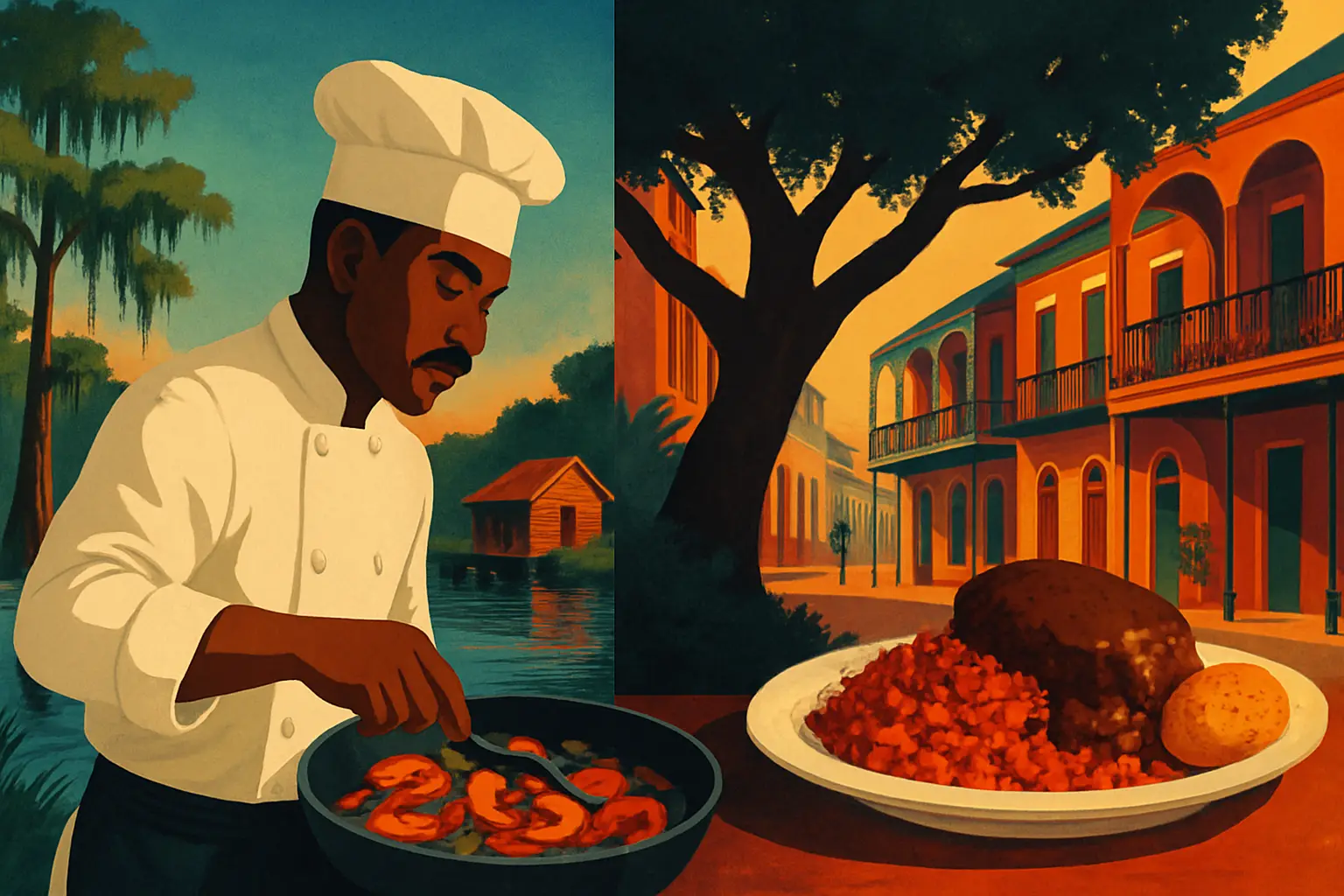
The word Creole in a Louisiana context originally referred to people born in the colony — of European descent, distinguishing colonial-born settlers from those born in France or Spain. Over time the term broadened to include people of mixed African, European, and Native American ancestry, and in the 20th century it came to be used most specifically by Black Creoles to describe their own community and cultural practices. Creole cooking, in the culinary sense, developed in New Orleans proper — a city governed by France (1699–1762), then Spain (1762–1800), then briefly France again before becoming American in 1803. Each colonial government left fingerprints: French butter sauces and classical technique, Spanish one-pot rice dishes and the use of tomatoes, West African okra and black-eyed peas, Native American file powder. The result is urban, cosmopolitan, and European in its reference points even as it incorporates African and Indigenous ingredients.
Cajun cooking has a completely different origin story. The Acadians were French colonists who settled in what is now Nova Scotia, Canada, beginning in the early 17th century. In 1755, the British colonial government expelled them en masse in the forced deportation known as Le Grand Derangement — roughly 3,000 eventually made their way to Louisiana over the following decades, settling in the bayou parishes west of New Orleans: St. Martinville, Lafayette, Breaux Bridge, Opelousas. Their cooking developed in a landscape of cypress swamps, rice fields, and coastal wetlands, using what that landscape provided: crawfish from the muddy bayous, pork from backyard hogs, rice from the shallow flooded fields. There was no French restaurant tradition to draw on and no port city bringing in imported ingredients. Cajun cooking is rural cooking — economical, deeply flavored, built around one pot and whatever walked, swam, or grew nearby.
Both Cajun and Creole cooking build from what Louisiana cooks call the Holy Trinity — onion, celery, and bell pepper — which functions as the aromatics base the way the French mirepoix (onion, celery, carrot) functions in classical cooking. The carrot is missing, the bell pepper takes its place, and this single substitution tells you something about the local ingredient environment: bell peppers grow abundantly in Louisiana; carrots are a northern European crop.
The Trinity is where the two traditions begin to diverge. Cajun cooks often add a fourth element — garlic — and cook the mixture longer and at higher heat, sometimes until the onions are deeply caramelized. The Creole approach tends to be more restrained and French in execution: the aromatics are sweated rather than browned, producing a more measured base that allows subsequent ingredients to build in layers.
The roux follows, and this is where the divergence becomes unmistakable. A proper Cajun roux requires standing at a cast-iron pot and stirring continuously for 30–45 minutes while flour and fat (traditionally lard, now often oil) cook over moderate-high heat until the mixture passes through tan, then peanut butter, then milk chocolate, then dark chocolate. The result is deeply nutty and smoky, giving Cajun gumbo its characteristic dark mahogany color. Creole roux — particularly in the classical restaurant tradition — is lighter, often butter-based in the French manner, cooked to blond or medium-brown. The lighter roux lets other flavors come forward; the darker Cajun roux is itself a primary flavor.
Beyond roux, the differences between Cajun and Creole cooking show up in a handful of specific ingredient choices that, once you know them, become reliable markers.
Tomatoes: Creole cooking uses them extensively — in gumbo, in shrimp Creole, in the base of red beans and rice. The tomato entered Louisiana via Spanish colonial rule; Spain was already using tomatoes in its own cuisine by the mid-18th century, and Spanish governors brought the ingredient with them. Cajun cooking, developed in rural bayou parishes largely independent of colonial city culture, barely uses tomatoes at all. A gumbo with a visible tomato base is Creole. A dark, tomato-free gumbo is almost certainly Cajun.
Cream and butter: Creole cooking, particularly as it developed in New Orleans fine-dining establishments in the 19th and early 20th centuries, incorporated French cream-sauce technique — bananas Foster, oysters Rockefeller, shrimp Creole in a butter-enriched sauce. Cajun cooking used lard rather than butter and cream rarely, if ever; the cooking fat was what the pig provided.
Andouille and tasso: Both traditions use these cured pork products as seasoning meats, but they are more central to Cajun cooking. Andouille is a heavily smoked, garlic-forward sausage; tasso is a spiced, cured pork shoulder. In Cajun cooking they often serve as both seasoning and primary protein. Creole cooking tends to feature Gulf seafood more prominently — shrimp, oysters, crab — reflecting New Orleans's position as a port city with daily access to the Gulf's catch.
File powder: Ground dried sassafras leaves, file (pronounced FEE-lay) is a Native American contribution — specifically from the Choctaw people of Louisiana — that serves as both a thickener and a flavoring. It adds a distinctive earthy depth and is added after cooking to avoid making the dish stringy. Both traditions use it, though Cajun gumbo tends to rely more heavily on file and okra for thickening, while Creole gumbo sometimes uses roux as the primary thickener and file as a secondary addition.
Three dishes come up in almost every Cajun-Creole conversation, and each one has version-specific differences worth knowing.
Gumbo exists in both traditions, and the differences are real. Cajun gumbo: dark roux base, no tomatoes, built around chicken and andouille sausage or shellfish, thickened with okra and/or file, deeply earthy and smoky. Creole gumbo: lighter roux, often tomato-enriched, may include oysters (more a Creole feature than a Cajun one), and the sauce reads brighter and more acidic. Both are served over white rice as a main-course dish. Do not let anyone call one more authentic than the other — they are genuinely different recipes sharing a name.
Jambalaya has a Cajun and a Creole version with one visible difference: Cajun jambalaya contains no tomatoes and cooks to a slightly brown, smoky color because the meat is browned directly in the pot before the rice is added. Creole jambalaya includes tomatoes and comes out a deeper red. The Cajun version is sometimes called 'brown jambalaya'; the Creole version 'red jambalaya.' Both cook the rice directly in the pot with the meat and aromatics, distinguishing them from other rice dishes where the rice is prepared separately.
Crawfish etouffe — 'smothered' in French — most consistently belongs to the Cajun tradition. It was developed in Breaux Bridge, Louisiana, in the early 20th century, and its base is the Holy Trinity plus butter or roux, with crawfish tail meat smothered in the sauce and served over rice. Creole versions exist in New Orleans restaurants, but the dish's roots are firmly in the bayou parishes.
New Orleans restaurants span a spectrum from purely Creole to Cajun-influenced to outright fusion, and most menus don't label which tradition a dish comes from. Here is how to navigate the landscape.
For classical Creole: Antoine's (713 St. Louis Street, French Quarter) opened in 1840 and is the oldest continuously operating restaurant in the United States — oysters Rockefeller was invented here in 1899 by Jules Alciatore, who substituted oysters for escargot when snails were scarce. The dining rooms, with their aged photographs and formal white-tablecloth service, function as a museum as much as a restaurant. Commander's Palace (1403 Washington Avenue, Garden District) is where Emeril Lagasse trained under Paul Prudhomme; its Saturday jazz brunch books out weeks in advance, and its turtle soup, bread pudding souffle, and pecan-crusted Gulf fish represent the highest technical level of Creole cooking. Galatoire's (209 Bourbon Street) is the Creole establishment that New Orleans locals actually eat at — the trout amandine and shrimp remoulade are benchmarks, and Friday lunch is a multigenerational ritual; the line forms before they open at 11:30 a.m.
For Cajun influence in the city: Cochon (930 Tchoupitoulas Street, Warehouse District) is chef Donald Link's restaurant dedicated to Cajun traditions — the name means 'pig' and the menu covers boudin, cracklins, and a cochon de lait (roasted suckling pig) that represents some of the closest thing to authentic Cajun Country cooking available inside New Orleans. Brigtsen's (723 Dante Street, Riverbend) occupies a Victorian cottage in an Uptown neighborhood; chef Frank Brigtsen trained under Paul Prudhomme and his cooking blends both traditions in dishes like duck and andouille gumbo.
For Creole soul food: Dooky Chase's Restaurant (2301 Orleans Avenue, in the Treme neighborhood) is the institution where civil rights leaders ate during segregation. The late chef Leah Chase, who died in 2019 at age 96, developed the Creole soul food canon: fried chicken, gumbo z'herbes, red beans and rice, and a bread pudding that set the standard. The restaurant continues under the Chase family — call ahead to confirm hours.
Antoine's — 713 St. Louis St., French Quarter; Tue–Sat lunch and dinner; reservations strongly recommended
Commander's Palace — 1403 Washington Ave., Garden District; Saturday jazz brunch books weeks ahead; jackets encouraged at dinner
Galatoire's — 209 Bourbon St., French Quarter; no reservations for the main downstairs room; Friday lunch is an institution, arrive by 11 a.m.
Cochon — 930 Tchoupitoulas St., Warehouse District; closed Sunday–Monday; boudin and cracklins are the starters to order
Brigtsen's — 723 Dante St., Riverbend (Uptown); dinner only, Tue–Sat; intimate Victorian cottage dining room
Dooky Chase's — 2301 Orleans Ave., Treme; call ahead, hours vary; cash preferred
If you eat Cajun food only in New Orleans, you are eating a filtered version — one adapted for an urban restaurant audience and shaped by proximity to French fine-dining tradition. The cooking in Lafayette and Breaux Bridge is different in ways that become clear the moment you eat in a diner there.
Lafayette is 136 miles west of New Orleans on I-10 — about two hours. The city of 130,000 is the cultural capital of Acadiana, the Cajun heartland. The annual Festival Acadiens et Creoles in October draws tens of thousands for food, music, and crafts on Girard Park. Year-round, Dwyer's Cafe (323 Jefferson Street, Lafayette) has been serving red beans and rice, meat-and-three plates, and stuffed bell peppers since 1927 — a lunch-only counter that has barely changed in a century.
Breaux Bridge, 15 miles east of Lafayette, holds the Breaux Bridge Crawfish Festival every May and calls itself the Crawfish Capital of the World without much argument. Cafe Des Amis (140 E. Bridge Street, Breaux Bridge) runs a Saturday zydeco brunch — live accordion music at 9 a.m., crawfish etouffe by 10 a.m., tables packed with locals — that is one of the most authentically regional experiences available in Louisiana.
The drive from New Orleans to Lafayette along I-10 crosses the Atchafalaya Basin on a raised causeway — the largest river swamp in North America visible in every direction. It is worth the trip on its own geographic terms.
Lafayette, LA — 136 miles west of New Orleans on I-10; ~2 hours; Dwyer's Cafe for a $10 lunch (323 Jefferson St.)
Breaux Bridge, LA — 15 miles east of Lafayette; Cafe Des Amis for Saturday zydeco brunch and crawfish etouffe (140 E. Bridge St.)
Festival Acadiens et Creoles — Lafayette, October each year; free admission; the largest annual Cajun cultural gathering in Louisiana
Order the gumbo and ask about the roux. A server who cannot describe the roux is at a restaurant that does not make it in-house. The question 'how dark is your roux?' will get you an answer that immediately tells you which tradition you are in — and whether someone spent 45 minutes at the stove that morning.
Eat red beans and rice on a Monday. This is specifically a New Orleans Creole tradition: red beans were cooked on Mondays because Monday was laundry day and the beans required minimal attention — just a low simmer while the washing was done. Most traditional Creole restaurants and neighborhood diners still serve red beans and rice on Mondays. It is not available every day at the best places.
Ignore the word 'Cajun' on non-Louisiana menus. Cajun seasoning has become a generic American spice blend applied to everything from pasta to salmon to french fries, with no connection to Louisiana. Real Cajun cooking is about layered technique and specific ingredients, not a reddish spice mix. Seek out the actual foundational dishes: gumbo, jambalaya, etouffe, boudin, cracklins, red beans.
Read together: for the French Quarter guide, which covers the colonial settlement where Creole culture developed, and the Treme guide, which covers the African American neighborhood that contributed West African ingredients and technique to both traditions — the food makes more sense with the neighborhood history behind it.