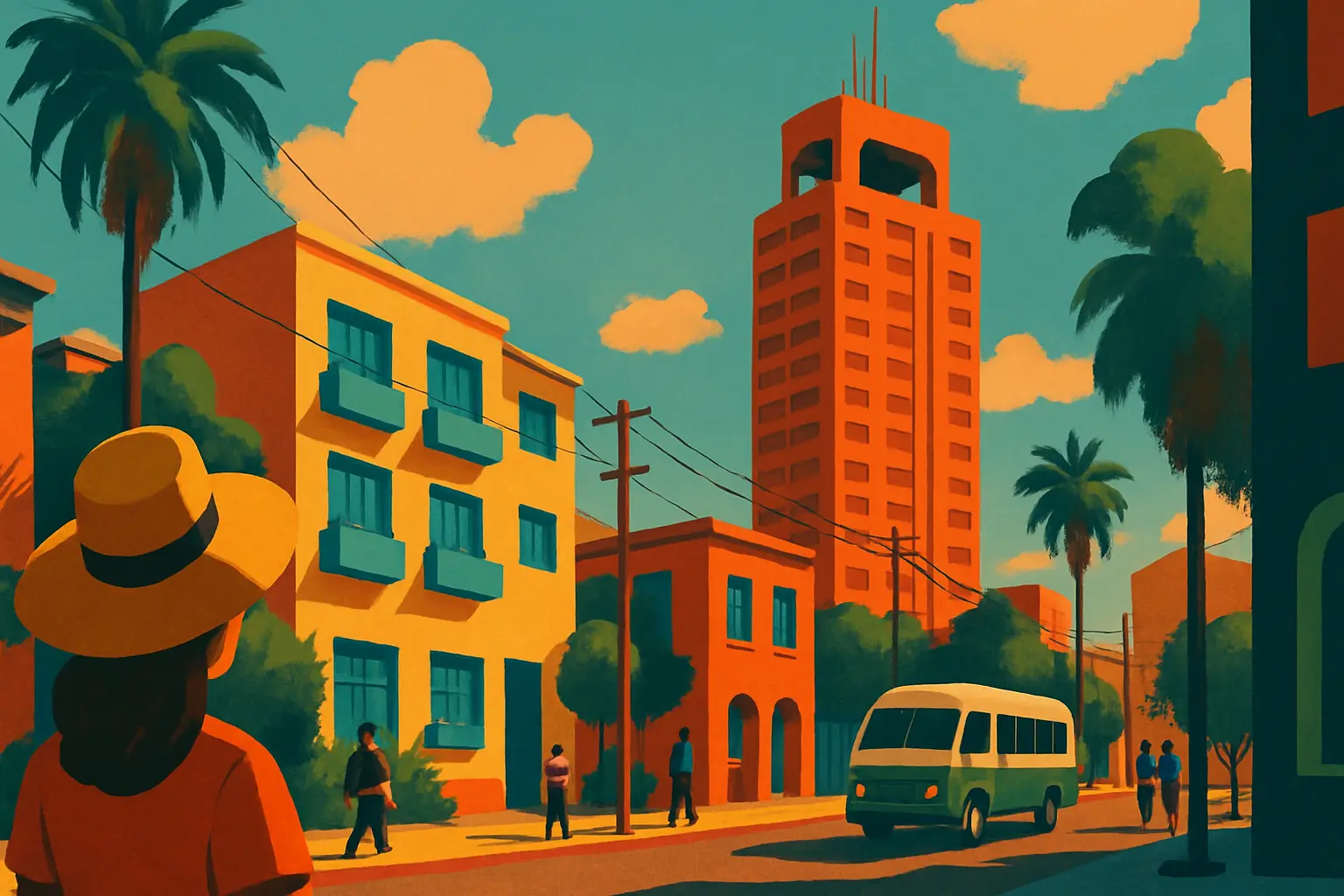
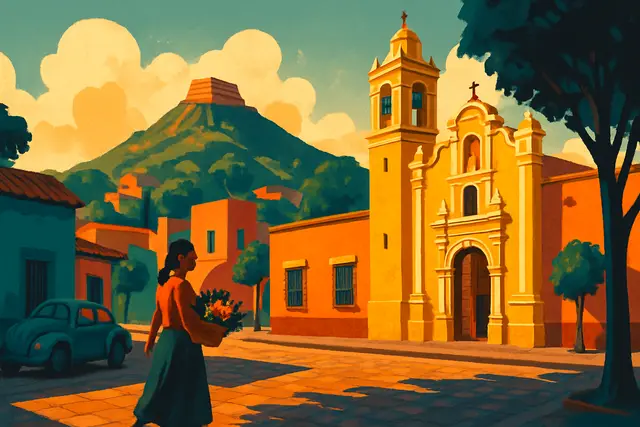
Colonia Nápoles occupies a rectangle of the Benito Juárez borough between Insurgentes Sur to the east, Avenida Universidad to the west, and the boundaries of Del Valle and Narvarte to the north and south. It's a mid-century neighborhood — officially established in 1908 on the grounds of two former agricultural estates called Rancho de Amores and Rancho de Nápoles — and it bears the name of the second ranch, which was itself named after Naples, Italy, likely by a landowner who'd traveled and wanted to signal sophistication.
In the 1940s, as the city rapidly expanded southward, the ranches were subdivided and sold under deed covenants requiring buyers to build in 'Colonial California' style: stucco facades, low-pitched roofs, arched entryways, small front gardens. This explains why the neighborhood still reads as visually coherent — the buildings don't match exactly, but they all speak the same architectural language. The Alameda Nápoles (the central park) was officially renamed Parque Alfonso Esparza Oteo by the city in 1951 to honor a beloved Mexican composer, though locals still call it Alameda Nápoles. By the 1960s and 1970s, Nápoles had filled in around major infrastructure — the World Trade Center Mexico City, the metro, and what would become the Metrobús corridor — and settled into the quiet residential density it still carries today.
The single most disorienting thing about Nápoles — in the best way — is its street naming convention. The entire grid is named after US states and cities. Walk south on Avenida Insurgentes Sur into the neighborhood and you'll cross Calle Indiana, Calle Ohio, Calle Texas, Calle Oklahoma, Calle Dakota, Calle Denver, and Calle Filadelfia before reaching the neighborhood's southern boundary. The main commercial street running east-west is Calle Nueva York.
No one is quite sure why this naming scheme was chosen for a neighborhood named after Naples, Italy. The most likely explanation: when the Rancho de Nápoles was subdivided in the early 20th century, the developers — likely influenced by the prestige of US urban development — decided to name the streets after American states to suggest modernity and forward-thinking planning. Whatever the reason, it produces a genuinely surreal navigational experience. You can get coffee on Texas, lunch on Oklahoma, and watch a concert at the corner of Insurgentes and Indiana, all without leaving a single neighborhood in Mexico City. For visitors who want a useful landmark: Calle Nueva York is the spine of neighborhood commerce — the shops, pharmacies, and local restaurants cluster here.
Get short, interactive stories that make each place easier to remember while you travel.
The single most striking building in Nápoles is also one of the most significant in all of Mexico City. The Monumental Plaza de Toros México — La Monumental, as locals call it — sits on Avenida Insurgentes Sur between Calle Indiana and Calle Delaware, and it is, by official measurement, the largest bullring in the world: a circular arena with 41,262 seats, a 43-metre sand ring, and a 2-metre-wide walking alley between the ring and the first row of stands.
It was built to replace the smaller Toreo de la Condesa, which had become inadequate for Mexico City's growing population of bullfighting fans. Construction began April 28, 1944. The arena was designed by architect Modesto C. Rolland and inaugurated on February 5, 1946, with a corrida that drew a crowd that reportedly surpassed even its enormous capacity. For most of the second half of the 20th century, La Monumental was the symbolic center of Mexican bullfighting — the venue where Spain's greatest matadors came to prove themselves, where legendary corridas were broadcast on national radio, and where a good Sunday afternoon could draw the kind of crowd that redefined what a crowd meant.
In 2022, the Mexico City Congress passed a reform restricting 'violent' bullfighting in the capital. The practical effect: La Monumental could no longer host traditional corridas. The venue's management responded by pivoting entirely to live music and events. By 2025, La Monumental had become one of the most important concert venues in Latin America — Billboard named it a top music venue that year — with an estimated 40 shows planned annually. Ye (Kanye West) performed two dates there in January 2026. The transformation from the world's largest bullring to a major concert arena, achieved in under three years, is one of the more unusual pivots in Mexico City's recent cultural history.
For visitors, the exterior alone is worth the stop: the circular concrete structure is monumental in the literal sense, and the scale only becomes fully apparent when you walk its perimeter. Check the events calendar before visiting — if a show is scheduled, tickets are available and the interior acoustic experience of that bowl shape is something that has surprised concert-goers who expected a standard arena.
The World Trade Center Mexico City stands on Insurgentes Sur inside Nápoles and has been a neighborhood anchor since its conception in 1947, making it one of the earlier examples of international-brand commercial infrastructure in the city. It's a functional business complex more than a tourist attraction, but it shapes the character of the Insurgentes corridor through Nápoles by drawing foot traffic, hotel guests, and office workers that support the cafés and restaurants nearby.
Two blocks west of Insurgentes, Alameda Nápoles — the Parque Alfonso Esparza Oteo — is the neighborhood's social center: a long, shaded park with a distinctive clock tower that serves as the unofficial symbol of the neighborhood, a small open-air forum for occasional live performances, and enough benches and tree cover to make it genuinely pleasant in the mornings before the heat arrives. It's a neighborhood park in the full sense — families, dogs, elderly residents walking laps, mothers with strollers, and the occasional group of teenagers monopolizing a corner. It's not a destination in itself, but it's the kind of space that reveals what a residential neighborhood actually feels like when you're inside it rather than passing through.
If you're already walking the Insurgentes Sur corridor through Nápoles, the Polyforum Cultural Siqueiros sits at the neighborhood's northern edge — technically on the Nápoles-Del Valle border — and offers one of the most extraordinary mural experiences in the city.
Alameda Nápoles (Parque Alfonso Esparza Oteo): shaded neighborhood park with clock tower, about two blocks west of Insurgentes Sur
World Trade Center Mexico City: on Insurgentes Sur inside Nápoles — long-standing commercial anchor that supports café and restaurant density nearby
Polyforum Cultural Siqueiros: on the Nápoles-Del Valle border at Insurgentes Sur — Siqueiros's 12-panel exterior murals and the rotating-stage La Marcha de la Humanidad inside
Nápoles isn't a food destination the way Roma or Coyoacán are — there's no single famous restaurant that draws visitors across the city. Instead, the neighborhood has the quiet, consistent food culture of a place where real people live: comida corrida fondas on residential streets, corner torterías, and a handful of proper restaurants that have been operating for decades without needing attention from outside the neighborhood.
Mazurka, on Calle Nueva York, is the most storied restaurant in Nápoles. It's a Polish restaurant — genuinely unexpected in Mexico City — opened in 1976 by a Polish immigrant family and known for hunter's stew (bigos), pierogi, and traditional soups. Pope John Paul II, who visited Mexico multiple times across the late 20th century, is said to have dined here during one of his stays — a connection the restaurant notes with appropriate pride. The clientele is a mix of Polish expat families, Mexican regulars who have been coming for years, and curious visitors who stumbled across it. It's not cheap by Nápoles standards, but it's not expensive by any other standard.
Cancino Nápoles offers wood-fired Neapolitan pizza and is the neighborhood's most obvious café-to-restaurant conversion — comfortable enough to work in during the day, good enough to return to for dinner. Dulce Madero on Calle Nueva York is a light-filled café-deli hybrid with a health-focused menu (smoothies, charcuterie, fresh salads) that opens early and fills with laptop workers by mid-morning. El Corazón del Mar handles seafood in a neighborhood that doesn't otherwise specialize in it — mariscos done with more care than the standard cevichería. For coffee specifically, Sede Café Nápoles has built a following among the neighborhood's growing remote-worker population with specialty beans and a terrace that catches afternoon light in a way that Roma cafés, for all their Instagram presence, rarely manage.
The shift is gradual but visible. Ask anyone who moved to Mexico City in 2022 or 2023 looking at Roma Norte and ended up in Nápoles, and the explanation is almost always the same: the math stopped making sense for Roma, and Nápoles offered everything that mattered without the things that didn't.
A furnished one-bedroom in Nápoles runs roughly 14,000 to 17,000 pesos per month — significantly less than the 20,000 to 26,000 pesos a comparable apartment in Roma Norte commands in 2026. The Metrobús on Insurgentes Sur means Roma Norte is eight minutes away. Condesa is twelve. Parque Hundido is a short walk. The streets are walkable, the neighborhood is low-rise, and the ratio of local-facing businesses to tourist-facing businesses makes daily life feel like daily life rather than a performance of it.
Nápoles is quieter than Roma Sur and better connected than the deeper parts of Del Valle. It doesn't have a famous weekly market or a landmark museum. What it has is scale — enough cafés, restaurants, green space, and transit to sustain a real stay — and the particular calm of a neighborhood that hasn't yet convinced everyone that it's worth discovering.
From Roma Norte: Metrobús Line 1 runs along Insurgentes Sur. Board southbound at Insurgentes-Sonora (near the Roma Norte metro station) and ride to Polifórum or San Antonio — both stops put you in Nápoles in under 10 minutes. Cost: 6 pesos.
From Condesa: The most direct option is a short Uber or Didi ride (roughly 50 to 70 pesos, 10 to 15 minutes depending on traffic). You can also walk south along Eje 2 Sur toward Insurgentes Sur and pick up the Metrobús there.
From Centro Histórico: Metro Line 1 (Pink) runs from Zócalo westbound. Exit at Insurgentes station, then walk south or transfer to the Metrobús southbound on Insurgentes Sur. Total time: 20 to 30 minutes.
On foot from Roma Sur: Nápoles' northern edge begins roughly at Eje 4 Sur (Baja California), which is about a 20-minute walk from the Sonora market area of Roma Sur. The walk south on Insurgentes Sur is useful because it passes the Polyforum en route.
Metrobús Line 1 (Insurgentes corridor): Polifórum and San Antonio stops serve Nápoles — 8 to 10 minutes from Roma Norte
Metro Pink Line (Line 1): Insurgentes station is the closest metro stop; from there, walk south or transfer to Metrobús
Uber/Didi from Roma Norte or Condesa: approximately 50–70 pesos, 10–15 minutes depending on traffic
Nápoles is in the Benito Juárez borough, which consistently records among the lowest crime rates of any borough in Mexico City. It's a dense residential neighborhood with high foot traffic during the day and reasonable activity in the evenings around Insurgentes Sur and Calle Nueva York. Standard Mexico City precautions apply — use Uber or Didi rather than unregistered taxis at night, don't display expensive equipment unnecessarily on the street — but Nápoles doesn't require any heightened vigilance beyond what you'd apply in Roma or Condesa.
The best times to visit are weekend mornings (when Alameda Nápoles fills with families and the café terraces are at their liveliest) or early evenings on concert nights at La Monumental, when the neighborhood gains an energy it doesn't carry on quiet Tuesdays. The rainy season runs June through September — bring a light layer for the afternoon downpours, which typically last 30 to 90 minutes and clear before evening.