Zakynthos is the southernmost of the main Ionian Islands — a group that also includes Corfu, Kefalonia, and Lefkada — sitting about 20 kilometers off the western coast of the Peloponnese. It is roughly 40 kilometers long and 20 wide, with a mountainous spine running north to south and a flat, olive-grove-covered plain on the eastern half where the airport sits.
The 313 years of Venetian rule that ended in 1797 — when Napoleon dissolved the Republic of Venice and handed the Ionian Islands to France — left deeper marks here than anywhere else in the Venetian Greek empire. The Ionian Islands were the only part of Greece that passed directly from Venice to Napoleon to Russia to Britain to Greece, never experiencing Ottoman rule. That political history shows in the food (Venetian dishes like sofrito and bianco appear on every taverna menu), the architecture (the Venetian-era castle on Bochali Hill survived the 1953 earthquake), and the local character, which feels distinctly different from mainland Greek culture.
The earthquake matters: on August 12, 1953, a 7.2-magnitude quake — the most destructive in 20th-century Greek history — leveled Zakynthos Town almost completely, along with most of the island's historic architecture. The current Zakynthos Town is a deliberate reconstruction: neoclassical style, the same street grid as the Venetian original, but with wider streets to reduce future collapse risk. The rebuilt arcaded waterfront boulevard — Alexandrou Roma Street — consciously replicates the feel of the original Venetian thoroughfare, and it mostly succeeds.
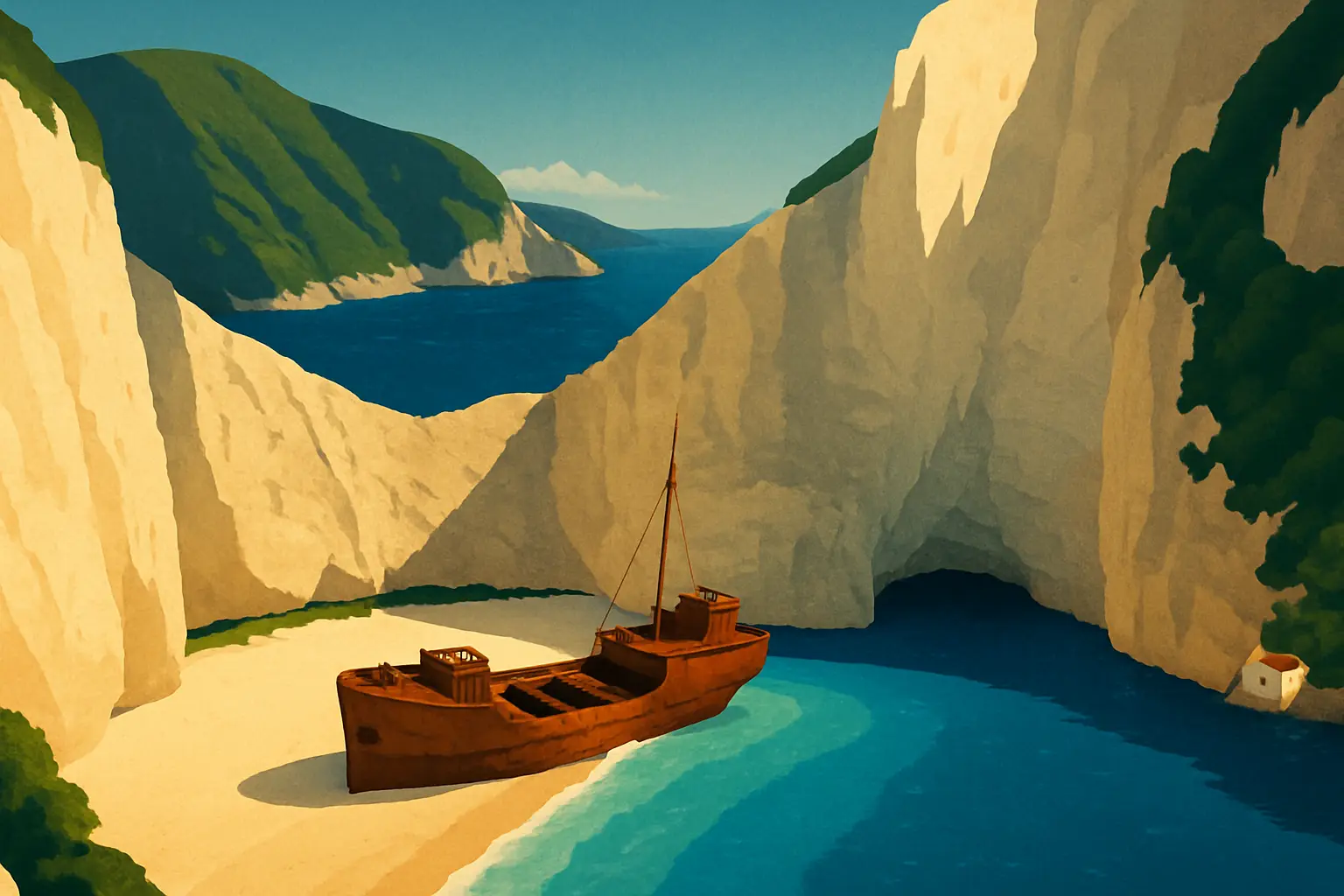
Navagio — officially Shipwreck Beach — is a limestone cove on the northwest coast, entirely enclosed by 100-meter white cliffs and accessible only by sea. The beach is about 200 meters long, covered in white pebbles rather than sand. The wreck at its center is the MV Panagiotis, a freighter that ran aground here in October 1980 — whether the crew was smuggling cigarettes, contraband alcohol, or something more valuable depends on the account you read. The ship was abandoned and has been oxidizing slowly ever since, which is why it photographs so well: the rust color is dramatic against the white chalk and the electric blue water.
Boats leave from Porto Vromi on the west coast, a small harbor accessible by a steep road from the interior, and from Agios Nikolaos harbor at the island's northern tip. Porto Vromi trips take about 25 minutes and run all day in summer; expect €15–20 per person round-trip on a shared boat, or €20–30 from Agios Nikolaos. Private speedboat hire costs more and gets you there before the crowd. The beach is most photogenic in the morning — in peak July and August, shared boats converge on the cove from 10 a.m. onward and the white pebbles fill with hundreds of people. Porto Vromi departures before 8:30 a.m. give you the cove nearly to yourself.
The clifftop viewpoint is a separate experience — arguably the better one. It's accessible by rental car or scooter via a signed road branching west from the main north-south highway, about 3 kilometers north of Porto Vromi. The viewing platform sits directly above the cove at roughly 100 meters height, looking down into the water that makes the photographs impossible to believe. Go before 9 a.m. and you will likely be alone.
Get short, interactive stories that make each place easier to remember while you travel.
The southern coast of Zakynthos — specifically Laganas Bay and its surrounding beaches — hosts the single largest nesting population of loggerhead sea turtles (Caretta caretta) in the Mediterranean. Around 1,000 nests are laid here every summer, each containing roughly 110 eggs. The turtles emerge from the sea between June and August, dig their nests at night on beaches they navigate back to by magnetic field after 20–30 years at sea, and return to the water before dawn. Eggs incubate for about 60 days; hatchlings emerge between August and October.
The National Marine Park of Zakynthos was established in 1999 specifically to protect this habitat, and it regulates the entire bay — no motorized water sports within the zone, strict beach management, and a full closure of all park beaches after sunset from June through mid-August. This sometimes frustrates visitors who booked Laganas-area accommodation expecting unrestricted beach access. The logic is simple: turtle nests are above the waterline and at the top of the beach, which is exactly where tourists place sunbeds and umbrellas.
Gerakas Beach at the eastern end of the bay is the most accessible nest-monitoring site and the one most worth visiting. Rangers from ARCHELON (the Greek Sea Turtle Protection Society) run morning nest checks that visitors can observe; the organization also leads scheduled night-monitoring events in July and August. Dafni Beach nearby is quieter and has active nesting. Sekania Beach — which has the highest nest density on the island — is closed to the public entirely.
Marathonisi ('Turtle Island') is a small uninhabited island in the middle of Laganas Bay, accessible by boat tour and one of the few places in Greece where snorkeling within genuine sight of a free-swimming loggerhead is realistic on a good day. The island's beach is also a nesting site, which is why boats are restricted to daytime arrivals only.
Zakynthos Town sits on the eastern coast, built along a 2-kilometer waterfront with the Venetian-era castle on Bochali Hill rising 100 meters above and behind it. The town functions as a normal Greek small city in a way the beach resorts of Laganas and Tsilivi do not: a covered market, kafeneions with backgammon games running at 10 a.m., a courthouse, pharmacies.
Solomos Square at the northern end of the waterfront is the formal center — named for Dionysios Solomos, the poet who wrote Greece's national anthem and was born on Zakynthos in 1798. The square is anchored by his marble statue and flanked by two museums. The Museum of Solomos and Eminent Zakynthians covers not only the poet but the island's unusually rich literary tradition — Zakynthos produced a disproportionate number of influential Greek writers and composers in the 18th and 19th centuries, and the museum explains why.
The Church of Saint Dionysios at the southern end of the waterfront holds the relics of the island's patron saint in a silver reliquary case. The church survived 1953; the bell tower beside it is a later addition. Inside: heavily gilded iconostasis in the Venetian-Byzantine style, ceiling frescoes that combine Orthodox iconography with Italian Baroque compositional logic — the visual equivalent of the island's history.
Bochali Hill above the town holds the remains of the Venetian Castle of Zakynthos, partially restored and open daily. The walls date from the 15th century. The view from the upper ramparts takes in the entire eastern coast, the flat agricultural plain, the airport, and — on clear days — the Peloponnese mainland across the water.
The north of Zakynthos is entirely different in character from the south: quieter roads, olive groves, goat farms, small villages without resort infrastructure. The 45-minute drive from Zakynthos Town pays off at Skinari Cape and the Blue Caves, a series of sea caves at the island's northern tip where shallow crystal-clear water over white limestone walls creates light effects that turn the water a luminous, unreal blue-green. Early to mid-morning is the optimal window — the angle of the sun determines how intensely the color fires.
Small wooden boats depart continuously from Porto Skinari, a tiny harbor at the cape, for 15–20 minute cave tours at around €10 per person. The boats are small enough to enter the caves directly; the guides time the entry to catch the light at its most intense. Most visitors combine this with snorkeling just outside the cave entrance — water visibility here runs 20–25 meters on calm days.
From Porto Skinari, a paved road continues east to Agios Nikolaos harbor, where the longer Navagio boats depart. The road passes through the village of Volimes, which holds a weekly market selling local cheese, thyme honey, and handmade lace — the lace craft is a Venetian-era tradition still practiced by older women in the village and increasingly rare on the island.
One more stop worth noting before you leave the north: Xigia Beach, accessible by a signed road from the main highway. The beach is small and the sand is nothing special, but natural sulphur springs vent directly into the sea here, creating visible plumes of warmer, mineral-rich water. The smell is unmistakable — but the water's claimed therapeutic properties for skin conditions have made it a genuine local attraction rather than just a curiosity.
Zakynthos food is Ionian food, which means 300 years of direct Venetian influence: olive oil used generously and early in the cooking rather than as a finishing drizzle, tomato sauces with onion and garlic that are gentler and sweeter than mainland Greek preparations, and two specific dishes that appear almost nowhere else in Greece.
Sofrito is the defining dish: veal sliced thin, pan-fried until well crusted, then braised slowly in white wine with garlic, parsley, and white wine vinegar until the meat is tender and the sauce is sharp and aromatic. It reads Italian — it is Italian, adapted directly from the Venetian soffritto technique — but the Zakynthian version has a specific balance (the vinegar cut, the garlic quantity) that distinguishes it from versions on other islands. The better tavernas in Zakynthos Town serve it as their serious main course.
Bourdeto is the second definitive Ionian dish: a spicy fish stew built on scorpionfish or other firm-fleshed local fish, cooked in a sauce of tomato, onion, and paprika. The heat level varies by taverna but the baseline is genuinely spicy by Greek standards — the spice came through the Venetian spice trade and stayed.
Ladotyri Zakynthou is the island's PDO cheese: hard, aged sheep's milk, preserved in olive oil, which gives it a smooth, slightly waxy exterior and a flavor that is nutty and rich with a mild olive oil undertone. Meaningfully different from the 'Ladotyri' sold in Athens supermarkets — ask specifically for Zakynthian Ladotyri in the covered market in the town center.
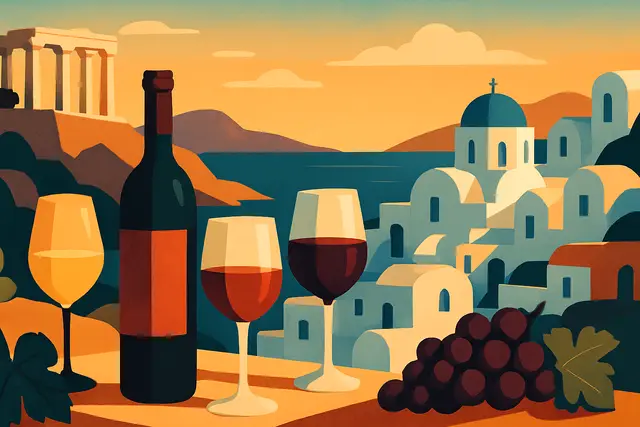
Verdea is the island's traditional dry white wine, made from a local grape variety grown in the interior and aged in oak. Unusual in style — slightly oxidized, closer in character to a light fino sherry than a conventional dry white — and almost entirely unavailable outside the island. A few producers still bottle it under the Verdea name; the covered market in Zakynthos Town sometimes stocks bottles from local estates.
Is it overcrowded? Yes — in one specific zone. The Laganas resort area in peak July and August operates as a British-package-holiday enclave: loud music venues, sunbed monopolies, a tourist density that bears no relationship to the island's actual character. That is one small corner of a 400 square kilometer island. The north, Zakynthos Town, the rural interior, and the beaches beyond Laganas (Gerakas, Dafni, Porto Zoro, Banana Beach south of Argassi) are genuinely quiet by comparison. Visiting Zakynthos without staying in Laganas is a different island.
Best time to visit? June is the strongest case for an early-summer trip: water temperature reaches 23–24°C, the turtle nesting season opens (first nests typically appear late June), Navagio is uncrowded before 9 a.m., and the island's interior is green before August's dry season turns it brown. September is the other strong month — turtles begin hatching (best window: mid-August through late September), crowds drop sharply after the first week of September, and sea temperature hits its annual maximum at around 26°C.
How to get there from Athens: The fastest option is a direct flight from Athens International (ATH) to Zakynthos (ZTH) — 45 minutes, Aegean Airlines and Olympic Air both run it year-round. Summer adds charter connections from across Europe. By sea: drive or take a KTEL bus to Kyllini (about 3 hours from Athens to the Peloponnese coast), then a 1-hour car ferry operated by Ionian Ferries across to Zakynthos Town. The ferry crossing in late afternoon — with the western light on the Ionian water — is one of the more pleasant 60 minutes in Greek travel.
Getting around the island: Renting a car or scooter is the only practical option for seeing beyond the resort clusters. Scooter rental in Zakynthos Town runs around €20–25 per day in June; car rental from €35–50. Public buses connect Zakynthos Town to Laganas, Tsilivi, and a few villages but stop well short of Navagio viewpoint, Porto Skinari, and the interior roads. The island is small enough that a full day's driving covers the north cape, Navagio viewpoint, Zakynthos Town, and a return through the interior without rushing.