Zaragoza (population 680,000) is the capital of Aragón, the historical kingdom that, through the 1469 marriage of Fernando II of Aragón and Isabella I of Castile, co-founded the unified Spain that would go on to build an empire. The city predates that history considerably: the Romans established a settlement called Caesaraugusta on this bend of the Ebro River in 14 BC, on the orders of Emperor Augustus. The name Zaragoza is a direct Arabic corruption of that Latin name, carried forward through seven centuries of Islamic rule.
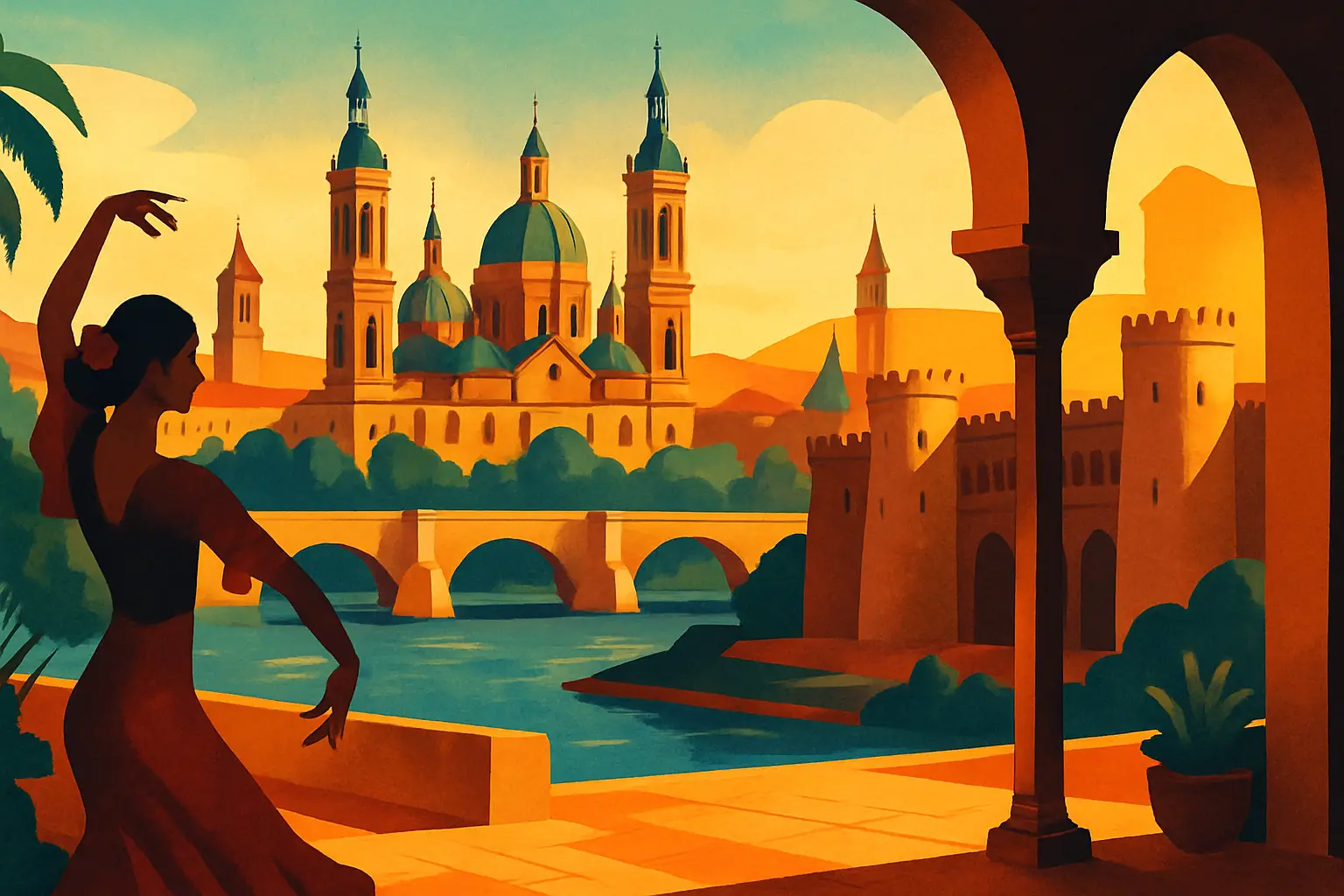
The Ebro is the defining physical fact. Spain's most voluminous river runs through the center of Zaragoza before heading northeast toward the Mediterranean, and the city grew in concentric layers around its bank — Roman forum under the current streets, Moorish palace to the west of center, Christian cathedral complex on the riverside, baroque basilica where the Roman walls once stood. The entire historic core is walkable in under an hour, which means you can move from a UNESCO Moorish throne room to a 17th-century basilica to a tapas street in an afternoon without ever getting in a taxi.
The practical reason most travelers overlook Zaragoza is also the practical reason to visit: the AVE high-speed rail puts it 1 hour 15 minutes from Madrid Atocha and 1 hour 30 minutes from Barcelona Sants. It functions perfectly as a day trip from either city, or as an overnight stay that breaks the Madrid-Barcelona corridor into two genuine experiences rather than one long journey.
The Basílica de Nuestra Señora del Pilar is the most visited pilgrimage site in Spain — a statement that is easy to underestimate until you stand in the Plaza del Pilar, one of the largest public squares in Europe (350 meters long), with the basilica's outline of 11 domes and four corner towers dominating the skyline above the Ebro. What draws pilgrims is a specific and unusual theological claim: the church is built around a jasper pillar that, according to Catholic tradition, was left by the Virgin Mary when she appeared to Saint James (Santiago Apóstol) in approximately 40 AD. The significant detail is the date — 40 AD, before Mary's death, which would make this the only Marian apparition in history to have occurred during her own lifetime. The pillar is venerated in a small side chapel, accessible through a queue that moves steadily throughout the day; pilgrims touch or kiss the exposed section of jasper. The chapel smells of candles and packed crowds, and the contrast with the vast, gilded baroque nave outside it is striking.
The building itself is 17th-century baroque, and its scale is genuinely overwhelming — the interior nave runs 130 meters long and 67 meters wide under the principal dome. But the most significant artwork inside is not the architecture. In the Regina Martyrum chapel (right side of the nave), there are ceiling frescoes painted in 1772 by Francisco de Goya, then 25 years old, in the early phase of his career before he became court painter and then deaf and then the darkest genius in European art. The frescoes are visible but distant; binoculars help. The contrast between this youthful commission and his later Black Paintings (now in the Prado in Madrid) makes it one of the more interesting places in Spain to think about a single human creative arc.
Get short, interactive stories that make each place easier to remember while you travel.
The Aljafería was built between 1065 and 1081 by Al-Muqtadir, the Islamic ruler of the taifa kingdom of Zaragoza, as a pleasure palace and seat of power. It predates Granada's Alhambra by roughly 200 years and shares its DNA — intricate plasterwork arabesques, geometric muqarnas ceilings, courtyard gardens designed around the sound of water — while being smaller, less restored, and far less visited. Where the Alhambra draws 6,000 visitors daily and requires booking weeks ahead, Aljafería operates at a fraction of that pressure, which means you can actually stand in the Golden Hall (Salón Dorado) beneath its horseshoe arches and take in the carved stucco without a crowd pressing against your back.
The building has layers that go beyond its Islamic origins. After Zaragoza fell to Alfonso I of Aragón in 1118 during the Reconquista, the palace passed through Christian hands. When Fernando and Isabella united the crowns of Castile and Aragón, they added their own royal apartments in a Gothic style — a wing decorated with Fernando's personal motto and their combined heraldic symbols. You can walk from 11th-century Islamic geometry directly into 15th-century Gothic royal quarters in the same building, which is an unusually compressed way to experience Spanish architectural history.
The Spanish Inquisition operated its Aragonese tribunal from Aljafería, and the building later became a military barracks — a use that paradoxically protected it from the kind of grand 19th-century "restoration" that altered many other historic buildings beyond recognition. It now houses the Cortes de Aragón (Aragonese Parliament), which occupies the newer wings while the historic palace sections remain open for visits.
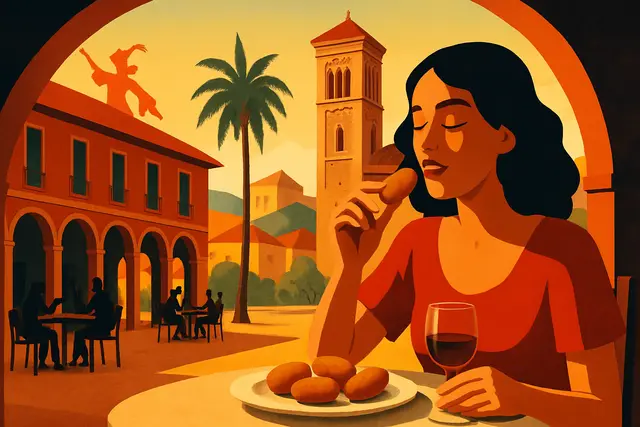
El Tubo (The Tube) is the informal name for the dense network of narrow streets between Calle Estébanes, Calle Libertad, and Plaza Santa Marta in Zaragoza's old town. The name comes from the tunnel-like width of the streets, which at their narrowest are barely four meters across — buildings leaning toward each other overhead, bar terraces occupying every available centimeter of sidewalk. In an era when most Spanish cities have abandoned the practice, many bars in El Tubo still include a free tapa — a small bite of food — with each drink ordered, at no extra charge. The custom is associated with Aragón specifically and reflects a drinking culture built around wine from the Campo de Cariñena region south of the city (the oldest wine-producing area in Aragón, with documented winemaking since the 3rd century AD).
The bars worth knowing: Bar Flor on Plaza Santa Marta has operated for decades and makes the most dependable tortilla española in the district — ask for it slightly runny in the center (*poco hecha*), which is the Aragonese preference. La Miguería (Calle Estébanes) specializes in migas, a dish of fried breadcrumbs cooked with cured pork, garlic, and dried peppers — a shepherd's food from the Aragonese interior that has become a restaurant staple. Casa Juanico does ciervo (venison) in season, a reminder that Aragón borders the Pyrenees and has a hunting culture almost entirely absent from Spain's coastal restaurant menus.
The defining local meat is ternasco de Aragón, a denomination-protected young lamb slaughtered at no more than 90 days old and fed exclusively on mother's milk and natural grasses. The flavor is milder and more delicate than Castilian lechazo — less assertive fat, more subtle gaminess — and it's typically served as chops rather than the whole-roasted quarter you'd find in Segovia.
Standing 150 meters from the Basilica del Pilar at the opposite end of the Plaza del Pilar, the Catedral del Salvador (known as La Seo, from the Catalan/Aragonese *seu* for cathedral) is architecturally more interesting than its famous neighbor and almost entirely overlooked by visitors who spend their time photographing the Pilar's tiled domes. La Seo was built between the 12th and 17th centuries, which means it contains Romanesque, Gothic, Renaissance, baroque, and Mudéjar elements — sometimes in the same wall section.
The critical detail is the apse. The exterior rear of the cathedral is covered in Mudéjar brickwork: geometric patterns of glazed tile and terracotta brick laid by Muslim craftsmen working under Christian patronage after the Reconquista. This isn't a decoration applied over existing architecture — it's structural brickwork that is also, simultaneously, a highly sophisticated geometric design system. Aragón has the highest concentration of Mudéjar architecture in Spain, and the ensemble of towers, churches, and cathedral elements in Zaragoza is UNESCO World Heritage listed (since 2001) specifically for this tradition. La Seo's tower was built directly over the minaret of the Friday mosque that previously occupied the site.
Inside, the Museo de Tapices (tapestry museum) houses a collection of Gothic and Flemish tapestries from the 14th–17th centuries, including a series depicting scenes from the Trojan War that arrived in Zaragoza through Aragonese trade networks with Flanders. The museum is accessed through La Seo's cloister and costs €4; it's genuinely worth the detour.
The Fiestas del Pilar run for approximately 10 days centered on October 12 — Spain's national holiday (*Día de la Hispanidad*) and the feast day of the Virgen del Pilar, patron of the city and, technically, of all Hispanic peoples worldwide. The festival is the largest annual event in Aragón and one of the largest in Spain, drawing visitors from across the country and from Latin America.
The defining visual of the festival is the Ofrenda de Flores (Offering of Flowers), held on October 12. Thousands of participants — many in the traditional regional costumes of Aragón's various municipalities, with women in elaborate embroidered mantillas and men in dark Aragonese dress — carry flowers through the streets to the Plaza del Pilar and construct a floral mantle around a large outdoor statue of the Virgin. By late afternoon, the statue stands 15 meters tall in a cloak of fresh carnations, roses, and chrysanthemums. The visual is genuinely singular and not reproducible anywhere else in Spain.
The jota aragonesa — Aragón's regional folk dance, characterized by fast footwork, castanets, and a particular kind of upright, proud posture — is performed in the streets, in impromptu competitions, and in formal concerts throughout the festival. Street musicians and choirs appear throughout the old town. Military parades, traditional games, fireworks over the Ebro, and nightly concerts in the Plaza del Pilar round out the program.
For 2026: if you want the Fiestas del Pilar, book accommodation by late July. Hotels in the historic center sell out 2–3 months ahead, and prices roughly double for the October 7–18 window. If you want Zaragoza without the crowds, September offers mild temperatures (22–26°C), empty museums, and the same bars.
The AVE high-speed train is by far the most practical way to arrive. Zaragoza sits directly on the Madrid-Barcelona corridor, meaning trains between the two capitals stop here throughout the day.
Madrid Atocha → Zaragoza-Delicias: ~1h 15m | From €15 advance booking | Up to 20 departures daily
Barcelona Sants → Zaragoza-Delicias: ~1h 30m | From €15 advance | Same Madrid-Barcelona trains, reversed
Zaragoza-Delicias station to historic center: 3 km | Tram Line 1 (€1.45) or taxi (~€8–10)
Within the city: Historic core is walkable (Pilar to Aljafería: 15-min walk) | Tram and bus useful for outer areas
ZaragozaCard: 24h/48h/72h tourist pass for unlimited public transport + museum discounts | From €17 at the tourist office in Plaza del Pilar
Zaragoza sits inland on the Ebro plateau, which makes it one of the hotter and windier major cities in Spain. The cierzo — a cold, dry north wind that funnels down through the Ebro valley — defines autumn and winter, and can make January genuinely unpleasant. July and August see temperatures regularly exceed 35–38°C, and the city loses a significant portion of its population to the Pyrenees and the coast. The historic center in August can feel emptier than expected for Spain's fifth-largest city.
September and October are the ideal window. Temperatures sit at 20–28°C, crowds are minimal outside the Fiestas del Pilar week, the light is excellent for the Aljafería's carved stonework, and the Campo de Cariñena wines appearing on bar menus reflect the season's harvest energy. April and May are the other sweet spot — warm, the city's parks along the Ebro in bloom, and shoulder-season pricing on accommodation.
For the Fiestas del Pilar specifically: arrive October 10 to catch the full setup energy, stay through October 13 to see the post-*Ofrenda* calm, and book everything as early as possible. For the La Mercè festival in Barcelona in late September, a Zaragoza-Barcelona route by AVE (90 min) makes a logical two-city pairing if you're timing around Catalan and Aragonese autumn festivals.
Best months: September–October (mild weather, Fiestas del Pilar) | April–May (spring, lower prices)
Avoid: July–August (extreme heat, 35–38°C, locals leave for holidays) | January (cierzo wind, cold)
Fiestas del Pilar 2026: approximately October 7–18 | Book accommodation by late July
Weather in September: 22–26°C daytime | Evenings drop to 14–16°C — bring a layer
Most museums closed Monday | Aljafería free Friday PM and Saturday AM | La Seo closed Sunday AM for services