Semana Santa (Holy Week) runs from Palm Sunday through Easter Sunday, in late March or April depending on the year. It is a liturgical event organized outside the official Church hierarchy — the processions are staged by lay brotherhoods, not by diocesan priests — which gives the tradition a degree of independence and variation that makes it genuinely regional rather than nationally uniform. Two cities can both call their celebration Semana Santa and have almost nothing else in common.
The central objects in every procession are the pasos — heavy, ornate wooden floats carrying sculptural scenes from the Passion of Christ or images of the Virgin Mary. The floats are carried on the shoulders of costaleros, men hidden entirely beneath the paso's wooden skirt, who receive instructions from a capataz (foreman) tapping on the wood to signal starts, stops, and turns through the streets. A single paso can weigh 4,000–5,400 kilograms and require 40–50 costaleros moving in coordinated, centimeter-scale steps. They work in complete darkness, bent over, often for several hours at a stretch, and are not visible to anyone watching from the street.
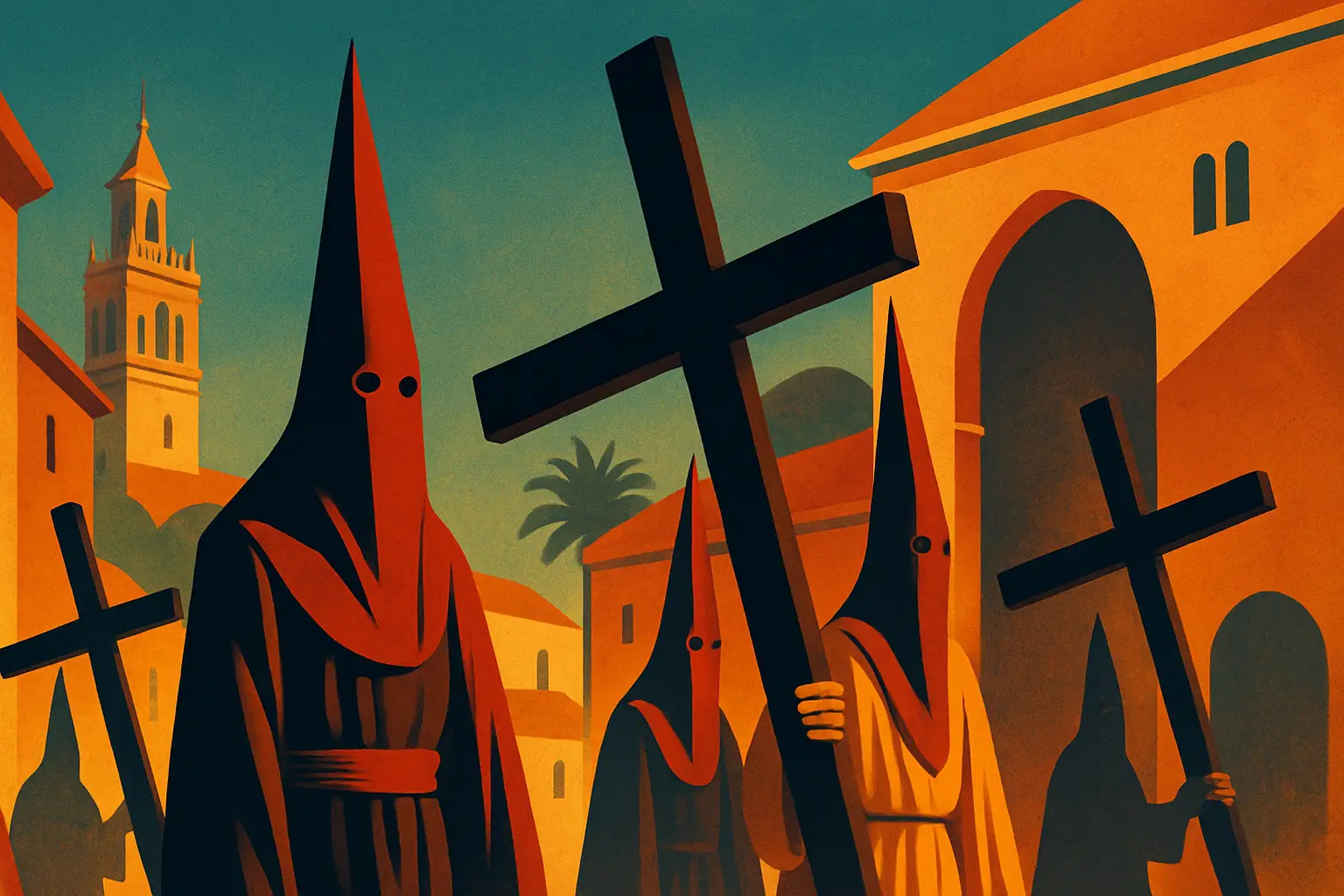
The robed figures carrying candles and iron crosses alongside the pasos are nazarenos — members of the brotherhood participating as an act of penance or devotion. Their distinctive capirotes (peaked conical hoods) were a standard form of penitential dress across medieval Catholic Europe; they survive in Spain because Semana Santa maintained unbroken continuity across centuries. Understanding this history is essential context for visitors arriving without it — the imagery has a specific origin and meaning that predates the 20th century by several hundred years.
Seville's cofradías (also called hermandades) are private religious organizations with their own governance structures, patron saints, headquarters (casas hermandad), membership hierarchies, and, in many cases, founding documents from the 14th or 15th century — predating the unification of Spain under Fernando and Isabel in 1479. Each brotherhood is responsible for organizing its own procession, maintaining its own pasos, dressing its own nazarenos, and managing its own finances independently of the Church.
The internal culture of a cofradía runs deep. Members spend the entire year preparing: rehearsing the paso's route, maintaining and restoring carved images, fundraising, and debating protocol questions — the order of processions, which brotherhood processes at which hour, which archway a paso passes under — that carry real historical and social weight in Sevillian society. Membership can pass through families across generations, and belonging to a prominent brotherhood carries civic prestige.
Two brotherhoods dominate popular recognition. La Macarena (officially La Pontificia, Real e Ilustre Hermandad y Archicofradía de Nazarenos de Nuestra Señora de la Esperanza Macarena) carries the 17th-century image of the Virgin kept in the Basílica de la Macarena in Seville's northern neighborhood — considered the most emotionally powerful Marian image in all of Andalusian religious art, and the subject of genuine, intense popular devotion that is not performative or tourist-facing. Los Gitanos (La Hermandad de los Gitanos), based in Triana, carries the Esperanza de Triana — the Virgin of the Triana neighborhood — and is historically identified with Seville's Romani and flamenco heritage, giving it a character unlike any other brotherhood in the city. When the Esperanza de Triana crosses the Triana bridge in the early morning hours of Madrugá, the crowd that gathers is made up largely of Triana residents for whom this moment is personal, not touristic.
Get short, interactive stories that make each place easier to remember while you travel.
Seville's 72 brotherhoods process across 11 days on a choreographed schedule. Each begins at its home church, routes through the city's streets to La Carrera Oficial — the official route running from Campana, down Calle Sierpes, through Plaza de San Francisco, and past the Cathedral on Avenida de la Constitución — then returns. This route is where the paid grandstands are set up and where official dignitaries observe. The total walking time for a single brotherhood on the full route can reach 10–12 hours.
For free views, the strongest strategy is positioning along secondary streets before the processions reach the official route. Calle Sierpes itself is technically on the official route but too narrow for grandstands — processions pass within arm's reach of anyone standing at the sides. It is crowded from early evening, so arrive by 8 p.m. at the latest to secure a position. Plaza del Salvador, northeast of the Cathedral, is an excellent free-viewing point where pasos must slow and turn through narrow archways, revealing the costaleros' work in real time — you can hear the rhythmic shuffle of feet beneath the paso and the capataz's calls.
The most important strategic decision is which day to attend. Palm Sunday (March 21, 2027) is the most accessible for first-timers: crowds are large but not at Madrugá intensity, and the afternoon timing of most processions is manageable. Holy Wednesday has among the highest concentration of processions of any single day. Madrugá (midnight into the early hours of Good Friday, March 26) is the peak: La Macarena, Los Gitanos, El Gran Poder, and El Silencio all process, the city stays awake, and the emotional intensity of the streets at 2 a.m. is unlike anything else in Spain's calendar.
Seville is the most famous and the most crowded — but three other cities offer celebrations significant enough to be destinations in their own right.
Málaga stages processions with floats that rival Seville's in scale and frequently exceed them in sculptural ambition. The *tronos* (thrones) used in Málaga are notably larger and more elaborately decorated than their Sevillian counterparts. The main processions move down Calle Larios, Málaga's wide central pedestrian boulevard, which makes viewing considerably more accessible than Seville's narrow historic center. The atmosphere skews festive and musical rather than solemn — a different emotional register than Seville, but equally authentic and specifically Malagueño. The Málaga city guide covers the city's broader context, but during Holy Week it becomes a city organized around this single event.
Valladolid holds a Semana Santa officially recognized as one of International Tourist Interest, and it makes the strongest case for an 'alternative to Seville' in terms of historical depth. The city's Museo Nacional de Escultura (Calle de Cadenas de San Gregorio, 1–3) houses the original polychrome wooden sculptures by Juan de Juni and Gregorio Fernández — the artists who defined the visual language of Semana Santa pasos across all of Spain. Seeing the originals in the museum, then watching the same sculptural tradition play out in the city streets during processions, gives Valladolid's Semana Santa a resonance that Seville's, for all its emotional power, cannot replicate on the same terms.
Toledo stages processions through its UNESCO-protected medieval streets at a scale that larger cities cannot replicate. The smaller brotherhoods, tighter streets, and absence of formal grandstands create an experience that feels less like a managed public event and more like something you've stumbled into. Toledo's historic center is compact and walkable, and because the city is already a major day trip from Madrid, it is straightforward to combine Semana Santa attendance with accommodation in the capital.
Semana Santa is not a loud festival. This surprises many visitors who associate Spanish fiestas with noise and open celebration. The dominant emotional register — at least in Seville — is one of collective, deliberate gravity. Processions move in near silence, broken only by the rhythm of the drums and brass that mark the paso's pace and the occasional saeta.
A saeta is an improvised devotional song, sung spontaneously from a balcony or window as the paso passes below. It shares its roots with flamenco's deepest song forms — the cante jondo, the siguiriya — and carries the same quality of raw, unperformed emotional intensity. There is no warning and no announcement. Someone in the crowd simply begins, and the entire procession halts. The paso is lowered to the ground. Everything stops. The city goes quiet. The singer finishes. The crowd applauds, the capataz knocks twice on the wood, and the costaleros lift the paso back to their shoulders. Hearing an unannounced saeta from a balcony on Calle Sierpes at 2 a.m. while standing in a crowd of thousands is, by most accounts, one of the most disorienting and powerful experiences available to a traveler in Spain.
The sensory details that photographs cannot convey are also what make the experience distinctive: the smell of beeswax from thousands of candles, incense from the brotherhoods' brass thuribles, and orange blossom from the trees lining Seville's streets — which are in full bloom during March Holy Week. The combination is specific and unrepeatable in any other context.
Semana Santa 2027 in Seville runs Palm Sunday March 21 through Easter Sunday March 28. Key processing nights: Holy Thursday March 25 (heavy Madrugá buildup), Good Friday March 26 (Madrugá itself). Plan accommodation around these dates.
**Accommodation strategy:** For Seville, begin searching October 2026 — 5–6 months ahead of the 2027 dates. Budget travelers should base in Dos Hermanas, Alcalá de Guadaíra, or Camas and commute via RENFE local trains, which run all week. For Málaga, 6–8 months ahead is sufficient. Toledo and Valladolid require far less lead time.
**Transport:** Seville's historic center is closed to private vehicles during procession hours. Walking is the only realistic way to navigate. The city runs special Semana Santa public transport schedules — check Tussam (tussam.es) and RENFE Cercanías for updated routes.
**Paid grandstand tickets (palcos):** Sold by the Agrupación de Cofradías de Sevilla, typically available months in advance at agrupacioncofradiassevilla.es. Prices range from €25 to €100+ per seat. Most experienced attendees prefer free standing on Calle Sierpes — the proximity and atmosphere are better than the grandstand view.
**What not to do:** Never cut across an active procession route — it is considered deeply disrespectful and practically impossible (processions can take 1–2 hours to pass a single point). Don't talk loudly during a saeta. Don't treat the costaleros emerging from beneath the paso as a photo opportunity — they have just carried 4,000+ kilograms for hours.
**Palm Sunday (March 21)** is the recommended first day for first-timers: the afternoon timing is manageable, crowds are large but navigable, and it gives you a complete introduction to how processions work before the intensity escalates through the week.
**Practical budget:** Hotel rates in Seville during Semana Santa run €200–€500/night for mid-range rooms. The week's food and drink costs are otherwise normal — tapas bars and restaurants operate as usual. Grandstand tickets, if purchased, are the main added expense. Plan for €40–€60/day beyond accommodation for a comfortable experience.