1. Two cities on the edge of a cliff
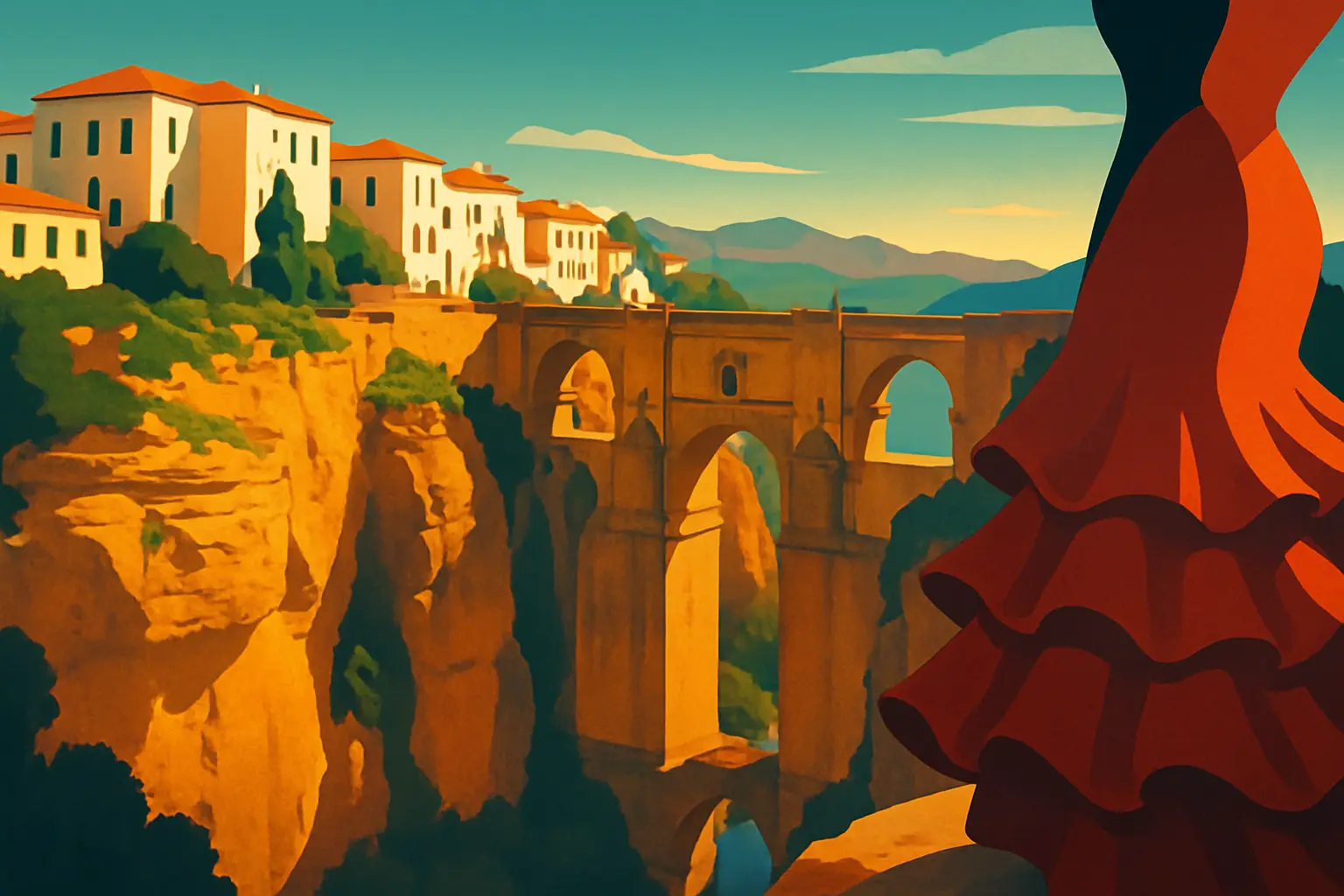
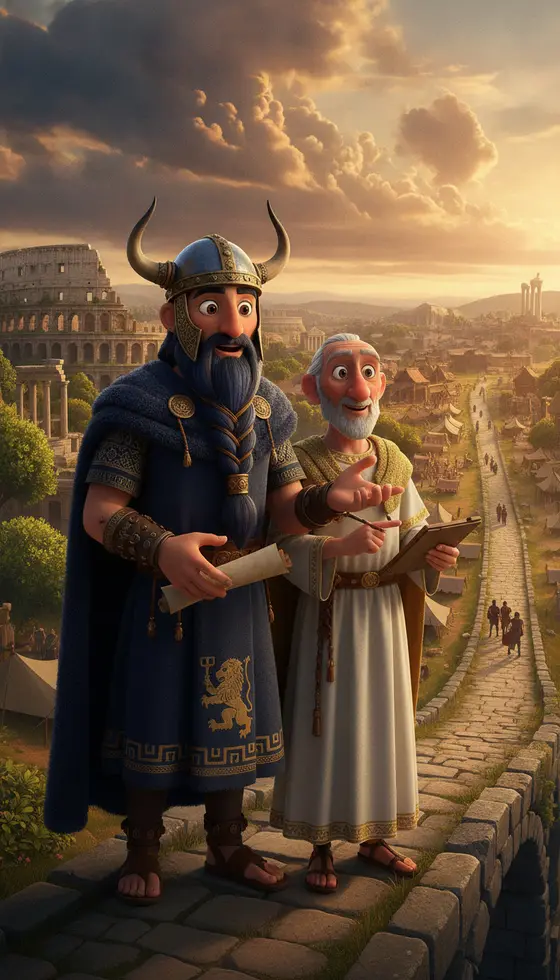
Ronda's unusual layout is a product of its history as two entirely separate settlements. La Ciudad — the old town — sits on a flat-topped mesa on the south side of El Tajo gorge and was the site of the original Moorish city of Izn-Rand Onda, established in the 9th century. When Christian forces captured it in 1485 during the Reconquista, a new settlement grew on the north side of the gorge — El Mercadillo, the 'little market' — connected to the old city only by a series of increasingly inadequate bridges.
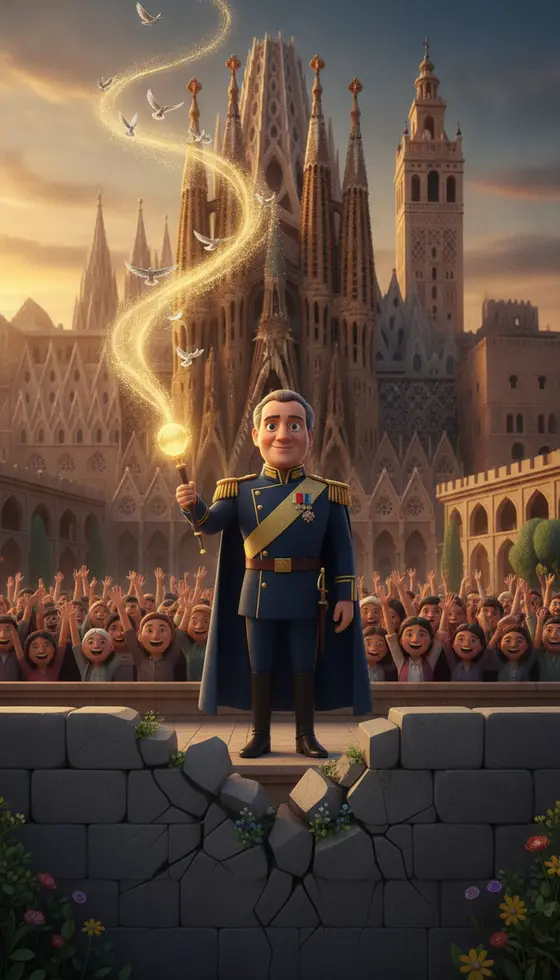
For centuries, crossing between the two halves meant descending into the gorge on steep, slippery paths. The Puente Viejo (Old Bridge), built in the 16th century on Roman foundations, was steep and narrow. A proposal to build a proper road bridge came in 1735, under King Felipe V, setting in motion one of the most protracted engineering projects in Andalusian history.
Today the gorge is called El Tajo — from the Spanish tajo, a cut or slash — a 120-metre-deep canyon carved through limestone by the Guadalevín River. Three historic bridges cross it; the Puente Nuevo is the largest by far and the one that stitches the living city together.
2. The Puente Nuevo: 42 years, one collapsed predecessor, one hidden room
A first attempt at a new bridge began in 1735 and collapsed in 1741, killing approximately 50 workers. The surviving accounts describe a partial arch failure during construction. The loss set the project back to zero.
The current bridge was designed by José Martín de Aldehuela of Manzanera in Teruel and constructed between 1751 and 1793 — 42 years from new start to completion. It is 98 metres high from the road surface to the gorge floor, roughly the height of a 30-storey building, and built entirely from limestone blocks cut from El Tajo itself. Workers were lowered by ropes into the gorge to quarry the stone by hand. No mortar binds the primary structure; the blocks were cut to fit with enough precision that weight and geometry hold everything together.
Inside the bridge's central arch, Aldehuela designed a chamber accessed through a doorway on the east face. This room served as a guardhouse in the early 1800s, then as a prison for most of the 19th century. During the Spanish Civil War of 1936–39, the chamber was used — according to Ronda's civic records, and consistent with accounts by multiple historians — as a site where prisoners were executed, their bodies dropped into the gorge below. Ernest Hemingway visited Ronda in the 1930s and referenced Spanish Civil War cliff executions in For Whom the Bell Tolls; he also wrote about Ronda's bullfighting culture in Death in the Afternoon (1932).
The chamber is now open to visitors — entry is through the Museo del Bandolero on Calle Armiñán, €4. The window inside the arch, looking straight down 98 metres to the river, is one of the more vertigo-inducing vantage points in Spain.
3. La Ciudad: what remains of the Moorish old town
La Ciudad is the atmospheric core of Ronda: narrow lanes of whitewashed houses, a set of Arab baths, a preserved minaret, and a palace built on the site of the old medina. Most visitors walk it in a loose loop from the bridge.
The Baños Árabes (Arab Baths) on Calle San Miguel, just below the city's southern edge, are among the best-preserved in Spain. Built in the 13th century under the Nasrid dynasty — the same rulers who built the Alhambra in Granada — the baths retain their intact star-shaped skylights in vaulted ceilings that filter daylight in shifting geometric patterns. Entry is €4; they are rarely crowded and are usually the most peaceful stop in Ronda.
The Palacio de Mondragón, on Plaza de Mondragón, was built in the 14th century as a Moorish royal palace and became the first residence of Ferdinand and Isabella in Ronda after the 1485 conquest. The interior is now a municipal history museum, but the real reason to pay the €4 entry is the garden behind it — a Mudéjar terrace that runs right to the cliff edge, with views across the valley below that most visitor guides do not mention.
The Minaret of San Sebastián on Calle Marqués de Salvatierra is a 14th-century mosque tower that survived the Reconquista and was converted into a church bell tower. Its upper section — the muezzin's balcony — still carries its original geometric stone carvings intact. It is not advertised as an attraction and easy to walk past without noticing.
4. The Plaza de Toros and how Ronda shaped bullfighting
Ronda's claim on the history of bullfighting is documented and specific. The Plaza de Toros de Ronda, completed in 1785, is one of the oldest stone bullrings in Spain. Its 66 Tuscan stone columns and two-storey arcade have been in continuous use for 240 years. Each September, the ring hosts the Corrida Goyesca — a fight conducted in 18th-century Goya-era costume that draws the most celebrated matadors in the country.
The more enduring contribution came from the Romero family. Three generations of Romeros — Francisco, his son Juan, and grandson Pedro Romero (1754–1839) — codified modern bullfighting technique from Ronda across the second half of the 18th century. Francisco Romero is credited with introducing the muleta (the red cloth used in the final stage of the fight) and the estoque (the killing sword) as standard equipment. Pedro Romero refined these tools into a formal technique built on stillness and precision rather than evasion, and reportedly fought 5,558 bulls without sustaining a serious wound.
Hemingway's friendship with the Ronda-born matador Antonio Ordóñez is the subject of The Dangerous Summer (1960), a long-form account of Ordóñez's rivalry with a fellow matador across a season of fights that Hemingway followed across Spain. Ordóñez's family home was in Ronda, and the ring is where Hemingway watched him fight. The bullring museum (included in the €8 ring entry) holds Pedro Romero's original cape and sword, portraits of three generations of the Romero family, and documentation of every Goyesca fight since 1954.
5. Where to eat and drink in Ronda
Ronda's restaurant scene is more serious than its day-trip status suggests. The key eating street is Calle Nueva from the Mercadillo side of the bridge toward Plaza del Socorro, and the lanes surrounding the plaza itself.
•**Restaurante Bardal** — Calle José Aparicio, 1. Two Michelin stars. Chef Benito Gómez cooks a seasonal tasting menu using Ronda's mountain produce — local black pig, wild mushrooms, spring greens from the Serranía de Ronda. Reservations required well in advance; the shorter lunch tasting menu is more accessible in both booking and price.
•**Taberna El Lechuguita** — Calle Pozo, 2, in La Ciudad. A small traditional tavern serving wines from the Serranía de Ronda denomination, produced from vineyards at 700+ metres elevation — among the highest-altitude wines in Spain. The rabo de toro (oxtail stew) is one of the better versions in Andalusia.
•**Casa Santa Pola** — Calle Santo Domingo, 3. Tapas bar inside a building that was a private house until 2001, with exposed stone walls and original Moorish arches visible through the renovation. Order the pluma ibérica and the patatas bravas.
•**Bodega San Francisco** — Calle Ruedo Alameda, 32. Wine shop and bar with an unusually good selection of Ronda D.O. wines by the glass. The owner pours informally and explains each wine; bottles available to take home. A good stop after the bullring visit.
6. Day trip logistics and what everything costs
Ronda works as a full day from Málaga or Sevilla, or as a two-night base if you want to drive into the surrounding pueblos blancos — Grazalema, Zahara de la Sierra, and Setenil de las Bodegas are all within 45 minutes by car.
•**From Málaga:** Alsa bus, 6 daily departures, 1h 45m, €12–€15 return. Renfe train via Bobadilla junction, 2h 15m, more scenic but fewer departures. First bus from Málaga around 7 a.m.; last return from Ronda around 8 p.m.
•**From Sevilla:** Alsa bus direct, 2h 45m, 2–3 departures daily. No convenient direct train.
•**From Granada:** No good public transport option. Rental car recommended — 1h 30m on the A-92 then A-374.
•**Inside Ronda:** The Puente Nuevo, La Ciudad, and the bullring are all within a 15-minute walk of each other. No car needed within the city. The gorge footpath is the only descent requiring more than flat walking.
•**Entry costs:** Arab Baths €4, Palacio de Mondragón museum €4, bullring + museum €8, Puente Nuevo chamber via Museo del Bandolero €4. Full day covering all four sites: €20 per person.
7. Is Ronda worth a day trip?
Yes — with the caveat that the trip rewards preparation more than most day trips in Andalusia. Visitors who arrive knowing only the bridge photo see a beautiful stone arch. Visitors who know that a predecessor bridge killed 50 workers, that the current one took 42 years to finish, and that a room inside it was used for Civil War executions are experiencing something genuinely strange and specific to Ronda.
The Málaga-to-Ronda bus climbs from sea level to 740 metres through olive groves and limestone hills — a scenic ride worth taking slowly and not treating as dead time. If two days are available, spending a night in Ronda lets you walk La Ciudad before 9 a.m., when the day-trip coaches haven't arrived and the old Moorish streets are nearly empty.
8. Best time to visit Ronda
September and October are the best months — the Corrida Goyesca falls in early September, summer crowds thin out, and the mountain temperatures are ideal for walking. Spring (March to May) is the second-best window: the Serranía de Ronda turns green and wildflowers cover the limestone slopes around El Tajo.
August is manageable but the town is at peak tourist density. Ronda's elevation keeps it cooler than the coast, and arriving before 9:30 a.m. or after 5 p.m. changes the experience significantly. The Corrida Goyesca week in early September requires hotel reservations months in advance — outside that period, accommodation is easy to find with a week's notice.