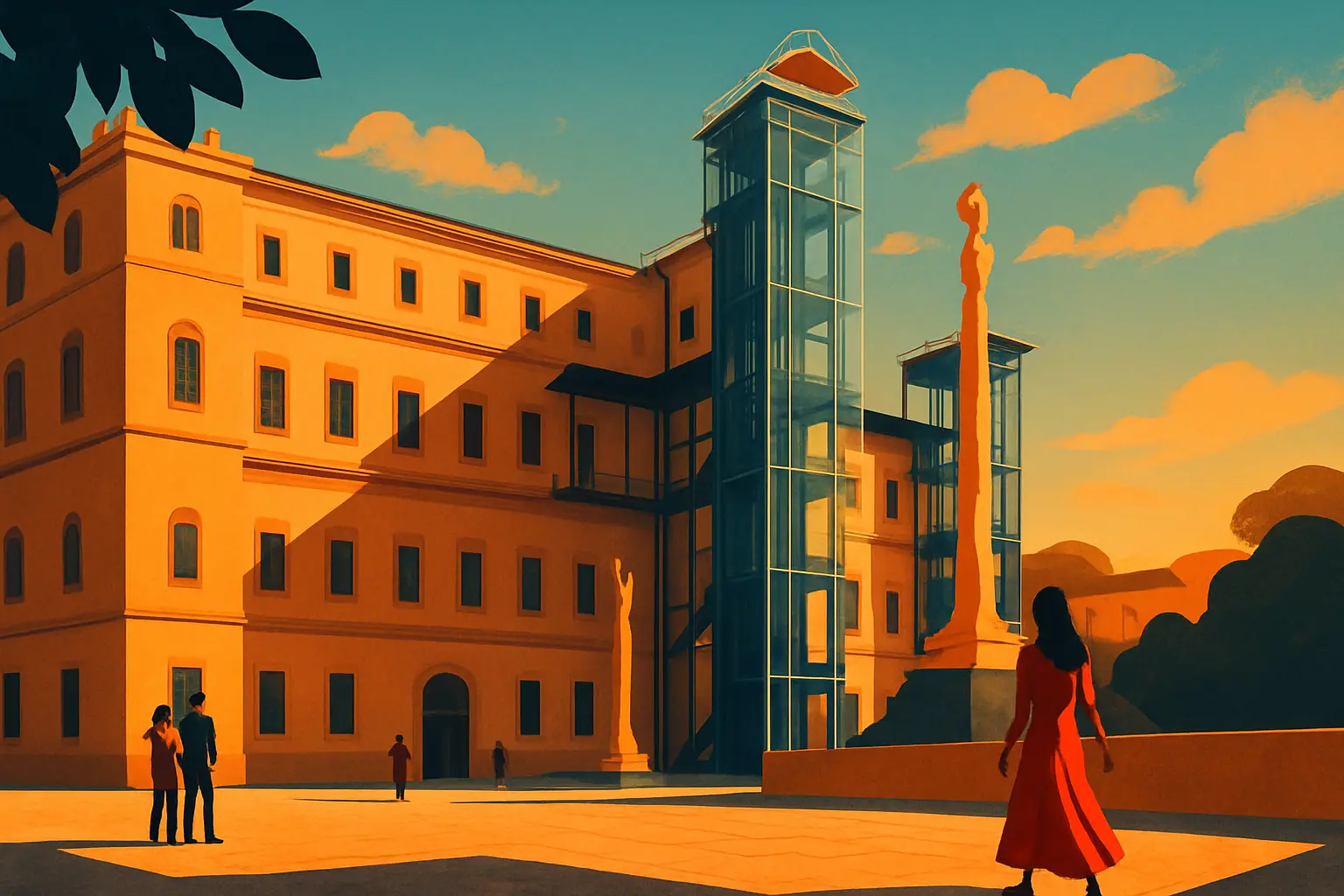
The Reina Sofía's main building — the Edificio Sabatini — was not built for art. It was commissioned by Carlos III in 1758 as the Hospital General de San Carlos, one of the largest medical facilities in 18th-century Europe. The architect José de Hermosilla drew up the original design; Francisco Sabatini, the Italian-born architect who also designed the Sabatini Gardens flanking the Royal Palace, took over the project and oversaw its completion. The hospital opened in 1787 and served that purpose for nearly 180 years — treating soldiers wounded in the Napoleonic Wars, then patients through the civil conflict of the 19th century — until medical advances made the neoclassical structure unsuitable for modern care. It closed as a hospital in 1965 and sat partially empty for years.
The conversion to an arts center began in the early 1980s, driven by the post-Franco cultural opening that was reshaping Spain's public institutions. Queen Sofía opened it as a national museum for contemporary Spanish art in 1992 — the same year Barcelona hosted the Olympics and Seville hosted the World Expo, in a deliberate cluster of events designed to signal Spain's arrival as a modern European democracy after 40 years of Francoist isolation.
In 2005, the French architect Jean Nouvel completed a major expansion — the Edificio Nouvel, a low-rise structure wrapped in a red metallic canopy that encloses the museum's central courtyard, tripling the available gallery space without altering the Sabatini's historic exterior. The addition is polarizing architecturally — the red and the neoclassical stone clash visibly — but the internal result, a covered outdoor courtyard with a cafe and seamless flow between buildings, works well.
Pablo Picasso painted Guernica in his Paris studio in 1937 in response to a specific event: the bombing of the Basque town of Guernica by Nazi Germany's Condor Legion and Fascist Italy's Aviazione Legionaria on April 26, 1937, acting in support of Franco's Nationalist forces. The attack killed between 150 and 1,600 civilians — estimates vary because the Nationalist government denied the raid for decades and suppressed casualty records. Picasso, outraged and already opposed to Franco, completed the painting in 35 days.
The painting measures 3.49 meters tall and 7.76 meters wide — roughly the wall space of a two-car garage. In the room where it hangs, the scale is confrontational in a way photographs don't convey: you cannot take in the whole composition without stepping to the far wall, and the white and gray of the canvas fills your peripheral vision as you approach. Picasso painted it entirely in black, white, and gray — deliberately, to evoke the newspaper photographs of the bombing that were circulating in Paris at the time.
The iconography is deliberately ambiguous. The screaming horse at center is the most contested element: some read it as the Spanish Republic in its final agony, others as civilian life under air attack. A bull in the upper left corner watches the scene; Picasso called it a representation of brutality and darkness but refused further elaboration. A bare electric bulb hangs at the top like a cold, indifferent eye — deliberately unlike any divine light. At the bottom left, a soldier's severed hand still grips a broken sword, and small flowers grow from the rubble beside it: the one note of ambiguity in an otherwise relentlessly dark composition.
Picasso refused to let the painting go to Spain while Franco governed. It spent 42 years at the Museum of Modern Art in New York under the condition that it return only when Spain became a democracy. Picasso died in 1973 without seeing that day. After Franco's death in 1975 and the ratification of the Spanish Constitution in 1978, the painting was repatriated in 1981 — first to the Casón del Buen Retiro (a Prado annex), then moved to the Reina Sofía at its 1992 opening.
The same room holds 45 preparatory sketches and six oil studies Picasso made during those 35 days. They are positioned on the walls flanking the main canvas, and most visitors don't slow down for them. This is a mistake: the studies show a composition in radical flux — early versions had a raised fist at center, a screaming woman instead of the electric bulb, and a different configuration for the dying horse. Seeing the evolution makes the final painting's specific choices legible in a way that simply facing the canvas does not.
Get short, interactive stories that make each place easier to remember while you travel.
The permanent collection in the Sabatini Building is arranged chronologically across the second and fourth floors, with Guernica in Room 206 on the second floor. The rooms immediately surrounding it contain works of comparable importance that receive far less attention.
Salvador Dalí's 'El Gran Masturbador' (The Great Masturbador, 1929) hangs in the galleries adjacent to the Guernica room. It is a large, fleshy, unsettling self-portrait painted in the year Dalí met Gala, who became his lifelong partner and muse — the most personal of his Surrealist works and one of the technically finest. The museum also holds his 'El enigma de Hitler' (The Enigma of Hitler, 1939), in which a photograph of Hitler dissolves into the soft, melting landscape Dalí was perfecting that year. Both are usually viewable without the Guernica crowd.
Joan Miró's works span several rooms and trace his evolution from the more representational painting of his early career through the biomorphic, primary-color language that became his signature. His forms look simple — flat fields of red, blue, and yellow crossed by bold black lines — and reward a second look. The museum holds early Miró works that show the Catalan countryside he returned to repeatedly throughout his Paris years.
Juan Gris, the third major Spanish Cubist, is represented by large-format Synthetic Cubist paintings that provide the best comparison in the museum to Picasso's own Cubist phase — the two artists were working in adjacent studios in Montmartre in the 1910s. The Gris canvases are on the second floor near the Picasso rooms and are often walked past quickly in the direction of Guernica.
Jean Nouvel's 2005 building is the right wing of the museum complex, connected to the Sabatini by an enclosed courtyard. It houses the post-1968 collection and the temporary exhibition galleries, which consistently rank among the best large-format exhibition spaces in Spain.
Eduardo Chillida's large iron and steel sculptures — made in the Basque Country from the late 1950s through the 1990s — require the open floor plans and high ceilings the Nouvel provides. His work is about the space inside and around the material as much as the material itself; photographs flatten what the sculptures do in three dimensions. The Chillida rooms on the Nouvel's upper floors are usually quiet, even on busy museum days.
Antoni Tàpies, the Catalan artist who built his canvases from thick impasto mixed with sand, rope, and torn paper, has a significant presence in the Nouvel wing. His work occupies a space between painting and sculpture — surfaces that look like scarred walls or excavated archaeological layers — and requires close inspection to read what's embedded in the material.
The temporary exhibition halls in the Nouvel run three to four major international shows per year. Past exhibitions have included retrospectives of Louise Bourgeois, Cindy Sherman, and El Lissitzky. The current programming is listed at museoreinasofia.es — a major temporary show here can be worth the ticket on its own, and the Nouvel galleries for temporary work are better suited to large-format contemporary installation than most European museums of comparable age.
The default path — enter on Calle de Santa Isabel, elevator to the second floor, Guernica, back to the entrance — is the most common and the least rewarding.
A better order:
Start on the ground floor. The Sabatini atrium holds Alexander Calder's mobile 'Vertical y rojo', viewable before buying a ticket. Five minutes watching it move is worth doing before anything else.
Enter the second floor from Room 201, not Room 206. The chronological collection begins with Picasso's pre-1937 work, Juan Gris, and the Cubist sequence. Starting here means you arrive at Guernica having understood the artistic context from which it emerged — the painting becomes significantly more legible.
After Guernica, continue through the Dalí and Miró rooms on the same floor rather than reversing back to the entrance. The transition from Picasso to Dalí to Miró within a single floor walk shows the Spanish avant-garde as a continuous conversation rather than isolated individuals.
Cross to the Nouvel wing for the post-war collection and the current temporary show. The courtyard cafe in the Nouvel is a better rest stop than the Sabatini's ground-floor option — quieter and with a view of the exterior architecture.
The fourth floor of the Sabatini contains the second half of the permanent collection (1940s through 1960s) and is the least-visited major gallery in the museum, even on high-traffic days. If time is short, skip it — but if you have four hours, it rounds out the picture.
For the Guernica room: peak crowds run from 11 AM to 5 PM. Opening time (10 AM) and the free-entry window (7 PM onward) are both substantially quieter. The painting is behind glass and protected by a low barrier, but there is no time limit on viewing.
The museum is at Calle de Santa Isabel, 52, at the southern end of the Paseo del Arte. A second entrance on Ronda de Atocha serves the Nouvel wing.
Hours: Monday and Wednesday through Saturday, 10 AM–9 PM. Sunday, 10 AM–7 PM. Closed Tuesdays — the most common visitor mistake. Confirm current hours at museoreinasofia.es.
Admission: €12 general. Free for EU residents under 18. Free Monday and Wednesday–Saturday 7–9 PM. Free Sunday all day.
Metro: Atocha Renfe (Line 1, light blue) or Estación del Arte (Line 1), both 3–5 minutes on foot from the Calle de Santa Isabel entrance.
Combined ticket: The Paseo del Arte card covers the Reina Sofía, the Prado, and the Thyssen-Bornemisza for around €33 — valid for one visit to each over 12 months. Worth it if you are visiting all three, which is the standard Madrid art museum itinerary.
Bags: Large bags and backpacks must be checked at the free cloakroom near the main entrance. Smaller day bags are allowed in the galleries.
Photography: Permitted throughout the permanent collection including Guernica, without flash. Tripods are not allowed.
Nearby food and drink: The [Barrio de las Letras](/es/blog/barrio-de-las-letras-madrid-neighborhood-guide) — Madrid's literary district — begins one block north of the entrance on Calle de las Huertas. Strong tapas options within a 10-minute walk. [Retiro Park](/es/blog/retiro-park-madrid-visitor-guide), which hosts a free annex exhibition space of the Reina Sofía (the Crystal Palace), is a 12-minute walk northeast.
How long should I plan for? Two to three hours covers Guernica, the full permanent collection, and a pass through the Nouvel wing. Four hours allows the temporary exhibitions too. The museum rewards slowing down — the usual mistake is rushing through the Picasso rooms toward the exit.
Is it worth visiting if I'm not a modern art fan? Yes, specifically because of Guernica's historical context: the Spanish Civil War, the painting's 42-year exile in New York, its politically charged return in 1981 — this is a history story as much as an art story. The preparatory studies in the same room make the final painting comprehensible even without an art background.
How does it compare to the Prado? The Prado covers the 12th through 19th centuries; the Reina Sofía begins roughly at 1900. They are complementary rather than competing. The Prado is larger and has more works of universal name recognition; the Reina Sofía is more focused and has greater emotional intensity in its anchor work. The Paseo del Arte combined ticket assumes you'll visit both, and most visitors who plan properly do.
Is the museum accessible? Yes. All floors of both buildings are served by elevators. The main entrance on Calle de Santa Isabel has step-free access from street level. The courtyard between the Sabatini and Nouvel buildings is fully accessible.
What about the Crystal Palace in Retiro? The Reina Sofía also manages the Palacio de Cristal in Retiro Park, which hosts rotating large-scale installations from the museum's collection — free admission, no ticket required. If you are visiting Retiro Park, it is worth checking what is currently installed there.