Retiro Park was not built for the public. In 1632, Felipe IV's chief minister, the Count-Duke of Olivares, commissioned an enormous palace-and-garden complex on the eastern edge of Madrid as a retreat for the royal court — a space for private performances, hunting, and the political theater that ran the Spanish Empire. The Buen Retiro Palace that anchored the complex was one of the largest royal residences in Europe at its construction, stretching across what is now the Parque del Retiro and the area around the Casón del Buen Retiro museum.
For most of the 17th and 18th centuries, the garden was closed to ordinary Madrileños except on specific feast days when the royal family graciously allowed the public to observe their own property from a distance. The park only began opening more regularly after Napoleon's armies occupied the palace complex in 1808 and badly damaged it. What the French left behind was too large and expensive to rebuild; the Spanish crown gradually withdrew from the space and opened it to public access in the early 19th century.
The decisive break came in 1868, when the Glorious Revolution overthrew Queen Isabella II and the new government formally transferred the grounds to the city of Madrid as public property. The palace itself had been demolished decades earlier. What survived — the Great Lake, the formal gardens, and the bones of the royal pleasure grounds — became the park that exists today.
In 2021, the Retiro and the Paseo del Prado were jointly designated a UNESCO World Heritage Site under the title 'Paseo del Prado and Buen Retiro, a Landscape of Arts and Sciences' — the first Spanish urban landscape to receive the designation.
The Palacio de Cristal is the most surprising building in the park and, because it sits away from the main paths on the east side of the lake, one of the most frequently missed. It was built in 1887 to house a botanical exhibition of tropical plants and fauna from the Philippines — then still a Spanish colony — and its iron-and-glass construction, designed by the architect Ricardo Velázquez Bosco, was inspired by the Crystal Palace built for London's Great Exhibition of 1851.
The original exhibition ended. The plants were removed. For much of the 20th century the building served various storage and administrative purposes. Since 1992, it has functioned as an annex exhibition space for the Museo Nacional Centro de Arte Reina Sofía, hosting large-scale contemporary art installations that would be impossible to install in the Reina Sofía's permanent galleries — works that require height, light, and space the museum's converted hospital building cannot provide.
The installation changes with each exhibition cycle; past projects have included immersive hanging sculptures, site-specific light works, and large textile installations that interact with the glass walls. Admission is always free and no reservation is required. The building is open Tuesday through Sunday (check the Reina Sofía website for current hours, which shift seasonally). Even when there is no exhibition running, the structure itself — iron columns, curved glass panels, the lake visible through the walls — is worth the walk.
For visitors already planning to see Guernica at the Reina Sofía on Calle de Santa Isabel, the Crystal Palace makes a natural companion stop: enter the park at the Atocha end, walk north along the lake to the Crystal Palace, then continue through the park to exit near the Retiro metro station, catching the Palacio de Velázquez exhibition space on the way.
Get short, interactive stories that make each place easier to remember while you travel.
The Fuente del Angel Caido — Fountain of the Fallen Angel — sits on an artificial mound in the park's southern section, about a 15-minute walk from the main Retiro metro entrance. It is one of the very few public monuments in the world that openly depicts Lucifer, and the only major one in a Western European capital.
The sculpture was created by Ricardo Bellver and completed in 1877. It depicts the moment of Lucifer's expulsion from heaven — his body falling backward, arms outstretched, expression combining agony and defiance — based directly on imagery from Book XII of Milton's 'Paradise Lost' and the biblical passages from Isaiah 14 describing the fall of the morning star. Bellver exhibited the work in Paris in 1878, where it won a medal, before it was installed on its current base in the Retiro.
The base itself became the source of Madrid's most durable urban legend. The fountain sits at an elevation that Madrid's official surveys have placed at approximately 666 meters above sea level. Whether this was intentional on the part of the city planners who sited it in 1885 is genuinely unknown — the documents from that period do not address it — and the city's tourism authority has never officially confirmed or denied the figure. Local guides have been repeating it for at least 40 years. The elevation number appears on enough surveying maps that it is not simply invented, though the precision of 19th-century surveying means the actual figure likely falls somewhere in a range that includes 666.
The fountain is surrounded by a formal stone basin and approached by steps on four sides. It is rarely crowded — most park visitors cluster around the lake and the Crystal Palace — and is worth visiting in late afternoon when the low-angle light throws the figure into sharp relief against the sky.
The Estanque Grande del Retiro — the Great Pond — sits at the center of the park and has been there, in roughly its current form, since the royal garden was first laid out in the 1630s. It was originally designed for elaborate nautical celebrations: the royal court would stage mock sea battles on the water for entertainment, with illuminated barges and costumed naval encounters performed for the court from the surrounding banks. The lake is about 200 meters long and 120 meters wide — large enough for a proper boat, too small for anything more theatrical than a leisurely circuit.
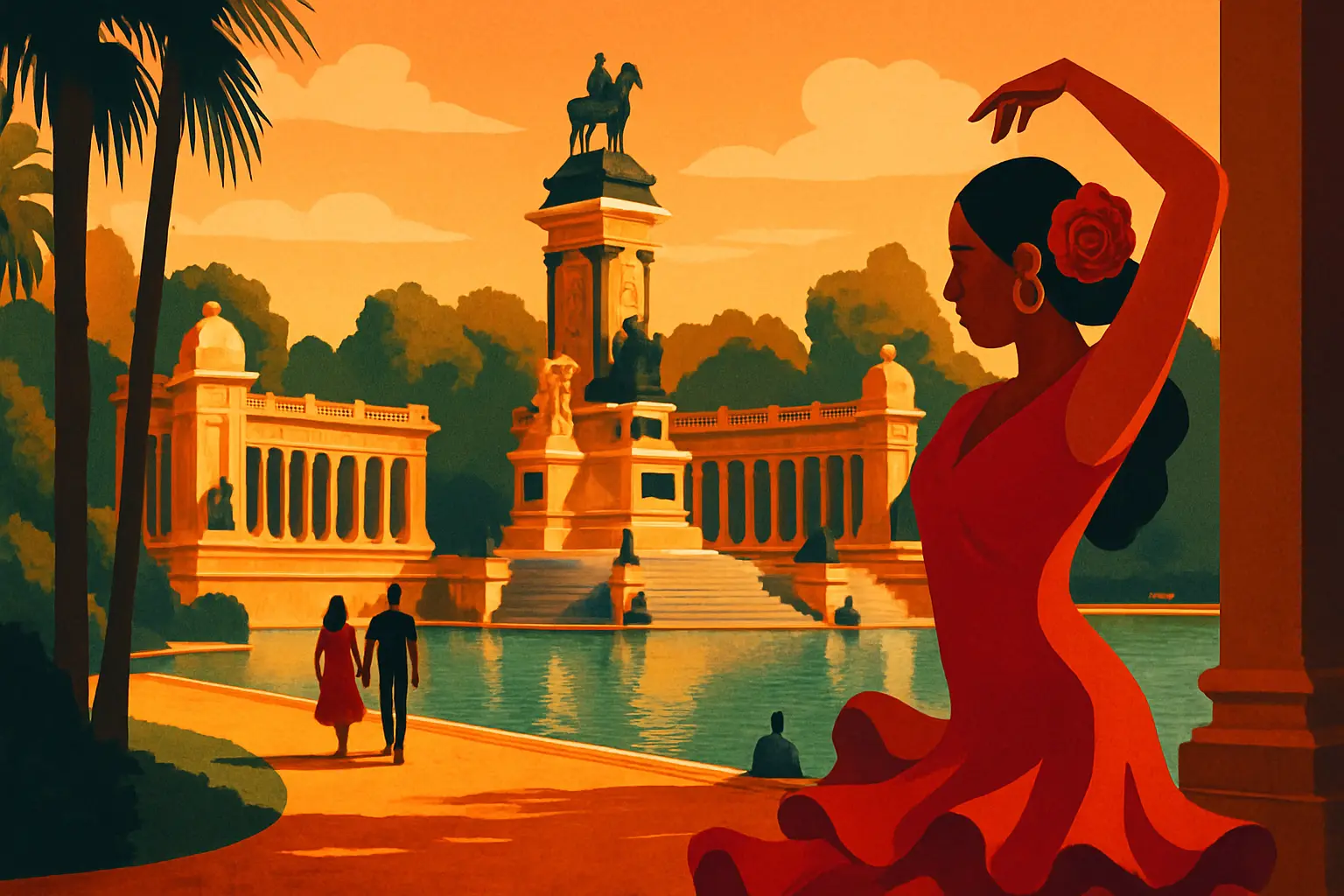
The Monument to Alfonso XII on the lake's east bank was completed in 1902 by the architect José Grases Riera and is more imposing up close than it appears in photographs: a curved colonnade of white limestone 86 meters wide, surmounted by an equestrian bronze of the king, the whole structure reflected in the lake it faces. It is free to walk up to and around, and the steps at the base are one of Madrid's best informal gathering spots — on Sunday afternoons, people sit on the steps reading, talking, and watching the boats.
The rowboat station is on the south shore of the lake, a short walk counterclockwise from the Alfonso XII monument. Boats rent for around €6 per 45 minutes (prices have risen gradually — check the current rate at the station). No reservation is required; you pay on arrival. The operators are consistent about the time limit and will wave you in when it expires. September weekday mornings are by far the easiest time to get a boat without waiting; summer Saturday afternoons can mean a 30-to-40-minute queue.
Most visitors to the Retiro stay in the northern and central sections — around the lake and the Crystal Palace — and miss the southern half, which is quieter, less manicured, and contains some of the park's more unusual features.
La Rosaleda, the Rose Garden, sits in the park's southwest corner and contains more than 4,000 rose plants across dozens of varieties. It peaks in May and June, when the garden competition (*Concurso de Rosas*) draws expert judges and the entire section is in full bloom. In September, a second and quieter blooming cycle brings out the hardier varieties — nothing like the June spectacle, but pleasant and far less crowded. The Rosaleda is free and has no gates.
Behind the Rosaleda, toward the park's southern wall, a small cypress hedge labyrinth operates on an informal honor system — find your own way in and out, no staff, no fee. It is modest by formal maze standards (perhaps 10 minutes to solve) but genuinely disorienting in the way that most park mazes are not, because the cypresses are tall enough to eliminate sightlines completely.
The Paseo de las Estatuas — the Avenue of Statues — runs north-south through the western portion of the park, lined with stone busts and full-figure sculptures of Spanish monarchs and historical figures commissioned in the 18th century for the Royal Palace but deemed too numerous or too heavy for installation there. About 20 statues remain on the avenue; they are identified by plaques, and the quality ranges from precise classical portraiture to something more approximate. Fernando VI and Carlos III are the best-carved of the group.
Madrid's summer (July and August) is punishing — temperatures regularly reach 38–42°C, the park's grass burns yellow, and the paths bake in direct sunlight from 11 AM until 7 PM. Madrileños themselves mostly avoid the Retiro in August between 10 AM and 7 PM. Tourist numbers are also at their annual peak in July and August, which means queues at the rowboat station and crowds around the Crystal Palace that make it harder to see the exhibitions.
September reverses both problems. Temperatures drop to a range of 20–28°C by mid-September — warm enough to sit outside, cool enough to walk at midday without discomfort. The grass recovers its color with the first autumn rain. The international tourist numbers begin to thin after the first week of September as European school terms resume, leaving the park to a mix of Madrileños and the visitors who planned ahead to avoid the peak.
The specific September advantage for the Retiro: the afternoon light. Between 5 and 8 PM in September, the low-angle sun crosses the lake from the west and turns it into a surface that photographers have been trying to capture correctly for a century. The Alfonso XII monument, backlit, throws a long shadow toward the near shore while the far bank remains illuminated — it is the kind of light that makes the park look like a stage set built for the purpose.
For the Crystal Palace, September is also when new exhibition cycles often begin — the Reina Sofía typically opens major new shows in September and October following the summer program. Check museoreinasofia.es before your visit to see what is installed.
Entry to the Retiro is free and has always been free. The park has multiple gates and no admission points.
Hours: 6 AM–midnight (May–September) / 6 AM–10 PM (October–April). Gates close 30 minutes after the park, not the park itself.
Metro: Retiro (Line 2, red) puts you at the northwest corner of the park, closest to the Crystal Palace and the Palacio de Velázquez. Atocha Renfe (Lines 1 and C-series Cercanias) puts you at the southwest corner, 5 minutes from the Fallen Angel fountain. Banco de Espana (Line 2) is at the north edge near the Puerta de Alcala.
Size: 118 hectares. A full circuit of the park perimeter on foot takes approximately 75–90 minutes at a moderate pace. Most visitors spend 2–3 hours.
Rowboats: approximately €6 per 45 minutes. Station on the south shore of the Estanque Grande. No reservation needed.
Crystal Palace (Palacio de Cristal): free entry. Open Tuesday–Sunday approximately 10 AM–6 PM (hours shift seasonally — confirm at museoreinasofia.es). The Palacio de Velazquez nearby keeps similar hours and also hosts free Reina Sofia exhibitions.
Food and drink: several cafe kiosks operate inside the park on weekends. The nearest quality options are in [Barrio de Salamanca](/es/blog/barrio-salamanca-madrid-neighborhood-guide) (north exit) for upscale eating, or the [La Latina](/es/blog/madrid-la-latina-neighborhood-guide) area (15 minutes by metro southwest) for traditional Madrid food.
Accessibility: the main paths and the Estanque Grande area are wheelchair accessible. The Fallen Angel mound and some garden paths are not fully paved.
Best photo spots: Alfonso XII monument from the west shore of the lake, 5:30–7 PM. Crystal Palace interior against the sky from the far end of the building. The Fallen Angel in late afternoon with the low western sun behind it.
Is Retiro Park safe? Yes, during daylight and early evening hours. The park is heavily used by Madrileños for running, family outings, and weekend recreation — it feels like a neighborhood park, not a tourist attraction cordoned off from daily life. After 10 PM on weeknights, the areas away from the lake and main paths become quieter and less well-lit; there is no particular danger, but the typical late-evening advice for any large urban park applies.
Can I run in the park? Yes. The outer perimeter path is a popular running circuit used by Madrileños every morning from 6 AM onward. The full perimeter is approximately 5.5 kilometers.
Are dogs allowed? Yes, on a leash in most areas. Dogs are prohibited from the Rosaleda (Rose Garden) and the formal garden areas directly around the Crystal Palace.
Is there parking near Retiro? Underground parking exists at Plaza de la Independencia (Puerta de Alcala end) and Calle de Alfonso XII, but driving to the Retiro from central Madrid is rarely faster than the metro on a weekday and considerably more expensive. The metro recommendation is practical, not just environmental.
What else is nearby? The park's western edge runs along Calle de Alfonso XII, directly across from which is the Museo del Prado (a 10-minute walk along the Paseo del Prado from the Retiro metro exit). The Reina Sofía is a 15-minute walk south from the Atocha park entrance. Visiting all three in a single day is standard — but ambitious. Two per day leaves enough time to actually see things rather than cover them.
For a broader Madrid food context before or after your visit, our guide to what to eat in Madrid covers the neighborhood restaurants within walking distance and explains the city's eating schedule, which trips up most first-time visitors.