Chamberí occupies a position in Madrid that is geographically central and socially overlooked. It sits immediately north of Malasaña and west of Chueca, bounded roughly by Paseo de la Castellana to the east, Calle de Alberto Aguilera to the south, and Calle de Bravo Murillo to the west. Its streets are wide by Madrid standards, its buildings disproportionately handsome, and its bars and restaurants almost entirely free of the laminated English menus that colonize neighborhoods closer to the Puerta del Sol.
The barrio was developed as part of the Ensanche — Madrid's planned urban expansion in the second half of the 19th century — and built for the professional classes: lawyers, civil servants, university professors, and their families who wanted space and quiet without leaving the city. The result was wide boulevards, ornate Belle Époque facades, and a social infrastructure of neighborhood markets, corner pharmacies, and a circular central square (Plaza de Olavide) designed for residents who intended to sit there for an hour rather than pass through it.
That original character has survived with unusual fidelity. Chamberí has been gentrified — rents now average €1,100 per month for a one-bedroom apartment — but gentrified in a way that substituted middle-class commerce for working-class commerce rather than replacing the resident population with tourists. The neighborhood still has a functioning pharmacy on most blocks, two neighborhood markets, and a central square where children run circuits around adults sitting at café terraces.
For travelers trying to understand how Madrileños actually live — as opposed to how Madrid performs for visitors — Chamberí is the most direct evidence available.
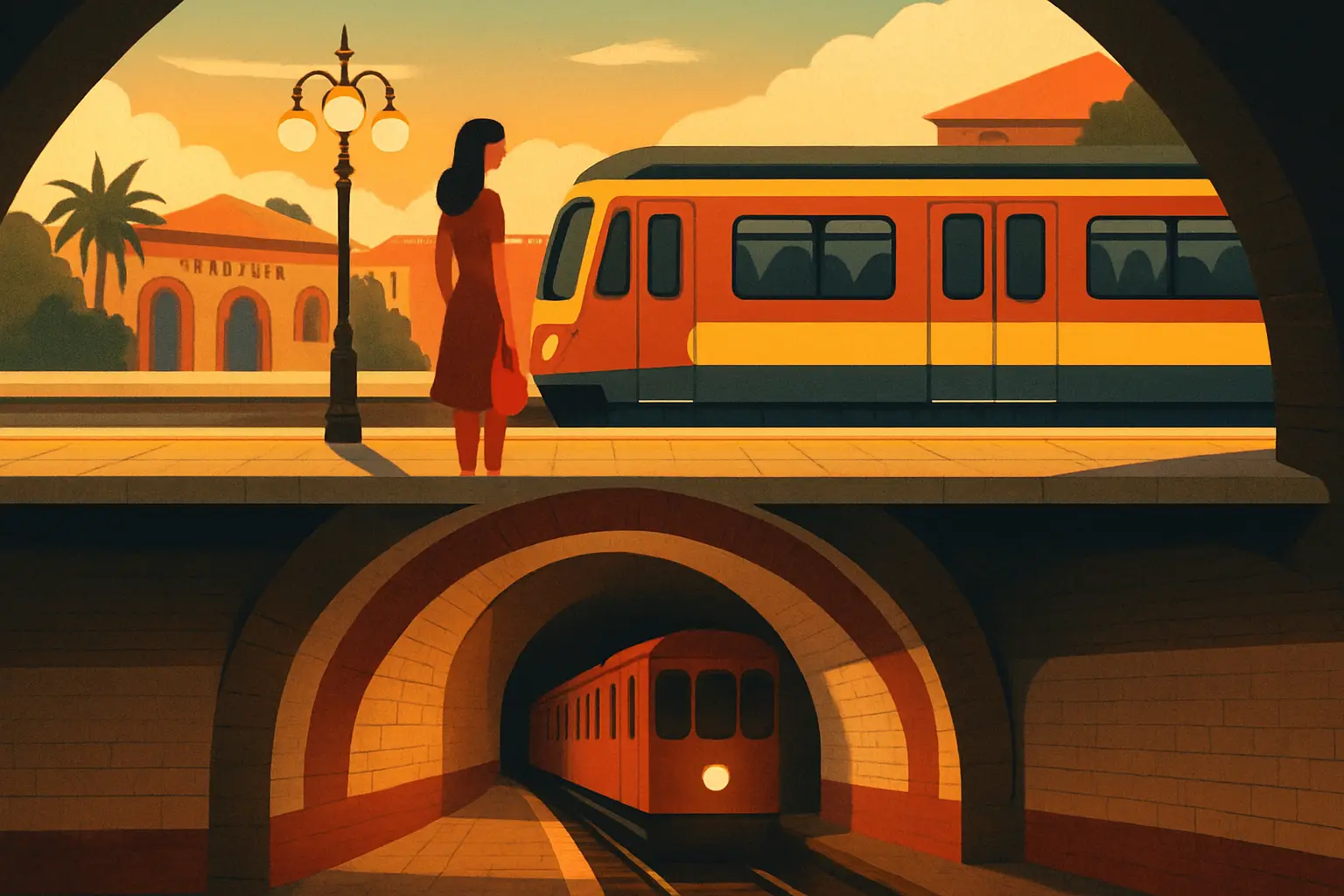
In 1919, the year Madrid opened one of the earliest metro systems in continental Europe, a station was built at Plaza de Chamberí. It served the original Line 1 for 47 years. Then, in 1966, the metro authority extended its trains. The platforms at Chamberí were too short to accommodate the new longer carriages — a structural constraint, not a financial one — and the station was closed. Sealed off from the live operational tunnel, it sat completely undisturbed while trains continued to pass through it several times per hour without stopping.
When the city began rehabilitation in 2006, workers found the station nearly untouched. The ceramic advertising panels from 1919 — hand-painted tiles promoting Anís del Mono liqueur, domestic products, and Madrid commerce of the period — still lined the platform walls. The original wooden ticket booths were intact. Period maps, signage, and station furniture remained in place. The station reopened in 2008 as Andén 0 (Platform Zero), a museum accessible via a staircase entrance from street level at Plaza de Chamberí.
Entry is free, but a timed slot must be booked in advance at metro.madrid.es — weekend reservations fill several days ahead. The museum is open Wednesday through Sunday, 10 a.m. to 6:30 p.m. Plan 30–40 minutes. Audiovisual displays explain the history of Madrid's metro system and the specific engineering decision that caused Chamberí to be bypassed rather than rebuilt.
The experience is singular in a way that is difficult to convey without standing in it: a platform from 1919, with advertising for products that no longer exist, while the current metro runs 10 meters away on the same tunnel alignment. The trains do not stop. The station waits.
Get short, interactive stories that make each place easier to remember while you travel.
At Paseo del General Martínez Campos, 37 — three metro stops south of Andén 0, in the quieter eastern section of Chamberí — sits a museum that consistently ranks among Madrid's least-visited major collections despite being open since 1932. The Museo Sorolla was the home and working studio of the Valencian painter Joaquín Sorolla (1863–1923), who spent the final years of his life here and designed the building around how he painted: a house organized around large north-facing skylights that flood the studio with neutral, constant light.
Sorolla is sometimes described as the Spanish Impressionist, though the label undersells the coherence of his method. He was obsessed with Mediterranean light — particularly reflected light off water, white walls, and skin in open air — and his most celebrated works depict the beaches and garden pools of Valencia and Andalusia with a technical precision that makes the light itself feel like the subject rather than the scene it falls on. The works hanging in his former home include some of the most luminous beach paintings produced in 20th-century European art.
The museum holds his working studio with brushes and palette preserved as he left them in 1923, three garden spaces he designed himself in Andalusian, Castilian, and Valencian regional styles, and a substantial archive of personal letters, photographs, and working drawings. The garden — fountains, azulejos tile-work, roses, and cypress — was designed by Sorolla to provide painting subjects within the property and functions as a coherent outdoor room rather than decorative landscaping.
Admission is €3. Free on Saturday afternoons from 2 p.m. and all day Sunday. Open Tuesday–Saturday 9:30 a.m. to 8 p.m., Sunday 10 a.m. to 3 p.m., closed Mondays. Closest metro: Gregorio Marañón (Lines 7 and 10). Allow 60–90 minutes; the garden deserves 20 of them. What makes the Sorolla Museum feel different from Madrid's larger institutions is scale — you are walking through a studio and a home, not a purpose-built exhibition building, and the paintings are inseparable from the light conditions of the rooms where they were made.
Chamberí's most socially significant feature is not a monument but a single street. Calle de Ponzano runs roughly north-south through the eastern part of the neighborhood and contains a concentration of tapas bars, pintxos counters, and food-focused wine bars dense enough to fill an entire Thursday evening without covering the same ground twice. Madrileños refer to the ritual simply as doing *el Ponzano* — a social circuit that begins at one end of the street, progresses through three or four bars, and ends somewhere for dinner.
The format is stripped-down by design. Bars along the street serve pintxos — small bites on bread bases topped with tortilla, jamón, anchovy combinations, or seasonal ingredients — priced at €1.50–€3 each, ordered at a counter while standing. A caña of draft beer runs around €2. A copa de vino is €3–€4. The eating happens on your feet, at a narrow zinc bar, while the conversation gets progressively louder and the street outside progressively more crowded.
Sala de Despiece at Calle de Ponzano, 11 is the street's most architecturally distinctive venue — a counter-only space designed to resemble a butcher's display case, serving creative small plates built around high-quality protein and seasonal produce with a kitchen visible from every standing position. Expect €25–€35 per person; reservations for groups over two are advisable. It represents a newer generation of Chamberí food culture — more consciously designed than the older bars on the same street — but the quality is consistent with the neighborhood's general refusal to be ordinary.
The best window for Calle Ponzano is Thursday evening between 7:30 and 10 p.m. After 10 p.m. the density on weekend evenings becomes an obstacle rather than an atmosphere. Come early or come on a Thursday.
**Sala de Despiece** — Calle de Ponzano, 11. Counter-only modern tapas, visible kitchen, creative small plates. €25–35 per person. Reserve for groups.
**Mercado de Vallehermoso** — Calle de Vallehermoso, 36. The neighborhood's iron-frame market, renovated and still functioning as a working food market. Good for produce, jamón, and cheese shopping Monday through Saturday mornings.
**El formato del Ponzano** — Most bars on the street are unpretentious: a caña and three pintxos costs under €8. Avoid sitting down at any bar that shows you a printed menu as soon as you enter — that format is not how the street works.
Chamberí's central square, Plaza de Olavide, is a circular space ringed by café terraces and apartment blocks, designed in the 19th century as a residential gathering point rather than a monumental plaza. It does not appear on most tourist itineraries. It functions exactly as originally intended.
The streets radiating outward from the plaza hold some of the best-preserved Belle Époque residential architecture in Madrid. Calle de Almagro, running east from the square, is lined with ornate facades from the 1890s–1920s — buildings commissioned by the professional and merchant class that settled Chamberí during its first development decades. The ironwork balconies, ceramic tilework over doorways, and occasional mansard rooflines are all architectural signals of the moment when Madrid's growing bourgeoisie was consciously trying to build a city that looked more like Paris than a provincial Castilian capital.
The neighborhood's most visible vertical landmark is the tower of the Iglesia de Santa Teresa y Santa Isabel on Calle de Alonso Cano, a neo-Gothic church from the 1880s designed by the architect Fernando Arbós — who also worked on the exterior of the Biblioteca Nacional on the nearby Paseo de Recoletos. The tower is visible from several blocks in every direction and serves as a useful orientation point when the street grid becomes confusing.
For a more intimate architectural experience, walk Calle de Génova westward from Alonso Martínez toward the Sorolla Museum — this is where the late-19th-century building stock is densest and least interrupted by later additions. The ground floors have been converted into banks, law offices, and architecture studios. The floors above look the same as they did in 1905.
Chamberí is easy to reach by metro and extremely difficult to reach by car — which is structurally part of what makes it feel like a neighborhood rather than a destination.
**For Andén 0 (ghost station):** Metro Line 2 to **Iglesia** (one stop from Alonso Martínez) deposits you directly on Plaza de Chamberí, where the museum entrance is located. The walk from Iglesia station to the Andén 0 entrance is under 2 minutes.
**For Museo Sorolla:** Metro Lines 7 or 10 to **Gregorio Marañón**. The museum at Paseo del General Martínez Campos, 37 is a 6-minute walk from the station exit.
**For Calle Ponzano:** Metro Line 1 or 4 to **Bilbao**, or Line 7 to **Alonso Cano**. Both stations put you within a 5-minute walk of the street.
**How long:** A meaningful visit — Andén 0 (pre-booked), Museo Sorolla, a walk through Plaza de Olavide and Calle de Almagro, and two or three stops on Calle Ponzano in the early evening — fills a comfortable full day. Each museum deserves 60–90 minutes without rushing.
**Combining with Malasaña:** The two neighborhoods share a border at Calle de Alberto Aguilera. A morning in Chamberí followed by an afternoon in [Malasaña](/es/blog/madrid-malasana-neighborhood-guide) is one of the more instructive pairings in Madrid — Chamberí shows what the professional city chose to keep; Malasaña shows what happened when a working-class district was remade into something else entirely.
**Budget:** Entry to both major attractions (Andén 0 and Museo Sorolla on a Saturday afternoon) is free. Three stops on Calle Ponzano with pintxos and drinks costs €20–30. A sit-down lunch at a menú del día restaurant on Calle de Santa Engracia costs €14–16 for three courses with wine.
Can I just show up at Andén 0 without a booking? No. The museum operates on timed entry and does not admit walk-ins once a slot is full. Book at metro.madrid.es — free of charge — and arrive at least 10 minutes before your reserved time. Weekend slots are typically booked several days ahead; midweek mornings have more availability.
Is Chamberí worth visiting if I only have one day in Madrid? Honestly, it depends on what you want from that day. If you want the Prado and the Palacio Real, stay south. If you want to understand what Madrid is like when it is not performing for visitors — and see a genuinely unique piece of metro history — Chamberí deserves at least a half day. The ghost station alone is worth the metro ride.
Is it safe? Chamberí has some of the lowest pickpocketing rates in central Madrid. The neighborhood has a permanent resident population that keeps its public spaces active and informally supervised at most hours. Calle Ponzano on a Thursday evening gets loud and crowded but not unsafe.
Best time of year? September and October are ideal — summer heat breaks, the evening terrace culture continues, and the neighborhood operates at full speed after August slowdowns. May and June are excellent. July and August are hot (peak temperature around 37°C in July), but Chamberí functions year-round because its resident population does not leave the way tourist-dependent neighborhoods do.
What to skip: Any restaurant on Calle de Génova with an English-language chalkboard outside. The immediate perimeter of Alonso Martínez plaza at midday, which operates as a lunchtime overflow for the business district to the east and not particularly well. The neighborhood rewards walking its residential streets rather than staying on its commercial arteries.