Barrio de las Letras — the Literary Quarter — is the official name given in recent decades to an older neighborhood that locals have long called Huertas, after the main pedestrian street that runs through it. The two names refer to the same place and are used interchangeably, though guidebooks tend toward Barrio de las Letras and residents tend toward Huertas.
Geographically, the neighborhood sits in central Madrid, bounded by the Paseo del Prado to the east (where the Prado Museum, the Thyssen-Bornemisza, and the Reina Sofia are located), Calle de Atocha to the south, Carrera de San Jeronimo to the north, and Calle del Prado to the west. The neighborhood shares a border with Sol and the historic center to the north and with Lavapies to the southwest — but where Lavapies has historically been Madrid's immigrant and working-class quarter, Huertas has been, for four centuries, a district of writers, playwrights, actors, and the taverns that sustained them.
The center of the neighborhood's public life is Plaza de Santa Ana, a wide, elongated square lined with bar terraces, the neoclassical facade of the Teatro Espanol, and the Hotel Me Madrid on one end. The square is the natural meeting point, the place where the neighborhood's energy concentrates in the evenings, and the logical starting point for any visit.
In the late 16th and early 17th centuries, Madrid's royal court established itself permanently in the city, and the writers, playwrights, and artists who depended on patronage clustered nearby. The result was an extraordinary concentration of literary talent in a small area.
Miguel de Cervantes (1547–1616) lived at Calle del Leon 9 during the final years of his life, while composing the second volume of Don Quixote (published 1615) and other late works. He died in April 1616 — the same month and year, famously, as William Shakespeare — and was buried at the Convent of the Trinitarians at Calle Lope de Vega 18.
Lope de Vega (1562–1635) was the more commercially successful of the two during their lifetimes — an almost industrial playwright who claimed to have written 1,500 plays, of which around 400 survive, and who dominated the Spanish theater for decades. He lived in the house at Calle Cervantes 11 from 1610 until his death in 1635. That building is now the Casa Museo Lope de Vega, the only preserved domestic space from Madrid's Golden Age literary scene.
Francisco de Quevedo (1580–1645), one of the most caustic satirists in Spanish literary history, lived at various addresses in the neighborhood. His poems on greed, hypocrisy, and the decay of the Spanish state were written from within these streets. Pedro Calderon de la Barca (1600–1681) was born nearby and became the official court playwright; his play La vida es sueno is still performed at the Teatro Espanol on the same site where Calderon himself would have seen productions.
Get short, interactive stories that make each place easier to remember while you travel.
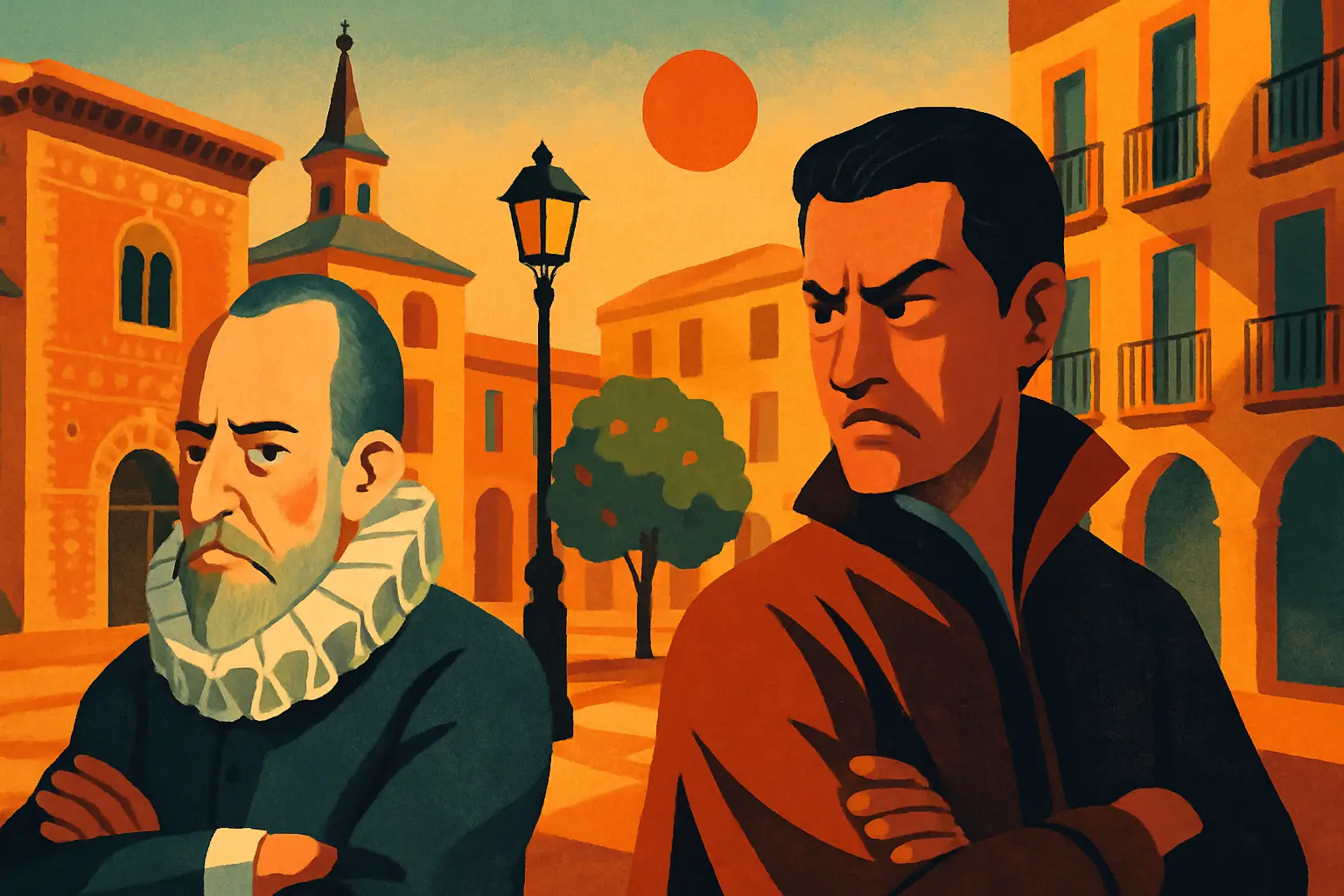
The literary antagonism between Cervantes and Lope de Vega is one of the more entertaining feuds in European cultural history, partly because it was so specific and so public. Understanding what they were fighting about makes the neighborhood considerably more interesting to walk through.
The core of the dispute was professional and personal. Lope de Vega had mastered the comedia nueva — a fast, crowd-pleasing form of theater that broke classical dramatic rules and made him enormously popular and wealthy. Cervantes, who struggled financially for most of his life, had tried and failed to match Lope's theatrical success and resented it bitterly.
The attacks escalated from professional slights to public insults. Lope circulated a private letter mocking Cervantes' work (it became public; these things always did). Cervantes responded through satirical asides in his fiction. When Cervantes published Part I of Don Quixote in 1605 to enormous popular success — the kind of success Lope could not match in prose fiction — the rivalry curdled further.
The ultimate indignity came in 1614, when an unknown author published a fraudulent second volume of Don Quixote under the name Alonso Fernandez de Avellaneda, mocking Cervantes personally. Cervantes was convinced Lope was behind it (scholars remain divided). He responded by writing his own authentic second volume at speed — published in 1615 — and having his hero Don Quixote explicitly debunk the fake version within the narrative itself, possibly the earliest metafictional move in the history of the novel.
They died within a year of each other. Cervantes in April 1616, Lope in August 1635. They were buried blocks apart in the neighborhood where they had competed for decades. Then someone named the streets after them — the other one's street.
In 2015, a team of forensic archaeologists undertook a search beneath the floors of the Convent of the Trinitarians Discalced at Calle Lope de Vega 18 — the address where Cervantes had been buried in 1616. The burial records existed, but his precise location within the convent had been lost during a 17th-century renovation when the bones were moved without documentation.
The team spent four months working in difficult conditions inside the convent. In March 2015, they announced the discovery of bone fragments in a niche beneath the church floor, alongside a deteriorated coffin plank bearing the initials M.C. The forensic analysis — examining bone density, age markers, and damage to the left hand consistent with the injury Cervantes sustained at the Battle of Lepanto in 1571, where he lost use of his left hand and referred to himself throughout his career as the 'one-armed man of Lepanto' — led to the conclusion that the remains were almost certainly his.
His bones were reinterred with ceremony at the same convent in June 2015. The building remains an active religious convent and is not normally open to visitors. But standing in front of the facade on Calle Lope de Vega — reading the address, knowing what is behind the wall — is a strange and specific Madrid experience. A convent named for a playwright, on a street named for the man buried inside it.
The Casa Museo Lope de Vega at Calle Cervantes 11 is the most direct encounter available in Madrid with how Spain's Golden Age writers actually lived. Lope bought the house in 1610 and remained there until his death in 1635, producing some of his most significant work within its walls. The Real Academia Espanola purchased the building in 1935 and eventually restored and opened it as a museum in 1993.
The house is small by any standard — a two-story structure with low ceilings, narrow rooms, and a modest garden that Lope cultivated himself and wrote about with evident affection in his poetry. The rooms contain period furniture and objects (some original to the period, some period-appropriate reproductions) that give a concrete sense of domestic scale in early 17th-century Madrid: the study where he wrote, the bedroom, the chapel where he received religious orders late in life. Lope was ordained as a priest in 1614, between marriages, without substantially changing his domestic habits.
The garden is the most quietly affecting part of the visit. Lope grew herbs, fruit trees, and flowers there and referenced them repeatedly in his poetry. The courtyard garden of a 400-year-old Madrid house, maintained and planted according to period records, is a form of historical specificity that no exhibition panel can replicate.
Admission is free. Tours run every 30 minutes and last approximately 45 minutes. Closed Mondays and August. Arriving when the museum opens is the best strategy — tours are capped at 15 people and fill quickly.
Plaza de Santa Ana is the social center of Barrio de las Letras — a long rectangular square that functions simultaneously as Madrid's best outdoor terrace district and as a neighborhood meeting point for locals who have nothing to do with tourism.
At the eastern end stands the Teatro Espanol, founded in 1583 as a corral de comedias — an open-air courtyard theater, the standard performance format of Golden Age Spain — and operating continuously in some form ever since. The current neoclassical facade dates from the 19th century, but the institution's connection to Lope de Vega, Calderon, and the comedias written in the surrounding streets is direct. In September, as the city recovers from August, the theater reopens for its new season: the program typically includes at least one Golden Age work alongside contemporary Spanish and international drama. Checking the program at teatroespanol.es before visiting is worthwhile.
Cerveceria Alemana at Plaza de Santa Ana 6 has been operating since 1904 and was a regular haunt of Ernest Hemingway during his Madrid years (he wrote about it in The Sun Also Rises). The beer is straightforward and correctly cold; the interior — dark wood, marble tables, white-jacketed waiters — has changed very little since the 1940s.
Calle de las Huertas, the neighborhood's main pedestrian artery running south from the plaza, is where the sidewalk verse inscriptions are concentrated: lines from Cervantes, Quevedo, Lope, and Calderon embedded in the marble pavement in bronze lettering. They were installed in the 1990s as part of a neighborhood renewal initiative and are easy to miss if you walk at speed. Slow down, look down, and read them. They are a form of public literary monument that only works if you pay attention.
The neighborhood has excellent options across all price points, leaning toward traditional Madrid wine bars and modern Spanish cooking rather than tourist-facing menus.
**Casa Alberto** — Calle Huertas 18. One of the oldest continuously operating taverns in Madrid, founded 1827. The bar serves house vermouth from a barrel on the back counter alongside tapas of callos (Madrid tripe stew), morcilla, and house croquetas. The interior — tiled walls, dark wood, antique mirrors — is the real thing. Closed Sundays at dinner and Mondays.
**La Venencia** — Calle Echegaray 7. A legendary sherry bar operating since 1929, serving only sherry — manzanilla, fino, amontillado, oloroso, palo cortado — poured from barrels directly into straight-sided glasses, no ice, no mixers. The bartenders do not allow photographs inside; the prohibition is enforced. A glass runs €2.50–€3.50. Opens at 1 p.m. and fills by 2 p.m. on weekdays.
**Lhardy** — Carrera de San Jeronimo 8, on the neighborhood's northern edge. Madrid's oldest restaurant (1839), famous for its cocido and its 19th-century interior. Lunch in the dining room is a special occasion; the ground-floor counter — hot consomme poured from a silver samovar, small croquetas, house vermouth — is accessible for under €10 and requires no reservation.
**LATERAL** — Calle de las Huertas 57. A modern Madrid tapas bar with reliably good execution: jamon croquetas, patatas bravas, fresh tostas. Better quality than the tourist-facing terraces on Plaza de Santa Ana at similar prices. Open 10 a.m. to midnight.
Barrio de las Letras is one of the most walkable neighborhoods in central Madrid, and most visitors arrive on foot from Sol or Gran Via.
**Getting there by metro:** Anton Martin (L1, blue line) drops you at the southern edge on Calle de Atocha. Sevilla (L2, red line) leaves you at the northern edge on Carrera de San Jeronimo. Either is a 5-minute walk to Plaza de Santa Ana.
**Best months:** April–June and September–October. July and August are hot and crowded; August also sees many local businesses close for vacation. September is particularly good: theater season opens, tourists thin noticeably, and evening temperatures are comfortable for outdoor dining.
**Combining with the Prado:** The Prado Museum at Paseo del Prado 12 is a 10-minute walk east. Arriving at the Prado when it opens at 10 a.m., spending two to three hours inside, then walking west into Barrio de las Letras for lunch makes a full and coherent day — the [Prado's collection](/es/blog/el-prado-museum-five-masterworks-guide) was assembled by the same Spanish Habsburg monarchs who patronized the Golden Age writers. The Reina Sofia — Picasso's Guernica — is a 10-minute walk to the south.
**How long to spend:** Half a day covers the key sites at a comfortable pace — Casa Museo Lope de Vega, a walk along Calle de las Huertas, and lunch in the neighborhood. A full day allows you to combine with the Prado and end the evening on Plaza de Santa Ana.
**What to skip:** Restaurants immediately on Plaza de Santa Ana with large laminated menus and outdoor promoters are tourist traps. Walk one block onto Calle de las Huertas or Calle Echegaray for substantially better food at lower prices.
**Safety:** The neighborhood is safe and well-lit. The streets around Plaza de Santa Ana can be loud late on Friday and Saturday nights as bar terraces fill — this is a normal Madrid nightlife neighborhood, not a concern.