Almería's relative obscurity has a simple explanation: the AVE high-speed rail arrived here later than to most major Andalusian cities, and for decades the only way to reach the city in reasonable time from Madrid or Barcelona was to fly or accept a lengthy conventional train journey. Seville, Córdoba, Málaga, and Granada all had AVE connections years earlier; Almería joined the network in 2022 with an intermediate link through Granada. The result of that delay was that Spain's tourism industry organized itself around the connected cities, and Almería became the Andalusian destination that guidebooks mention briefly before pivoting to Granada.
For visitors willing to make the trip, this situation produces what travelers usually have to fly to the developing world to find: a working Spanish city, largely unperformed for tourists, where local bars and restaurants price for local incomes, where the main attractions receive a fraction of the crowds they'd see in a better-known city, and where the daily rhythm of Andalusian life — the long lunch, the evening paseo along the Paseo de Almería, the tapas circuit from 20:00 onward — is still intact and unhurried. September is one of the best months to visit: the summer heat has broken slightly (typical highs of 30–33°C rather than the 38–42°C peaks of July), the beaches are warm but no longer overwhelmed, and the city returns to its local rhythm after the August holiday exodus.
The Alcazaba de Almería sits on a limestone hill above the city center at Calle Almanzor, commanding unobstructed views over the port and the bay. Built beginning in 955 CE under the Córdoban caliph Abd al-Rahman III and substantially expanded under Al-Khayr — the Hammudid governor who made Almería the most important port of Al-Andalus in the eleventh century — the fortress is one of the largest and best-preserved Moorish fortifications on the Iberian Peninsula. It is larger in area than the Alhambra in Granada, though far less visited.
The complex divides into three distinct enclosures, each readable as a layer of the city's history. The first enclosure was military — the garrison walls, cisterns for siege-proofing the water supply, and the outer barbican. The second enclosure held the medina itself: the caliph's palace, gardens, bathhouses, and mosques, of which surviving foundations and reconstructed sections give a clear sense of the sophistication of eleventh-century Andalusian courtly life. The third enclosure, the highest point of the hill, was added after the Christian Reconquista by the Catholic Monarchs in the late fifteenth century: a keep and a small chapel built directly over the former mosque, a piece of architectural overwriting typical of the Reconquista's material politics.
The garden terraces of the second enclosure are among the most underrated open spaces in Andalusia — structured around channels, reflecting pools, and rose plantings that follow an Islamic garden layout reconstructed from archaeological evidence. Visiting the Alcazaba, then reading about the Alhambra's Nasrid Palaces gives you the full arc of Moorish palace culture in Andalusia, from its eleventh-century Almería origins to its Granada culmination in the fourteenth century.
Get short, interactive stories that make each place easier to remember while you travel.
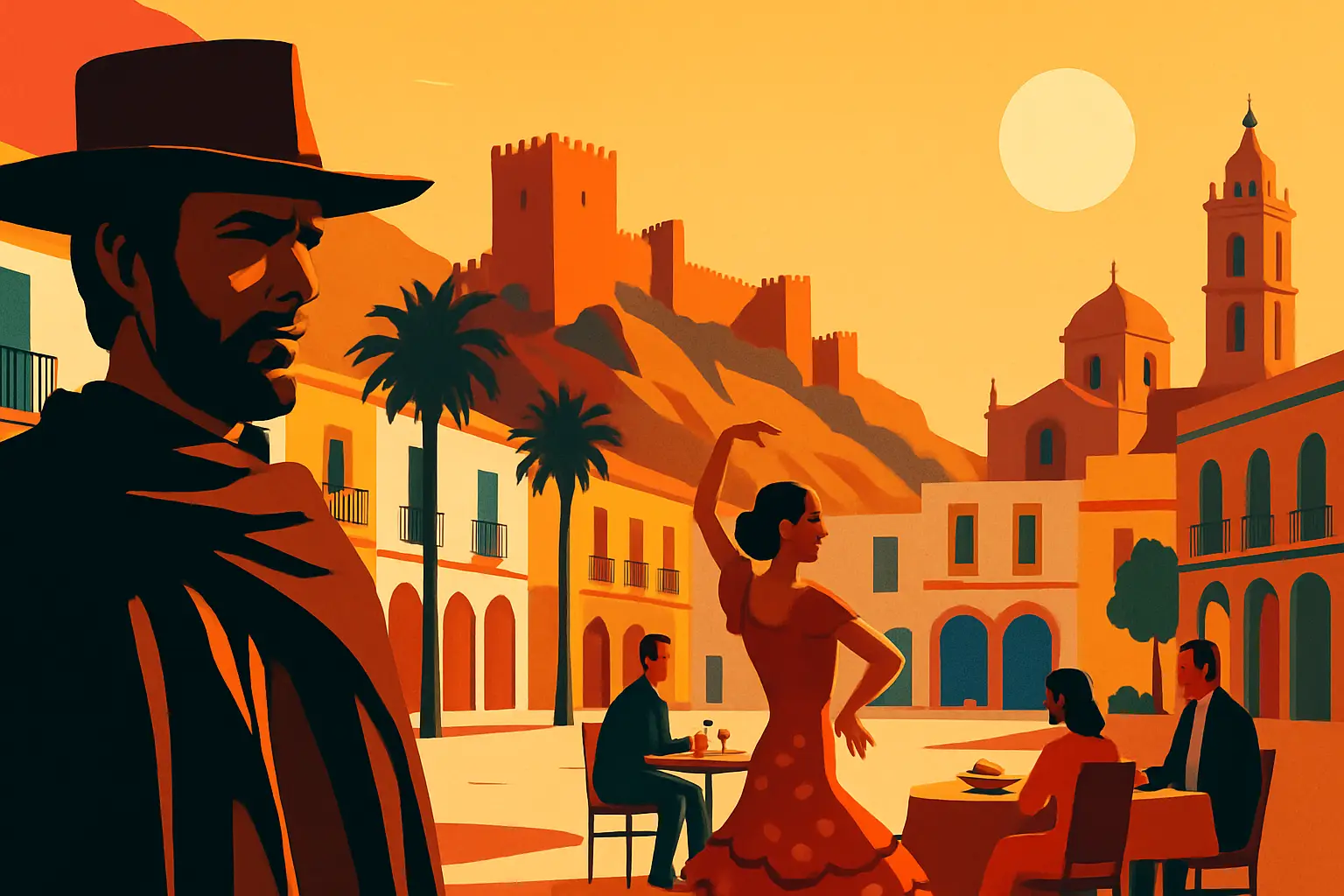
Forty-five kilometers north of Almería, the Desierto de Tabernas is the only true desert on the European continent — a landscape of eroded gullies, sparse scrub, and bone-colored ridges that receives less than 200mm of rainfall per year. In the early 1960s, Italian director Sergio Leone drove through this landscape while scouting locations for a low-budget cowboy film he was planning to shoot as an Italian-Spanish co-production. What he saw in the Tabernas was indistinguishable on film from the American Southwest he couldn't afford to shoot in. He went home and wrote a script.
The result was A Fistful of Dollars (1964), shot almost entirely in the Tabernas and in the town of Colmenar Viejo near Madrid, with a then-unknown American television actor named Clint Eastwood in the lead role. The film's success led to For a Few Dollars More (1965) and The Good, the Bad and the Ugly (1966), with Almería Province providing locations for all three. The rock formations around Gérgal, the dry riverbed outside the town of Tabernas, and the ruins at Rodalquilar — where Leone staged the final confrontation in *The Good, the Bad and the Ugly* — are all identifiable to anyone who has watched those films.
Three Western film sets survive in the Tabernas today as tourist parks: Mini Hollywood (also called Oasys Park), Fort Bravo (now Texas Hollywood), and Western Leone. Mini Hollywood is the most developed, with a pool, animal enclosures, and scheduled Western-show performances. Fort Bravo is more atmospheric, closer to the raw feeling of the original films. Both are reachable from Almería city by car (40 minutes north on the A-92) or by organized tour from the city center.
Almería holds a claim — contested by Granada, but supported by most serious food writers who have visited both — to the most generous free tapas tradition in Spain. Where Granada's bars typically bring a small portion with each drink, Almería's bars in the old city routinely send out *mediaciones* — half-portions of actual cooked dishes — with a standard caña or glass of house wine costing €2–€2.50.
The concentration of serious tapas bars runs along Calle Trajano, Calle Juan Leal, and the streets radiating from Puerta de Purchena in the city center. Bar El Quinto Toro on Calle Trajano 19 is the local institution: a high-ceilinged, slightly chaotic bar where the kitchen rotates through migas con chorizo (fried breadcrumbs with sausage), grilled tuna with onion, garlic prawns, and small cazuelas of braised oxtail depending on the day. Bar Torreluz on Avenida de Federico García Lorca is slightly more polished and operates across three connected bars, each with a different pricing tier.
The practical approach: arrive at 20:30 when bars first fill up, order your first drink, eat what arrives, move on after two or three drinks, and repeat across three or four different bars. You will spend €8–€12 in drinks across an evening and eat at a level that competes with a €35–€40 sit-down meal in Seville. This is not a deal requiring local knowledge to access — it is simply how the city functions, and has functioned for as long as current bar owners can remember. For more on how Almería's tradition compares to the rest of Spain, see tapas culture explained region by region.
Almería's old city is compact, built on a grid that predates the Christian takeover in 1489, with Moorish street patterns still legible in the narrower lanes around the Almedina — the original medina that developed below the Alcazaba walls. The Paseo de Almería, the city's main pedestrian artery, bisects the historic center and functions as the evening paseo ground: madrileños would recognize the ritual of circling and greeting, though here it's Andalusian and conducted at a slightly slower pace.
The Catedral de la Encarnación de Almería, on Plaza de la Catedral, is one of Spain's most unusual religious buildings — a cathedral constructed between 1524 and 1562 that was deliberately built to double as a fortress. The exterior is military: thick walls, round towers at the corners, narrow windows on the lower levels, battlements instead of a conventional Gothic crown. The design reflects Almería's exposed position on the Mediterranean coast during a period of constant Barbary pirate raids from North Africa; the cathedral was intended to serve as a refuge for the city's population during attacks, with the towers providing defensive positions. The interior is more conventionally Renaissance — three naves, carved choir stalls by Juan de Orea from the 1560s, and a side chapel with a sixteenth-century alabaster altarpiece. The contrast between the martial exterior and the religious interior is unlike almost any other cathedral in Spain. Open Monday–Friday 10:00–14:00 and 16:00–18:30, Saturday 10:00–14:00, admission €5.
Twenty kilometers southeast of Almería city, the Parque Natural Cabo de Gata-Níjar protects 45 kilometers of volcanic coastline — the driest, least developed, and most ecologically significant stretch of Mediterranean shore in Spain. The park was formed by volcanic activity 8 million years ago; the distinctive rock formations, dark volcanic sand beaches, and near-translucent water color all come from the underlying mineralogy.
The main access village is San José, a small fishing town that has grown to accommodate summer visitors but remains far less built up than comparable beaches on the Costa del Sol. From San José, a 30-minute walk south reaches Playa de los Genoveses — a broad, calm bay with pale sand and water that photographs as Caribbean blue. A further 20 minutes along the cliff track leads to Playa de Mónsul, which appeared in the opening sequence of Steven Spielberg's *Indiana Jones and the Last Crusade* (1989) and is recognizable by the large volcanic rock that sits on the beach. Both beaches are protected from development; there are no chiringuito bars, no pedalo rentals, no parasol infrastructure. Bring water and food.
The lighthouse at Cabo de Gata itself, at the southernmost tip of the park, is accessible by car (parking at the end of the AL-3115 road) or by a 3-hour coastal walk from San José. The sea view from the lighthouse includes the Alborán Island and, on clear days, the faint outline of the Moroccan Rif mountains across the strait — the closest point on the Spanish mainland to Africa.
Almería rewards planning around its climate. July and August bring temperatures of 38–42°C in the city center, with little cloud cover. September and October are the genuine sweet spot: temperatures of 28–33°C, warm sea water above 24°C, and significantly fewer visitors than peak season. The Cabo de Gata beaches are swimmable well into November.
**By air:** Almería Airport (LEI) receives direct flights from London Gatwick, Amsterdam, and several German cities year-round, with more routes in summer. Taxi from the airport (8 km east of city center) to Casco Histórico costs approximately €14.
**By train (AVE):** From Granada to Almería, 1h45m on the Madrid–Almería line. From Madrid Atocha, the total journey with the Granada connection is approximately 3.5 hours. Renfe tickets purchased in advance are significantly cheaper.
**By bus:** ALSA operates direct buses from Granada (2h30m), Málaga (3h30m), and Madrid (6h30m). The bus station at Calle Rambla Obispo Orberá 53 is a 10-minute walk from the Alcazaba.
**Accommodation:** Most visitors stay in the Casco Histórico or along the Rambla, within walking distance of the Alcazaba and the tapas circuit. For Cabo de Gata access, San José village has a growing number of casas rurales and small hotels — book well ahead for July and August; the rest of the year, last-minute availability is generally not a problem.
**Language:** Almería is not a heavily bilingual city. English is understood in hotels and some tourist-facing bars, but the tapas circuit functions in Spanish. A few words — *una caña* (small beer), *un vino de la casa* (house wine), *¿qué hay hoy?* (what's the tapa today?) — will carry you further than any translation app.
**Safety:** Almería is safe by any Spanish standard. Standard precautions apply near the bus and train stations after dark, but the historic center is relaxed and well-used by locals at all hours.