1. The complex at La Villa de Guadalupe — two churches, one hill, one plaza
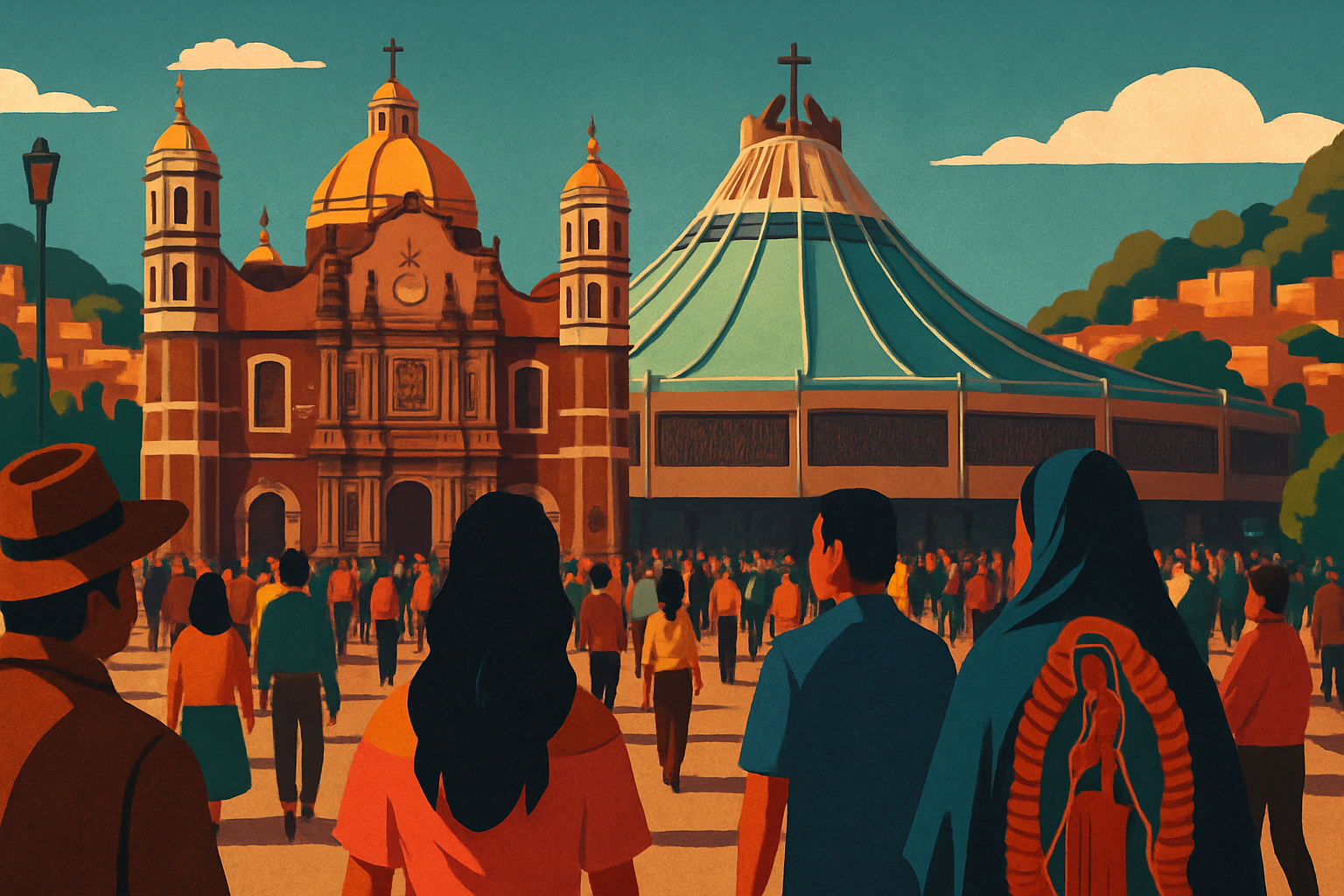
The Basílica de Guadalupe is not a single building. It's a hillside complex in the Gustavo A. Madero borough called La Villa de Guadalupe, about 8 kilometers north of the Zócalo. When you exit the metro at La Villa-Basílica, you emerge onto Plaza de las Américas — a wide pedestrian esplanade that opens onto the full religious site. Three main elements make up the complex: the large circular new basilica (completed 1976), the visibly tilting old basilica standing directly beside it (built 1709), and a set of hilltop chapels at the top of Cerro del Tepeyac, the hill that rises steeply behind the plaza. Most visitors focus only on the new basilica and miss the hill entirely. That's the wrong call — the hill is where the story actually begins, and the view from the top changes how you read everything below it.
•New basilica (1976): circular, modern, designed by Pedro Ramírez Vázquez — same architect as the Museo Nacional de Antropología
•Old basilica (1709): tilting visibly, now a museum — step inside for the disorienting sloped floor
•Cerro del Tepeyac: the hilltop with the apparition chapels, a 15-minute walk or a short funicular ride up
2. Juan Diego and the tilma — what the apparition story says and why it still matters
On December 9, 1531 — ten years after the Spanish conquest of Tenochtitlan — a Nahua man named Juan Diego was walking across Cerro del Tepeyac when he reportedly heard music and saw a radiant woman who identified herself as the Virgin Mary. She spoke to him in Nahuatl, his indigenous language, and asked that a church be built on the hill. The local bishop was skeptical and demanded proof. On December 12, Juan Diego opened his ayate — a rough cloak woven from maguey plant fibers — to release the roses he had gathered as evidence, and found that the image of the Virgin had appeared imprinted on the cloth. The bishop believed him. That cloak, called the tilma, has been on public display ever since. It is now nearly 500 years old. Ayate fiber typically degrades within 20 years under normal conditions; the tilma has not deteriorated. In 1979, ophthalmologist Dr. Javier Torroella Bueno published an analysis of high-magnification photographs of the image's eyes and identified reflections he interpreted as the figures who would have been present when Juan Diego opened his cloak before the bishop. Juan Diego was canonized as a saint by Pope John Paul II in 2002, at a ceremony held in this basilica. Whether you read the tilma as a miracle or a historical artifact, it's been sitting in this room for five centuries. That alone is worth standing in front of.
•December 9–12, 1531: the four apparition dates, now observed as a formal feast on December 12
•The tilma is made from maguey-fiber ayate cloth — material that degrades in decades, not centuries
•Juan Diego canonized as a saint in 2002 — one of only a handful of indigenous Mesoamerican saints in the Catholic church
3. The old basilica is sinking — and you should absolutely go inside
The Antigua Basílica de Guadalupe, completed in 1709, stands directly next to the new building and is the most visually striking structure in the complex. It's tilting at a visible angle — the floor inside runs at a noticeable grade, and looking back at the main entrance from the altar amplifies the lean dramatically. Mexico City is built on the drained lakebed of Lake Texcoco, and the saturated clay compresses unevenly, causing buildings across the city to sink at different rates. The old basilica has dropped more than two meters in some sections. By the 1970s, it was structurally compromised beyond safe use for the crowds it attracted, which led directly to the commissioning of the new circular building next door. Today the Antigua Basílica functions as a museum and holds smaller masses. Walk in, stand at the altar, and look back toward the exit — the tilt feels like standing on the deck of a ship mid-turn. The building is a kind of slow-motion monument to the geological fact that this city exists where a lake used to be.
•Floor grade is real and disorienting — plan five minutes inside just for that sensation
•Now a museum and small-mass venue — check the schedule if you want to see a service in the historic space
•Mexico City's lake-clay geology: the reason buildings across the centro have settled unevenly for centuries
4. The moving walkways under the tilma — how it actually works
The tilma hangs behind the main altar of the new basilica, enclosed in bulletproof glass under controlled climate and humidity. Because the complex receives millions of visitors on peak days, a system of flat conveyor walkways runs along both sides of the altar — you step on and the belt carries you slowly underneath the image while you look up. You cannot stop or linger; the crowd keeps moving. The tilma is displayed several meters above altar level, so if you want a detailed look, bring compact binoculars or plan to use the large digital screens mounted in the side aisles, which show high-resolution close-ups of the image. For a longer, unhurried look, arrive before 8 a.m. on a weekday: the walkways are nearly empty, attendants are more relaxed, and it's possible to step off, circle back, and ride through again without being swept along by a crowd three people deep. The new basilica holds roughly 10,000 people — and still fills up completely on December 12.
•Conveyor belts run under both sides of the altar — the ride takes about 90 seconds
•Bulletproof glass + climate control protect the 500-year-old cloth
•Side-aisle digital screens show extreme close-ups if you want detail the naked eye can't catch at that distance
5. Cerro del Tepeyac — the Aztec sacred site underneath the Catholic one
The hill behind the complex was already a pilgrimage destination before the Spanish arrived. Cerro del Tepeyac was dedicated to Tonantzin — a Nahuatl name meaning 'our sacred mother,' associated with the earth-mother deity — and Aztec pilgrims traveled long distances to leave offerings at the hilltop shrine. The 1531 apparition narrative arrived at this same location eleven years after the conquest, featuring a Virgin who spoke Nahuatl and appeared on a hill already considered sacred. Many scholars of Mexican religious history interpret the Guadalupe tradition as one of the clearest examples of syncretism in the Americas: the Catholic and indigenous sacred sites fused into a single point of devotion that drew from both traditions. The climb to the hilltop takes about 15 minutes on foot via a paved path, or a few pesos on the small funicular near the back of the plaza. At the top, a statue of Juan Diego marks the apparition spot. On a clear morning in May, before the smog builds, you can see across the city to Iztapalapa and the hills beyond.
•Pre-Hispanic site of Tonantzin worship — the hill was sacred before the conquest, not after it
•Funicular runs from behind the plaza to the top chapels — takes about 3 minutes, costs around 20 pesos
•Best views of the basilica complex are from the hilltop — useful perspective on how large the site actually is
6. December 12 — what the pilgrimage looks like when 10 million people show up
The Feast of Our Lady of Guadalupe on December 12 is one of the largest annual pilgrimage events anywhere in the world. More than 10 million people arrive in the days surrounding December 12, many on foot from towns hundreds of kilometers away. Some complete the final stretch on their knees — crawling toward the basilica as an act of devotion, padding their knees with cardboard or cloth. The plaza fills with indigenous dance groups in feathered Aztec regalia, mariachi bands performing Las Mañanitas (a birthday serenade traditionally sung to the Virgin at midnight), family groups who have been making this trip for generations, and vendors selling hot atole, buñuelos fried in large vats, and candles printed with the Virgin's image. The energy is unlike anything else in the city — devout, festive, and exhausting in the best possible way. If you're in Mexico City in early December, walking from the metro through the pilgrimage approach to the plaza once is one of the most vivid things the city offers. Wear flat shoes, don't block the path of anyone crawling, and plan for crowds that make peak December 12 Bellas Artes look empty.
•December 12: Feast day — plan weeks ahead if visiting, as hotels near La Villa fill completely
•Las Mañanitas at midnight: mariachi serenades to the Virgin mark the official start of the feast
•Pilgrimage approaches via Calzada de Guadalupe, the main avenue from the metro — the walk itself is part of the experience
7. Is the Basílica worth visiting if I'm not Catholic?
Yes — without qualification. The Virgin of Guadalupe is arguably the single most important symbol in Mexican national identity, appearing on murals, taxi dashboards, political posters, and forearm tattoos across the country in a way that long ago escaped purely religious meaning. Understanding her means understanding something foundational about Mexico that religion alone doesn't fully explain. The site also delivers on purely secular terms: the tilting old basilica is architecturally bizarre and historically interesting, the new circular building is genuinely impressive at scale, and the Tepeyac hill adds a pre-Hispanic layer that turns the visit into a 500-year story with multiple competing narratives. Budget 1.5 to 2 hours if you want to do the hill. Don't skip the hill. The context you carry up with you — the Aztec shrine, the conquest, the apparition, the tilma in the glass case below — makes the view from the top feel like a compressed version of Mexico City's entire history visible at once.
•The Virgin of Guadalupe appears across Mexican secular culture — understanding her makes the whole country more legible
•The [Aztec history context](/blog/aztec-history-for-beginners) is useful before this visit — the Tepeyac site makes much more sense with it
•Budget 1.5–2 hours for new basilica + old basilica + hilltop chapels — 45 minutes is too short
8. Practical FAQ: hours, how to get there, and what to wear
The basilica complex is open daily from approximately 6 a.m. to 9 p.m. and admission is free throughout. Metro Line 6 (the red line) has a dedicated station called La Villa-Basílica — the exit drops you almost directly onto the plaza esplanade, and the ride from Bellas Artes takes about 25 minutes with no transfers. Dress modestly: covered shoulders and no shorts is the standard expectation inside both churches. Enforcement varies but erring toward respectful is both easier and correct. Small bags pass through without issue; large backpacks may be checked during busy periods. There are clean public restrooms off the main plaza near the museum entrance. Bring water — the Tepeyac hill climb in May or June sunshine is warm, and there are no fountains on the trail. The best overall experience is a Tuesday or Wednesday morning arrival before 10 a.m., when the walkway crowd is thin, the plaza is uncrowded, the hill trail is quiet, and the whole complex feels like something you've found rather than something you've been processed through.
•Hours: daily 6 a.m.–9 p.m., free entry throughout the complex
•Metro Line 6 → La Villa-Basílica: the most direct route, exits directly onto the plaza
•Best visit: weekday morning, arrive before 10 a.m. — avoid weekends and all of early December unless going for the pilgrimage