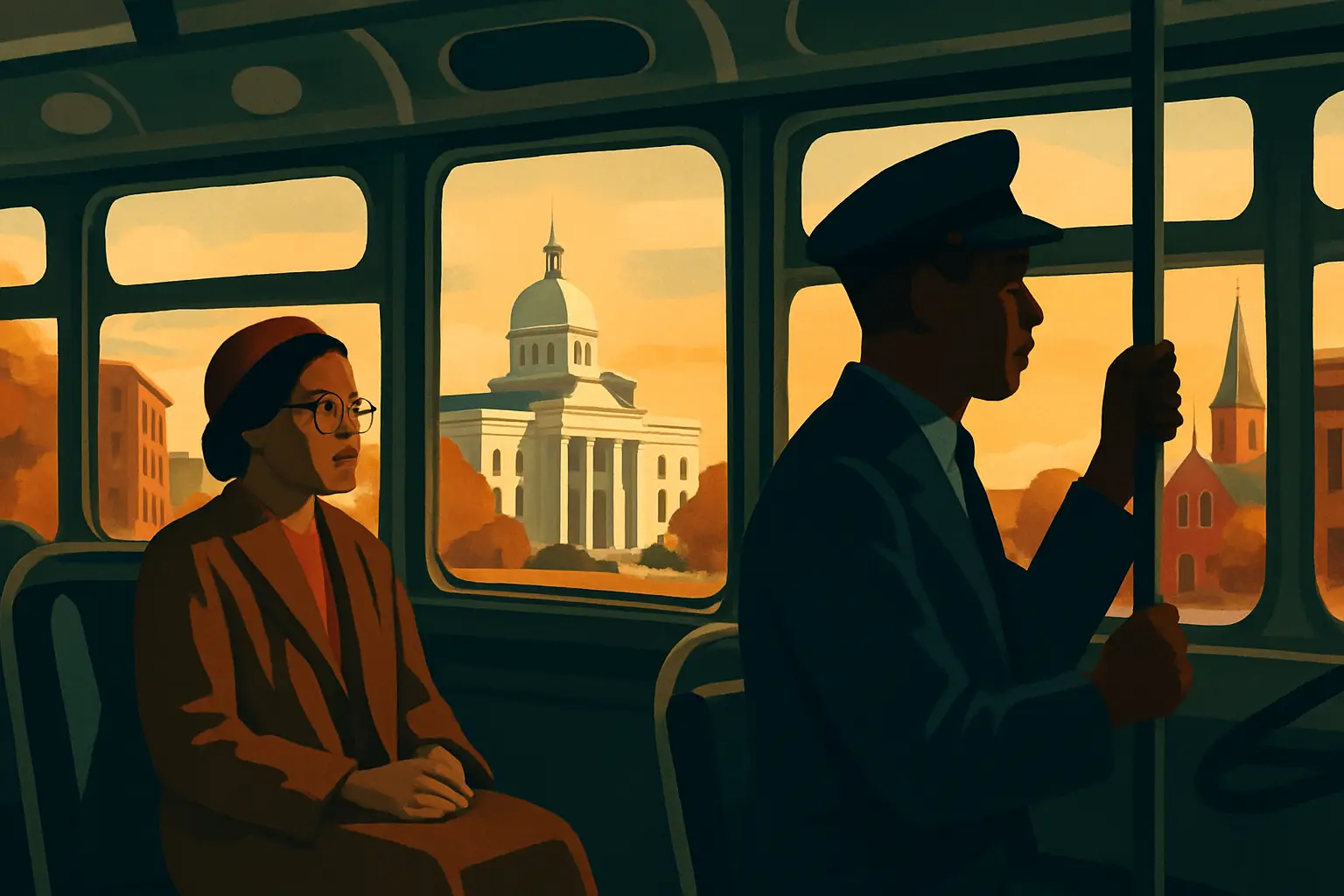
Rosa Parks (February 4, 1913 – October 24, 2005) was a civil rights activist and secretary of the Montgomery, Alabama chapter of the NAACP. On December 1, 1955, she refused to give up her bus seat to a white passenger as the city's segregation ordinance required. She was arrested, convicted, and fined. The Black community of Montgomery responded by boycotting the entire city bus system for 381 days. The boycott ended when the U.S. Supreme Court affirmed a lower court ruling in Browder v. Gayle, declaring bus segregation unconstitutional. Parks became one of the most recognized symbols of the Civil Rights Movement — but the story behind the symbol is sharper, and more strategic, than the legend suggests.
Parks boarded Cleveland Avenue Bus 2857 after a day of work as a seamstress at the Montgomery Fair department store. She sat in the first row of the 'colored' section — not at the front of the bus, but in the first row behind the white-reserved rows. When the bus filled and driver James Blake ordered the Black passengers in her row to stand so a white man could sit, three passengers complied. Parks did not. She was arrested shortly after.
What most textbook versions omit: Parks had not stumbled into this moment. That summer she had attended the Highlander Folk School in Monteagle, Tennessee — a training center for civil rights organizers that had educated union activists and desegregation campaigners since the 1930s. She was, at the time of her arrest, NAACP chapter secretary, not a random tired commuter. She had also previously been thrown off this same driver's bus years earlier for boarding from the front door rather than re-entering from the rear as the rules required. The act of resistance on December 1 was a choice made by someone who understood exactly what she was doing and what it might start.
Get short, interactive stories that make each place easier to remember while you travel.
The Montgomery Bus Boycott began four days after Parks' arrest, on December 5 — the morning of her conviction. It was organized almost overnight. Jo Ann Robinson of the Women's Political Council printed and distributed roughly 52,000 flyers across Montgomery the night of December 1, calling for a one-day boycott on the day of Parks' trial. E.D. Nixon, president of the local NAACP chapter, coordinated Black community leaders to extend it beyond one day. A 26-year-old pastor who had been in Montgomery less than a year — Martin Luther King Jr., at Dexter Avenue Baptist Church — was chosen to lead the newly formed Montgomery Improvement Association.
For 381 days, approximately 40,000 Black residents of Montgomery refused to ride the city buses, which relied on Black ridership for roughly 75 percent of their revenue. Participants organized carpools, walked miles to work, and arranged mule-drawn wagon rides. Homes and churches were bombed, including King's home. The boycott ended December 20, 1956, when the Supreme Court's ruling took effect and the buses were legally desegregated.
The legal victory actually came through a separate lawsuit. The plaintiffs in Browder v. Gayle were four other women — Claudette Colvin, Susie McDonald, Aurelia Browder, and Mary Louise Smith — who had each been mistreated on Montgomery buses before Parks' arrest. The distinction matters: Parks' arrest sparked the boycott, but the legal theory that ended segregated busing was built on a broader case. Civil rights strategy in this era was rarely the work of one person.
Nine months before Parks' arrest, a 15-year-old student named Claudette Colvin refused to give up her seat on a Montgomery bus. She was arrested, handcuffed, and taken to jail. Community leaders considered using her case as the test case against bus segregation but decided against it — Colvin was a teenager, she was pregnant at the time, and strategists felt the circumstances were too complicated for a clean public narrative.
This decision reveals something important about how the Civil Rights Movement operated. Parks was not chosen randomly; she was considered an ideal plaintiff because of her character, her organizational role, and her personal history of dignity under pressure. Jo Ann Robinson, E.D. Nixon, and other strategists understood that the test case would play out in newspapers, in courtrooms, and in the living rooms of white moderates they needed to reach. Rosa Parks, in Robinson's words, was the right person at the right moment — but the moment had been building for years before December 1, 1955.
After the boycott ended, Parks and her husband Raymond faced job loss and constant threats in Montgomery. They moved to Detroit in 1957, where Parks eventually found work in the office of U.S. Congressman John Conyers and remained on his staff for over two decades. She continued marching — she was at Selma in 1965 — and participating in major civil rights events for the rest of her life.
In 1987 she co-founded the Rosa and Raymond Parks Institute for Self Development, a nonprofit focused on youth leadership and education. She received the Presidential Medal of Freedom in 1996 and the Congressional Gold Medal in 1999 — the two highest civilian honors in the United States. When she died on October 24, 2005, at age 92 in Detroit, she lay in honor at the U.S. Capitol Rotunda, the first woman and the second Black American in history to receive that tribute. The city of Montgomery later renamed the street where she was arrested — Cleveland Avenue — Rosa Parks Avenue.
Montgomery is one of the most historically dense cities in the American civil rights story, and nearly all of its major sites are within easy walking distance of downtown. Most visitors underestimate how compact the landscape is.
The Rosa Parks Museum at Troy University (252 Montgomery Street) tells her story from arrest through boycott with original artifacts and an immersive recreation of Bus 2857. Allow 90 minutes; closed Sundays. The Dexter Avenue King Memorial Baptist Church (454 Dexter Avenue, at the base of the Alabama Capitol steps) is the church where King preached during the boycott and where the Montgomery Improvement Association met to plan strategy. Guided tours are available; check the church's website for current hours. The National Civil Rights Memorial (400 Washington Avenue), designed by Maya Lin and maintained by the Southern Poverty Law Center, lists the names of 41 people killed during the civil rights struggle on a circular granite water table. It is free and open to the public. The Freedom Rides Museum at 210 South Court Street, housed in Montgomery's original Greyhound Bus Terminal, documents the 1961 Freedom Rides and the federal enforcement that followed.
All four sites form a self-guided walking loop of about 1.5 miles. To understand how Montgomery's story connects to the broader movement in Alabama, see our guide to Birmingham and the Civil Rights Movement.
Is the Rosa Parks Museum free? No. Admission is charged; check Troy University's website for current pricing. A student rate is available. The museum is closed Sundays.
How long does a full civil rights visit take? Allow a full day for the Rosa Parks Museum, Dexter Avenue Church tour, National Civil Rights Memorial, and Freedom Rides Museum. Each site takes 45–90 minutes. The walking loop between them is under 2 miles.
Is Montgomery worth a dedicated trip? Yes, especially combined with Selma (55 miles west). The Edmund Pettus Bridge and the Selma to Montgomery National Historic Trail provide direct continuity with the boycott's legacy — the Bloody Sunday marches of 1965 were a direct outgrowth of the movement that Parks helped ignite ten years earlier.
When is the best time to visit? Year-round; Montgomery's winters are mild. Spring (March–April) aligns with civil rights anniversary marches and commemorations. Summers are hot and humid.
Do I need to book Dexter Avenue Church tours in advance? Yes — guided tours of the church require advance scheduling. Check the church's website for current availability. Walk-in visits to the exterior and sanctuary are sometimes possible but not guaranteed.