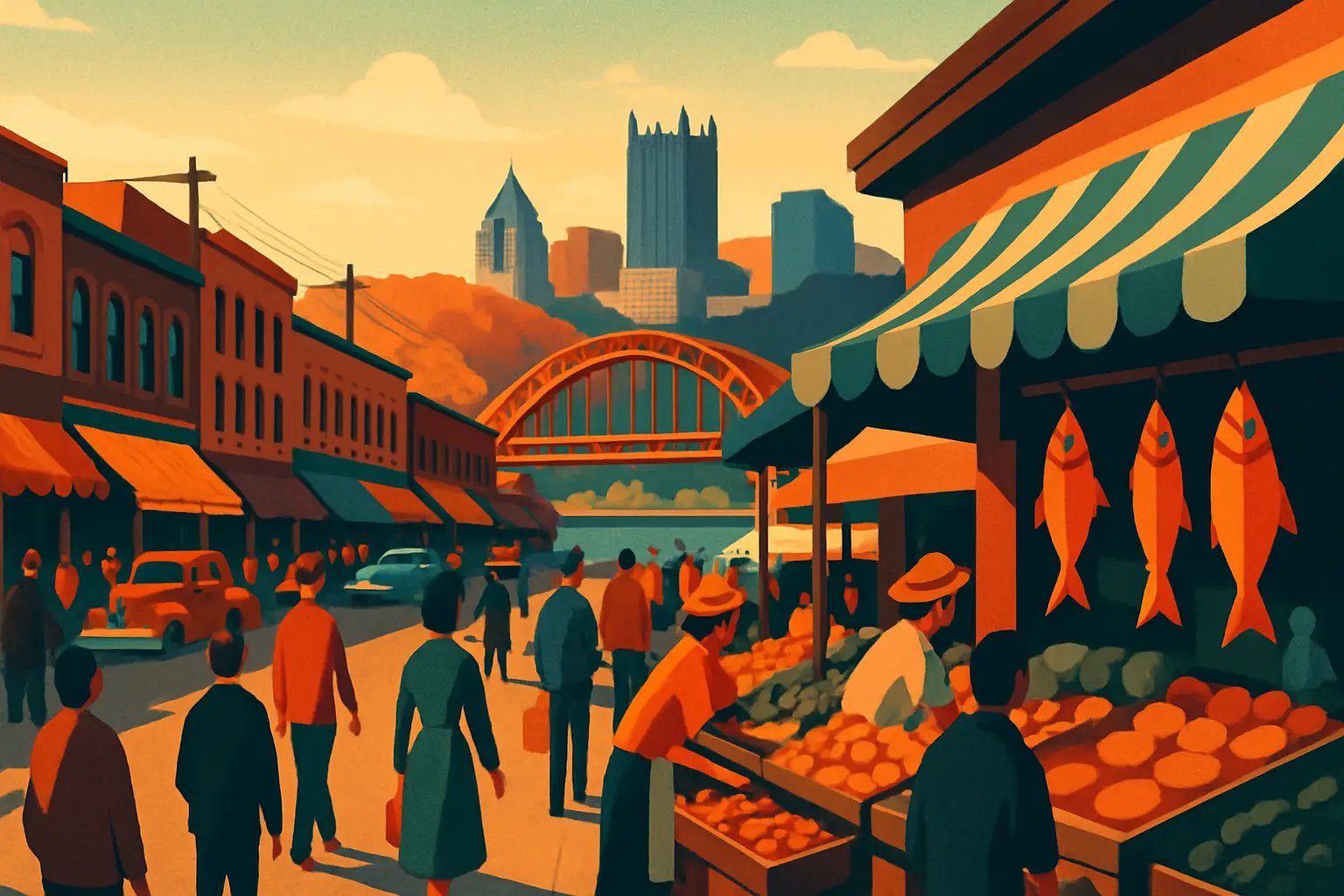
Strip District Pittsburgh: The Saturday Morning You Didn't Know You Were Missing
The Strip District is Pittsburgh's original engine room — a mile of wholesale markets, century-old fish stalls, and immigrant grocery shops wedged between the Allegheny River and the bluff that separates downtown from everything east. It has been feeding the city since before the steel industry made Pittsburgh famous, and every Saturday morning it becomes the most honest expression of Pittsburgh's food identity you'll find anywhere in the city. Wholey's fish counter runs out of soft-shell crabs by 10 a.m., La Prima Espresso's regulars are gone before 9:30, and the Strip District Terminal's produce stalls are worth building your weekend around.
🗺️ Short stories • Collectible cards • Learn as you travel
By 10 a.m. the neighborhood is shoulder-to-shoulder. Wholey's Fish Market (1711 Penn Ave) opens at 8 a.m. and that's when the best whole fish and live shellfish selection is available. Parking fills in the city lots along 15th and 21st Streets before 10 a.m.; rideshare from downtown takes about 7 minutes.
Don't skip Penn Mac
Pennsylvania Macaroni Company (2010-2012 Penn Ave) looks like a corner grocery and is actually a warehouse of imported Italian ingredients — 200-plus pasta shapes, 80-plus olive varieties, and finishing oils and anchovies you won't find in most American specialty stores. Budget 30 minutes and bring a cooler if you're driving.
Getting there without a car
Pittsburgh's light rail (the T) doesn't serve the Strip. Port Authority Route 54C and Route 93 buses run along Penn Avenue directly through the neighborhood from downtown. From the Cultural District, it's a 20-minute walk along Penn Avenue through a streetscape that changes visibly every few blocks.
The complete Strip District Pittsburgh neighborhood guide
1Why a Narrow Strip of Land Became Pittsburgh's Most Storied Neighborhood
The Strip District takes its name from geography: a narrow strip of flat land between the Allegheny River to the north and the bluff that rises abruptly behind it to the south, creating a natural corridor that 19th-century railroad engineers recognized immediately. The Pennsylvania Railroad ran its lines directly through this corridor, making the Strip the wholesale distribution hub for produce, meat, and fish across western Pennsylvania. By the 1880s, warehouse operators and food dealers had built market houses along Penn Avenue and Smallman Street to meet the morning trains arriving from the farms of the Allegheny and Ohio River valleys.
Italian, Jewish, and Eastern European immigrant communities settled where the food economy led them, opening retail shops that served the working-class neighborhoods climbing the bluffs above and the steelworkers from the mills downstream. The result was a concentration of food culture that was practical first and culinary second — butchers, fishmongers, pasta importers, and bakers serving a population that ate well because it lived close to its supply chains.
The steel industry's collapse in the 1970s emptied many of the warehouse floors and hollowed out the commercial density. The revival started slowly in the 1990s as restaurants discovered cheap industrial space within walking distance of downtown. By 2010, the mix of century-old food institutions and new restaurant openings had produced something unusual: a neighborhood where history and appetite reinforce each other rather than competing. The Strip District Terminal's renovation around 2019 brought the Saturday market back at institutional scale, and the result is the most complete expression of Pittsburgh's food identity within city limits.
2Wholey's Fish Market: 110 Years on Penn Avenue
William Wholey opened his first fish stand in the Strip District in 1912. The building that houses the market today at 1711 Penn Ave is a four-story operation with fresh fish counters on the ground floor, a seafood restaurant upstairs, and a live tank section holding blue crabs, lobsters, and seasonal shellfish from both the Gulf Coast and the North Atlantic. On Saturday mornings, the line for the fresh fish counter frequently extends onto the sidewalk by 9 a.m.
The market carries species that most inland US fishmongers don't reliably stock — whole sea bass, fresh sardines when in season, live soft-shell crabs from May through September, and whole branzino priced well below what coastal specialty retailers charge. A pound of jumbo shrimp runs $14–18 depending on season; whole fish are priced closer to wholesale than retail. The experienced staff will clean, fillet, or season anything to order.
The detail most visitors miss: Wholey's also operates a deli counter at the back of the ground floor with smoked fish, pickled herring, and a selection of prepared seafood salads. A brown paper bag of smoked salmon or pickled herring, eaten at one of the outdoor tables in front of the building, is the Strip District's best free-standing meal and costs less than $12.
Wholey's Fish Market: 1711 Penn Ave; Mon-Sat 8 a.m.-6 p.m., Sun 9 a.m.-5 p.m.
Live tank section open during market hours; soft-shell crab season runs roughly May through September
The upstairs restaurant serves fried fish platters and crab cakes on weekdays and weekends; reservations not required but useful for larger groups on Saturdays
Keep touring
Discover more about United States in minutes
Get short, interactive stories that make each place easier to remember while you travel.
3Primanti Brothers: The Sandwich Built for Truck Drivers
Joe Primanti opened his food stand in the Strip District in 1933 specifically to serve the truck drivers who moved wholesale produce through the neighborhood and couldn't afford the time to sit down properly. The solution he built — a sandwich with the French fries and vinegar-dressed coleslaw inside the bread alongside the meat, designed to be eaten with one hand — was so practical that it outlasted the truck drivers by nearly a century and became Pittsburgh's most recognizable food export.
The original Primanti Brothers location at 46 18th Street is still operating in a space that is emphatically not designed for comfort: communal tables, fast service, paper towels at each table instead of napkins. Order the Pitts-Burgher (cheese steak) or the Jumbo Kosher Bologna. The fries are cooked from fresh-cut potatoes, the coleslaw is vinegar-based rather than mayo-based — a critical detail that separates it from imitations — and the Italian bread is baked daily. A full sandwich runs $12–16. Cash and card accepted.
For the sake of accuracy: the Primanti Brothers location near PPG Paints Arena downtown operates with a game-day crowd and a food-service efficiency model calibrated for 20,000 people filing out of a hockey game. The 18th Street original is a different experience entirely — smaller, slower, and still run with the stripped-down pragmatism of its founding premise.
4La Prima Espresso, Penn Mac, and the Italian Backbone of the Strip
Two storefronts define the Italian culinary character of the Strip in ways that require no embellishment.
La Prima Espresso at 205 21st Street has been the neighborhood's coffee institution since 1989. It operates as an Italian-style espresso bar — marble counter, small standing tables, pastries from the Italian baking tradition — where baristas pull single shots and macchiatos to order rather than working from a batch-brew system. The espresso is dark, dense, and not calibrated for the American preference for a smooth finish. The regulars eat at the counter for exactly as long as it takes to drink a small coffee. On Saturday mornings from 8 to 10 a.m., this is the most purely Pittsburgh room in the city.
Pennsylvania Macaroni Company, at 2010–2012 Penn Ave, has been operating since 1902 and functions as an import warehouse for the home cook who knows what they're looking for. The pasta selection exceeds 200 shapes. The olive counter holds more than 80 varieties sourced from Spain, Italy, Greece, and North Africa. Anchovies come from at least four producers, each with a distinct salt and cure profile. Aged Parmigiano-Reggiano sits beside domestic provolone and fresh mozzarella from the case. Prices throughout are below what specialty urban grocers charge because Penn Mac is still, in its operational logic, a wholesale business that happens to sell retail.
La Prima Espresso: 205 21st St; Mon-Fri 7 a.m.-4 p.m., Sat 7 a.m.-2 p.m., closed Sunday
Pennsylvania Macaroni Company: 2010-2012 Penn Ave; Mon-Sat 8 a.m.-5 p.m., Sun 8 a.m.-4 p.m.
Penn Mac's prepared antipasto counter near the entrance is one of the cheapest ways to assemble a serious picnic in Pittsburgh
5The Strip District Terminal: What the Market Has Become
The Strip District Terminal at 2100 Smallman Street is a revitalized 1920s-era warehouse complex that became the neighborhood's central market anchor when it reopened around 2019. The building spans most of a city block and houses a mix of permanent retail tenants — a butcher, a cheesemonger, a wine shop, a specialty fish counter — alongside a weekend market where local farmers and food producers set up on Saturdays and Sundays from 9 a.m. to 2 p.m.
In late August and through September, when the post runs, Pennsylvania's fall harvest hits the market stands: peaches from Adams County orchards south of Pittsburgh, paste tomatoes for sauce, sweet corn from the river valleys north of the city, and the first of the stone fruit from the Allegheny foothills. Vendor prices are closer to farm-stand level than urban-market level because most sell direct from their own operations without a retail markup.
Inside the Terminal, Smallman Galley is a food hall where newer Pittsburgh restaurant concepts often run their first public iteration before moving to standalone locations. It's a reliable indicator of what the city's next cohort of restaurant operators is cooking, and worth walking through even if you've already eaten.
Strip District Terminal: 2100 Smallman St; retail tenants open daily, weekend market Sat-Sun 9 a.m.-2 p.m.
Smallman Galley inside the Terminal: hours vary by vendor, typically 11 a.m.-9 p.m. most days
Parking available in the Terminal's lot off Smallman Street on weekdays; on Saturdays, arrive before 9:30 a.m. or expect to park several blocks away on side streets
6Beyond the Market: The Strip District's Restaurant Scene in 2026
The Strip District's restaurant scene extends well beyond its market anchors.
Gaucho Parrilla Argentina at 1154 Penn Ave opened in 2016 and built its reputation on an open wood-burning grill and a menu anchored by Argentine cuts — entraña (skirt steak), vacío (flank), and mollejas (sweetbreads) — cooked at fire-forward temperatures over quebracho hardwood charcoal. The chimichurri is house-made, the wine list is Argentine-heavy, and the room fills early on weekday evenings. Reservations are strongly recommended for dinner.
Kaya at 2000 Smallman Street has been serving Caribbean-influenced food in the Strip for more than 25 years and continues to hold up as one of Pittsburgh's most consistent kitchens. Jerk chicken, plantains, and rum cocktails anchor a menu that hasn't needed to reinvent itself because it was built on a sound premise: good sourcing and a distinct culinary tradition not represented anywhere else nearby.
Dish Osteria on Penn Avenue handles the formal Italian-American dinner for the neighborhood — handmade pasta, a deep Italian wine list, and an intimate room that books out on weekend evenings. The cacio e pepe and the duck ragu are both worth ordering if you're deciding.
For coffee beyond La Prima: 21st Street Coffee and Tea (at 21st and Penn) serves specialty-grade espresso in a larger, less austere space for those who want to sit and work on weekday mornings.
7Getting There, When to Go, and How It Connects to the Rest of Pittsburgh
How do I get to the Strip District from downtown Pittsburgh? Pittsburgh's light rail (the T) does not stop in the Strip. The most direct transit options are Port Authority Route 54C and Route 93, both of which run along Penn Avenue from downtown through the heart of the neighborhood. By foot from the Cultural District or the Convention Center, it's a 20-minute walk east along Penn Avenue. By rideshare, downtown to the middle of the Strip runs 7–10 minutes.
Is there parking? City-operated lots exist along 15th and 21st Streets. On weekdays, parking is easy and inexpensive. Saturday mornings between 9 a.m. and noon are difficult — the lots fill by 10 a.m. and street parking on Penn and Smallman is gone by 9. If you're driving on Saturday, arrive before 9 a.m. or plan to park in downtown's lower garages and walk.
When should I visit? Saturday mornings from 8 a.m. to noon are the Strip at full energy — Wholey's, Penn Mac, La Prima, and the Terminal market all operating simultaneously. The neighborhood on weekdays is quieter, the restaurants are easier to access without waits, and the market infrastructure is absent.
How does it connect to other Pittsburgh neighborhoods? The Strip District sits between downtown Pittsburgh to the west and Lawrenceville to the east — both accessible on Penn Avenue. Lawrenceville extends the Strip's restaurant density with more sit-down dinner options, independent coffee shops, and a creative-economy tenant mix. The 31st Street Bridge connects the Strip to the North Shore and PNC Park if a Pirates game is on the itinerary.
Route 54C and 93 buses: depart from stops on Penn Avenue in downtown Pittsburgh; frequency every 12-20 minutes on weekdays, less frequent on weekends
Walking distance from downtown: 20 minutes east along Penn Avenue; the neighborhood begins at approximately 11th Street
Lawrenceville: continue east on Penn Avenue past 35th Street; the Penn Avenue corridor is walkable end-to-end in about 45 minutes
North Shore (PNC Park, Acrisure Stadium): cross the Allegheny River via the 16th Street Bridge or the 31st Street Bridge, both pedestrian-accessible from the Strip
Keep touring
Pittsburgh rewards the curious traveler
TourMe turns neighborhood history into short, collectible stories you read as you explore. Discover why the Allegheny River made the Strip District possible, what the railroad companies that built it left behind, and how a city that lost its steel industry rebuilt its food culture around the same blocks. The Strip District is full of things worth knowing — and TourMe is built for travelers who want to leave knowing them.